There are different types of fuel cells that can produce energy. Some of the cells can be used to produce small amount of power which can be utilized by vehicles, and the others - to power big engines of the power plant that provide power for cities. Some of the examples of use fuel cells are: combustion engines that burn fuels cells and use the pressure created by the expansion of the gasses to perform work; batteries - are able to convert chemical energy into electrical when it is needed. In essence, fuel cells do more work more efficiently; they provide energy and ability to transform it from one type of energy into other type.
Types of Fuel Cells
There are many types of fuel cells and each one of them uses different cell chemistry. Fuel cells classified by their operating temperature and the type of the electrolyte that they use. All of the fuel cells are used to provide more than one source of the energy, and are able to transform one type of energy into the other. For instance, certain fuel cells provide electrical energy and produce the steam at the same time. The steam is used to spin turbines, which produce electrical energy. This type of fuel cell provides two types of energy, one is chemical and the other is product of the first which is transformed into different source of the energy.
| Fuel Cell | Abbreviation |
|---|---|
| Polymer exchange membrane fuel cell | PEMFC |
| Solid oxide fuel cell | SOFC |
| Alkaline fuel cell | AFC |
| Molten-carbonate fuel cell | MCFC |
| Phosphoric-acid fuel cell | PAFC |
| Direct-methanol fuel cell () | DMFC |
Facts about Fuel Cells
Some of the given fuel cells will work great in at stationary power plants and the others will work in some small applications. The main role of the fuel cells is to serve as a source of energy in more than one way.
Polymer exchange membrane fuel cell (PEMFC)
This type of cells is the main focus of Department of Energy. DOE focused on this type of energy for a reason, that reason is that this could be next fuel for the automotive transportation. PEMFC is the type of fuel cells that has high power density and low operating temperature. The operation temperature of this type of cell is 60 to 80 degrees Celsius. This means that it doesn’t take the fuel cells too long to worm up, and, therefore, less energy is wasted to convert this type of fuel cell to alternative energy. This type of fuel cell is great for automotive needs, it doesn'’t have that much of volume and it’s operation temperature is not that great. It is very convenient for the use in vehicles because they don’t have that much of storage.
Solid oxide fuel cell (SOFC)
SOFC operates under very high temperatures. The operating temperature of this fuel is around 700 and 1000 degrees of Celsius. This type of cell can be used in large factories and electric plants as source of electricity in towns. There advantages and disadvantages of this type of energy. The disadvantage - is the fact that it has high operating temperature, it means that parts of the fuel cell can break down after cycling on and off repeatedly. The advantage - this type of cells is very stable when in continuous use, and also it can provide the steam that can be used as an additional source of power. This type of fuel cell is very useful on the large scale.
Alkaline fuel cell (AFC)
This type of fuel cells is used by the US since 60s. The AFC is used in space engineering, and it very susceptible to contamination. It requires pure hydrogen and oxygen for it to work. This type of cells most likely is not going to be used commercially. The AFC is great source of energy but because of its high cost it will not be used commercially.
Phosphoric-acid fuel cell (PAFC)
PAFC has potential to be used in smaller energy stationary-power generation engines. It operates at higher temperatures, so it takes longer time to warm up. Just because of its high temperatures it is unsuitable to use in cars.
Direct-methanol fuel cell (DMFC)
This type of fuel cells is in some aspect is like PEMFC. It has higher operation temperature just like PEMFC, but it needs large amounts of platinum to act as a catalyst. It uses large amounts of platinum which makes this type of fuel cell very expensive. This type of fuel cells has less probability of use because of it’s high supporting cost.
Next I will explain little bit more in depth about Polymer Exchange Membrane Fuel Cells.
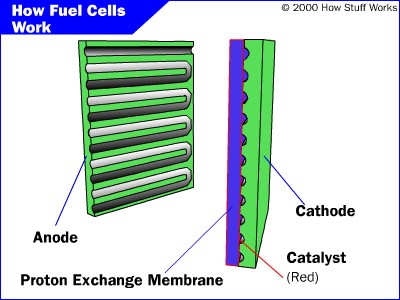
The PEMFC cells are the most promising technology. This kind of cell can be used as a source of energy for the car or even house because of its small operating temperature. This type of cells use the simplest reaction to power it up. There are four basic elements of PEMFC:
◊Anode – the negative post of the fuel cell.
◊Cathode – the positive post of the fuel cell.
◊Electrolyte (proton exchange membrane) specially treated material which conducts positively charged ions.
◊Catalyst – special material that facilitates the reaction of oxygen and hydrogen.
The way it works is the following.Pressurized hydrogen gas enters the fuel cells on the anode side. The gas is forced trough the catalyst by the pressure. When H2 molecules come into contact with catalyst (platinum), they split into two H+ ions and two electrons e- . The electrons are conducted through the anode, and from there they get to external circuit (there they do the work: turn motor and etc) and then return to the cathode side of the fuel cell. Then, on the cathode side O2 is forced trough the catalyst where it forms two oxygen atoms. Each of these atoms has strong negative charge and because of that they attract the two H+ atoms. They form H2O then.
Conlusion
There are many alternatives for the energy. We can use fuel cells to replace or as a secondary source of known energy. Some of them can be used for small things (vehicles) and the others for things on larger scale (factories). However, use of fuel cells arise couple problems: one of them is whether it is cost effective or not, and the other is how efficient it is. I’m sure that in near future we will be able to develop a fuel cell that can be less pricey, efficient and it can be used in everyday life. Until then, we have to enjoy what we have already and be more careful with our resources.
