
František Krupička – Brzotice, Bohemia to America
František ”Frank” Krupicka was born 7 February 1866 in Brzotice No. 1, Ledec county, Bohemia (Czech Republic). Brzotice is a small village located 41.3 miles SE of Prague. This is in the Dolni Kralovice Parish. He was the second child born to Antonin Krupicka and Barbora Charvatova. There were 10 children born to this couple. Some died as infants or small children.
Research conducted in the archives has supplied me with some information about my grandfather and his ancestors. We know that František’s father, Antonin (19 Nov 1836-?), his grandfather, Antonin (21 Jun 1803 – 8 Aug 1875) and his great-grandfather, František ”Franz” (1 Jun 1745 - ?) were senkyrs at Brzotice No. 1. A senkyr interpreted means tapster or one who pours drinks. ”Franz” was listed on a document as a serf and senkyr at Brzotice No. 1. The sons from each generation following were born at this house and worked at this Pub. More research needs to follow in the area of Brzotice.
František fell in love with a servant woman and had three children with her. We don’t know why they never married. Her name was Barbora Burda (?1864 – 3 Sep 1889) daughter of Josef and Anna (Malkova) Burda. They had František, Jr. (23 Nov 1885 - ?), Frantisca (24 Nov 1888 - ?) and Emanuel (29 Aug 1889 – 21 Sep 1889). It is sad that Barbora died from childbed fever about 5 days after Emanuel’s birth and then Emanuel died from lung fever at 23 days of age. Grandpa František became a father at age 19 and he was 23 when Emanuel was born. Research hasn’t shown what he did but I’m going to assume that he worked for his father in the Pub and that Barbora worked for the Krupicka family in their establishment.
Sometime after Barbora and Emanuel’s death, František applied for what my interpreters have described as a Trade or Groom’s Book. It looks like a passport. This book has a paragraph that says, According to the rulings of the trades, issued 7 April 1866 for the kingdom of Bohemia, excluding the capital city of Prague. This book was issued on 11 June 1891 to my grandfather and was signed by F. Turek, Mayor of the city of Brzotice (Brzoticich). Then on pages 28 and 29 of the book, it states Valid for traveling in the Austro-Hungarian Empire and through the German states for a period of one year. Stamped Ledec, 2 July 1891.
We now believe the ship that František and his two motherless children, František, Jr and Františca sailed on was the S.S. America that docked in Baltimore on 22 July 1891. He was listed as Franz Krupicka, age 26, Laborer. The children were not listed with him so further study of this manifest will be done. The date and arrival city were recently taken from a copy of Frank's Petition for naturalization papers. We have conflicting dates reported for his immigration. The 1910 US Federal Census specifies the year of immigration as 1892. František had two brothers that left for America. I know that Antonin (14 Oct 1868 – 29 Dec 1915), third born in the family, sailed for America on the S.S. Germanic in August 1886 and arrived 6 Sept 1886. He traveled with a Frank Korinek and Marie Korinkova. Antonin married Marie in Chicago, Illinois on 5 Sep 1887. The fourth born son, Josef (21 Jul 1870 - 8 Oct 1945), came to Chicago, too. The 1920 and 1930 US Federal Census specifies Josef immigrated in 1898 and verifies his wife, Marie Dvorakova immigrated in 1901. The brother, Jan ”John” must have grown into adulthood because grandpa talked about having a brother Jan. Perhaps, Jan stayed in Brzotice. This is where more research is needed as I don’t have death dates on some of the younger children. We know there were twins, Ludvig and Jan born 3 May 1874 and that Jan died shortly thereafter. Then a girl, Antonie, born Feb 1877. Then another boy, Jan Nepomuk born 9 Dec 1879; Emanuel born 19 Aug 1882 and the last child, Maria born in 1887 and died at one year on 15 Oct 1888. Her mother would have been 51 when she was born. This is unusual but not impossible.
To continue this story, I must quote the words of my mother, Annella Krupicka. She married John Krupicka who was a son of František from his marriage to Rüzena ”Rose” Raisler. František, from this time forward will be referred to by his Americanized name, Frank. Mother states, ” I think about what a lot of courage it must have taken to set out for a strange country with two little kids, very little money and not able to speak a word of English.” Mother was interested in family and asked Frank questions. Frank spoke very little English, even after being in America so many years. It got all mixed up with his native tongue but we understood him quite well. Mother said, ”It seems to me Frank said his daughter was about four years old at the time he came over here but she wasn’t certain of that fact.” Mother said, she is sure Frank probably told her all about it but she didn’t make any notes and fifty years had passed when I asked her to write a story about Grandpa Frank. Here is some of what we know about his ill-fated arrival in Chicago.
When Frank and his two children arrived at the train depot in Chicago, the little girl became separated from her father and brother and they never saw her again. Mother thought her name was Mary but the records in Brzotice show that it was Frantisca...perhaps, her middle name was Mary although it wasn’t listed in the records. This story horrified my mother...to think of that poor little lost waif who never saw her father or brother again. She asked Frank how it happened and he just threw his hands up in the air in despair and shook his head sadly and said, ” I don’t know, so many people, so many people and nobody understood us.” She thinks she asked him why he chose to come to Chicago but she doesn’t remember what he said about it. She was quite positive that Frank worked for a meat packing plant in Chicago but I haven’t found where that would have been or a name of the place. He didn’t like Chicago very much. He said, ”It was pretty tough and he carried a small handgun for self protection.” This little handgun has been passed down to one of Frank’s great-grandsons.
I haven’t found any descendants of Frank’s son, Frank, Jr. Frank told mother that he had lost all contact with his son after the elder Frank left Chicago. That would have been in 1900. Many years after the elder Frank’s death, Mother visited with Frank’s brother Josef’s family in Waubin, Minnesota and they told her that Frank, Jr. had married a Chicago girl and they had several children. They were of the opinion that Frank, Jr. had taken his mother’s maiden name which would have been Burda. Copies of the Frank Burda obituaries haven’t provided any leads up to this time – May 2002. If anyone reading this story can help trace this family, please contact me at slaraeg@hotmail.com. I don’t know where to look for records on a lost little girl from the Chicago train depot in 1891 or 1892. If I confirm the exact year of the emigration, then perhaps an orphanage or police records might provide some clues. We can only hope that she was adopted by a nice family and led a good life. Many years ago, Jack Bailey had a show called ”Queen for a Day” and Mother heard part of the story of a woman from California that was featured on the show. Her story sounded similar to our lost girl. She was adopted by a nice Hungarian couple and was well educated and had a Master’s Degree in Art and was married to an Art Professor who worked at a University in California. She had no children. She had no idea of her roots. Mother tried to contact the Jack Bailey show...but had missed the part where the woman’s name was given. No one from the show got back to mother so she let it go. Whether it was my lost half Aunt or not, I will never know. This was long enough ago that I’m sure this woman is no longer living. Mother was sure it was her because she said she was lost in the Chicago train station. I wouldn’t know which University in California to look for anyone who might have remembered a Professor and his wife with this story.
Frank was a slender fellow and listed as five foot seven and a half inches on his naturalization petition. His hair was light brown and curly. He kept his hair cut so short that no one would have guessed it was so curly. He liked his hair cut short. These curls have passed down in our family...my father, John, myself and a brother had real curly hair and some of my siblings had waves. One of my boys has really curly hair and the other two children have some waves. I don’t know many of the cousins so I don’t know if curls passed down the line in their families. His Trade Book stated that his eyes were gray and the naturalization petition says they were brown. By nature, he was a fiery little guy and he let you know pretty quickly if he was unhappy about something or other. In Bohemia, he was a Catholic, but he got so mad at Father Devlin at St. Augustine’s Church in Austin, Minnesota where he settled, that he left the church for good and all but his first born daughter, Josephine, were baptized at the First Methodist Church in Austin. Mother thought that in his heart, Frank was always a Catholic. He kept Catholic pictures and statues of some of the Saints displayed in his home. Mother said he was a nice looking man. He had a nice complexion and his nose was straight although maybe a bit on the generous side! He told Mother he had grown three sets of teeth in his life. Mother thought he was kidding but my father, John, his son, said it was true!
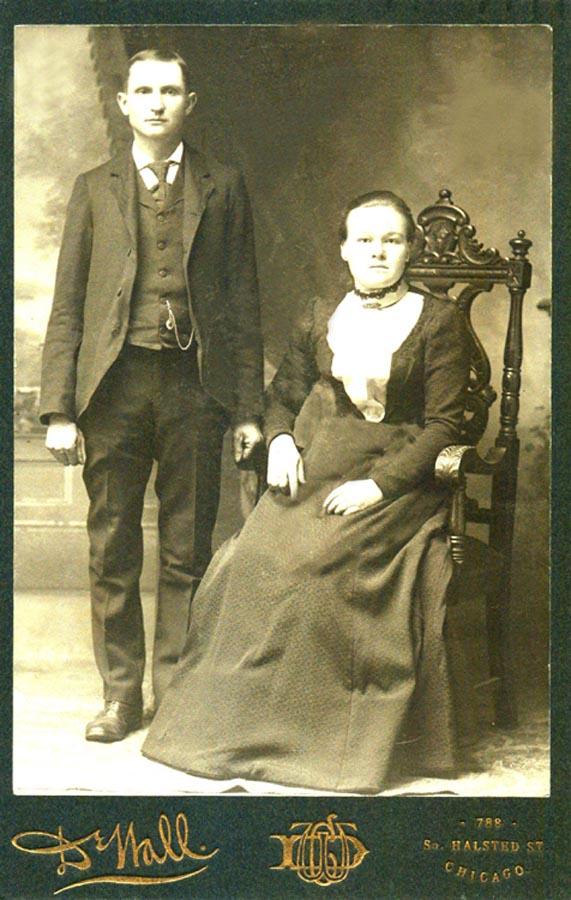
Frank Krupicka met the woman he married at a dance. Her name was Rüzena ”Rose” Raisler (12 Mar 1876 – 5 Nov 1930) and she was born in Chicago to Bohemian emigrants, Johann ”Jan” Nepomuk (23 Dec 1829 – 19 Dec 1897) and Josefa (Jelinek) Raisler (4 Aug 1836 – 13 Aug 1898). Jan and Josefa and their first born, Anna, came from Hresihlavy, Bohemia leaving on a German ship on 5 Aug 1857 and arriving in Chicago, Illinois on 23 Sep 1857. Frank and Rose were married in Chicago, Cook, IL on 10 April 1900. Rose or Rosie, as she was sometimes called, was the seventh child in the family of eight. She worked as a tailor. Mother thought it was in her brother, Josef’s tailor shop but maybe she worked at the same shop. Josef (?1866 – 7 Jul 1881) died at age 15 in his home at 280 W 20th St in Chicago from an accidental gun shot wound in his abdomen. He had a gun in his hand...perhaps he was cleaning it or just playing with it.
Using Census information, it appears that Frank and Rose moved from Chicago to Canby, Yellow Medicine, Minnesota sometime in 1900 and lived on a farm. The 1900 Census shows that Frank was buying this farm. However, the Minnesota and Chicago census shows that Rose lived in both places. The Minnesota Census was taken a few days before the Chicago Census so I can only assume that Rose decided to leave the farm for some reason and go live with her sister, Anna Candra because she was pregnant and wanted to be near her family in Chicago when she had her first baby. There is no way to know if Frank stayed in Minnesota during this time or not. Their first child, Josephine (28 Mar 1901 – 30 Aug 1921) was born in Chicago. By May 1904 Frank and Rose had moved to a farm near Hayward, Freeborn, Minnesota and that is where their second son, Ludvig John (13 May 1904 – 23 Jan 1981) was born. Frank heard that the Hormel Meat Packing Plant in Austin, Minnesota was hiring men and he applied for a job and was hired. That was in 1904 so that is when they moved to Austin and they rented a house in a section of Austin known as ”Dutch Town”. Just about everyone living in ”Dutch Town” worked at Hormels. The Krupicka family lived in various areas of Austin until 1928 when they built a new home at 1209 Grove Street. Six more children were born in Austin to the Krupicka family. They were Julia Emma (24 Nov 1905 – 9 Jan 1948), John Lewis ( 30 Aug 1907 – 14 Dec 1969), Rose Barbara (16 Oct 1909 – 8 Jul 1910), Anthony (11 May 1911 – 29 Mar 1991), George Joseph (30 Apr 1914 – 30 Aug 1960), Barbara Lillian (27 Dec 1918 – 4 Nov 1981).
Frank was a farmer at heart. Until the city ordinances came on the scene, there were always cats, dogs, rabbits, goats and chickens and now and then a cow to milk. Oft times he would come home from the plant with a newborn piglet or two. At that time, these little ‘orphans’ of the stockyards were given to anyone that wished to try their luck at raising a pig for butchering. The mama’s were already pork chops, you see. Frank’s kids hated all this animal stuff but Frank paid no attention to this...he was concerned with providing food for their tummies and shoes for the footsies! He always had a big garden and spent many evenings hoeing and tending his crops.
Grandpa Frank liked a glass of beer (pivo) and maybe a little ‘Schnapps’ now and then. Mother thought he probably learned to drink in ”Dutch Town” but she didn’t know about his father and grandfather’s owning a Pub. I’m sure he was well acquainted with beer (pivo) in Brzotice. After prohibition, Frank decided to try his hand at making home brew (as did most of his neighbors). Once in awhile some of the newly bottled beer would blow up with a crash bang in the basement (maybe it was too green). Frank would charge downstairs yelling and waving his hands and shouting, ‘Yesus Marta, sacra menske, pevo gone, pevo gone”. He was an industrious man and I am sure he rarely missed a day of work in all the twenty seven years at Hormels.
Frank’s wife, Rüzena had lots of patience and fortitude. Everyone called her ‘Rosie’. She was a pretty woman with green eyes and reddish, blond hair. She was real slendar as a girl but gained quite a bit of weight as the years went by. She was about five feet seven inches tall – not a small woman by any means. Rosie loved the movies. She and the kids attended the local theatre regularly. Frank went along sometimes on Sunday afternoons. Back in the late 1920’s, Austin had four movie theatres and all had a good following. The Park Theatre featured Vaudeville every Sunday and they were on the Orpheum Circuit so we got some wonderful talent.
Frank never owned a car. In the good weather, he rode a bike to work or he walked. I think that maybe Frank and Rosie’s son John was the first in his family to own a car and then his brother, Lud, was next to get a car. Mother knows that John horrified his parents when he had a couple of tattoos put on his arms by a friend whom had acquired a tattoo set. He got a good ‘strapping’ for that escapade. Thank goodness the tattoos were nice as he had them all his life and everybody thought he was a Navy man!
Friday suppers at the Krupicka house consisted of all kinds of sweets from the South Main Street Bakery. Sometimes it was pineapple and cottage cheese which they all seemed to look forward to. Rosie was a good cook and she made lots of Bohemian dishes including Poppyseed Kolaches and Saurkraut and Dumplings. She would fry a little onion and then brown a tablespoon of flour in this – then dump in the saurkraut and juice – add a dab of water and some caraway seed and cook this until it was nice and brown. It was the best saurkraut I ever ate and so good with roast pork. They ate lots of duck and goose because Frank always had ducks, geese and chickens. One dish that Frank liked and all the kids (except John) hated the sight of was fried blood with eggs mixed in and all scrambled. Frank always put chickory in his coffee – Mother thought it was ‘bitter’ stuff. He liked liver and sweetbreads and tripe and kidneys – all organ meats – which the kids wouldn’t touch with a ten foot pole!
Mother wished she could remember more about the family. She and John were married in 1928 and as they were not living in Austin, she didn’t get to spend very much time with her in-laws before they died. She and John moved back to Austin a few months before Rosie passed away. Mother was always interested in family roots and asked Frank about his life in the old country and that is how she happened to know a little about things. I’m so happy she did that as there is no one else that had taken the interest to do that.
Frank had some problems with asthsma. Perhaps it was from the air pollution in the department he worked in at Hormels. He also had heart troubles and suffered with dropsy (edema) from poor circulation. He passed away suddenly on 20 Dec 1931. John and Annella were with him. He said something in Czech to John that he felt a bit sick and then he died. The funeral was taken care of by the Mayer Mortuary and St. Olaf Lutheran Church and burial was at the Oakwood Cemetery in Austin.
Here is a story that Frank told us – it was about a ‘gang of men’ stopping at his farm in Canby, Minnesota and asking permission to rest their horses in the barn overnight. They stayed in the barn with the horses. They paid Frank a ten dollar gold piece and left in the early morning. Frank thought it was some of the old ‘Jesse James Robber Gang’. Mother didn’t know if this could have been true as she thought that gang met their doom in the mid 1880’s. Frank was convinced though that they were robbers. ”They all had guns on their persons”, he said.
At the time John and Annella were married, neither Frank or Rosie were in good health and both of them had been in the hospital several times in the year or two before they died. Rosie wasn’t able to do any work so they hired help to come in during the day. Barbara, the youngest child, was only 12 when her mother died. Most of the grandchildren of Frank and Rosie, didn’t know their grandparents. Only some of Julia’s children met them and Florence remembered getting to stay up and sit with them while the other kids had to go to bed. She remembered her Grandma’s good food. She said, Grandpa always dressed nice. Lud’s son, Leonard, and John's son, John would have been young toddlers when the grandparents died.
Mother said, ”She wished she had known Frank and Rosie longer as she might have had a lot more information to write about.” As Frank and Rosie’s grand-daughter and a Family Historian, I am grateful beyond words for my mother’s interest in people and her good memory. Thanks to Annella Krupicka and Ludvig Krupicka, I had access to Frank’s Trade Book and that gave me the clues to the village of Brzotice in Bohemia. There are details I’m missing but maybe in time I can update this story. Thank you, too, to my researcher, Dr. Julius Müller in Prague for his solving the mystery of Frank’s first family. I have photocopies of some of the birth and death records. Research in CR is very expensive but I felt it was worth spending the money to find out what the KRUPICKA ROOTS would tell us. The history of Bohemia and that area now called Czech Republic is worth studying. For the relatives who are able to travel, a visit to Brzotice or Hresihlavey should be very interesting. Neither village/hamlet is too far from Prague. I haven’t ruled out a trip to find the graves of the great-grandparents and Uncles or Aunts that were left behind. I understand it is a very beautiful country to visit.
©Scarlett Krupicka Glover, May 2002
RESEARCH UPDATE:
October 2002 - A descendant of Emanuel, the youngest brother of Frank, Antonin and Josef has been located in Kutna Hora, CR. This is a break-through and very exciting news!
A visit to meet my cousins and friends in the Czech Republic is planned. We also will meet my husband's cousins in Finland on this trip. This is what genealogy is all about - making connections and friendships across seas.
December 2004 - It is time to add here that we made that trip to Finland, Estonia, Copenhagen and the Czech Repulic in early Fall of 2003. It was a wonderful trip and we felt the bond with the home countries. I won't detail Finland as this web page deals with my Bohemian roots.
My sister joined us in Prague (Praha) and it was a fun experience. My husband and I were met by my cousins to say Ahoj and by my friend at the airport and my friend and his wife drove us to our hotel near his flat and he and his wife and daughter had us for a meal that evening. The next day they showed us the ropes - in other words, how to buy bus tickets and what buses to ride and walked us around down town Prague. The following day, we were the guides for my sister and we spent 3 days checking out Prague. That weekend, my cousin and a friend picked us up in a van and drove us to Kutná Hora. We stayed with my cousin's family for 3 weeks and experienced the culture first hand. My cousin speaks no English and I and his wife used dictionaries and my limited Czech to communicate. It was sometimes hard not to be able to communicate properly but we had fun. Good thing I talk with my hands a lot! The family friend would take us on trips around the country on weekends. Some days, my cousin, Josef took us to a castle or zoo. We saw a lot of the area and lots of castles, etc. We got to know Kutná Hora quite well. We visited the family that lives in my grandfather's home twice. They were so hospitable and helped me to find out a little information. I did add a few names of relatives but I didn't meet any of them. The language barrier was a roadblock for me and I would want to learn more Czech before another visit. I'll leave this as a short synopsis of our trip in this Update category.