




|
|
|
“… L’era nucleare, nella quale la razza umana sta vivendo e nella quale, a breve, potrebbe morire, è iniziata per l’opinione pubblica con il lancio di una bomba atomica su Hiroshima il 6 agosto del 1945. Ma per gli scienziati nucleari e per qualche autorità Americana, essa è iniziata nel momento in cui la costruzione di un’arma nucleare è stata possibile. Il lavoro per la sua costruzione è stato iniziato dagli Stati Uniti, Canada e Gran Bretagna molto tempo prima l’inizio della seconda guerra mondiale. L’esistenza di possibili forze esplosive nei nuclei degli atomi è stata ipotizzata sin da quando la struttura di quest’ultimi fu scoperta da Rutherford. Un atomo consiste in una minuscola parte centrale chiamata “nucleo” e da elettroni che circolano attorno ad esso. L’atomo di idrogeno, che è il più semplice ed il più leggero, ha solo un elettrone. Gli atomi più pesanti ne hanno sempre di più all’aumentare del peso. La prima scoperta fatta su ciò che succede nei nuclei è stata la radioattività la quale è causata da particelle che vengono sparate fuori dal nucleo. E’ stato scoperto che una grossa quantità dell’energia è rinchiusa nel nucleo ma, fino a poco prima dello scoppio della seconda guerra mondiale, non erano stati trovati dei metodi per poterla utilizzare interamente. Una scoperta rivoluzionaria fu quella che, in certe circostanze, la massa può essere trasformata in energia, in accordo con la formula di Einstein che asseriva che l’energia formata è pari alla massa persa moltiplicata per il quadrato della velocità della luce. La più semplice illustrazione (di questo fenomeno, ndt) è osservabile nel processo che avviene tra l’idrogeno e l’elio. Una atomo di elio consiste in quattro atomi di idrogeno e, perciò, ci si potrebbe aspettare che esso abbia quattro volte la massa dell’idrogeno. Ma questo non avviene. Se fissiamo il numero 4 come valore della massa dell’elio, la massa dell’idrogeno non è 1 ma 1,0008. Quando quattro atomi di idrogeno si combinano per fare un atomo di elio, l’eccesso (di massa, ndt) viene rilasciato sotto forma di energia e cessa di esistere come massa. Questo è il motivo per il quale il sole è caldo, perché esso è una fabbrica di elio. La stessa cosa avviene ogniqualvolta gli elementi più leggeri si combinano per formare quelli più pesanti e questo è il processo, chiamato “fusione”, che viene usato nella bomba H. La bomba A, invece, si basava su un processo differente, dipendente dalla radioattività. In questo processo, chiamato “fissione”, un atomo pesante si scompone in due atomi più leggeri. In generale, nelle sostanze radioattive, questa fissione avviene con una velocità costante che è lenta nelle sostanze che si trovano in natura. Ma c’è una forma di uranio, chiamato U235, che, quando è puro, causa una reazione a catena che si espande come il fuoco ma con una rapidità enormemente più grande. Questa è la sostanza utilizzata nella costruzione della bomba atomica. Ma ci furono una serie di difficoltà da essere superate. La prima di queste fu quella di separare l’U235 dall’uranio ordinario, nel quale esso è presente solo in una piccola porzione. Il traditore Fuchs (Klaus Fuchs, uno scienziato americano che vendette segreti nucleari all’USSR, ndt) fece un prezioso lavoro nell’agevolare questo processo ed è ironico il fatto che se la sua infedeltà fosse stata scoperta prima, la bomba A non sarebbe stata pronta in tempo per essere usata contro i giapponesi. Il fatto che la costruzione di una bomba potesse essere possibile era noto ai fisici nucleari sin dalla scoperta della razione a catena, avvenuta poco prima dell’inizio della seconda guerra mondiale. Malgrado tutti gli sforzi per la segretezza, molta gente sapeva che il lavoro per la sua costruzione era in atto. Lo sfondo politico del lavoro degli scienziati atomici fu la determinazione nello sconfiggere il nazismo. E’ stato creduto – io penso giustamente – che una vittoria nazista sarebbe stata un terribile disastro. E’ stato, inoltre, creduto, nelle nazioni occidentali, che gli scienziati tedeschi fossero molto avanti nella costruzione di una bomba A e che, se essi avessero preceduto l’occidente, avrebbero probabilmente vinto la guerra. Quando la guerra finì, si scoprì, con il completo stupore sia degli scienziati americani che di quelli inglesi, che i tedeschi erano lontani dal successo e, come tutti sanno, che i tedeschi furono sconfitti prima che qualsiasi arma nucleare fosse costruita. Ma io non penso che gli scienziati nucleari dell’occidente possano essere accusati per aver creduto il lavoro (della costruzione di una bomba atomica, ndt) urgente e necessario. Anche Einstein lo favorì. Quando, comunque, la guerra tedesca finì, la gran parte di questi scienziati che avevano collaborato nella costruzione della bomba A, considerarono opportuno che essa non venisse utilizzata contro i giapponesi, i quali erano già vicini alla sconfitta e, in ogni caso, essi non costituivano una minaccia per il mondo come Hitler. Molti di loro fecero pressanti proteste al governo americano suggerendo che, invece di utilizzare la bomba come un’arma di guerra, esso avrebbe dovuto, con un pubblico annuncio, farla esplodere in un deserto e che il controllo futuro dell’energia nucleare avrebbe dovuto esser posto nelle mani di un’autorità internazionale. Sette dei più eminenti tra gli scienziati nucleari prepararono e scrissero quello che è conosciuto come “The Frank Report” che essi presentarono al Segretario della Guerra nel giugno del 1945. Questo è un documento veramente ammirabile ed acuto e, se esso avesse ottenuto il consenso dei politici, nessuno dei conseguenti terrori sarebbero nati…” Riporto
anche il testo originale dal quale è stata effettuata la traduzione: The
atom bomb "The nuclear age in which the human race is living, and may soon be
dying, began for the general public with the general public with the dropping of
an atom bomb on Hiroshima on 6 August, 1954. But for nuclear scientists and for
certain American authorities, it had been known for some time such a weapon was
possible. Work towards making it had been begun by the United States, Canada and
Britain very soon after the beginning of the Second World War. The existence of
possibly explosive forces in the nucleus of atoms had been known ever since the
structure of atoms was discovered by Rutherford. An atom consists of a tiny core
called the ‘nucleus’ with attendant electrons circling round it. The first
discovery that had to do with what goes on in nuclei was radio-activity, which
is caused by particles being shout out of the nucleus. It was known that a great
deal of energy is locked up in the nucleus, but, until just before the outbreak
of the Second World War, there was no way of releasing this energy in any large
quantity. A revolutionary discovery was that, in certain circumstances, mass can
be transformed into energy in accordance with Einstein’s formula which stated
that the energy generated is equal to the mass lost multiplied by the square of
the velocity of light. The simplest illustration is in the relation of hydrogen
and helium. A helium atom consist of four hydrogen atoms, and one might,
therefore, have expected that it would have four times the mass of an hydrogen
atom. But this is not the case. Taking the mass of a helium atom as 4, the mass
of the hydrogen atom is not 1, but 1,008. When four hydrogen atoms combine to
make a helium atom, the excess is released as energy and ceases to exist as
mass. That is why the sun is hot, because the sun is a helium factory. The same
sort of thing happens whenever lighter elements combine to form heavier ones,
and it is process, called ‘fusion’, which is used in the H-bomb. The A-bomb, however, used a different process, depending upon
radio-activity. In this process, called ‘fission’, a heavier atom splits
into two lighter atoms. In general, in radio-active substances this fission
proceeds at a constant rate which is slow where substances occurring in nature
are concerned. But there is one form of uranium called ‘U235’ which, when it is
pure, sets up a chain reaction which spreads like fire, though with enormously
greater rapidity. It is this substance which was used in making the atom bomb.
There were a number of difficulties to be overcome. The first of these was to
separate out U235 from ordinary uranium, of which it formed only a small
portion. The traitor Fuchs did valuable work in furthering this process, and it
is an ironic fact that if his treachery had been discovered sooner the A-bomb
would not have been ready in time for use against the Japanese. The fact that such a bomb should be possible had been evident to nuclear
physicists since the chain reaction was discovered just before the beginning of
the Second World War. In spite of all attempts at secrecy, many people knew that
work towards its manufacture was in progress. In sottofondo: J. S. Bach, Canone n. 14 alla Decima in Contrappunto alla terza da L'arte della fuga, BWV 1080 |
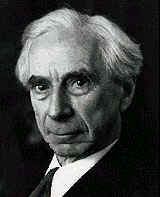 Bertrand
Russell (Ravenscroft - Galles, 1872 – 1970) oltre ad essere stato un
grandissimo filosofo e matematico (ne ricordiamo soprattutto la sua
interpretazione della Matematica come logica delle relazioni e le sue
famose antinomìe, fra le quali spicca quella degli insiemi normali) è
stato, anche, un attivo pacifista continuamente in lotta per la difesa dei
diritti umani. In uno dei suoi libri, “Has Man a Future?” (Ha un futuro
l’uomo?), egli riflette sull’era atomica e sulle sue origini ma propone
anche un ritratto sintetico e fedele della situazione storico-politica che fece
da sfondo alla nascita delle prime bombe atomiche:
Bertrand
Russell (Ravenscroft - Galles, 1872 – 1970) oltre ad essere stato un
grandissimo filosofo e matematico (ne ricordiamo soprattutto la sua
interpretazione della Matematica come logica delle relazioni e le sue
famose antinomìe, fra le quali spicca quella degli insiemi normali) è
stato, anche, un attivo pacifista continuamente in lotta per la difesa dei
diritti umani. In uno dei suoi libri, “Has Man a Future?” (Ha un futuro
l’uomo?), egli riflette sull’era atomica e sulle sue origini ma propone
anche un ritratto sintetico e fedele della situazione storico-politica che fece
da sfondo alla nascita delle prime bombe atomiche: