 |
 |
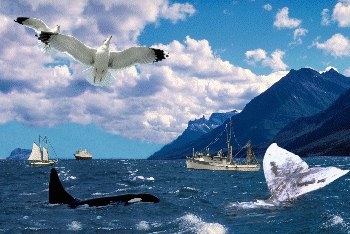
| PACIFIC MARINE ECOZONE (WATER) Location, Landform, and The Formation The Pacific Rim is located above the continental shelf, which is also the leading edge of the great North American tectonic plate. As the plates drifts almost subtly westwards, the continental shelf is folding under the Pacific tectonic plate, which forms the bottom of the Pacific Ocean. Undersea volcanoes and the famous west coast earthquakes are the result of the geological forces in acition where the shelves meet The formation of the Pacific Rim had started in the Mesozoic era and was completed in the Cenozoic era. Rock Type Here in the Pacific Rim, the land form region is the Western Cordillera, and the rock types that could be found here are sedimentary, igneous, and metamorphic. Physical Landscape covered under Pacific Maritime ecozone (territorial) Climate Unlike the Arctic and the Atlantic ecozones, it is rare to find sea ice in the Pacific Rim. There are little oceanic water exchange between the Atlantic and Pacific ecozones as there is a land barrier imposed by the Alaskan pennisula, which inhibits the cold arctic currents from flowing down to the West Coast. From North to South within Canadian boundaries, ocean surface temperatures in the ecozone fluctuate by about three degrees celcius at any one time. However, seasonal ocean temperatures vary within a narrow range of about seven degrees celcius, which is a big contrast to the twenty degrees celcius difference of the East Coast. Based on the stable temperatures of the Pacific Rim, it is considered as the transition zone between the polar seas of Arctic and the temperate waters of the mid-latitude Pacific Ocean. Seasonally, there are the formation of ice outside of Canada's territorial waters "at the northern boundary of the Bering Sea, the Sea of Okhotsk, and in bays and inlets where there are considerable flows of fresh water off the land. Because of the wonderful climate available, and the majetic sceneries of the Pacific Rim, many found it a good place to live in and a popular site for vacation. Vegetation Rivers nearby carry a vast amount of nutrients to the ecozone, the Pacific Rim. These nutrients stimulate the growth of phytoplankton, algae, and other marine plant life. Near the southern end of Vancouver Island, the deep water upwelling encourages a prolific ocean ecosystem. It has little contact with the Arctic, so it has different populations and distributions of species such as the plankton. In the intertidal zone of the Pacific Rim, there lies the "vast forests of Macrocystis, or Giant Kelp, along with several varieties of seaweed and coral reefs". Wildlife The Reintroduction of Sea Otters The Pacific population of sea otters had been extirpated by the early 1930s; thus, the urchin population, which was once controlled by the sea otters exploded decimating many kelp forests and their associated algae communities. Today, we re-introduced the sea otters back into the Pacific Rim and they are thriving. As a result, the kelp forest may also be revovered. "Along the coastal edge, coastal salt marshes and mudflats contain large beds of eelgrass", which are important spawning sites for the another inhabitant of the Pacific Rim - Pacific Herring schools. Fishes Other than the sea otters and the Pacific Herrings, there are also many other animals that live in the Pacific Marine ecozone. This ecozone is the home to about "3800 species of invertebrates, a mixture of oceanic, subpolar, neritic (living in the tide waters and landwashes), and benthic (bottom-dwelling) plankton." 3.5% of all marine invertebrates in the world are found here, which provide rich food sources for the 220 species of fish living in the ecozone. The fishes that form the backbone of commercial fisheries are the Pacific Herring, Salmon, Halibut, Steelhead, and Dolly Varden, among many others. Over the years, people overfished the Salmon and the Herring, and although the Herring population is recovering, the Salmons still remain precarious. Marine Mammals Not only are there fishes in the Pacific Marine Ecozone, there are also many marine mammals, such as the Stellar Sea Lions, Sea Otters, Northern Fur Seals, Orcas, and Gray Whales. There is also a large bird population that live in the Pacific Rim, which includes ducks, geese, Petrels, Guillemots, Murrelets, and Auklets, with some Puffins, and Murres. Some species of raptors, like the Bald Eagles and the Osprey feed in the "near-shore wetlands and rivers". Furthermore, there are Brandt's Cormorants in British Columbia, but they live off the west coast of Vancouver Island. |
 |
 |
| The Pacific Rim is also known as the Pacific Marine Ecozone. Its territorial area is known as the Pacific Maritime Ecozone. The Pacific Rim refers to the part of British Columbia located next to the Pacific Ocean. The waters of the Pacific Coast are best known to Canadian today for their popular tourism destinations and the prominent, yet troubled, fishing industry. This ecozone is the home to abundant plant and wildlife, but also has one of the fastest growing human populations in North America. This interesting ecozone "extends from the southern tip of Vancouver Island to Dixon Entrance, north of the Queen Charlotte Islands. Ignoring international boundaries, it actually reaches as far north as Alaska and the Bering Sea and south to the coasts of the states of Washington and Oregon. |
 |
| Links |
 |
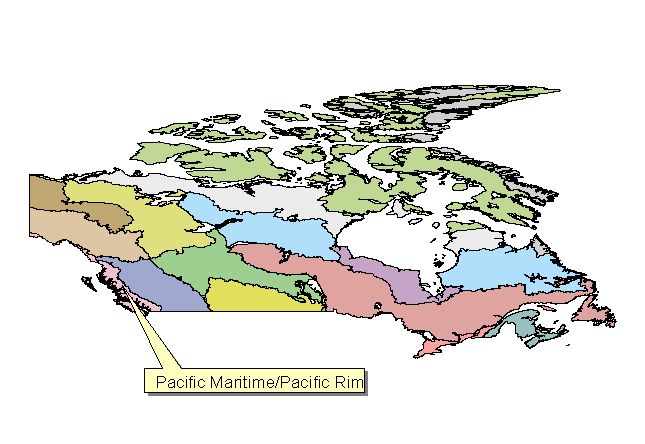 |
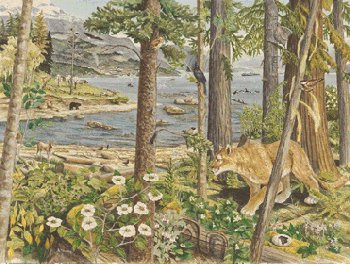
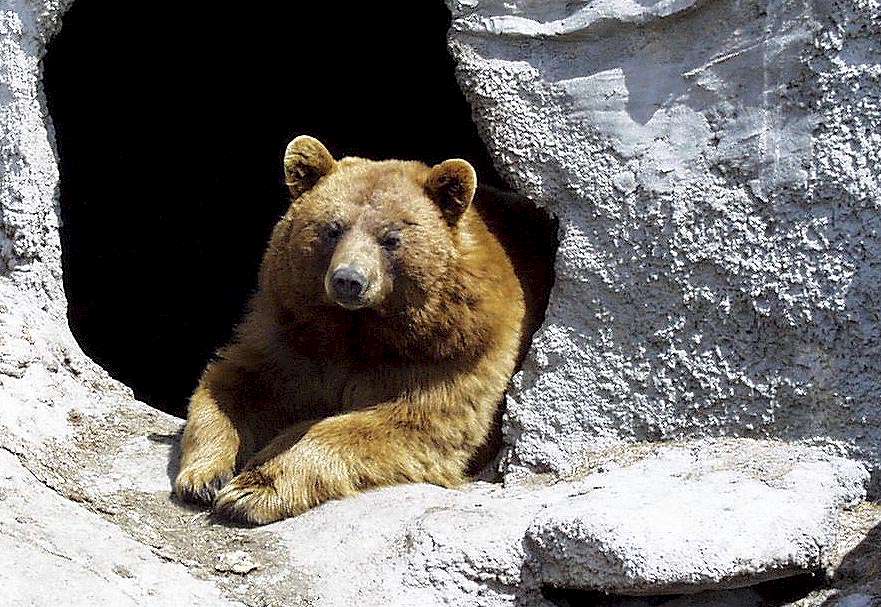
| PACIFIC MARITIME ECOZONE (TERRITORIAL) Location, Landform, and The Formation The Coastal Mountains dominate most of the ecozone, rising steeply from the fjords and deep channels that line the Pacific Coast. Glaciers and snowfields cap the tallest ranges. This territorial part of the ecozone includes Mount Waddington - BC's highest mountain. The mountains of Vancouver Island and the Queen Charlotte Islands make up in ruggedness what they lack in elevation. Igneous and sedimentary rock lie baneath most of the area while fallen rocks and glacial deposits predominate on the surface. The ecozone lies within the Pacific Ring of Fire, a narrow, semi-circular area known for volcanic eruptions and earthquakes as a result of the clashing, and the friction between the Earth's crustal plates. Rock Types This ecozone is made up of two types of rock - igneous, and sedimentary. Physical Landscape The land is very rugged and mountainous. Climate The Pacific Maritime ecozone has some of the warmest and wettest weather in Canada. It has a maritime climate as it is located next to a large body of water known as the Pacific Ocean. Here, little precipitation is received, very close to 600 mm of precipitation per year in the Lower Georgia Strait. However, the areas farther north tends to be wetter, receiving up to 3 000 mm of precipitation. The monthly temperatures are very stable, and when compared to the rest of Canada, there is little variations. The average temperatures in July range from 12 - 180 degrees celcius. and for January, 4 - 60 degrees celcius. The frost free period lasts for at least 220 days in the moist southerly valleys, and down till 100 days for areas in the mountains. Vegetation Many plants could be found here in the moist ecozone. Here the temperate rain forests are the nicest ones in the world and where the oldest and biggest trees exist. Trees like the western red cedar, yellow cedar, western hemlock, Fouglas-fir, amabilis fir, mountain hemlock, Sitka spruce, and alder composed the temerate coastal forests. Many of these trees reach very large dimensions and grow to great ages, forming ancient or old growth forests of this ecozone. The southern portion of the ecozone is mainly Douglas-fir, while in the north, amabilis fir is more common. In places at higher elevations, mountain hemlocks are found there. "Variations in altitude account for the presence of widely contrasting ecosystems within the ecozone ranging from mild, humid coastal rainforest to cool boreal and alpine conditions at higher elevations." - http://www.ec.gc.ca/soer-ree/English/Framework/NarDesc/Zone.cfm?EcozoneID=14 Wildlife Not only is there a large variety of plants, but there are also many species of animals that could be found on the territorial part of the ecozone. In the marine region, lots of sea critters, and mammals live there, and now below are the animals found in the Pacific Maritime Ecozone. Land Mammals "Black tailed deer, black and grizzly bear, elk, wolf, otter, and raccoon", mountain lion, fisher and American Pika are some mammals that could be found here. - http://www.ec.gc.ca/soer-ree/English/Framework/NarDesc/Zone.cfm?EcozoneID=14 Birds (unique) Bird species that are unique to this ecozone are the American black oyster catcher, the California and mountain quail, tufted puffin, the chestnut-backed chickadee. Birds (most representative) The most representative birds of this area are the pygmy-owl, Steller's jay, Northwestern crow, Northern Saw-whet owl, and the blue grouse. |
 |
| www.ec.gc.ca/soer-ree/English/vignettes/Terrestrial/pm/land.cfm |
 |
|
|