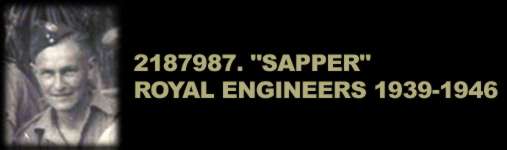
Middle East and home...
Disembark and straight on the train which eventually landed us up to Rebden Bridge just outside Halifax on the Yorkshire Moors to a temporary billet in a disused warehouse, then 14 days leave and home.
Eventually my name appeared on the list for transfer to Catterick Transit-camp. More weeks of hanging about dodging as many fatigues as possible, and then en-train once more to Liverpool Docks and aboard the troopship H.M. Devonshire.
The next V.E. Day was declared which we spent hanging over the ships side-rail watching the celebration bonfires and high jinks, as no one was allowed ashore.
Armed guards on all gang-planks prevented us from joining in, but the generous power that be granted an issue of two free bottles of beer each from the canteen!
We set sail the next day to as yet an unknown destination, would you believe it, the Bay of Biscay for the second time, then the Straits of Gibraltar again but this time straight through and on up the Medy to Alexandria.
Eventually I found myself landed at the R.E.Transit-Camp at Ishmelia by the great lakes of the Suez Canal. Under canvas with temperatures of 100+ degrees, first issue of Mosquitoe-nets and repellent and dark warnings of 'Inspect your boots thoroughly every time you put them on for Scorpions etc!' Also 'Do not at any time manage to fall into the 'sweet-water canal' with dire results Bubonic-Plague'.
A few weeks acclimatising and messing about with Pontoons on the lakes I was sent on a six-week course of 'Refrigeration Plant and Equipment' stationed just outside Suez quite interesting but of no great value to me. So I could claim (Very nearly) to have served in the Fareast i.e.: 'East of Suez' as they saying goes.
Eventually I was posted to 542 E&M Coy.R.E reinforcement "M.Section" at that time stationed in Beruit. I was put on the train with odds and bods, but mostly full of Arabs, at Alexandria and faced a 400+ mile journey up through Palestine to Syria in stifling heat and flies in full marching order, it took two days.
Reporting to billets over-looking the docks and then given a job at a nearby M.T. and arms dump repairing and general messing about with Bull-Dozers, Bren-Carriers etc.
Vague days with scorching heat and could only work early morning and late in the day. At mid-day control, tools etc were too hot to touch. At this time of my introduction to the Middle East was a time of un-rest.
Jews and Arabs at each other's throats and wanting Independence, the British did not go down too well in certain quarters. We could not go out off duty in less than two's or three's and then you risked life and limb if you ventured in the Arab quarters of town, a knife in the back in a crowed street was not unknown.
Rifles when not on Guard-Duty were padlocked together round the tent-poles as, in the past, they could silently disappear during the night. On guard duty at night we had strict instructions to keep in constant sight and sound of the next man. It could be a bit hair-raising on a dark night with the sounds of celebration perhaps of end of Ramadan waiting up from the surrounding mud hut of the locals!
After a few weeks the Depot was moved and once more I was on the move back down to Palestine to rejoin the Coy.
At Lydda just outside Tela Aviv and Jafja where I was suddenly struck down with Dysentry and Sand-Fly Fever. A further session in isolation hospital, which consisted of a camp of wooden, huts pretty primitive conditions, but we survived somehow. But at least here things began to quieten down a little to more like peace-time order.
Bathing in the sea off Tele Aviv, sightseeing trips to Jerusalem, the 'Wailing-Wall' and the old-city. Also Bethlehem and the Garden of Gethsemanee on Christmas Eve of that year. A moving experience I found all the while I was in this area and later on the Sinai Desert.
The Coy had various jobs in hand, dismantling diesel engines that had been pumping water for various camps, erecting water-towers at other, and in particular when removing some petrol storage tanks we found colonies of Scorpions had made their home under earth!
Another job when you had to keep your wits about you. Some of the lads used to pour a ring of petrol around them then set it alight, this caused the little devils to commit Hari-Kari and sting themselves to death.
I was sent out to Gaza and the Sinai Desert on detachment to another Coy, drilling for water as it was near the coast, more lovely sea-bathing in the Meddy and great fun surfing in the great 'Rollers' on the in-coming tide.
Another pleasant interlude when I was attached to the Palistine Police, which in those days was an all British Force, stationed in the desert on the outskirts of Haifa. Their job involved, among many others, stop and searching Bedouin Camel-trains for gunrunning and smuggling Hashish. We did several patrols with them as well as off-duty Camel racing, Gymkanas etc, they had two Arab Trackers in the section and these chaps were spot on in searching and finding what they were looking for.
Eventually came the time when my "Python-Number" (as it was called) came up on the notice board, which meant demobilisation in order of seniority and length of service I travelled back to Alexandria where we were relived of riffle and ammo and ready to board a troop-ship for Blighty and De-Mob.
A pleasant trip back up the Meddy threading through the Greek islands, Sicily etc, hugging the coast. Eventually we arrived at Marselles where, surprise surprise disembarked to wait for troop-train journey right across France through grand hill scenery to Calais.
On to the ferry and final happy sight of the White Cliffs of Dover once more. Train again to our final destination Aldershot.
Here was hive of activity, handing in gear to store and then being kitted out with De-Mob suit complete with trilby hat, meanwhile being addressed with the strange sounding 'Mr' after six years of 'Sapper'.
A final goodbye and good luck handshakes with the Duty Officer, a rail-warrant in my pocket to Barnet, and home, September 1946, a long haul but I made it...
"At the going downof the sun,and in the morning we will remember them"
S. R. Dracass
