Country Life
in the Early 1920's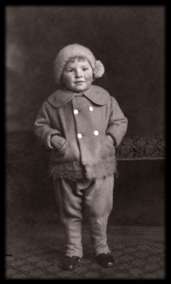
Hedge Lane, Palmers Green, where I was born in 1920 was more or less as the name suggest, a lane that wandered down-hill from the High Street with a few 'two-up two-down' cottages to the River Lea which meandered across the end.
An old wooden footbridge was the means of crossing the river, where a herd of cows quietly browsed in the lush water meadows.
My hazy recollections of early childhood are of hot summer days with occasional walks across the river and along the towpath with father on Sunday mornings. I also remember a 'Wig-Wam' erected in the back garden, made from an old sheet scrounged from Ma and a few whithy sticks, and an imaginary 'Pow-Wow' with an unknown tribe but I was only the 'Red Indian' with a chicken feather stuck in my hair.
By the time I was 5yrs old we had moved house to Whetstone a little further in the county. The house in Atheneum Road was similar but boasted three bedrooms, one being named the 'Box room', presumably because you could just get a single bed in it and that's about all.
A small farm down the road and across the way from our front gate, a meadow with once again cows grazing. Still a quiet village in the 1920's, the "Griffin Inn" in the high street had, along side a horse-trough, the old "Whetstone" which they say was used for sharpening swords etc, for the Battle of Barnet and other affrays no doubt….
Further along the Great North Road heading for Barnet, between the Bull and Butcher and Black Bull pubs, was the village "Smithy" where I spent many happy hours hanging around the open doors, or on cold wintry days, sometimes allowed with old Ted's (the blacksmith) permission, to stay still and quiet by the roaring forge absorbing all the sights and smells of the constant stream of all shapes and sizes of horse for shoeing. Cart-horse, Hunters, Trap-cobs, the lot, besides the attending carters, tradesmen, village-gossips etc, all with good humoured talk and leg-pull together with Ted's occasional curses at a fratous beast.
Near to the forge
was Elm Farm and my brother elder by 4yrs and I cadged lifts on the hay-carts
coming and going from the fields, and were allowed on occasions to help in
the unloading back in the hay-loft, there were no bales in those days, hay
making being all done by hand.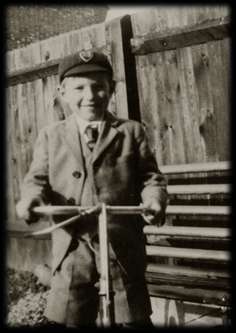
Later on when we managed to scrounge a couple of old "bone-shaker" bikes we would hang on with one hand to the carts coming up the lanes and think that great fun and daring. If any of the other village kids not so fortunate as to have a bike saw us at this trick they would shout out to the carter "hey-up, whip behind Guvner!" Then perhaps he would good naturedly just flick back over the hay-load with his long whip to dislodges you, much to the hilarious delight of all in view. Nobody in this day and age of hustle and bustle seems to have the time or inclination to stand and stare to absorb life as it goes on around them! Later on when a bit older and more adventurous whilst on the same trick of "whip-behind" as we called it on an old steam lorry, going up Barnet Hill it had to pull out to pass a hay-cart and suddenly I found myself in the middle of the road and my front wheel stuck in the tram lines, a bit of a fright which stopped the lark!
As a rare treat a tram-car ride was great fun and a real fine exciting feeling when going down Barnet Hill at a fair lick the old tram used to sway about rattling and clanging along. The driver on the front platform clanging a bell which operated by a pedal device in the floor by his foot, to keep the tram lines clear of other traffic and jay-walkers.
Riding on the open top-deck was lovely on a warm summers day but not so good in winter or wet rainy days. On the wood-slatted seats they had tar-paulin sheets attached to the seat in front of you and you had to un-hitch one end and hold it over your shoulders. It kept some off but mostly the rain dripped down your neck and all over your back. A bit later on they improved them and had an enclosed roof and side windows.