

(Two Sided Pumpkin)
Sold at Laguna Beach, California auction in 2004
Proceeds went to The Family Violence Project
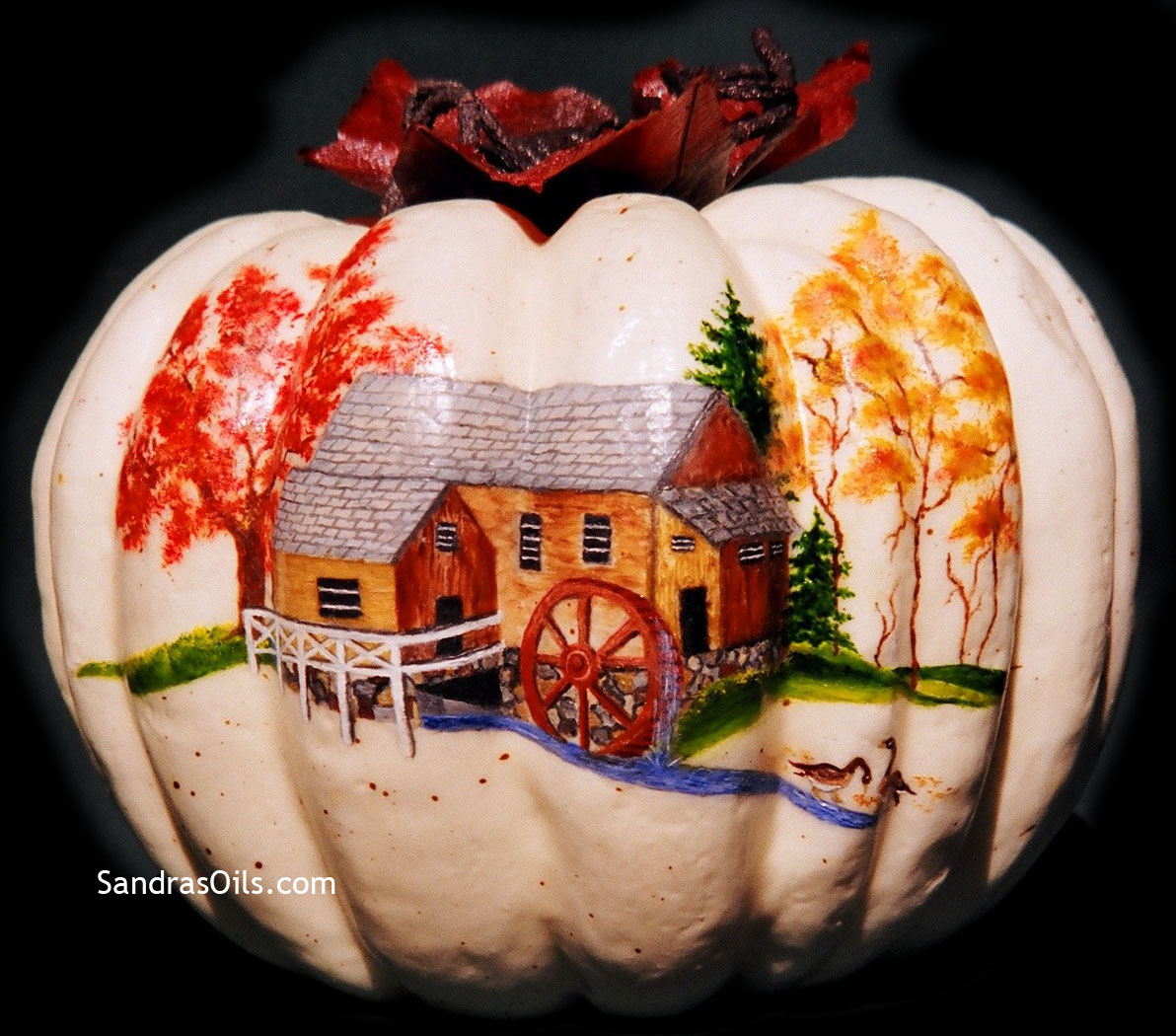
(Side 1)
Grist is grain waiting to be ground. Gristmills have used water power to grind grains into meal since the first century B.C. The miller placed grain into a funnel-like hopper above a pair of two circular millstones weighing up to 3,000 pounds. He opened a sluice-gate allowing the weight of the falling water to turn the water wheel. Fixed in the floor of the mill, one stone turned above the other while their grooves acted as scissor blades to slice the grain. The miller adjusted the distance between the stones to regulate how finely the grain was ground.
In the 19th Century there were 23,000 gristmills in the United States alone. Most were neighborhood grist mills selling their service of grinding to nearby farmers charging a toll of 1/16th of the grain. The meal was stored in meal chests waiting to be scooped up into sacks to be taken home for baking or given to livestock. One can visit remaining, but largely inoperative, gristmills today in New England and reflect upon their history being reminded that "keeping one's nose to the grindstone" is derived from the miller of the gristmills of the past.
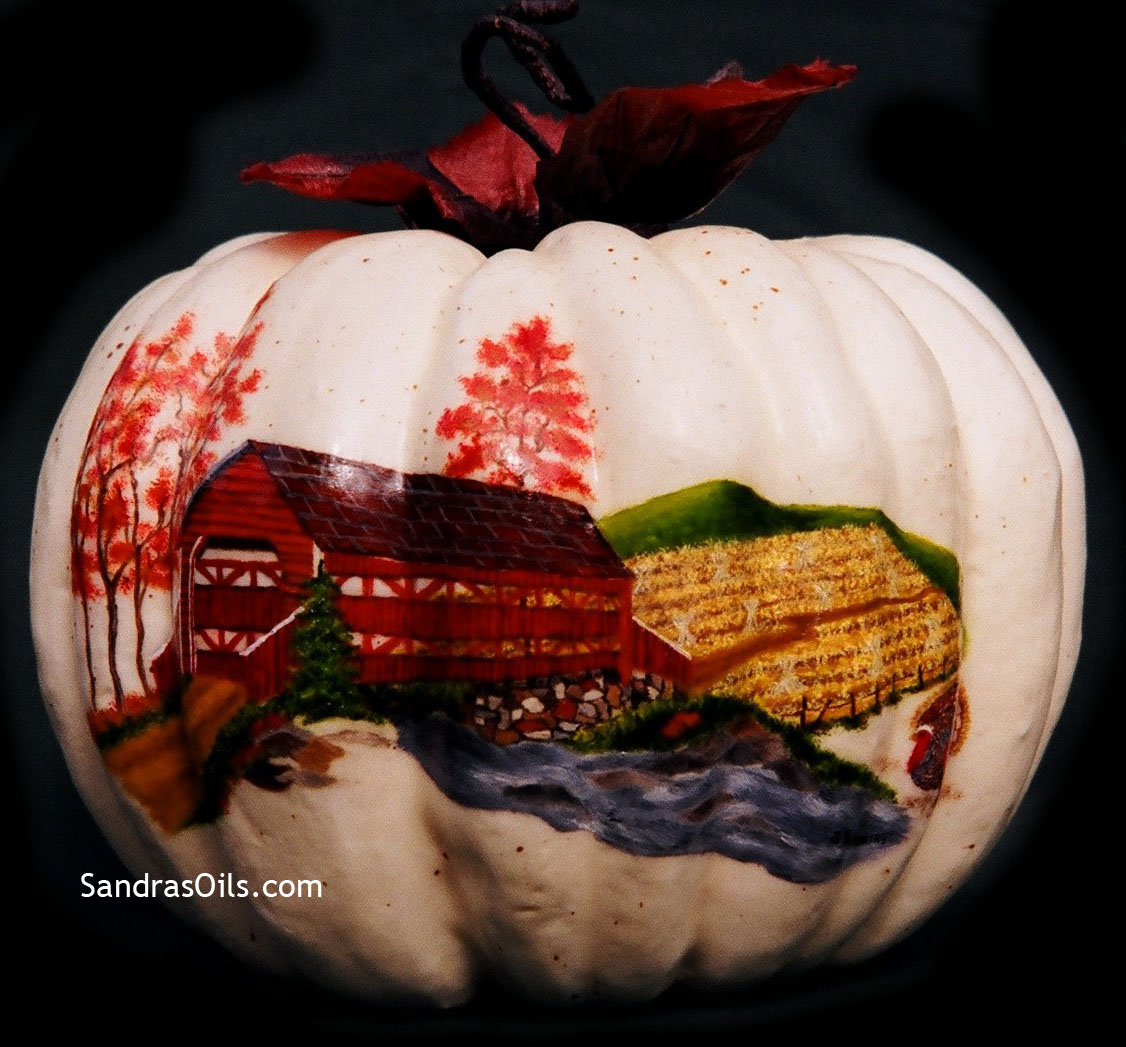
Side Two
(88' long, 14.25' wide, 10' high at truss, 11.9' high at center)
Wooden covered bridges symbolize rural America. Some have remained standing for centuries keeping their wood floors dry to avoid decay from rain, snow and ice. Not built for walking, horse drawn carriages and cars pass through single-file. Known as "kissing bridges" many couples have had their first kiss (or second, or third) when passing through a covered bridge. Most of these bridges were painted red because iron ochre was an inexpensive pigment. The early recipe for bridge paint: 2 qts. skim milk, buttermilk or whey, 8 oz. new slaked lime, 6 oz. oil from ground flaxseed, 2 oz. turpentine, and 1.5 lbs. pulverized ochre. The most common design was Town Lattice. Crossing a covered bridge is like entering a portal of time that transports you back to the horse and buggy days. Today "Covered Bridge Festivals" commemorate their history.
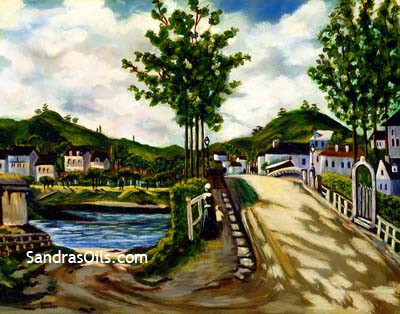
Reminiscent of Claude Monet's The Seine at Bougival (1869), this painting evokes the tranquility of a French countryside. Rolling hills and a flowing river are all part of the panorama as a mother and child cross the bridge to shop and visit with friends in a nearby village.
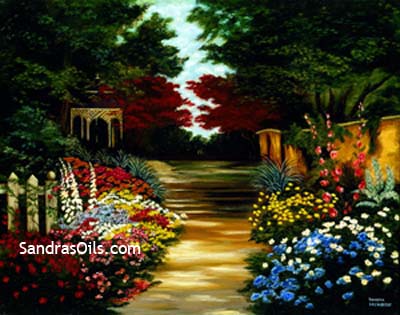
English gardens are known for their studied overgrown beauty in density and design using luxuriant colors and textures. Stroll down this pathway admiring the panoply of colors and pause in the gazebo to reflect upon the visual cornucopia before exploring the gardens beyond. This painting was influenced by the contemporary Italian artist Edigio Antonaccio's Garden Walk.
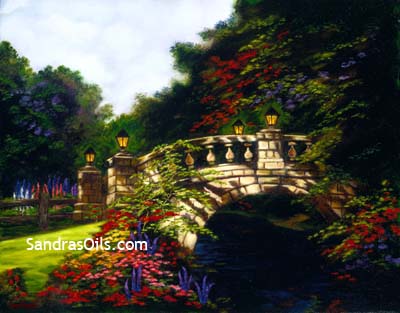
Evening approaches as you cross over a bridge and stroll down a pathway to the quiet waters of a stream. As evening descends English gas lanterns provide light and warmth to enhance the visual intensity of the landscape. This was inspired and painted in the style of Thomas Kinkade.
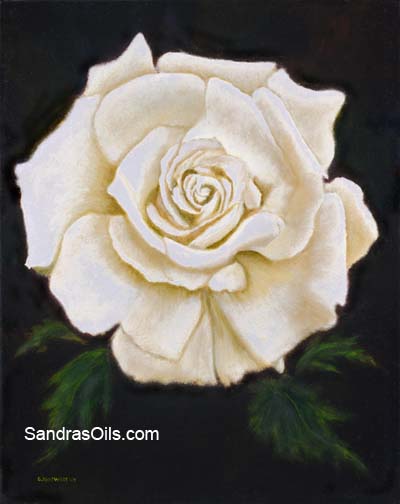
For millennia the rose has been symbolic of love, hope, politics, war and peace. No other flower is so universally known and admired as that of the rose.
Roses were used to adorn the palace of Babylonian King Nebuchadnezzar. Rose-water filled the swimming baths and fountains of the Roman Empire.
England controlled large portions of France for approximately 300 years. During that time red roses were imported to Provins by the Count of Champagne, a crusader and troubador. Edmund of Lancaster, a son of Henry III of England, was his overlord. Edmund incorporated the red rose into his emblem in the 13th century.
In the 15th Century (1455-85) a series of dynastic civil wars for the English throne occurred between the House of York (white rose) and the House of Lancaster (red rose). Known as the War of the Roses, it ended in 1485 with the marriage of Henry VII of England to Elizabeth of York uniting the houses.
During the 17th century, roses or rose-water were in high demand and considered as legal tender by royalty.
Today Bulgaria's Rose Valley production and export of rose oil for perfumes are an important contribution to its economy.
The history and importance of the rose belie its being the progeny of a thorny bush. Serenity captures the velvety texture and beauty of a white rose which exudes the essence of its fragrance to the viewer.
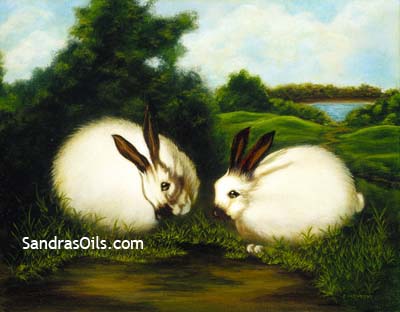
In the early morn two fluffy, white rabbits are nestled together in the midst of a lush, green landscape. How did they arrive at their serene destination? Perhaps they wandered down the pathway from the distant lake.
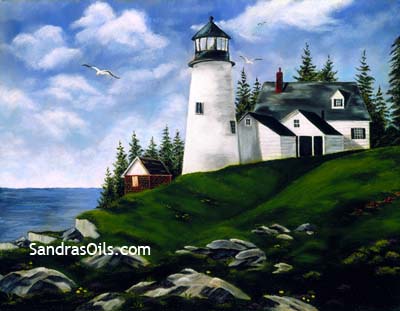
The first known lighthouse was the Pharos of Alexandria, Egypt founded by Alexander the Great in 332 BC. Throughout centuries lighthouses have signaled danger and provided aid to seafarers. Being a lighthouse keeper has often meant a dangerous and solitary life. This picture is so illustrative of the bleakness and loneliness of those who have provided hope during the coastal tempests. Amidst windswept rocks this beacon of hope stands strong and secure. My painting is a study of Joan Tierney's High Visibility.
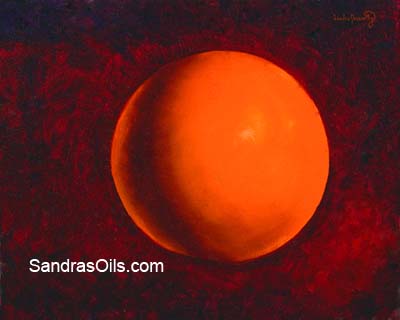
An eclipse is the total or partial obscuring of solar or lunar light. Let the vibrant colors of this contemporary painting entice your imagination and serve as an invitation to muse. Are warriors on horseback with spears surging into battle as the moon turns to blood? Is it Apocalyptic? Is it reminiscent of Pieter Bruegel the Younger (Flemish, 1564-1638) paintings of Judgment Day?
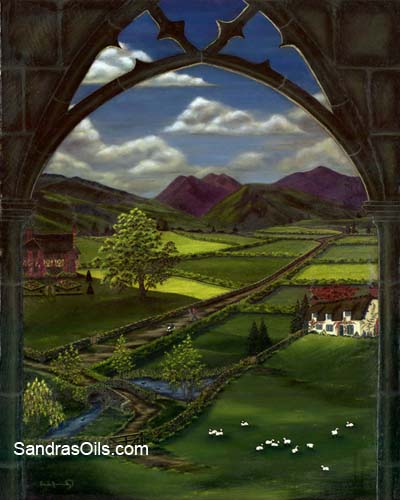
The view of the countryside from a cloister encompasses all of the imagery of pastoral England. Sheep graze in a field, ducks float in a stream and patchwork fields lined with hedgerows stand as they have for generations. An English Manor House and a shepherd with his dog returning to his thatched-roof cottage complete this landscape. Distant mountains reign over the captivating depiction of ageless England.
This painting is a study of Rembrandt's self-portrait of 1629 at the age of thirty three, "Rembrandt with Gorget." The original painting hangs in the Mauritshuis at The Hague in The Netherlands.