 |
|---|
|
|---|
|
|---|
|
|---|



Over 3000 years ago the Greek poet Homer sang of "the blessed Ethiopians." The English man of letters Samuel Johnson wrote a novel 200 years ago about an Ethiopian prince, in which the philosophers of the country contemplated the mysteries of the universe. In the twentieth century, Pan-Africanists such as W. E. B. Du Bois saw Ethiopia as the "all-mother of men," an ancient land of immense importance to human history, while the followers of Marcus Garvey dreamed that the children of slaves might return to Africa and live in Ethiopia, a nation that in the biblical Book of Psalms "stretched out her hands unto God." More recently, television and newspapers have depicted Ethiopia in harsh terms as a land of famine, war, and very little else, but the country possesses an extraordinary history, which remains little known outside its borders.
The land we now know as Ethiopia witnessed the birth of modern humanity over 100,000 years ago, and it was home to some of Africa's most ancient and advanced civilizations. Indeed, Ethiopia is one of the oldest nations on earth.
Location:
Geographic coordinates
8°00′ N 38°00′ E
Ethiopia is located in the Horn of Africa and is bordered on the north and northeast by Eritrea, on the east by Djibouti and Somalia, on the south by Kenya, and on the west and southwest by Sudan. The country has a high central plateau that varies from 1,800 to 3,000 m (6,000 to 10,000 ft) above sea level, with some mountains reaching 4,620 m (15,158 ft). Elevation is generally highest just before the point of descent to the Great Rift Valley, which splits the plateau diagonally. A number of rivers cross the plateau -- notably the Blue Nile rising from Lake Tana. The plateau gradually slopes to the lowlands of the Sudan on the west and the Somali-inhabited plains to the southeast.
Statistics:

Prehistory:
Ethiopia was home to some of our earliest human ancestors. Some of the oldest remains of Homo sapiens, dating back about 130,000 years, have been found in the far south, along the Kibish River in the Omo Valley region (see African Origins of Humanity). Until 1994 the oldest known branch of the human family tree was represented by fossil remains found in 1974 at Hadar, 350 km (217 mi) northeast of the Ethiopian capital, Addis Ababa. The famous partial skeleton called "Dinqinesh," or "Lucy," a specimen of Australopithecus afarensis, which dates from between 3 million and 3.6 million years ago, is exhibited in the National Museum at Addis Ababa. Discoveries of even older hominid remains have now surpassed Australopithecus afarensis. The remains of 17 individuals, identified as members of a new species, Australopithecus ramidus, have been found at Aramis, on the north side of the Awash Valley, about 75 km (47 mi) south of the Hadar region. These new finds take the record in Ethiopia back 4.4 million years, and appear to confirm estimates that the hominid line diverged from that of modern apes between four million and six million years ago.
History:
Axum-
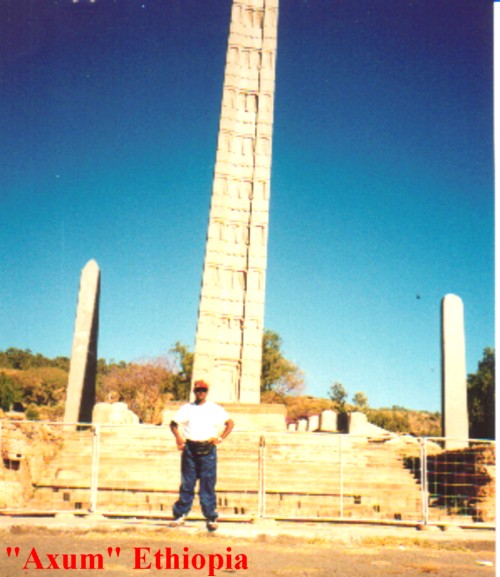 the greatest of all the ancient African civilizations; the empire was ruled from its capital city of Aksum (see Ancient African Civilizations). South Arabian and Aksumite sources, written in the ancient Ethiopian language known as Ge'ez, refer to the so-called Habash people who inhabited the empire. The name of this people is the basis of the word "Abyssinia," by which Ethiopia has often been known. The name of Ethiopia is taken from a Greek expression meaning "burnt faces." The Greeks applied this term to the Kushite kingdom and black Africa in general. In the fourth century c.e. the kings of Aksum began to use the Greek term (Aithiopia) for their own country when they wrote in Greek. A trilingual inscription of Ezana, the king who converted to Christianity about 340 c.e., employs both names. This is the first known use of the word "Ethiopia" by one of its own rulers to describe part of the modern country. The land was usually called Aksum, after its capital.
Lalibela-
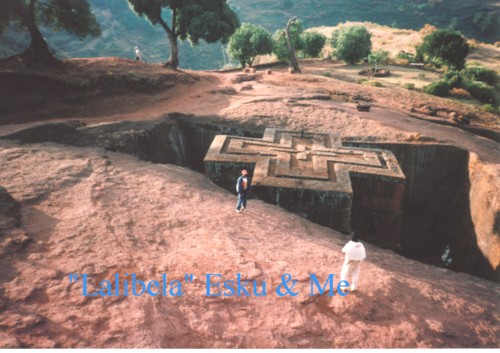 The 11 churches are regarded as one of the wonders of the world, excavated from solid rock with an immense underground maze of tunnels and passages. There are two main groups of churches, with another church dedicated to Saint George a short distance away. No one really knows when or why the houses of worship were constructed. Ethiopian tradition connects them with the most famous king of the Zagwe dynasty, and the town, formerly known as Roha, has come to be known by that king's name. The Life of Lalibela describes how King Lalibela (who ruled from the late twelfth to the early thirteenth centuries) was carried away to the heavenly Jerusalem. There he was instructed to build the churches. Angels worked beside his men as they cut each one from the rock, and then kept working through the night. However, the style in which the churches were made is remarkably similar to the surviving architecture of ancient Aksum, and scholars have become intrigued by the possibility that some of the churches could be much older than the reign of Lalibela. Some of them may also have been constructed as palaces rather than as churches.
According to an Ethiopian saying: "If you do not wish to see Lalibela, you are like someone who has no desire to see the face of Christ."
Gonder-
 The graceful city of Gonder founded by Emperore Fasilidas around 1635. The earlier Gonder period included powerful emperors whose deeds are described in the royal chronicles. Gonder itself is a remarkable testimony to their efforts, the first capital after centuries in which the empire had been governed from tents.
After the expulsion of the Portuguese, Ethiopia was again isolated from European influence. During the following centuries, foreign travelers made occasional visits to the country, which was now ruled from the new capital built at Gonder, north of Lake Tana. Like the Jesuits before them, these visitors recorded their observations of different peoples, plants, and animals, political affairs, religious issues, opportunities for trade, and many other features of Ethiopian life.
Although relatively free from the coups that have plagued other African countries, Ethiopia's turmoil has been no less devastating. Drought, famine, war and ill-conceived policies brought millions to the brink of starvation in the 1970s and 1980s.
In 1974 this helped topple Haile Selassie. His regime was replaced by a self-proclaimed Marxist junta under which thousands of opponents were purged or killed, property was confiscated and defence spending spiralled.
With the overthrow of the junta in 1991, political and economic conditions stabilised somewhat, but not enough to restore investors' confidence, which received a further blow with the war with Eritrea in the late 1990s.
A fragile truce has held, but the UN has warned that continuing disputes over the demarcation of the border threaten peace.
Ethiopia remains one of Africa's poorest states, with a very low income per capita and a population that is almost two-thirds illiterate. Its economy is highly dependent on agriculture, which in turn is almost entirely dependent on rainfall.
The Ethiopian People's Revolutionary Democratic Front (EPRDF), Mr Meles took part in the guerrilla campaign against the Mengistu regime, and was chosen as transitional head of state after the overthrow of the dictator in 1991. Once a Marxist-Leninist, by the 1990s he had become a self champion of the free market and parliamentary democracy. He was one of the architects of the 1994 constitution, which provided for a federal republic with ethnically-based regions. This result a great divition among people who have been living in harmony for mony years. Since 1995 he became prime minister and in 2005 re -elected himself despit the oppossion party majorit win. In addition mony people were killed and thousands were arrested in protests sparked by opposition allegations of electoral fraud by the ruling party. The people of Ethiopia are stil in strggle to find freedom, justes and equality to all.
If you are interseted to know more about the History, Culture, People etc..please visit the Ethiopian links @: "http://www.abyssiniacybergateway.net/ethiopia"