

This is Kerala
| About Kerala |
|---|
| About YWAM |
| Ministries |
| Prayer Station |
| Spiritual Mapping |
| Prayer walk |
| Training |
| Staff |
| Donate |
| Sign Guestbook |
| News Update |
| Humor |
| Contact |
| What Media says |
| Why I went to Kerala |
Location: India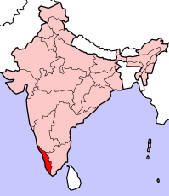
Area: 38,863 sq km
 Population: 40,000,000
Capital: Thiruvanthapuram
Language: Malayalam, English is widely spoken
Religion: Hindu 47%, Christian 30%, Islam 23%
Time: GMT = 5:30
Climate: Tropical
Kerala God's own country
 Kerala is a narrow strip, extremely
fertile and is almost impossibly green throughout. The slender green sliver of land that
clings to the southwestern flanks of the Indian peninsula, as it lies
between the high Western Ghats towering
500-2700 m in the east
and the vast Arabian Sea in the west and
networked by forty four rivers, Kerala enjoys unique
geographical features that have made it one of the most sought after tourist
destinations in Asia.
The small, emerald crescent of land
Kerala is a narrow strip, extremely
fertile and is almost impossibly green throughout. The slender green sliver of land that
clings to the southwestern flanks of the Indian peninsula, as it lies
between the high Western Ghats towering
500-2700 m in the east
and the vast Arabian Sea in the west and
networked by forty four rivers, Kerala enjoys unique
geographical features that have made it one of the most sought after tourist
destinations in Asia.
The small, emerald crescent of land
contains jungles, beaches, mountains, lake and some of the most romantic natural resources in the world. Lush hill stations and exotic wildlife. Waterfalls. Sprawling plantations and paddy fields. Ayurvedic health holidays. Enchanting art forms. Magical festivals. Historic and cultural monuments. An exotic cuisine... All of which offer you a unique experience. And what's more, every one of these charming destinations is only a two hour drive from the other. A singular advantage no other destination offers. Kerala is India’s most literate, prosperous and densely populated state. When you visit Kerala, you feel as if you are entering another country. For administrative purpose, the state of Kerala is divided into fourteen districts. Most of these districts offer all the tourism products typical of the State.
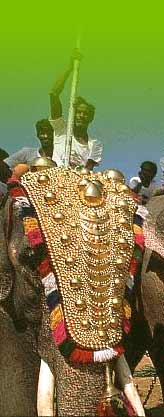
History of Kerala:
Original inhabitants were animists, followed by the Dravidians. After
Alexander's triumphant sweep over Asia Minor, the ports of Kerala became a
link between the Middle East, the Mediterranean and China.
In 1498, Vasco da Gama made his historic landing on the Malabar Coast. In
1723, the East India Company signed a strategic treaty with King Marthanda
Varma. For a few decades, Hyder Ali and his son -Tipu sultan proved to be a
thorn in the flesh of the British, sweeping down several times into Kerala.
In 1947, it was the turn of the British to pack their bags
The People:
Kerala also has considerable ethnic diversity. The Malayali majority belong
to the Dravidian group (local race) of early Indian peoples.
There is a small population of descendants of Indo-European migrants from
the north. Certain hill tribes exhibit affinities with the Negrito peoples
of Southeast Asia. Most Keralites are Hindus, but there are also large
Christian and Islamic, and lesser Jain and Jewish, minorities.
The official language is Malayalam. A long contact with the outside world
has led to an intriguing blend of cultures and given Keralites a
cosmopolitan
Climate in Kerala:
The climate is equable and varies little from season to season. The
temperature normally ranges between 27º
and 32º C in the plains but drops to about 21º C in the highlands.
Winter - 32 to 20 º C. Kerala is strongly buffeted by both the
southwest and northeast monsoons. Rainfall in many parts of the state
exceeds 118 inches. Best season: October to March.

Kerala, India's most advanced society
A hundred percent literate people. World-class health care systems. India's lowest infant mortality and highest life expectancy rates. The highest physical quality of life in India. Peaceful and pristine, Kerala is also India's cleanest State.

Suicide
Kerala continued to be on the top of the list of suicide cases with more than 9000 suicides reported annually, which was around 27 persons a day or more than one person per hour, "The rate of suicides in Kerala was roughly 32 per one lakh persons in 2002, which was thrice the rate of suicide in the country", According to official figures, as many as 19,774 people killed themselves in the last two years, accounting for nearly 31.5 per 1,00,000. This figure was almost three times the national average of 11 per 1000.

Alcoholism
In terms of per capita liquor consumption also, Kerala tops the list. Each year Kerala guzzles 8.3 liters of liquor per person, the highest in India, and nearly three times the national rate. Health Minister Kadavur Sivadasan has said, Kerala ranks very high in the use of psychiatric drugs too.
Joblessness
The worst in India; 36% and 34% respectively of the rural and urban population in the 15-29 age groups are unemployed
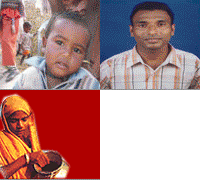
Poverty
In conventional economic terms, Kerala is one of the poorest places in the world. If Kerala were a separate country, it would place it 9th on a list of the world's poorest nations. There are 58 Municipal towns in Kerala, including the Corporation of Thiruvananthapuram, Kochi and Kozhikode. According to the 1991 census 42.69 lakhs of people, live in 7.84 lakh households, in 58 towns. Through a community based survey in all the 58 towns of Kerala, using the 9 demonstrable criterion of ‘Poverty Index’, 2.05 lakhs of urban poor families, with 1.1 million urban poor population, are identifies in the State. In the survey, all the households, 7.84 lakhs of them, were covered. This amounted to 26.72 percentages of the households of the municipal towns of Kerala.

Child Prostitution
According to a study sponsored by the state government identified 825 child sex workers of which 355 males and 470 females, aged between 8 and 18. Many of these children had finished their school and were in great demand of among clients fearful of contracting HIV/AIDS and other sexually transmitted diseases and believed child sex to be a safer options. Poverty, broken families or sexually abused by relatives, co-workers or bosses were found to be the chief factors driving these children into the sex trade. Children from other states are also brought to Kerala for sex trade.

Disowned Women
The Kerala society has a significant presence of a large number of socially disowned women such as widows, abandoned Muslim divorcees, and victims of deceit and cheating; besides a number of women and their parents or husbands discards young girls after becoming victims of rape. Cases of women who are single mothers pushed out of their houses into the street are numerous. The number of homeless women is increasing day by day. Female children, teenagers, and older women who flee their homes for fear of severe battering, sexual abuse, and mental torture are also on the increase. Dowry murders have become customary practices in the society.

Prostitution
Flesh trade is flourishing in Kerala. Men and women are taking to sex work to make easy money. The Kerala State AIDS Control Society study says around 5,500 women and 3,400 men are 'very actively' engaged in sex work in different parts of the state. Sex workers in the God's Own Country carry out operations from lodges, houses and the streets. 'Call girl' system has also become 'frequent' in major towns with students and housewives involved in it in a big way. The average age of the women involved in sex work is 32. Over 37 per cent are single, while 29 per cent are women deserted by their husbands. Divorcees constitute 19 per cent.
Christianity
Kerala has also had Christianity as long as Christianity has been in Europe. Christianity, Judaism and Islam found their way into Kerala. A tolerant people welcomed them. Kerala has an amazing mixture of religions Hindu, Christian and Muslims. Communal harmony and religious toleration are an essential part of Kerala’s culture and heritage. Nowhere in India, or may be in the entire world, you can witness such tolerance and co-operation and religious amity as seen in Kerala. Only in Kerala one can find people of different community come together and celebrate each other's festival with pomp. Kerala has numerous protestant denominations and evangelistic agencies. Moving of the spirit over the last 100 years brought multitudes of both nominal Syrian Christians and low-caste Hindus to faith in Christ. Casteism within the churches is an unmentioned reality. A revived church in Kerala would have a deep impact on all of India because of the level of education, wealth and dynamism.

This page last updated 30 Aug, 2005.
You are our visitor