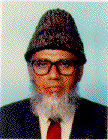
His parents were Al-Mawlawi Muhammad Hasbullah Sahib al-Nuri, father, and Madam Ayisha Thaminah, mother, both hailing from highly reputable, religiously-oriented-families. His father’s paternal lineage continues from a hereditary chain of ‘ulama’ as well as merchants and his mother’s paternal and his father’s maternal lineages are also traceable to a hereditary chain of spiritual luminaries (masha’ikh) of the Qadiriyyah Spiritual Order whose numerous descendants still serve the cause of Islam in various centres throughout Sri Lanka and Tamil Nadu. His father worked as a Government School Arabic Munshi (teacher) who was also a master of the Persian, Urdu, Tamil and Malayalam Languages. He passed away in the year 1984 at the sagely age of 85.
Moulavi M. H. Babu Sahib completed his primary, middle-school and secondary education in the Tamil language, since his "mother tongue" was Tamil, though both parents traced their ancestral origins to masha'ikh from Hadramawt (Yemen). He was also taught a little English. He completed reading the Noble Qur’an at the age of seven. When he was 12 years old his doteing mother passed away after prolonged illness. He has a brother and three sisters, of his mother and two sisters of his benign step-mother. After his completion of Tamil Higher (education) he came to Singapore in May 1947 at the age of 14 to help his uncles in business and to continue his studies in private schools in Singapore. Due to the dominance generally of non-Islamic and colonial influences in the schools, in those days, he was, like many other Muslim children, not much inclined towards Islam, despite his coming from a family with deep religious roots. But in the year 1950 he happened to listen to a highly inspiring lecture delivered by His Eminence Mawlana Muhammad Abdul Aleem Siddiqui, the founder of All Malaya Muslim Missionary Society, later Jamiyah , Singapore, who was then, of Meerut City, India. He had come to deliver that lecture in the first-ever South East Asia Muslim Missionary Conference held in Singapore. His impressive and coherent speech and its rationally compelling presentation of the subject by his eminence, shockingly, rekindled the latent fire of Islam in him. This pleasant episode served as a turning point in his life. Before this event he, of course, used to, indifferently, hear and read many unreasonable criticisms directed against Islam and the Prophet of Islam. Consequently, he therefore, was moved to study more about Islam. His first step was to get hold of Islamic lectures by the same spiritual savant given at various places across the world and subsequently published as booklets. Then, dissatisfied with second-hand knowledge, he decided to get his knowledge of Islam directly from its primary sources, i.e.: from the Qur’an and the traditions. He, therefore, decided to go abroad for pursuing formal religious studies. But many mundane things stood in his way. Meanwhile, he used to patronize bookshops and laid his hands on books of all subjects except novels and fictions. His study encompassed many subjects which he thought would have some kind of relevance to his search for religious and spiritual knowledge, including subjects like character-reading, dream interpretation and so on. This he, usually, did with a view to look out for criticisms and sarcasms levelled against Islam by its opponents. [Later when he studied Islam, formally, he made sure that he had the answers to all those criticisms]. Finally he managed to wrest himself free from all who and that which stood in his way and managed to threw aside all his worldly-priorities. And in the year 1957, after having completed his Cambridge School Certificate Exam, he went to India to pursue his religious studies much against the wishes of his relatives who would only like to see him either tied to the family businesses in Singapore or to go back to India with monetary wealth from Singapore. Upon arrival in India he joined the Madrasah Misbahul Huda (Arabic College) in Tamil Nadu. Thereafter, he studied in the Madrasatur-Rahmaniyyah (Rahmaniyyah Seminary) also in Tamil Nadu, India. He was fortunate enough in that, though all his teachers paid special attention to him, some of the teachers paid extra special attention to him and taught him with reciprocal enthusiasm. Of his teachers special mention should be made of Al-Ustadh Mawlana al-Mawlawi al-Fadil Muhammad Qasim Baqawi of Pallapatti, Madurai and Al-Ustadh Mawlana al-Mawlawi al-Fadil Abdul Hameed al-Nuri of Kiliyanur, Tamil Nadu, from both of whom he studied intellectually taxing subjects like Logic and Islamic Philosophy, though he did also acquire sizeable knowledge through his own devoted research. Upon completion of his studies he obtained his Mawlawi al-Alim Diploma from the Rahmaniyyah Seminary in the year 1962. But while he was still studying he had also succumbed to the wishes of his father and got married to his cousin in the year 1958. Thereafter, he was invited to teach in the Madrasatul-Islamiyyah Religious College, Tiruvithamcode, Kanyakumari District, Tamil Nadu. There he had his maiden teaching experience of teaching all the subjects prescribed in the highly regarded Nizamiyyah syllabus for an engageful period of two years.
Throughout his study period and in the years he spent teaching, his foremost aim and objective was to find effective answers to the criticisms of the opponents of Islam and towards this end he did extensive research on seeking the appropriate comparative terminological equivalents in Arabic and English of Islamic Fiqhi and Philosophic terminologies. He had the clear aim at the very outset of one day teaching all those subjects included within the Nizamiyyah syllabus in the English language, thereby wishing to liberate modern-day Muslims from their helpless dependancy on the highly suspected works of, often, maliciously-desposed-Orientalists for their pursuit of Islamic Studies through English.
In the year 1964 he returned to Singapore. For about five years he was back in business, again, helping some of his relatives, but spending all his leisure time at the Muslim Missionary Society (Jamiyah) Singapore, taking charge of the converts and encountering and correcting the numerous critics of Islam. [However, his connection to the converts to Islam and his lay services to them started much earlier when he first joined as an ordinary member of the Jamiyah in 1954 when he was 24 years of age, before even he went to study religion]. Since then hundreds of converts of various nationalities and ethnic groups have embraced Islam, alhamdulillah, through his humble hands. And thousands more have, over the decades, undergone their study of Islam and their basic religious training under him. Pre-conversion expositions, discussions and, when necessary, debates were conducted under his competent supervision. His brotherly influence on the converts led to the formation of the Kumpulan Saudara Bahru [Association of New (Muslim) Brothers] in 1972 at the premises of Madrasah Al-Sagoff under the aegis of the Majlis Ugama Islam Singapura (MUIS) , and which in 1976 was formally renamed as the Muslim Converts' Association of Singapore (Darul Arqam).
Also after the formation of MUIS in 1968 he was nominated to be a member of the Panel of its Appeal Board for hearing Shari‘ah appeal cases in the year 1969. Then in 1970 he was chosen to be a council member of the MUIS. He continued to be a member of this semi-government body upto 1976.
In the year 1969 when Hafiz Mawlana Dr. Muhammad Fazlur Rahman Al-Ansari Al-Qadiri of the World Fraternity of the Aleemiyyah Institute of Islamic Studies, Karachi, Pakistan, made his last visit to Singapore, he met him and was in his company throughout his stay in Singapore and during which time he found the Mawlana to be a spiritual luminary of identical views, opinions, aims, aspirations and objectives as he himself was beginning to have. Therefore, he became one of the Mawlana's disciples and consequently took his advices. He, thus became initiated into Al-Qadiriyyatul Aleemiyyah Spiritual Order.
Then in the year 1971 he was approached by the then Consul-General of Saudi Arabia in Singapore, Dato Syed Ibrahim Bin Omar Al-Sagoff to take-over the publication of the AL-ISLAM Quarterly Magazine from the Dato's own cousin Syed Hussain Al-Sagoff. This magazine has been published in Singapore under the subsidy of the Rabitat Al-Alam Al-Islami of Makkah Al-Mukarramah. Because of the unethical siphoning off of substantial portion of the funds provided by the Rabitah, unfortunately, by their entrusted representative, Moulavi Sahib, consequently, incurred a tremendous loss which together with associated intrigues by key sections of the local power elites resulted in the indefinite suspension of the magazine since 1978 onwards. Meanwhile he had also established a tutorial school for Islamic studies in 1975. Some of the students who had studied through this school have, subsequently, completed their doctorates in the universities of the UK or the US. The English-speaking world may, insha Allah, gain more from this school in the near future. In this regard, Moulavi Sahib himself believed that enlightenment, when it comes in the appropriate medium, opens hearts, even apparently, fated otherwise. In these globalising times this medium, as Moulavi rightly stressed, is obviously English. He believed, given the sustained support of genuinely Islamic-spirited and progressive-minded sponsors, this noble undertaking would see beneficial fruition.
As an outstanding exponent of Islam and the leading Muslim missionary in Singapore Moulavi Sahib had been chosen repeatedly by the multi-ethnic Muslim community of Singapore to represent Islam in virtually every inter-faith dialogue and inter-religious conference held either in Singapore or abroad, for about four decades, since the early 1960s. He was a veteran and highly regarded member of the Inter-Religious Organisation (IRO), Singapore. Through his services he had won recognition to himself as a non-fanatical, albeit, uncompromising scholar who brought earnest attention to and won ready acknowledgment for Islam as a highly benign, responsibly-tolerant and respectful religion from, even, non-Muslim scholars and leaders.
Because of his outstanding and dedicated services to Islam and Muslims, he was chosen as Secretary for Singapore by the Karachi-based Motamar Al-Alam Al-Islami . He was also awarded the prestigious Allamah Sir Muhammad Iqbal Centenary Medal for Islamic scholarship by the late President of the Islamic Republic of Pakistan, H. E. General Muhammad Zia-ul-Haq. In recognition of his contribution to the Muslims of Singapore for about 35 years he was also presented the Muslim Religious Council's Meritorious Services Medal by the, then, President of Singapore H. E. Ong Teng Cheong in 1994.
He was also actively consulted and was instrumental in the formation of Yayasan Mendaki and, subsequently, was nominated as advisor to the Association of Muslim Professionals (AMP)Singapore. Moulavi Sahib saw the urgency to have a thoroughly-grounded body of Islamic scholars in Singapore, which he has long witnessed to be the frontier of artful Islam-bashing activities in this region. He was concerned about the Islamic future of Muslims in Singapore whom he felt are being gradually marginalized even while some nurtured-show-piece cases have also been created to fool and manipulate the unsuspecting Muslim world that, of course, haplessly for the poor local Muslim souls, begins in the regional neighborhood.
As a result of his realization of this disturbing fact and his consistent refusal to go along with this obviously evil enterprise he had to make unparallelled sacrifices for the noble cause of Islam in Singapore. Resulting, unfortunately, in both him and, by extension, his children falling victims to the subversive and punitive pressures sophisticatedly orchestrated by powerful anti-Islamic forces in Singapore who, have even successfully co-opted important sections of the willing or unwitting Muslim leadership too, in this vile work. To a lesser extent, other local genuine Islamic scholars are, in his opinion, given the same treatment, though they may not have figured this out themselves.
Though Moulavi Sahib has been connected with almost all the leading Muslim organizations in Singapore, to put the record straight, it must be noted that he has always toiled within them in purely honorary capacities. On occasions he did lament the fact that those who really made monetary hay from these sunshine organizations are all those who are specifically cleared by the special services or those who were purely moonlighting in them at the behest of the same services. In the light of this sad reality the continued proliferation of Muslim organizations he felt may end up serving anything but Islam. Besides this would be a bad precedence internationally, too.
Moulavi Sahib did not hate politics or politicians though people may often come away with such an impression in any interaction with him. However, he believed in the separation of politics and religion, at least in Muslim minority settings, and thought this to be particularly good for the religious elites in such countries. Thus he felt that some individuals at least must be allowed to act as individuals for the sake of the community and religion. However, these individuals must be prepared to even sacrifice the comforts of the worldly life for the sake of higher religious goals. He counted himself among such individuals. Nevertheless, he encouraged politically-aspiring individuals among his students to contribute to the political well-being of Singapore, as part of their duties to the nation.
Moulavi Sahib was for long dedicatedly engaged in fundamental research on Islamic and Islam-linked topics. He has to his credit a score of high scholastic works, which have won international commendations from men of high erudition and distinguished scholarship in both the Western and Eastern worlds. He, alhamdulillah, reached Divine Mercy, auspiciously, on 4th December 2001 (18th of Ramadan 1422) at the age of 72 while admitted at the National University Hospital, Singapore. He leaves behind a wife, Mdm. Beevi Fatimah, two sons (Dr. Hujjatullah and Dr. Hikmatullah) and a daughter Ms. Majidah Marzuqah Beevi. May Allah (S. W. T.) grant him the full bounties of His Mercy and elevate and keep him in high station in His Infinite Presence, Amen!
 Get your own Free Homepage