Before you learn anything about music, it's important to know the basics! This website was created for those who would like to know more about music, but do not know where to start. So, providing you know some of this page's information, feel free to skip ahead and read onwards into the other sections. Perhaps you'll learn something new? Read slowly and take your time.
First, we must begin with some basic, boring, scientific information about sound. Sound is caused by the vibrations of matter, and has several qualities. I'll try and skip all of the confusing stuff about sound - such as rarefractions, wave types, amplitude, etc. - and state only a few very simple points:
~The loudness of sound is measured in decibles.
~The frequency of sound is the number of compressions (points of high energy in sound) which pass by one specified spot per second. Frequency is measured in Hertz (Hz).
~Music is different than noise because music's vibrations follow a pattern, unlike noise. That is why our voices cannot fit into a "note" on a musical scale: there is no pattern in them.
~A musical sound's highness or lowness is known as its PITCH. Pitch is directly related to frequency: a greater frequency means a higher pitch, and vis versa. Also, the length and thickness of an object can influence pitch. Long or thick objects which vibrate produce a lower pitch than short or thin objects. (Picture a double bass, and then picture a violin. Obviously, the bass produces a lower tone because its strings are longer and thicker than a violin's strings.) The exact reason for this has to do with the structure of a sound wave, and I would prefer to save that for your science classes!
~All of the pitches in music are simply certain frequencies of sound vibrations. For example, the standard tuning "A" which orchestras play at the beginning of a concert or rehearsal session has a frequency of 440.
~All instruments have different qualities based on how they are made and such. You can distinguish a cello from a trumpet, even if they are playing the same note, since they have different qualities.
Now that that's covered, we can move on to reading music!
It's fine to explain chords, notes, and scales to you, but reading music helps with comprehension even more. This is a very basic guide to reading two types: treble and bass clef. (The violin's clef is treble clef.) Although there are many, many, many clefs, I will not go into those, partially because I don't know them! Also, note that this guide only covers the staff and note recognition, not rhythm, or time signatures. Rhythm is covered in the next section, which you can access here.
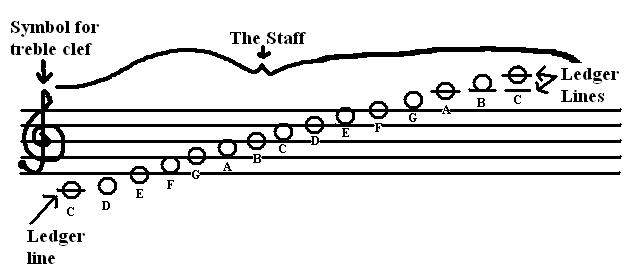
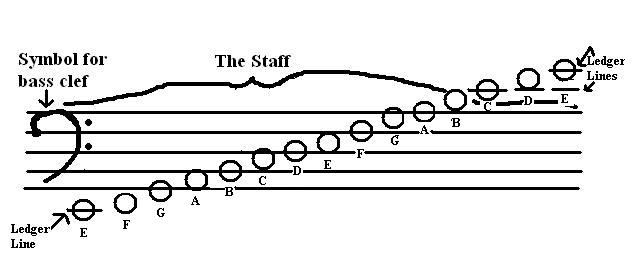
Music is made up of notes written on a staff. The staff is always made up of five horizontal lines - and, therefore, four spaces. A note can be written on a line or a space. The higher up a note is on the staff, the higher the note's pitch. Well, what if the note is too high or too low to fit on the staff? Ledger lines allow one to add a tiny part of the line, continuing the staff, just for that note. A composer can add as many ledger lines as s/he wants, but too many makes the music confusing. Therefore, sometimes the symbol "8va" is written ABOVE or BELOW some bracketed notes. These notes are to be played an octave (eight notes) HIGHER if the 8va is ABOVE the notes, and an octave (eight notes)LOWER if the 8va is BELOW the notes.
The first clef you'll need to learn is treble clef. Click here to see commonly used treble clef notes. (Of course, you can find more treble clef notes by adding more and more ledger lines!)
The next clef I know is bass clef. Bass clef is lower than treble clef. That means a note on one space or line in treble clef is much higher than a note on the same space or line in bass clef. Click here to see commonly used bass clef notes. (Of course, you can find more bass clef notes by adding more and more ledger lines!)
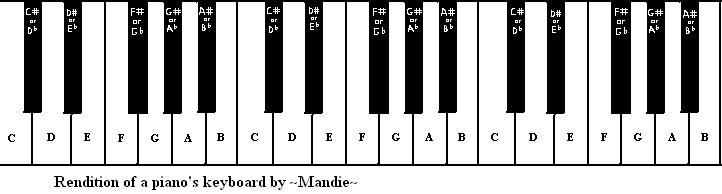
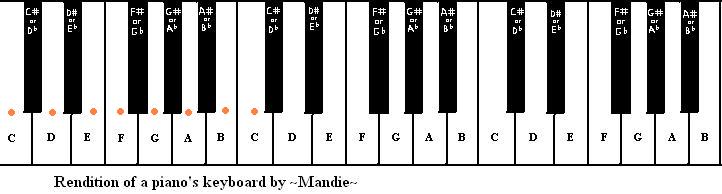
Although in other cultures, this might not be the case, Western music is based on HALF-STEPS and WHOLE-STEPS, each of which are designated frequencies apart. More about interval recognition will be stated later on, if half and whole steps are confusing to you. But for now, just click here to see part of a piano keyboard for an example. Each time the notes are right next to each other - like the ones labeled C and C# or E and F - the distance between notes is a HALF-STEP. When there is a note between two notes, they are a WHOLE-STEP apart. The color of the two keys does not affect their half-or-whole-step relationship.
Hopefully that explained half and whole steps a bit better...
There are seven pitches to Western music: C, D, E, F, G, A, and B. After B comes C again - the same basic pitch, only at a higher frequency.
Another way to refer to the musical pitches is with syllables rather than letters: "Do, Re, Mi, Fa, So, La, and Ti." (If it helps, think of the "Sound of Music" song to understand pitches!) In fixed do, the "do" is always C, "re" is always D, and so on. This is difficult. It means that if you have to sing a melody which starts on F, you cannot simply sing "do, re, mi..." you have to sing "fa, so, la...", since "fa" is always the syllable for F. In movable do,which is less professional than fixed do, do is the starting note of the key you are in. (Keys are explained here.) That means you could now sing the same melody as "do, re, mi..." since the syllable "do" now goes with the note "F." In a sense, you moved your base syllable so it was easier to sing. Does this make sense? I hope so.
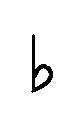
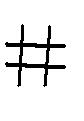
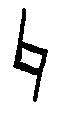
Notes marked FLAT in the music are one half-step lower than the actual note, and notes marked SHARP in the music are one half-step higher than the actual note. A FLAT sign looks like this. A SHARP sign looks like this. Therefore, raising "C" a half-step would make it a C#.
However, each note has two names. Sometimes, a C# may be called a D flat - if you are playing in a flat key. And why is that so? Well, if you think about it, it makes perfect sense. C and D are a whole-step off. If you raised the C up a half-step, wouldn't it be the same as lowering the D a half-step? (If you add a half to one, isn't the same as subtracting a half from two?)
One more thing: If you have a flat or sharp in the key signature (if you haven't read up on those, click the link above and do so soon!), it will remain, affecting every note in the piece. In D major, EVERY C is sharp, and EVERY F is sharp, unless noted otherwise. By placing a natural sign in front of a note that was flat or sharp in the key signature, a composer nullifies the flat or sharp for that note. But the natural sign only lasts for ONE MEASURE (until the vertical line shows up in the music). It's the same with sharps and flats. If a composer adds a sharp or flat that wasn't already in the key signature, that sign - or accidental - only affects the notes in THAT measure. If the composer wants an accidental in the next measure, well, s/he'll just have to add it again! Now, onto scales...
SCALES
There are many different types of scales which have been used throughout the ages. A scale is a collection of notes with designated steps - half or whole - between them. This means that no matter which note you start on, the scale will sound "the same" - only beginning on a higher or lower pitch. Some types of scales include Dorian, Phrygian, and Lydian, but these are not commonly used in Western music. Western music has two types of scales - MAJOR and MINOR. Major scales often sound "happy" or "positive," while Minor scales sound "sad" or "negative." Based on the "mood" of a piece, you can often tell whether it is written in a major or minor key.
Where "W" means whole-step and "H" means half-step, this is the pattern of steps in any major scale:
W W H W W W H
For you auditory learners, here is a C MAJOR scale.
Now, let's go back to our piano keyboard. We'll pretend we are playing a C MAJOR scale. C MAJOR has no sharps or flats. The keys we would play are marked with an orange dot. Click here to see the scale. Note that:
1. The second C is played as part of the ascending scale before the descending scale - starting on that same C - is played.
2. The scale could very well continue for another octave - that is, eight notes - until the next C. Scales can continue for as many octaves as you can play!
3. If you check, you'll see that the pattern of whole and half steps is followed.
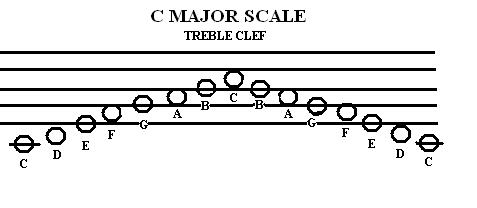
And by clicking here, you can see the notes of the scale on treble clef staff.
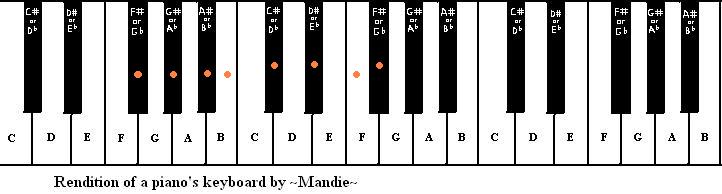
And here's an ENTIRELY DIFFERENT scale: F# major! If you know anything about key signatures, you should know the notes to play on the F# scale. But, if not, it's helpful to know about half-steps and whole-steps. Let's see which notes we would play on our piano keyboard to make an F# major scale.
MINOR SCALES have a different pattern of half-steps and whole-steps than major scales. There are three types of minor scales.
NATURAL MINOR scales simply follow the key signature of their RELATIVE MAJOR key. (Click here to learn about keys and how they are related.) A natural minor's scale half-and-whole-step pattern goes like this:
W H W W H W W
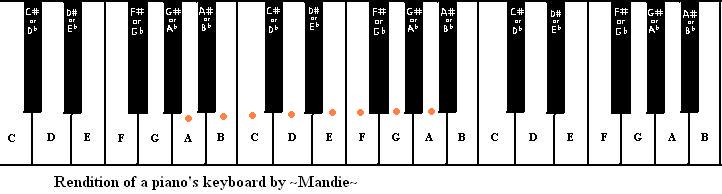
Here is an A NATURAL MINOR scale.
Here is what it (specifically A minor) looks like on our piano keyboard, and here is what it looks like on the treble clef staff.
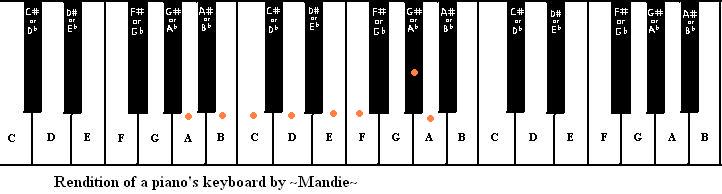
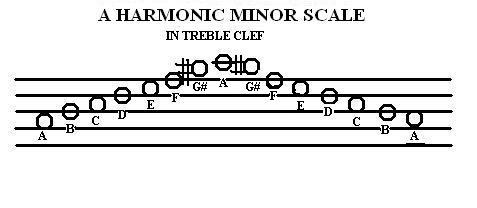
Next come HARMONIC MINOR scales. These are the same as natural minor scales, only the seventh tone is raised a half step! This gives you a very interesting-sounding scale.
Here's anA HARMONIC MINOR scale.
Here's what it (specifically A minor) looks like on the piano keyboard, and here is what it looks like on the treble clef staff.
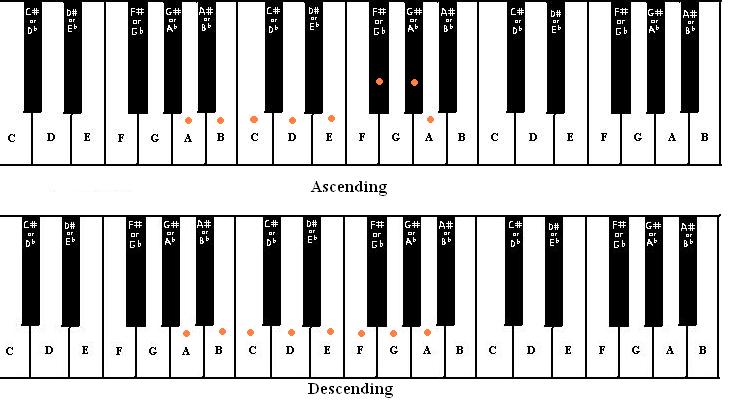
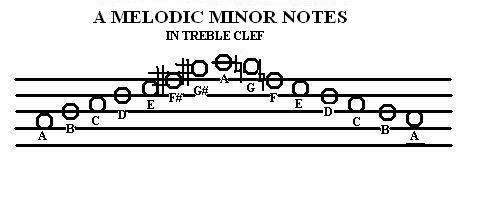
The final type of minor scale is MELODIC MINOR. Melodic minor scales are the type commonly used for violin. Unlike the other scales, the half-and-whole-step pattern for this type of scale changes depending on whether you are ascending or descending!
Ascending: W H W W W W H
Descending: W W H W W H W (just like a normal natural minor scale)
Here's an A MELODIC MINOR scale.
Here is what it (specifically A minor) looks like on the piano keyboard, and hereis what it looks like on the treble clef staff.
And there you have it! Now, you have everything you need to know about scales!
An interval is the distance from one note to the next. There is a lot to know about intervals, so I'll cover it as effectively as possible.
Intervals are the basis of any music. If you know the distance from one note to the next, you can play it in another key by changing the notes, but keeping the distance between the notes the same. Changing the music's key is called transposing.
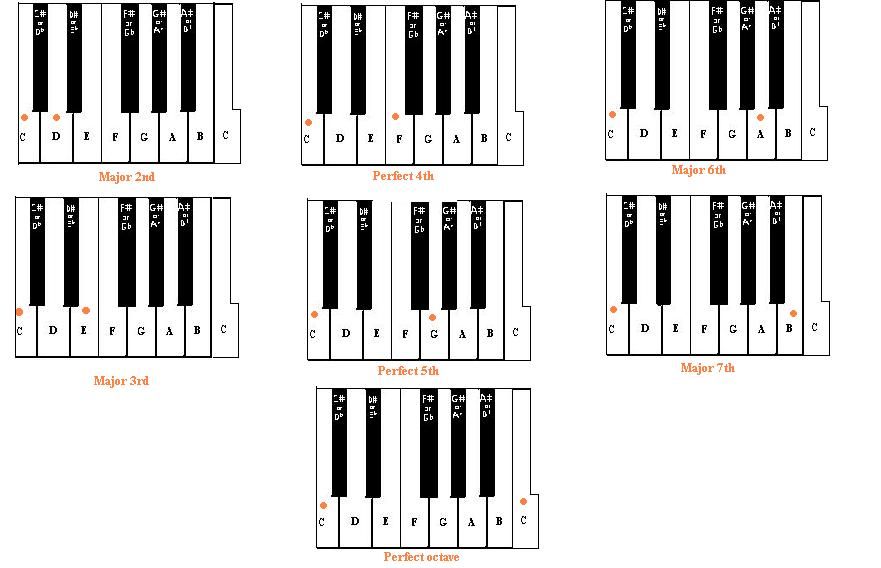
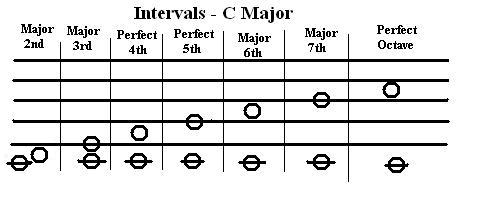
There are several intervals built on a scale. Each interval is named for the number of notes in it, including the first and last note. This means that a "4th" has two notes - the ones that are actually played - and two notes in between it.
The intervals are named the following: Major 2nd, Major 3rd, Perfect 4th, Perfect 5th, Major 6th, Major 7th, and Perfect Octave. An octave is eight notes.
Notice: the Major intervals are the 2nd, 3rd, 6th, and 7th, while the Perfect intervals are the 4th, 5th, and octave.
Click here to see a diagram of the intervals, using our piano keyboard. The notes with orange dots are the ones that are played to make up that interval. This is what the intervals in C Major actually look like on a treble clef staff. Remember that intervals must follow the key signature of that key. A Major 3rd in D Major must have an F#, or it is an entirely different interval.
Do you think you're done? Well, not quite. Intervals can be altered.
Major intervals can either be augmented or minor. Augmenting an interval means raising the top note of the interval one half-step. Making an interval minor means lowering the top note of the interval one half-step.
Perfect intervals can be altered, too. Raised perfect intervals are augmented, just like with major intervals, but lowered perfect intervals are called diminished.
Here is a table of intervals. If anything is incorrect, let me know!
INTERVAL
TYPE
RAISED
LOWERED
2nd
Major
More commonly called a minor 3rd
Minor second (half-step)
3rd
Major
More commonly called a Perfect 4th :)
Minor 3rd
4th
Perfect
Augmented 4th (or Diminished 5th)
More commonly called a Major 3rd :)
5th
Perfect
Augmented 5th (or minor 6th)
Diminished 5th (or Augmented 4th)
6th
Major
Augmented 6th (or minor 7th)
Minor 6th (or Augmented 5th)
7th
Major
More commomly called a Perfect Octave :)
Minor 7th (or Augmented 6th) Octave
Perfect
More commonly called...?!
More commonly called a Major 7th :)
Ahhh, chords.
Chords are often in the bass line of many pieces, and really, they are the "stuff" of music. Almost all music is built on chords, with melodies added above them. Therefore, chords are very important! And, as someone once told me, making chords is really just "stacking thirds." A basic term before we move on: arpeggio. An arpeggio occurrs when the notes of a chord are played one at a time. Each MIDI file here is an arpeggio followed by the chord. The root note is repeated an octave higher to finish off the chord.
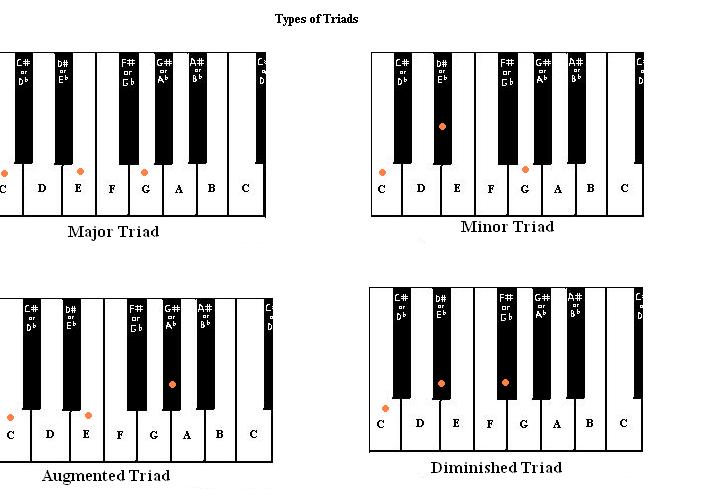
A triad is a chord with three notes in it. The most basic triads are major and minor triads. A major chord is made up of the root note, the middle note - which is the one which would form a major third with the root note, and the top note, the Perfect Fifth. In other words, a major chord is a major third below a minor third. A minor chord is made up of the root note, the middle note - which is the one which would form a minor third with the root note, and the top note, the Perfect Fifth. In other words, a minor chord is a minor third below a major third. The next type of triad is an augmented triad. This is the root note, the major third, and an augmented fifth! This means that two major thirds are stacked on top of each other. The last type of triad is the diminished triad.This has the root note, the minor third, and a diminished fifth! This means that two minor thirds are stacked on top of each other to form the chord.
Note that you can keep adding notes to the triads, just as the MIDI files do. They add the root note to the top of their triads. So long as the note is one of the three used in the triads, it will sound good when added to the chord!
Here are diagrams of the triads, for you visial learners. All triads are shown in C Major.
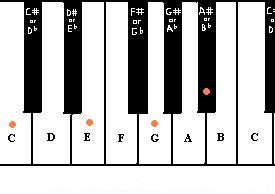
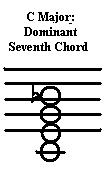
There is just one more basic chord I'm going to explain: the "dominant seventh" chord. This chord is named for its structure: A major chord with a minor third on top of it. This means the chord has a root note, a major third, the Perfect fifth, and then the minor seventh. So, its "thirds" structure is: Major third, minor third, minor third. By clicking here, you can see the dominant seventh chord displayed (in C Major) on a piano's keyboard. By clicking here, you can see the dominant seventh chord displayed in treble clef, in C Major, on the staff.
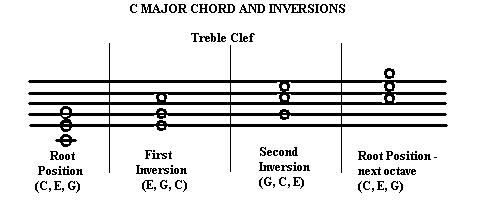
Finally: the root note of each chord is the bottom note. But you can move around that bottom note - to the middle or top of the chord! By moving the top note, but keeping the other pitches constant, you can make a chord inversion. For auditory learners, here is a C Major chord, (root position), here is its first inversion, and here for the second inversion. Then, you are back to your original chord, one octave higher. Click here to see the inversions of a C Major chord, in treble clef, on the staff. Any chord we've talked about can be inverted - twice!
AND THERE YOU HAVE IT!
Well, that's the end of this page on some basic musical note theory. If you would like to enjoy ear training on scales, intervals, and chords, be sure to click here. It's a great site...I got all of my MIDIs from it!
Keep in mind that there's much more to know - especially about scales and chords! More theory will be added to my site later! But, this is basic musical information on notes. I hope you gained something from reading this. Thank you!
Click here to go back to the main music information page...
Or click here to go back to the main page!