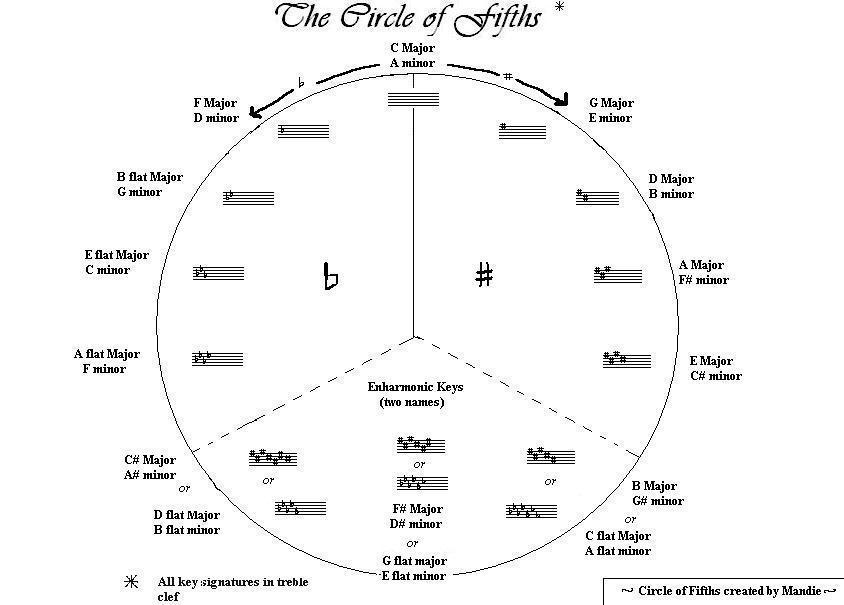
The Circle of Fifths is the arrangement of each of the musical keys (yes, there is an order)!
How is the Circle arranged?
The Circle of Fifths includes all thirty keys. There are seven Major sharp keys, seven Major flat keys, and one Major key with no sharps or flats. Similarly, there are seven minor sharp keys, seven minor flat keys, and one minor key with no sharps or flats. (7 + 7 + 1 + 7 + 7 + 1 = 30). Starting with the sharpless-and-flatless key (C major/A minor), the sharps are arranged around the Circle clockwise, while the flats run counterclockwise. Enharmonic keys - or keys with two key signatures, a sharp signature and a flat signature - meet at the bottom. Note that enharmonic keys ARE THE SAME KEY; they can just be written out in two different ways.
Why is it called the Circle of Fifths? Each successive key is the interval of one Perfect Fifth (or seven half-steps up) from the next key in the circle, going clockwise. Going counterclockwise, each successive key is one Perfect Fifth down (or seven half-steps down) from the next key in the circle. This simple knowledge makes memorization easy!
Why memorize the Circle of Fifths? By memorizing the Circle of Fifths, you can easily know the key signature for ANY KEY. You can also play them in the proper order while practicing. But you must know the order of sharps and flats. If you do not, see the text below.
How else could I memorize the key signatures for major keys?
How else could I memorize the key signature for minor keys?
To find the key signature for any minor key, you must first know its relative major. If you do not, you must figure that out first. Once you have done so, count down three half steps from the key note to find that key's relative minor. If you know the minor key's name, count up three half steps to find the major key, and then find its key signature.
This all seems complicated, but it gets easier. Be sure to practice! Soon, a quiz will be up to help you practice key signature recognition.
Below is the Circle of Fifths.