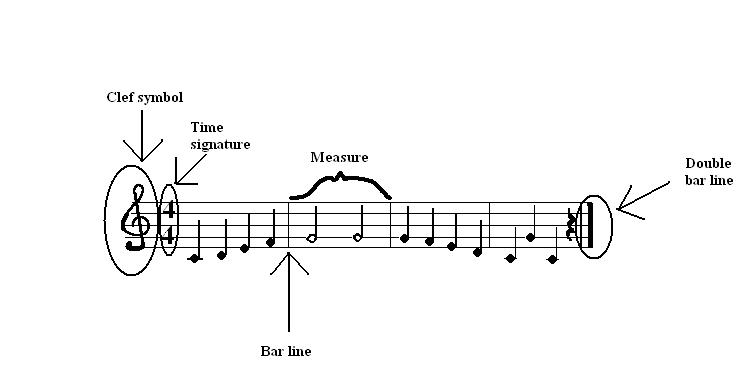
Naturally, written music can't just consist of a bunch of notes cluttered together on a sheet of music. Notes are organized into groups called measures or bars. The number and types of notes which can fit into a measure depend on the time signature, which is shown at the beginning of the measure just after the clef symbol and key signature (clefs and key signatures are explained on this page) as a "fraction." Time signatures will be covered later. At any rate, measures are separated by vertical lines running down the page. These lines are called bar lines. The end of a piece has two, thicker bars: the double bar line. Double bar lines indicate the end of a piece. If a double bar line is anywhere in the music with two dots in front of it, it is a repeat sign. Any area between two repeat signs (or, if there is only one, between the beginning of the piece and the repeat sign) needs to be played twice.
Click here for a diagram of some music. The key signature is not labeled since the key is C Major, and there are no sharps or flats.
That's about all there is to know about the structure of written music!
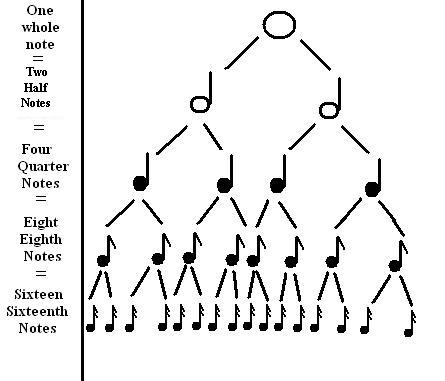
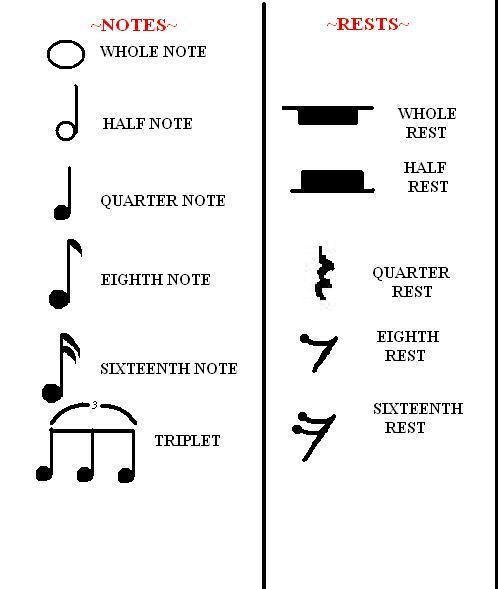
It's all well and good to know which notes to play. But how are you able to tell each note's duration? By memorization? Not likely! Based on what each note looks like, a musician can tell how long to hold that note. Notes are, basically, named after fractions: Whole notes, half notes, quarter notes, eighth notes, and sixteenth notes are the basic ones. (There are other types of notes: thirty-second notes, sixty-fourth notes, one hundred twenty-eighth notes, double whole notes...but those are rarely used.) Each "level" of notes are half as long as the level above it. For example, TWO half notes make a whole note, TWO quarter notes make a half note, TWO eighth notes make a quarter note, and so on. As you can see, this makes perfect mathematical sense. Click here for a chart of the different types of notes. There, you can see what each type of note actually looks like!
So, what is a time signature?
A time signature shows how many of which type of note fit into each measure. It is expressed as the "number of beats" in each measure and which notes "gets the beat." For example, in 4/4 - sometimes known as COMMON TIME, expressed by a C instead of a "4/4" - there are FOUR beats(or counts, which are explained later) to each measure, and the quarter note gets the beat. In 2/4 time, there are two beats to a measure, and the quarter note gets the beat. In 6/8 time, there are six beats to a measure...and the eighth note gets the beat. Does this make sense? The numerator of the fraction is the number of the bottom type of note that can fit into the measure.
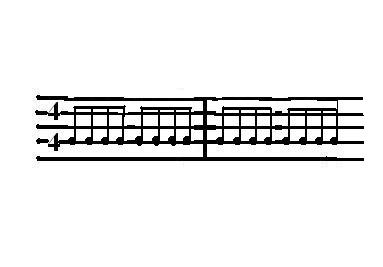
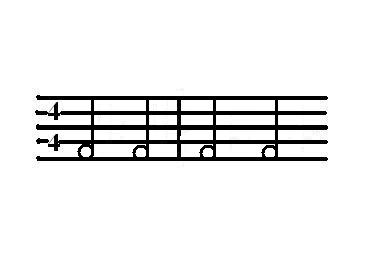
So, for all easy explanatory purposes, let's pretend you're in 4/4 time. So...there's FOUR QUARTER NOTES that could fit into each measure...right? But...isn't an eighth note half as long as a quarter note? ...so TWICE as many of them could fit into the measure - EIGHT EIGHTH NOTES! ...If you're very mathematical, realize that 4/4 is just a different way of saying 8/8! (Note: in the picture, the "flags" of the eighth notes are connected into groups of four. Eighth notes - or sixteenth notes - or anything with "flags" - are almost always connected if there is more than one of them next to each other!) ...So how many HALF NOTES could fit in each measure? That's right - TWO HALF NOTES - because each half note twice as long as a quarter note, taking up twice the amount of time!
As you can see, the notes in each measure simply have to add up to the same length of time. The length of time is simply the time signature. Four quarter notes does indeed equal two half notes or eight eighth notes; 4/4 does indeed equal 2/2 or 8/8. All of these are equal, forming one measure in 4/4 time! That's all there is to it!
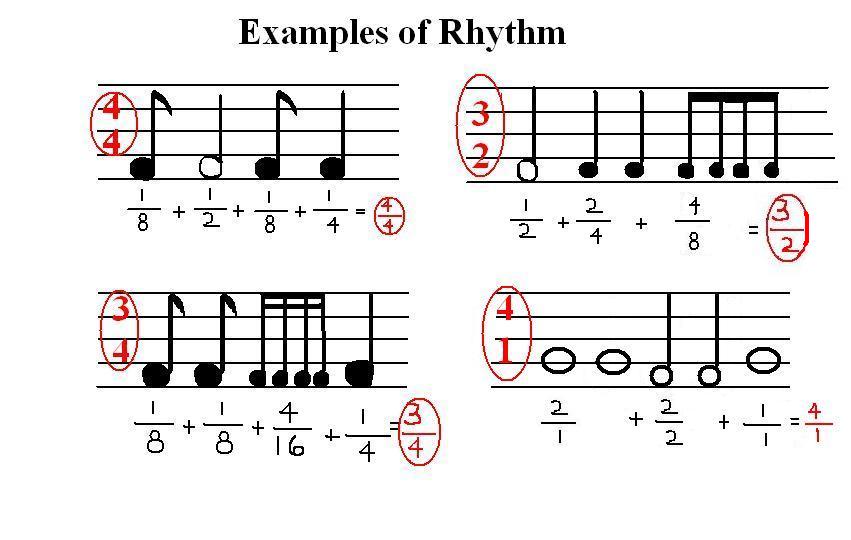
...Well...not really! Usually, in a musical song, each note won't be the same length! Different combinations of notes can be placed in the measure, so long as they agree with the time signature! Here are some examples. Notice that in each picture, the length of time per measure adds up to the time signature!
Unfortunately, most of us aren't supercomputers. We can't simply look at notes at calculate their exact length! That's why we have to COUNT!
Before you learn some standard methods of counting in music, take a look at the durations of several different-looking notes and rests.
A REST is a period of time in which you do not play any notes. The duration of the rests are the same proportionately as the durations of the notes. Also, notice the TRIPLET figure. Triplets are slightly faster than eighth notes, since ONE TRIPLET (three notes) make up a quarter-note's beat.
Also, note that by putting a DOT directly BEHIND A NOTE, you increase that note's value to 1.5 times itself! This means that a half note now has THREE BEATS (2 x 1.5), a quarter note now has 1.5 beats (1 x 1.5)...etc.! Dots can be added to any type of note! You pronounce that note as a "dotted (type of note)."
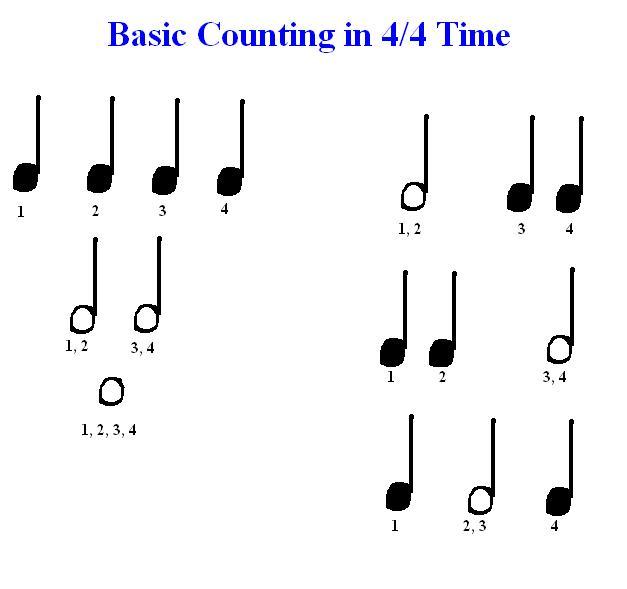
The easiest way to learn how to count is to start in our common time: 4/4. Begin counting by starting at 1 and counting up to 4 in each measure. For now, let's assume there are only quarter notes and longer notes in the measure. Each quarter note gets just one beat. Each half note gets two. Each whole note gets four whole beats! Click here to see how some basic 4/4 rhythms are counted!
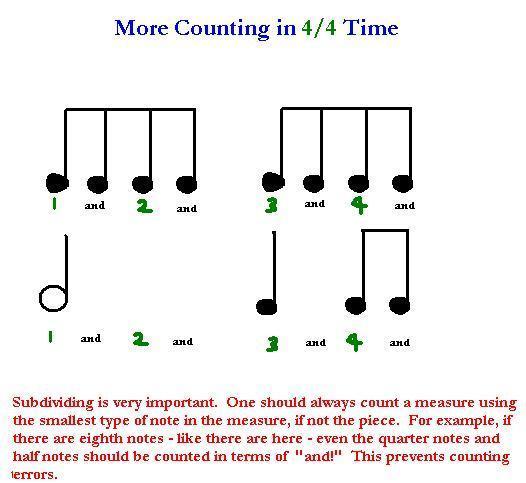
However, when the notes have a duration of less than a quarter note, there are different ways of counting: by SUBDIVIDING! Eighth notes are counted by adding "ands" to the quarter notes! Click here to see what I mean!
Similarly, if we subdivide even further, we obtain sixteenth notes! Sixteenth notes are counted like this: "one-ee-and-uh, two-ee-and-uh..." It's sounds silly, but it's true! Click hereMost note patterns will be a little bit more difficult to count. It's advisable to begin counting very simple rhythms, such as 4/4 rhythms that have all quarter notes or just half notes and quarter notes at first. Then, add on whole notes, eighth notes, and sixteenth notes. Pretty soon, it'll get easier! Click here, anyway, to see examples of more advanced counting with different types of notes in common time.
There you have it! That's how you count in 4/4 time. To count in other times, just make sure that the NUMBER OF BEATS per measure adds up to the numerator of the fraction (based on the note value in the denominator)!
That's all of the information I have on rhythm. Keep in mind that this is just to give you a basic understanding of rhythm. More complex information will be added to advanced pages later on! Well, I hope you enjoyed this, and I'm sorry if it was unclear! Thank you for reading!
Click here to go back to the musical information page...
Or here to go back to the main page!