
5891-80
District 80, Division B, Area B5

|
|
West Coast Toastmasters Club 5891-80 District 80, Division B, Area B5 |
|
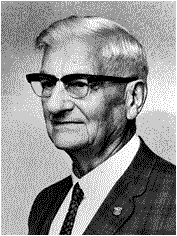
Since Toastmasters began, more than three million men and women
have benefited from the
organization’s communication and leadership
programs.
In October 1924, a group of men assembled by Dr. Ralph C. Smedley met in the
basement of
the YMCA in Santa Ana, California, U.S.A., forming a club “to
afford practice and training in the art of public speaking and in presiding
over meetings, and to promote sociability and good fellowship among its
members.” The group took the name “Toastmasters.” Soon men in other
communities and states asked for permission and help to start their own
Toastmasters clubs. By 1930, a federation was necessary to coordinate
activities of the many clubs and to provide a standard program. When a
speaking club in New Westminster, British Columbia, Canada, expressed
interest in forming a Toastmasters club, the group became known as
Toastmasters International.
For many years the “Home Office” of Toastmasters International was based in a series of rented office spaces. In 1962, the Toastmasters International staff moved to its first World Headquarters building in Santa Ana, California, not far from where the first club began. By the late 1980s, however, this building could no longer adequately house the increased staff needed to provide services to the growing number of Toastmasters. In 1990 World Headquarters relocated to a new building in Rancho Santa Margarita, approximately 20 miles south of Santa Ana, designed to accommodate Toastmasters International’s expected growth well into the 21st century.
Toastmasters International’s success and growth is due
in large part to the continued development of its educational programs. The
organization has come a long way since the first speech manual, Basic
Training, was developed more than 50 years ago. The current manual, now
called the Communication and Leadership Program, was most recently updated
in 2003. After members of Toastmasters complete all 10 speech projects in
that manual, they may apply for their Competent Toastmaster (CTM) award and
then choose from any combination of 15 advanced manuals.
Additional educational materials include the Success/Leadership and
Success/Communication Series, The Better Speaker Series, and the High
Performance Leadership Program. Toastmasters International’s education
system includes both a communication track and a leadership track. The
communication track award progression features the CTM, Advanced Toastmaster
Bronze (ATM-B), Advanced Toastmaster Silver (ATM-S), and Advanced
Toastmaster Gold (ATM-G); the leadership track award progression includes
Competent L eader (CL) and Advanced Leader (AL). The Distinguished
Toastmaster (DTM) remains the highest award.
In addition to the various educational materials available through the
Toastmasters International Supply Catalog, members receive the monthly
publication, The Toastmaster magazine. Club and district officers receive a
bimonthly publication, TIPS, and district officers receive District
Newsletter each month. Toastmasters International enters the new century as
the undisputed world leader in public speaking training, with over 9,300
clubs and more than 195,000 members in approximately 80 countries. In the
years to come, more people than ever will benefit from Toastmasters
leadership and education.
The names "Toastmasters International", "Toastmasters" and the Toastmasters
International emblem
are trademarks protected in the United States, Canada and
other countries where Toastmasters Clubs exist.
Unauthorized use is strictly
prohibited.