Isis 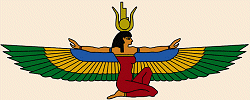
Isis, though worshipped
all over Egypt, was specially venerated in certain cities, and the following
are among the most common of her titles: --"The great lady, the
God-mother, lady of Re-a-nefer; Isis-Nebuut, lady of Sekhet; lady of Besitet; Isis in Per Pakht, the queen of Mesen; Isis of Ta-at-nehepet; Isis, dweller in Netru; Isis, lady of Hebet; Isis in P-she-Hert; Isis, lady of Khebt; Usert-Isis, giver of life, lady
of Abaton, lady of Philae,
lady of the countries of the south," etc. From a list of titles of the
goddess, it is clear that Isis was called Usert, in Thebes, Aat, in Heliopolis, Menkhet, in Memphis,
God-Mother, in Coptos, Hert,
in Letopolis; and "Hent,"
i.e., "Queen," in every nome; and another
important list tells us that Isis was called Ament, in Thebes, Menhet, in Heliopolis, renpet, In Memphis,
Sept, in Abydos, Hetet, in Behutet, Hurt, in Nekhen, Thenenet, in Hermonthis, Ant, in Dendera, Sesheta, in Hermopolis, Heqet, in Hibiu, Uatchit, in Hipponus, Mersekhen, in Herakleopolis, Renpet, in Crocodilopolis, Neb-tept, in Arsinoe, That, or Tchetut, in Aphroditopolis, and Shetat, in Bubastis. Among her general titles may be mentioned those
of "the divine one, the only one, the greatest of the gods and goddesses,
the queen of all gods, the female Ra, the female Horus, the eye of Ra, the crown of Ra-Heru, Sept, opener of the
year, lady of the New Year, maker of the sunrise, lady of heaven, the
light-giver of heaven, lady of the North Wind, queen of the earth, most mighty
one, queen of the South and North, lady of the solid earth, lady of warmth and
fire, benefactress of the Tuat, she who is greatly
feared in the Tuat, the God-mother, the God-mother of
Heru-ka-nekht, the mother of the Horus of gold, the lady of
life, lady of green crops, the green goddess (Uatchet),
lady of bread, lady of beer, lady of abundance, lady of joy and gladness, lady
of love, the maker of kings, lady of the Great House, lady of the House of
fire, the beautiful goddess, the lady of words of power, lady of the shuttle,
daughter of Seb, daughter of Neb-er-tcher,
the child of Nut, wife of Ra, wife of the lord of the abyss, wife of the
lord of the Inundation, the creatrix of the Nile
flood."
From a number of
passages in the texts of various periods we learn that
In the Theban Recension of the Book of the Dead is found a Chapter
(No. clvi.) which was composed for the purpose of
bestowing upon the deceased some of the magical power of the goddess. The
Chapter was intended to be recited over an amulet called tyet, made of carnelian, which had to be
steeped in water of ankhami flowers, and set in a
sycamore plinth, and if this were laid on the neck of a dead person it would
place him under the protection of the words of power of Isis, and he would be able to go wheresoever
he pleased in the Underworld. The words of the Chapter were: -- "Let the
blood of Isis, and the magical powers (or spirits)
of Isis, and the words of power of
The symbol of Isis in the heavens was
the star Sept (Sirius), which was greatly beloved because its appearance marked
not only the beginning of a new year, but also announced the advance of the
Inundation of the Nile, which betokened renewed wealth and prosperity of the
country. As such
Amulet
A symbol worn
as a talisman against evil or injury, often wrapped with mummies to protect
them on their journey through the Duat.
Duat
The world of afterlife where the
ancient Egyptians believed that the dead roamed.
|
|


Click here to return to the AVE MARIA! – Egyptian Book of the Dead
Osiris | Thoth
| Atum-Ra
| Netjer
| Ptah |
Kali
| Sekhmet
| ISIS
| Hathor
| Ma’at
|Nut|
Virgin
Mary | Kali-Joya