Hathor
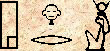
Lady of Heaven.
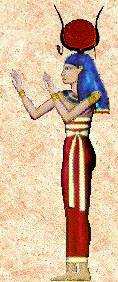
- Attributes: .Because her worship stretches
back to pre-dynastic times, we find Hathor
identified
with many local goddesses, and it can be said that all the goddesses were
forms of Hathor. At times we find her
playing the role of a sky-goddess, a sun-goddess, a moon-goddess, a goddess of
the east, a goddess of the west, a goddess of moisture, a goddess of
fertility, an agricultural goddess, and a goddess of the underworld.
 . . . . .Hathor was the goddess of
joy, motherhood, and love. She was considered the protectress
of pregnant women and a midwife. She was the patron of all women, no matter
their station in life. As the goddess of music and dancing her symbol was the sistrum. As a fertility
goddess and a goddess of moisture, Hathor was associated with
the inundation of the
. . . . .Hathor was the goddess of
joy, motherhood, and love. She was considered the protectress
of pregnant women and a midwife. She was the patron of all women, no matter
their station in life. As the goddess of music and dancing her symbol was the sistrum. As a fertility
goddess and a goddess of moisture, Hathor was associated with
the inundation of the
.
. . . .In later times, when
the Osiris cults gained
popularity, her role changed. She now welcomed the arrival of the deceased to
the underworld, dispensing water to the souls of the dead from the branches of
a sycamore and offering them food. Hathor was also represented
as a cow suckling the soul of the dead, thus giving them sustenance during
their mummification, their journey to the judgment hall, and the weighing of their soul. In
the Late Period, dead women identified themselves with Hathor, as men identified with Osiris. . . . . .
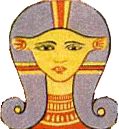
 Representation: Hathor was originally worshipped in the form of a
cow, sometimes as a cow with stars on her. Later she is represented as a woman with the
head of a cow,
and finally with a human head, the face broad and placid, sometimes she is
depicted with the ears or horns of a cow. She is also shown with a
head-dress resembling a pair of horns with the moon-disk between them.
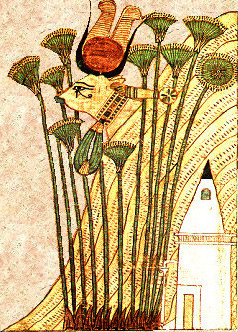
Sometimes she is met with in the form of a cow standing in a boat,
surrounded by tall papyrus reeds. As the "Mistress of the
Necropolis" she is shown as the head of a cow protruding from a
mountainside. In this case she wears a menat necklace, which is a symbol
of rebirth.
Representation: Hathor was originally worshipped in the form of a
cow, sometimes as a cow with stars on her. Later she is represented as a woman with the
head of a cow,
and finally with a human head, the face broad and placid, sometimes she is
depicted with the ears or horns of a cow. She is also shown with a
head-dress resembling a pair of horns with the moon-disk between them.
Sometimes she is met with in the form of a cow standing in a boat,
surrounded by tall papyrus reeds. As the "Mistress of the
Necropolis" she is shown as the head of a cow protruding from a
mountainside. In this case she wears a menat necklace, which is a symbol
of rebirth.
Click here to return to AVE
MARIA!
Hathor
Other Names: Het-Hert,
Hetheru
Patron of: the sky, the sun, the queen,
music, dance and the arts.
Appearance: A cow bearing the sun disk
between her horns, or a woman in queenly raiment wearing the sun disk and horns
on her head. Depictions of her as a woman with a cow's head do not occur until
later periods.
Description: Hathor is a very ancient goddess, dating
to predynastic times. When dynastic rule began, as Horus was associated with the king, Hathor was with the queen. Her name
translates to "The House of Horus," and so she is associated with the royal
family. But also, as the entire world could be said to be the House of Horus, Hathor can be seen as the mother-goddess
of the whole world, similar to Isis.
Hathor's cult
is unusual, as both men and women were her priests
(most deities had clerics of the same gender as they). Many of them were
artisans, musicians, and dancers who turned their talents into creating rituals
that were nothing short of works of art. Music and dance were part of the
worship of Hathor like no other deity in
Inspiration was also Hathor's bailiwick,
and many would come to the temples of Hathor to have their dreams explained or to beseech her for her
aid in creation, much in the same way the Greeks
invoked the Nine Muses.
Worship: Worshipped throughout all of
|
|

Click
here to return to the AVE
MARIA! – Egyptian
Book of the Dead
Osiris | Thoth
| Atum-Ra
| Netjer
| Ptah |
Kali
| Sekhmet
| ISIS
| Hathor
| Ma’at
|Nut|
Virgin
Mary | Kali-Joya