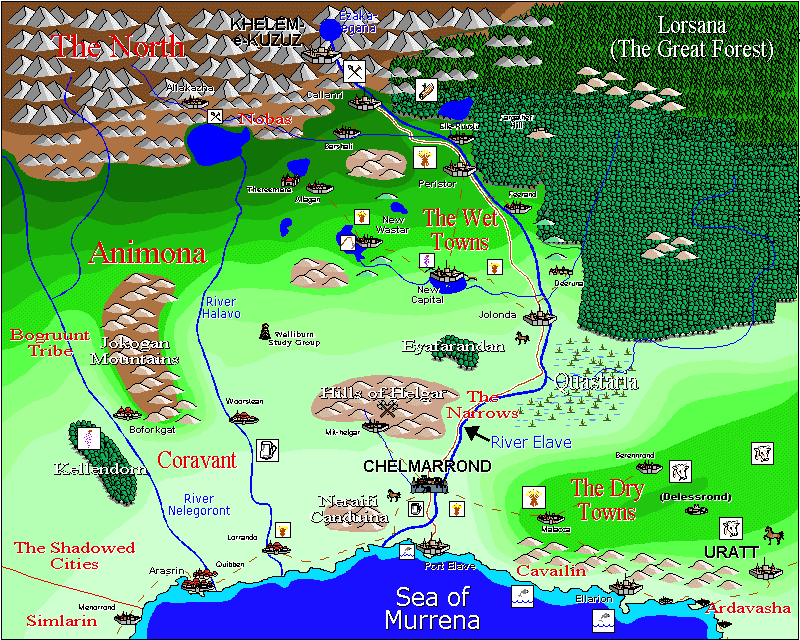
Sacawisha is the main setting for the campaign. The
name means “the land between,” and refers to the region's
position as an isthmus of sorts, surrounded by a sea to the south, and
nearly impassible mountains to the north. Two huge sub-continents come
together here, from east and west. Sacawisha is about 300 miles north to
south, and about 400 miles east to west.
The humans who inhabit the area call themselves Thearaddans. They are
the descendants of nomad invaders who came from the open plains to the west,
about 1900 years ago. They had a large, well-organized empire, which covered
most of Sacawisha, as well as the neighboring region to the southwest (now
called Simlarin). However, Thearaddan civilization (like most others) was
badly damaged by the Song of Woe. Now, the
Thearaddans of Sacawisha are divided into a large number of city-states and
small principalities, some of which are doing quite well (especially
Chelmarrond). Others are not doing very well at all. Many are hard-pressed
by monsters, demi-humans, and savage humans. Others are riddled with Song
Zones and Mindlost.
For some historical background, click here.
For information on the pervasive religion of the Thearaddans, click here.
To read about the effects of the Song of Woe on the practice of magic, click here.
Click here to download the CC2 map of Sacawisha.
The major regions of Sacawisha are described below.
Chelmarrond is the largest human city in Sacawisha. It is on the River
Elave, thirty miles from the coast, and is in an excellent position astride
all the major trade routes. A sea port, called Port Elave, is near the mouth
of the river, though it is in decline, as more and more trade goes straight
up the Elave to the new docks at Chelmarrond. The Prince of Chelmarrond
commands the allegiance of both these cities, as well as approximately five
thousand square miles of the surrounding area. The principality is far and
away the richest, most cultured, and most advanced land of Sacawisha. The
countryside is well populated, with many small, unwalled villages. Most of
the land is under cultivation.
Even though Chelmarrond could easily overwhelm its small neighbors to east
and west, Prince Ellart, Second of his Name, is content to simply grow
richer. The lands to the west are chaotic, and contain as many monsters as
people; they would not be worth the effort of conquering and controlling.
While Chelmarrond has (and does) meddled in the Dry Towns
to the east, any bold move will bring conflict with the Furce N'maida—which is decidedly not Ellart
II's cup of tea. He maintains correct relations with the Furce
N'maida, warm relations with the empire of Simlarin, and takes the gold of both.
The realm of Chelmarrond is also notable for its large demi-human
population. There are large colonies of halflings, especially in Chelmarrond
city; and many half-elves as well.
Chelmarrond is a very orderly realm, and no foolishness is tolerated.
The hills of Helgar, to the northwest of Chelmarrond,
contain the only dwarven population within Sacawisha. These people are
isolated and inward looking. Very few of them venture from their caves,
delved into the ancient hills. Other humans or demi-humans that venture into
the area can expect to be escorted out at spear point—assuming the
dwarves are in a good mood. Various unpleasant monsters also inhabit the
region.
The only outlet for the limited dwarven trade is the town of Mit-helgar
(“Helgarburg”). This town is primarily human, and, for a trading
town, is remarkably provincial. It may be classed as a “free
city”, ruled by a lord who is beholden to no one. Mit-helgar is a good
base for the adventurers that dare the hazards of the Helgars, seeking the
many ancient treasures said to exist, the legacy of older, more advanced
dwarven cultures.
Quastaria is the name given to the swampy region just to the northeast of Chelmarrond. The area is avoided at all costs by most, as
it has a very nasty reputation. In days of old, the religious city of Wastar
stood here. 1100 years ago, the gods destroyed the
city when the priests who controlled the city (as well as the faith of the
entire region) became overly proud. The swamp swarms with undead, the result
of the divine destruction. They fight it out with bullywugs, lizard men, and
human bandits for control of Quastaria, but nobody ever wins.
“The Narrows” is the name given to the stretch of the Elave just
north of the realm of Chelmarrond. It is a wild,
uncontrolled area, hemmed in by the Helgars to the
west, and the swamps of Quastaria to the east. Monsters
roam the area nearly unchecked. Undead penetrate from Quastaria.
The Narrows are important, though. This is the only way the many and varied
exotic goods of the Wet Towns can reach the rest of the
world. The economy of Chelmarrond depends to a great extent on trade with
the Wet Towns. To allow this trade to proceed, there is a road through the
Narrows, closely paralleling the river. The Elave is fine for downstream
traffic, but the current is fairly fast, and moving a boat upstream is
difficult (also, when a caravan is on the road, it has the added protection
of the river between itself and Quastaria). Hence, the road; and to protect
the road (and those who travel along it), a chain of massively fortified
colonies, roughly every 15 miles. Most of these cities are filled with
retired soldiers and the like, more military camp than community. A few
settlers, though, are attempting to carve a life out of the savage
wilderness of the Narrows.
The small, elven-controlled forest of Eyafarandan is the only island
of tranquillity in the region—and Eyafarandan does not welcome
visitors. It is said that Eyafarandan predates everything currently in
Sacawisha; its history is believed to date back several thousand years.
Eyafarandan is “a mystery wrapped in an enigma wrapped in a
riddle”. Ancient, incredibly powerful magics are thought to be
practiced here, but nobody really knows; anyone who has visited Eyafarandan
since the Song of Woe has returned—if they have returned—with
their memory altered or completely removed.
To the north of the Narrows lies the upper Elave. The
river extends about one hundred and fifty miles between the mountains of The North and the swamps of Quastaria.
Along this stretch lies another center of Thearaddan society: the so-called
“Wet Towns”.
The Wet Towns lie at the end of a long road: By boat from the rest of the
world to Chelmarrond, then along the difficult Road of
Chelond I through the Narrows. For many, though, the
trip is worth it. The Wet Towns are in a position to trade with the dwarves
of the mountains to the north, the wild elves in the forests to the east,
and the wide, strange plains far to the west. Then there is the region of Animona, just to the west, where old ruins lie about,
still unplundered. The most exotic goods in the world—spell
components, strange herbs and healing plants, the finest dwarven and elven
crafts, and strange relics of the old, pre-Song world, just to name a
few—all pass through the Wet Towns on their way to everywhere. Because
of this, the Wet Towns are a byword for strangeness and remoteness
throughout the world.
To the people of the Wet Towns, of course, their home isn't strange or
remote at all—it is just home. The people of the region are mostly
human, with a few half-elves (ten percent of the total), even fewer
halflings, and a tiny number of dwarves from the north who don't
call the Wet Towns home—they're just there to trade.
The Wet Towns are divided into a number of small realms—none of which
can hold a candle to Chelmarrond. The region is characterized by small
cities surrounded by vast acreages of forest. These cities intrigue amongst
each other for power, influence, and the ear of Chelmarrond.
For an overview of the Wet Towns, click here.
The northwestern part of Sacawisha is called Animona: the “realm of
chaos.” It is aptly named.
Before the Song, Animona, with its rivers, fertile grasslands, and bountiful
forests, was the heart of Thearaddan civilization. The lost city of Relarion was the capital of a large empire,
spanning western Sacawisha and northern Simlarin. Apparently, though,
Animona also contained a large population of the People of Woe. At the time
of the Song, Animona was the most heavily affected region. A few human and
demi-human survivors reached the Elave, or the coast to the south, bearing
tales of horror, but the vast majority of the population perished.
The land is now a vast wilderness, no doubt still fertile, but not for the
faint of heart. Monsters rule the region, having migrated in over the
decades since the Song. Song Zones pepper the area liberally. There are
several large Song Zones that support “inner zones,”
reality-altered regions where men and monsters alike lose their grip on
sanity and become Mindlost.
What attracts adventurous types to Animona are the riches hidden
there—the ruins of famous cities, where gold sometimes lies about in
old buildings, waiting to be claimed; the ancient magics said to be recorded
in the books and scrolls to be found; artifacts of unknown origin and power.
Such adventurers are a mainstay of the economy of the Wet
Towns, and many of the petty principalities of Coravant to the south. Of course, the life expectancy
of the adventurers is rather low.
To the east of Chelmarrond and the Elave lies a large
plateau. After a short climb, the land becomes flatter, water becomes more
rare, and the influence of the endless plains lying further east becomes
stronger. The people are still recognizable as Thearaddans, and they still
call themselves 'Tweeners. Differences are evident, though. The nature
of Interceders changes somewhat. Eastern architecture shows its influence.
Customs are slightly altered. New words have been adapted into Thearaddan.
This is the land of the Dry Towns.
The Dry Towns are organized similarly to the Wet Towns—a large number
of independent principalities, usually centered on a town of some size.
However, for the Dry Towns, the pressure from outside isn't from the
wilds: it comes from two large, organized states, the Empire of the Furce N'maida and the Principality of Chelmarrond.
These two states contend for power and influence in the Dry Towns. While the
Furce N'maida have a much larger and more powerful empire, their state
is loosely organized and perhaps overstreched. Furthermore, Chelmarrond is
composed of Thearaddans, like the Dry Towners—this makes for a natural
affinity. Therefore, the two states are equally matched in the struggle for
influence in the Dry Towns.
All this makes Dry Town politics much more intricate than that of the Wet
Towns. Movement is slow and subtle—until it becomes violent and
overwhelming. Dry Town political history is the story of nothing obvious
happening for years; then, a major conflict breaks out, an entire ruling
family is assassinated, a town vanishes in magical flame, or some equally
astonishing event takes place. Despite the outside threat, Dry Towners are
never shy about playing politics with their neighboring cities.
As to the land itself, it is fairly fertile rolling low hills and flatlands.
It somewhat lacks of water, however, so herding is a major source of food.
Trees are scarcer than in the wetter lands to the west and north, and in the
eastern Dry Towns, a sign of wealth or holiness. The farther to the east one
goes, the dryer the lands become.
At the far eastern edge, where the Dry Towns border the Empire, the Furce
N'maida influence becomes overwhelming, and people who are basically
settled nomads, with some Thearaddan influence, inhabit the easternmost Dry
Towns.
The Dry Towns are overwhelmingly human; non-humans are disdained in most
parts of the region.
For more information on the Dry Towns, click
here.
This name means, approximately, “the mess,” for that is what
Coravant has become since the Song of Woe. At one time, Coravant, along with
Animona, was the very heartland of Thearaddan
culture, while places such as the Wet Towns and Simlarin were remote
outlying provinces of the powerful old Empire of Relarion. Now, however,
Coravant divides the Thearaddan people into two.
Coravant is a jumble of states. Good government is rare. The largest domain
in Coravant controls 600 square miles and 10,000 people.
Also notable is the racial make-up of the region. Humans represent only
about one-third of the population of Coravant. The largest group is
“mixed:” half-elves; half-halflings, half-orcs; half-ogre,
half-satyr; and so forth. Most demihuman races, and almost every conceivable
combination of them, are represented.
Coravant is the only “settled” area of Sacawisha to host numerous
Song Zones. Some of these are clearly marked, others are not; any mage is at
risk whenever he/she casts a spell in Coravant. The most notable zone covers
part of the city of Boforkgat. This city is home to many rouge wild mages
(among other strange things).
For information on the cities and regions of Coravant, click here.
Lands Bordering Sacawisha
Of course, the lands around Sacawisha often have an impact on what occurs
within. A quick sketch of the major lands surrounding Sacawisha:
-
Simlarin is
the name given to the large empire south and west of Sacawisha. The Empire
is the practical successor to the old Empire of
Relarion, and was founded 230 years ago. Humans of the Thearaddan
race, who are dominant in most of its territory, run the Empire.
Currently, as for the last seventy years, the central authority of the
Empire is quite weak, and the Empire is in reality a coalition of large
principalities. Competition between the Empire and the Thearaddans of
Sacawisha is very slight. The Empire has no energy to spare on Sacawishan
intrigues, and the people of Sacawisha are much too busy reclaiming their
own lands.
-
The Empire of the Furce
N'maida has a major influence in Sacawishan affairs.
Like Simlarin, this Empire arose after the Song.
160 years ago, the Aragga (a term implying semi-divine status as
the greatest Furce N'maida chief of history) unified his wide-flung,
nomadic people into one mighty nation, and then proceeded, in twenty
years, to conquer roughly 2.5 million square miles of territory. Since
then, the Aragga's heirs have not been able to aspire to his high
status, and the Empire is now, like Simlarin, rather disorganized.
However, the component parts, ruled by chiefs of long and noble lineage
(as well as the more successful heirs of the Aragga), are still young,
restless, and aggressive states in their own right. The Aragga's Heir,
who rules from a new city in the middle of seemingly endless steppe, still
has some moral and practical authority over the far-flung Empire, but for
the most part, the Empire is ruled from eight ancient cities, the booty of
the nomads' jihad.
-
Lorsana, or the
Great Forest, is the result of Thearaddan hubris. When the gods of the
Thearaddans destroyed the city of Wastar, over 1100 years ago, the people
were also forbidden to cross the Elave north of what soon became Quastaria. (This intervention—the Forbidding—and the events leading up to
it, form a large part of the Thearaddan mythic cycle.) There was extensive
Thearaddan settlement of what was at that time a wide plain on the east
bank of the Elave. These people were put under a divine geas to evacuate
south and west, which, perforce, they did. The land sat empty for decades,
and the forest began to grow there. Eventually, the gods relented, but, by
then, the trackless woods, now inhabited by none-too-friendly wild elves
(who had migrated south with the expanding forest), stood as an
impenetrable barrier to re-settlement. The situation has changed little in
the centuries since—unaffected even by the Song of Woe, since few of
the People of Woe lived in the woods. Slowly, very slowly, the people of
the Wet Towns are penetrating the forest. Callanri lumberjacks take trees;
they use them for new houses and reduce them for pine tar. Feerand traders
range into the woods to bargain with the elves; the yearly meet at
Fargather Hill attracts more and more people. Settlers clear woods around
Feerand and Deeruna. At the current rate of expansion, the elves might
even notice in another century or so. Or they might start to worry about
the trend they can clearly see...
-
The North is the
simple name given to the mountain range at the top of Sacawisha. The range
is huge: it extends well beyond Sacawisha for a total length of over two
thousand miles. It is hundreds of miles deep, and the individual mountains
range up to 23,000 feet. Nobody knows what lies to the north of The
North. Dwarves, who have enjoyed a high civilization since before the
Thearaddan invasion, dominate the North. The
dwarves are rather isolated, though—the only practical trade route
with the rest of the world lies through the Wet Towns.
The dwarves do not necessarily see this as a major disadvantage—they
are not eager to come to grips with the whole outside world; the orcs,
giants, trolls and other assorted nasties they live with are bad enough.
The limited human contact with the dwarven realms comes almost entirely
through the awe-inspiring caverns of Khelem-e-kuzuz, one of the larger
dwarven cities, a mere 75 miles up the dwarven trade road from Callanri
(Distance as the crow files: 40 miles). The dwarves have successfully
turned this almost-magical city into a tourist attraction, luring the rich
merchants of Callanri and the other Wet Towns with its breathtaking views,
deep caves, and amazing underground sights. Of course, the dwarven trade
is vital to the Wet Towns—one of their main products to offer the
world. The dwarves are eager for this interaction as well, so long as the
humans keep their distance (unless, of course, they've come to see
Khelem-e-kuzuz).
-
Amagaresh
is both a people and a region—the coastal lands to the southeast of
Sacawisha. These people, relatives to the Wesstua whom the Thearaddans
drove from Sacawisha, have an exceedingly long history; their written
records go back over four thousand years. However, they were (and are) in
the distressing habit of keeping large numbers of slaves—including,
300 years ago, a generous representation of the People of Woe. As a
result, the devastation in Amagaresh was almost as bad as in Animona. The
land is still peppered with Song Zones, and the death rate was over eighty
percent. When the Furce N'maida came calling,
they found almost no resistance, and Amagaresh was the first foreign land
to be incorporated into the new Empire. The coastal cities of Amagaresh
are active, ancient ports, a nexus of trade over a sizable portion of the
world. These cities arouse deep interest in the up-and-coming merchants of
Chelmarrond.
-
The Islands of
Murrena, as they are called by Thearaddans, lie to the
south of Sacawisha, and to the east of Simlarin.
They are aptly named after the storm god—the seas in the Ocean of
Storms are violent in the extreme. The islands are inhabited by the
remnant of the Wesstua, and Thearaddans are still not welcome there.
-
Wistresh is
the name given to the high plains that march endlessly to the west of Animona. It is from here that the Thearaddan race
first came, almost two thousand years ago, to settle the lands now known
as Sacawisha (for more on the Thearaddan occupation of Sacawisha, click here). Wistresh is a strange, wind-blown land of
limited fertility, fantastic land formations, and a people—distant
relatives to the Thearaddans—known for their strange ways. Some few
brave traders, setting out from Barshali, make the two-year trip to
Wistresh and back, bringing strange relics and unusual jewelry.
Return to home page