| Cooling - From the simple to the ultimate V4 cooling system |
| A nice cool engine is a happy engine. The only negative aspect may be cold starting problems but this can be remedied by tinkering with the ignition and carburetion systems. There are a number of ways you can improve cooling without the expense and time involved in replacing the radiator and fan: |
| Recore and Extra Cores For the traditionalists who want to retain as many original parts as possible, the first step is to get the radiator recored. Recore-ing the rad involves sending your rad off to a specialist who replaces the two cores with new ones. The next stage - and one to consider now as you have already taken the rad out - is to have a 3rd core added. This obviously increases the surface area of the radiator cooling cores and increases coolant capciaty slightly. Never had this done but anecdotaly you are looking at �80 - �125. |
| Routine Maintainance Of course the best way to keep check on the cooling is to look after it. At the very least, replace the coolant / antifreeze every year, and give the whole system a flush with a garden hose. Preparatory coolant cleaners are avaialble and work in the same way as engine-flush. The cleaners break down rust and scale that builds up in all areas of the engine's waterways. |
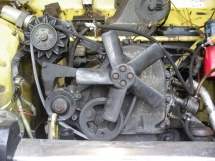
| Electric Fans There are a number of electric fans on the market from people like Pacet and Kenlowe. Replacing the belt driven fan does two things: Firstly you are bolting on a much more efficient and powerful fan, so cooling should be improved immediatley. Secondly, as the electric fan is thermostatically controled and does not rely on the engine for power, removing the belt driven fan releases a few bonus horsepowers. The electric fan will require more power from the electical system; for this reason I am uprating the std 35amp alternator with a 70am one from a Saab 900. Find out how here. |
| Push or Pull? Most fans come in Push or Pull varients. The Pacet Clubfan is changable. Push fans sit infront of the rad, behind the front grille - I know of one chap who mounted a slimline Kenlowe push-fan and kept the original belt driven fan. The belt driven fan was on all the time and the Kenlowe kicked in when it was needed. A bit 'belt-and-braces' for me but there you go...innovation counts. A Pull Fan, sits behind the radiator and pulls air into the engine bay. I have no data to decide which is best although there is more room behind the rad to accomodate a bulky pull fan and therefore, thinking aloud, maybe the merit of a push fan lies in improved airflow behind the rad as there is no fan there, and this facilitates the removeal of hot air from the radiator around the engine and out of the engine bay. Me? I am going with a 12" Pacet Push Clubfan (model number CF77). Pacet have asymetrically spaced blades, the marketing blurb has convinced me that this reduces noise, especially the 'throb' that fans create. I am also going with Push as I want to move the radiator deeper into the engine so that I can fit a Saab 900 radiator. A standard 96 radiator will require a 10" electric fan. |
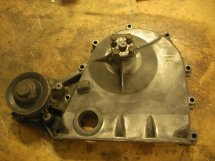
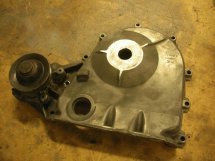
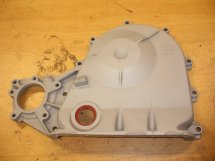
| Removing the Orginal Fan If you are going to do it, do it properly. You Will Need Socket set and cranked handle ring spanners Gasket set - check out fleebay - a full set is usually available for around �35 Angle grinder 30mm core plug and/or some of that 'metal' two part break-and-mix putty A 975mm x 10mm V shaped fan belt. e.g. 1984 Saab 900 1) Drain cooling system - don't forget to set the dashboard temp lever to "Hot" and openthe bleed nipples on the airbox and rad. 2) Remove the front grille and rad. 3) Undo all hoses attached to water pump 4) Loosen the alternator adjutment bracket and remove the fan belt. You can bin this. 5) Undo the four mounting bolts that hold on the fan and remove the fan. 6) Remove the Balance Shaft Pulley 7) Undo the 9 bolts around timing plate and the 5 bolts that attach it to the sump. Remove the timing cover. 8) Put the timing cover in a vice (you can remove the water pump if you want) and grind around the fan bearing housing. This is aluminium and easy to grind. When you see sparks you have hit the steel bearing. Score around the bearing ensuring that sparks are flyng all the way round to make sure you have completely gone through all the aluminium. 9) Clamp up the fan mounting and twist the timing cover back and fore to remove the fan bearing. 10)Clean up the mess with the angle grinder so that the front panel is pretty and smooth. 11) Fill the hole with the 30mm core plug or putty or both. Replace the Balance Shaft Pully seal with a new one from the gasket set. 12) I chose to spray my cover with Very high Temperature paint. You don't have to umless you value what it looks like! 13) Refit the timing cover. You will need the gasket set for this or some liquid intsant gasket goo. 14) Fit the new, shorter fan belt and set the aleternator. Away you go! Now you can mount you new fan. |
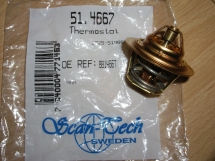
| Thermostat Change the standard 88 degree thermostat to a 83 degree thermostat. I got mine from Elk Parts for the princely sum of �5.95 +p&p. Go get one. |
 |
 |
 |
 |
 |
 |
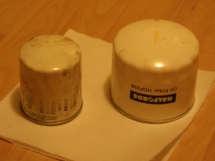 |
| Oil Filter An Oil Cooler system is the ultimate add-on but fairly costly and not usually necessary unless you have a high performance engine or you are competing. A simple measure is to fit the largest oil filter you can find (and be sure to add a touch more oil to compensate) Oil does three things: It lubricates, it cleans and it cools. Halford Classic Oil is as good as most people need and at �15 a can it won't break the bank to change the oil every 5000 miles but your engine will thank you for it. Why spend thousands on an engine and then ignore cheap maintainance like oil, filters and hoses? A larger filter will allow a little more oil in the system but more inportanly, it will clean more oil for longer, before it clogs. Any filters' performance decreases exponentialy. Having a larger surface area of filter for the same size entance and exit hole means that the volume of oil moving through the filter does not change but because of the larger internal area, it moves through at a lower preassure, meaning there is less resistance through the filter, meaning your oil pump does not have to work as hard meaning oil can move easier elsewhere. I used a filter for a deisel Fiat. Another �5 well spent |