

 |
 |
 |
 |
 |
|
BAHAY NA PULA>>PULANG SILID Ang Pulitika...
The Liberal Paradigm of the Mass Media The liberal paradigm describes the MM as the key instrument of ruling class domination in a liberal democracy. Beginning with a historical account of the concentration of ownership in the hands of a small number of corporations interlocked with business and the state, the MM is seen as an essential component in the ’system of control’ which perpetuates the ruling class and empire-building by its control and indoctrination of mass opinion. The majority are converted into a malleable mass, induced to conformity to the interests and policies of the ruling class, thus preventing change and perpetuating the rule by the corporate elite. For the liberals the top-down control by the mass media explains the ‘paradox’ of a highly unequal, military-driven empire in the context of a free and democratic political system. The principle role of the academics is to convince other academics to unmask the media, to expose its fabrications, deceptions and hypocrisy, by emphasizing the ‘contradictions’ between ‘our’ democratic values and the lies of the powerful. The more radical version of the ‘liberal’ view of the mass media attributes the high degree of consensus between elite and masses in the United States to the omnipresence and omniscience of the mass media. |
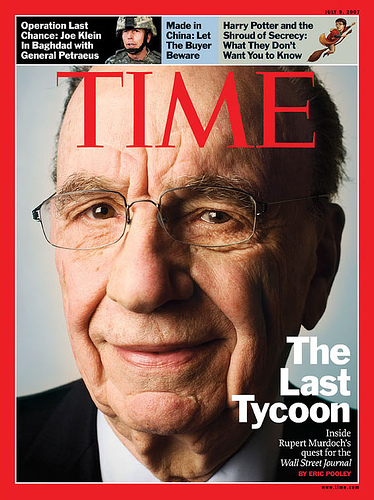
Rupert Murdoch, said to be the world's most powerful media mogul, owning tabloids, television stations, film production, and even social networking sites across Asia, Australia, Europe and America |
|
Marxist Critique The Marxist approach to the mass media begins necessarily with a critique of the conservative and liberal perspectives. Against the conservative critique, it points out that ‘power’ is not a disembodied resource but a relationship in which the owners of wealth and power can multiply and accumulate political and economic assets. The presumption that ‘everyone’ or all groups can have some influence overlooks the fact that ownership of the means of communication is linked to other powerful economic groups, which wield power over banks, investment, trust funds, and these, in turn, influence political leaders and parties controlling legislation, candidate selection and government spending and agendas: this undermines the foundations and validity of the pluralist paradigm. On all the major events of our time, the mass media loyally echoed the political line of the capitalist state, justifying the invasion of Iraq, the demonizing of Iran and echoing the state line on Iran’s nuclear program, Israel’s blockade of Palestine and invasion of Lebanon and the bailout of Wall Street. In all the major events, a unified mass media played a leading role in propagating the message of the ruling class, among the masses, with varying degrees of success. The liberal paradigm of ‘mass media determinism’ appears to have more credibility as its diagnosis of the structure of power and ownership of the MM corresponds to reality, as does its role in propagandizing the lies of the state on war and the economy. However, when we turn to the liberals’ image of MM control over mass opinion and attitudes, the assertions of all-powerful, all-controlling mass media successfully manipulating the public, these assumptions are questionable. Historically, monopoly-oligopoly control of the mass media has been unsuccessful in shaping mass attitudes and action in a number of important political contexts. This is true even in the United States. For example, despite unanimous MM support for the privatization of the Federal Social Security Program, the huge public bailout of Wall Street, the continuation of the military occupation of Iraq and military escalation in Afghanistan and the current private for profit health system, the great majority of the US public is strongly opposed to the MM line. Despite the fact that the leaders and the majorities of both ruling political parties do not reflect mass opinion, a majority of Americans have consistently backed a national, universal public health care, the withdrawal of US troops and they have vehemently opposed the Congressional support for Wall Street and the big finance industry. An analysis reveals that the MM are influential in shaping mass opinion in line with ruling class and state policies on foreign policies, particularly the war policy, at the start of a war, aggression or militarist posture before the economic and human costs are brought home to US citizens in their everyday lives. The MM is relatively ineffective when it supports domestic measures, which adversely affect the everyday socio-economic life of the mass of the American people. The MM operate most successfully when they dominate the flow and access of information, as in foreign policy, where they can fabricate, distort and emotionally charge what is heard and seen by the public. In contrast, MM ruling class propaganda is severely weakened by the evidence of empirical experience, which Americans live in relation to their health, pensions, wages and employment. Marxists would argue that particular economic conditions create a class awareness, which counterbalances the power of the MM. MAARI RING SILIPIN: |
| ©2009, RUPERT FRANCIS MANGILIT. All Rights Reserved |