Halden, Norway, was first mentioned in writing late 1500, as a small seaport exporting timber products. But signs indicate that there have been a small village here long before that. Some think there was a small "kaupang" here already in Viking-age.
 The
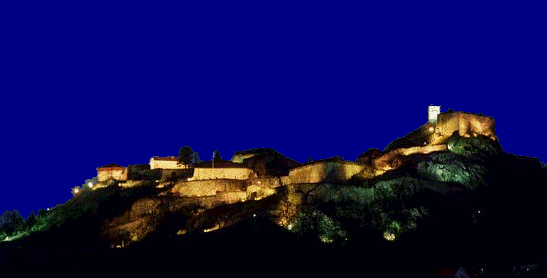
first fortress, Creetzensten, on the hills above the town, was built around
1645, and in the war between the Danish/Norwegian Union and Sweden 1656-1660
the fortress was attacked 3 times. In 1661 the fortress was renamed Fredriksten
and extensive building started.
The
first fortress, Creetzensten, on the hills above the town, was built around
1645, and in the war between the Danish/Norwegian Union and Sweden 1656-1660
the fortress was attacked 3 times. In 1661 the fortress was renamed Fredriksten
and extensive building started.
(Back
to folklore page)
In 1665, as a thanks for the efforts in the 1656-60 war, Halden was given unrestricted trading rights by the Danish/Norwegian king Fredrik, and renamed Fredrikshald.
Despite devastating town-fires in 1667 and 1676, the town flourished and was soon a important center for trade and timber export. But the new war with Sweden in 1716 put new burdens on the young town. July 4th 1716 the town and the fortress was attacked by strong Swedish forces and the town, but not the fortress, was conquered. But in the evening the same day, young servants and maids burned the town down, by throwing burning pitch-wreaths into the houses. The Swedish forces then had to withdraw. This effort made Fredrikshald/Halden the only town mentioned in our National Anthem, in a simple translation:
".......though we rather burned our country than we let it fall, just remember what happened down at Fredrikshald!"
In 1718 the fortress was attacked for the 5th time. This attack ended when the Swedish king Karl XII (in English-spoken countries called Charles XII), was killed in front of the fortress.
After the war of 1718 the town prospered and grew. A terrible town-fire in 1758 again set them back, but around 1800, Fredrikshald was the 3rd biggest town in Norway.
In a new war in 1814 the fortress was attacked for 6th time without being conquered, but the war ended the Danish/Norwegian Union. Instead Norway went into a union with Sweden. This Union slowed down the town's progress and after the last big town-fire in 1826, which ruined the whole town, the brave inhabitants had to start from the beginning again.
When Norway in 1905 broke out of the Swedish/Norwegian Union, Fredriksten Fortress was demilitarized and "degraded" to a tourist-attraction. It is visited by more than 200000 tourists each year and was in 1996 the 11th most visited tourist-attraction in Norway. The fortress is one of the biggest defence-constructions in Scandinavia, with walls covering more than 215000 sq.ft. (Top)
 Today
Halden, as it was renamed in 1927, is a small Norwegian town with 26000
inhabitants. Timber is still a important product for the town, as the most
important industry is the paper-mill "Saugbrugsforeningen". Other
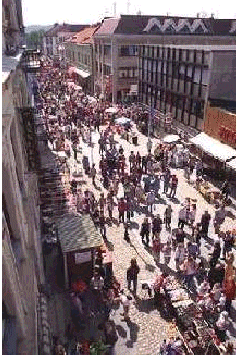
small industries and trade is also important, and the picture show how
crowded the shopping-street may be on a busy day.
Today
Halden, as it was renamed in 1927, is a small Norwegian town with 26000
inhabitants. Timber is still a important product for the town, as the most
important industry is the paper-mill "Saugbrugsforeningen". Other
small industries and trade is also important, and the picture show how
crowded the shopping-street may be on a busy day.
Halden is also the "head-town" for the county of Østfold's regional college with more than 2000 students.
 The
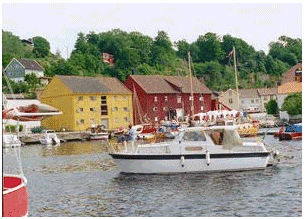
Guest-harbour, with the old sea houses in background, have 3 times - including
1998, been elected "Best
Guest-harbour in South Norway".
The
Guest-harbour, with the old sea houses in background, have 3 times - including
1998, been elected "Best
Guest-harbour in South Norway".
In 1996, Halden was officially elected "Environmental town" of Norway, because of its preservation of old houses and old building-style on new houses, and for the effective cleaning of the earlier highly polluted fjord and river.
Halden has many other tourist-attractions well worth a visit. Rød Manor from 1733, with its weapon-collection, the old Theater from 1838, the Halden-canal and watercourse with the highest Locks in North Europe to mention a few. (Top)
For further informations I'm sure the Tourist-office gladly help you. And I don't mind if you refer to my page. Their address is:
Halden
Tourist office,
PO Box 167, N-1751 Halden, Norway.
Phone +47 69 18 01 02
or you may mail me directly: [email protected]
..and, hey, don't forget to return to the Head-page and sign my Guest-book before you leave !
English - Norsk - Hometown - Folklore - Deadly - PowWow - TheBoss - Awards - Links
