Norwegians live in near contact with the nature - the woods, the mountains and the ocean - and this have of course characterized peoples believe and fantasy and developed many creatures peoples have believed in almost up to our own time. There is still peoples living that assert they have seen Huldra, and the Seamonster is even today swimming around in Lake Seljord.
But if you have ever stayed in a Norwegian wood in the late summer, when the twilight cover the landscape, or have camped by a silent lake in the late autumn, you may perhaps understand how some of these creatures have developed in the narrow crossing between fantasy and reality.
Let’s look at an example:
One evening in the late summer, in the special Norwegian twiligh you
only find north of the 60th latitude, you are walking back to you camping-site:
You leave the fields you have been crossing, and enter a narrow track trough
the woods. You don’t walk far, before you hear one of the Subterraneans
or maybe one of the small Trolls
jump off the track somewhere in front of you (or was it just a hare or
the fox you saw earlier today ?). You hear the muffle sound of Fossegrimen
strumming his fiddle near the streaming brook out to the right (or was
it just the combination of wind blowing through the trees and the clucking
sound from the brook?) and out to the left you see the clear contures of
a big Troll. (Or was this the
place where you saw that big root when you passed here in daylight - it
didn’t look THAT big then ?)
And when you in the early morning, just before sunrise, look out over
the silent lake you camped by, you may see a glimps of Nøkken
before he dive back into the dark water (or maybe it was a old timberlog
dipping in the waterline) and turning your head the other way you may see
Huldra dance over the far-away
bog in her light summerdress. (Or was it the last morning-fog blowing away
over the bog?)
Roughly you may divide the creatures of the Norwegian folklore in
two groups:
The Trolls and the Subterraneans (de Underjordiske).
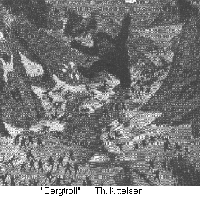
Trolls - There are big Trolls (also called Jotun -
Jutul - Jøtul - Rise - or female Trollkjærring
and Gygre) and small Trolls.
The small Trolls usually ain't considered dangerous, and they
are seldom mentioned in our fairy-tales and legends.
The big Trolls is creatures living in Norway before the peoples
came here. They are evil and usually hate peoples, especially Christian
peoples. Sometimes they have many heads, sometimes only one eye. But they
are stupid and often easy to trick, and if the sun shine on them they die
and turn to rocks. (Return)
The Subterraneans (de Underjordiske)
is a more comprehensive group.
They are often considered the ghosts of peoples that have lived earlier.
You usually can't see them, unless they want you to, but they usually live
in hills and mountains near peoples. The Subterraneans is also called
Haugefolk and Huldrefolk.
The Subterraneans often help the farmers and sometime give them
gifts (usually silver). (Return)
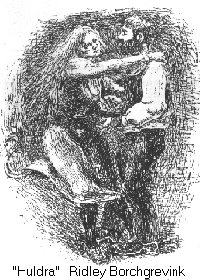 Huldrefolket
- Huldra (The name Hulder comes from old nordic hylja=hide) They often
own big, fertile farms (but you can't see them of course) and their cows
is fat and shining.
Huldrefolket
- Huldra (The name Hulder comes from old nordic hylja=hide) They often
own big, fertile farms (but you can't see them of course) and their cows
is fat and shining.
The most famous of them is the female Huldra. She is unbelively
beautiful. But she has a tail like a cow. Sometimes she try to lure young,
handsome men into the mountain to marry them, and if she succeede you usually
never see them again. If someone manage to leave the mountain they are
deaf and dumb forever. But if she like a man very much she may follow him
and marry him. When she stand before the altar she will loose her tail,
and become like other women. But she often retain her beauty, some of her
strenght and wisdom. If the man is faithful to her, he will often end up
with a big farm, rich and wealthy.
Tradition say there are 7 hulder-tails hanging on the wall in the Church
of Seljord. When the rectors wife once was asked about this she had a wonderful
answer: "I have never seen any, but of course, if it is so, they would
have been invincible for Christian peoples, so who knows......" (Return)
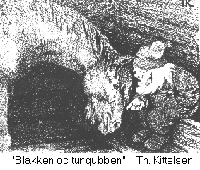 Nisse,
the name we use on this creature today, is relatively new. Old names is
Tomte, Gardvord, Haugebonde, Tunvette, Gardvette,
Tomtegubbe, well, they say belowed childeren has many names.
Nisse,
the name we use on this creature today, is relatively new. Old names is
Tomte, Gardvord, Haugebonde, Tunvette, Gardvette,
Tomtegubbe, well, they say belowed childeren has many names.
And the Nisse usually is belowed. He is a little old man with
long beard, often dressed in grey and with a red "topplue" (cap). He is
often considered to be the ghost of the first man who worked up the farm.
He often live in the barn, and take care of the animals of the farm. He
also help in other ways, and protect the farm against evil and disasters.
As long as he get the care and respect he deserve, he is a good helper,
but if not he may be angry and revengful. Many farms still follow the old
tradition of setting out a dish with porridge to the Nisse at Christmas
eve. (Return)
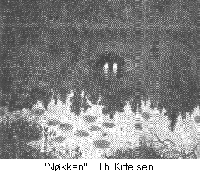 Nøkken
is a evil creature, living in rivers and lakes. He is a master
of fiddelplaying and many Norwegian fiddlers have learned their tunes from
him. He can turn himself into a log or a stone, and he may now-and-then
appear as a horse grazing by a lake. But if peoples come too near him he
will always try to drag them with him out in the water.(Return)
Nøkken
is a evil creature, living in rivers and lakes. He is a master
of fiddelplaying and many Norwegian fiddlers have learned their tunes from
him. He can turn himself into a log or a stone, and he may now-and-then
appear as a horse grazing by a lake. But if peoples come too near him he
will always try to drag them with him out in the water.(Return)
Fossegrimen is related to Nøkken. He live in waterfalls (foss) or streams, or in mills near waterfalls or streams. In the nights or silent evenings you may hear his luring fiddel- or flutemusic, but if you go too near him, he will try to drag you out in the waterfall with him.(Return)
Draugen is a creature from North Norway. He is the ghost of a
drowned seaman, and is dressed as a fisherman, but has no head. He is sailing
in a half boat. When you see him it's a warning of coming death and depravation.
He often live in boathouses and can transform himself to a stone.
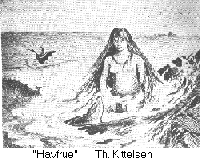 Havfrua
(the Mermaid) is a tradition we share with many other seafaring nations.
She is usually peaceful and warne the seamen against coming storms. When
you see her you should sail your boat to the nearest land immidiately.
Havfrua
(the Mermaid) is a tradition we share with many other seafaring nations.
She is usually peaceful and warne the seamen against coming storms. When
you see her you should sail your boat to the nearest land immidiately.
Sjøormen (the Seamonster) is another creature we share with other seafaring nations. They may be found along the coast as well as in inland water. The monster of Scotlands Loch Ness is of course wellknown. In Norway we have a Sjøorm in Lake Seljord.(Return)
Hekser (Witches) is not typical Norwegian,
but is often found in our fairy-tales. The Heks is often called
Trollkjærring.
The night to May 1st (Valpurgis night) they fly to Blokksberg on their
brooms to pay homage to the Devil. In my young days it was still a tradition
on some farms to shoot with a shotgun up in the air at Valpurgis night
to shoot down the witches.(Return)
Spøkelser (Ghosts) is not as common in Norway as in many other countries. In my home-town Halden, Norway, there is a ghost called "The White Lady" on the fortress Fredriksten. She is usually seen i light summer-nights.
If you who read this have similar creatures in your country, I wold
very much like to hear about them.
Please mail me at [email protected]
Theodor (Th) Kittelsen (1857 - 1914) who drew most of the drawings illustrating this page was the artist who "gave a face" to the creatures in the Norwegian folklore. He showed us how the Trolls and Nøkken look like in his marvelous drawings.
Ridley Borchgrevink (1898 - ??) is known for his paintings and animal drawings.