FRAP 40 provides that a rehearing may be requested by petition as follows:
The petition must state with particularity the points of law or fact which in the opinion of the petitioner the court has overlooked or misapprehended and must contain such argument in support of the petition as the petitioner desires to present.
The Notice of Entry of Judgment that accompanied the Memorandum Decision in this case specifies that a petition should only be made to direct this Court’s attention to one or more of the following situations: 1) a material point of fact or law overlooked in the decision, 2) a change in the law which occurred after the case was submitted and which appears to have been overlooked by the panel, and 3) an apparent conflict with another decision of the Court which was not addressed in the opinion.
In the Memorandum this Court found:
The district court properly dismissed Knight’s Fourth and Fourteenth Amendment unreasonable seizure claims because these claims were litigated and decided in a prior district court proceeding, and affirmed on appeal, Knight v. City of Seattle, 2003 WL 1900758 (9th Cir. April 16, 2003). See Steen v. John Hancock Mut. Life Ins. Co., 106 F. 3d. 904, 910-11 (9th Cir. 1997).
Knight v. City of
What Knight v. Seattle found was that a
Supreme Court of
What is undisputed and cannot be disputed, is that prior to December 12, 2003, the date of All Around Underground, WAC 204-96-010 mandated that a WSP trooper has no discretion, he must order the impound. All Around Underground found that this is not authorized by RCW 46.55.113, and ordered relief to the trucking company.
Pursuant to All Around Undergound, Mr. Knight is at least entitled to recover the impound fee. In re Matter of the 1992 Honda Accord and Becerra v. City of Warden, (June 19, 2003) ____ Wash. App. ___ found that pursuant to All Around Underground, a city ordinance that mandated impoundment went beyond the authority granted by the state legislation, RCW 46.55.240(1) to the cities for impoundments under chapter 46.55 RCW. Article XI Section 11 of the Washington Constitution provides that municipal ordinances shall not conflict with the general laws (meaning laws passed pursuant to Article II of the Washington Constitution) and provides the Legislature with the authority to define the powers of local governments to enact legislation. As to remedy and the good faith defense, the Becerra found that RCW 46.55.120(3) authorized monetary recovery, including impoundment, towing, and storage fees for an improper impoundment regardless of the good faith or lack of good faith on the part of the officer ordering impoundment.
The
impoundment of Mr. Knight’s vehicle was mandated by
WAC 204-96-010, it allowed
the WSP trooper no discretion. All Around Underground found
WAC
204-96-010 to exceed the statutory authority granted by the Legislature and
ordered refund of the impoundment, towing, and
storage fees to the trucking company for the improper impoundment.
Under the
Fourteenth Amendment, Mr. Knight is entitled to
equal protection of Washington’s laws, and entitled by right of due process to
not have those acting under color of the state’s laws, including Trooper
Mitchell and Clark’s Towing, exceed the authority of the state’s laws.
In the Memorandum this Court found:
The district court properly dismissed Knight’s Fourteenth Amendment claim alleging failure to meet the notice requirements of Was. Rev. Code § 74.20A.320(1) because Knight was served by certified mail with the notice of noncompliance and intent to suspend licenses.
This fact has NEVER been proven by the State Officers in either federal or state court. There was no discovery process allowed by the district court in this case and therefore no opportunity for either party to prove or disprove this fact. It also ignores the language of RCW 74.20A.320(1):
The department may serve upon a responsible parent a notice informing the responsible parent of the department's intent to submit the parent's name to the department of licensing and any appropriate licensing entity as a licensee who is not in compliance with a child support order. The department shall attach a copy of the responsible parent's child support order to the notice. Service of the notice must be by certified mail, return receipt requested. If service by certified mail is not successful, service shall be by personal service.
In the district court, Mr. Knight was only allowed the
opportunity to establish that this case should not be dismissed under
Younger abstention doctrine. That the
Memorandum did not cite
Younger indicates that Mr. Knight proved
abstention inappropriate. If abstention
is not appropriate, Mr. Knight is entitled to a proper discovery process under
the Federal Rules of Civil Procedure and the local
district court rules so he
may prove that service by certified mail was not successful and the alternative
of personal service was not completed within the requirements of
What Mr. Knight
did enter into the record were three declarations with attached exhibits. These attached exhibits include the evidence
obtained by discovery and the results of the relevant state court proceedings. Specifically Exhibits D, E, F, G, and H to
the Declaration by Roger W. Knight in Support of Plaintiff’s Response to Order
to Show Cause (Knight Declaration I), Document No. 10, ER 46-49 (declaration
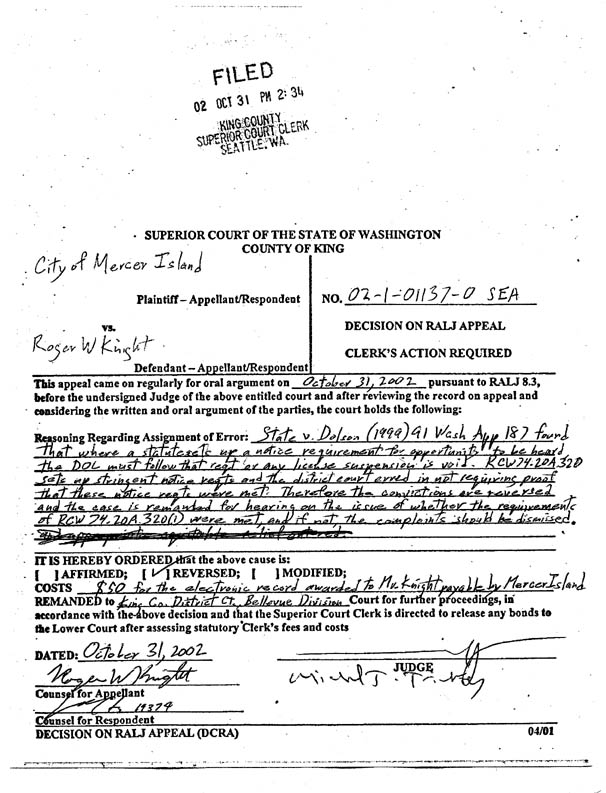
authenticating attached Exhibits) and ER 72-104, the Exhibits. ER 74 indicates a clean driving record on the
part of Mr. Knight as of
The
Declaration by Roger W. Knight in Support of Plaintiff’s Supplement to Response
to Order to Show Cause (Knight Declaration II) ER 42-45 and its
attached
Exhibit shows that Mr. Knight
won reversal of the convictions for Driving While
License Suspended (DWLS) in City of
Mercer Island v. Knight,
Subsequent
to the January 7, 2003 Order, Document No. 21, ER 6-7, on January 13, 2003, the
City of Mercer Island dropped the
state court DWLS case without presenting
evidence as to service required by
RCW 74.20A.320(1). This was entered into the record of the
district court case from which
Knight v.
City of Mercer Island et al, 9th Cir. No. 03-35116 arises. While Mr. Knight settled with the
City of
What is
also undisputed is that no criminal DWLS charge was ever filed arising from the
incident of
If the appropriate Washington and local prosecuting authorities do not like their chances of proving service required by RCW 74.20A.320(1) prior to the incidents of January, February, and August 2002, in a state court criminal prosecution for DWLS, then Mr. Knight is entitled to the opportunity to prove service was not accomplished as required by RCW 74.20A.320(1) in a civil 42 U.S.C. §1983 action brought in federal court.
Because of
the lack of proper notice required by
RCW 74.20A.320(1), the
Memorandum’s next
finding is also without basis in fact.
As for judicial remedies
RCW 74.20A.320(3) prohibits consideration of
ability to comply with the support order.
An administrative law appeal to a state superior court can only allege
invalidity of the statutory scheme in addition to error by the administrative
agency,
RCW 34.05.570(3)(a). The
administrative agency may not consider a claim that the statute is invalid, Bear v. Gorton, (1974) 84
The final finding by the
Memorandum
reads:
The
district court properly dismissed Knight’s claim alleging violations of the
anti-peonage statute, 42 U.S.C. § 1994, and the
Thirteenth Amendment because
Knight was not subject to peonage, or involuntary servitude in liquidation of
any debt or obligation. See
United States v. Kozminski, 487
Strictly
speaking, Mr. Knight did not plead a
Thirteenth Amendment claim, he relied on
42 U.S.C. §1994. Also strictly speaking,
Clyatt v. United States, (1905) 197
This
judgment is confirmed when we turn to our previous decisions construing the
Thirteenth Amendment. Looking behind the broad statements of purpose to the
actual holdings, we find that in every case in which
this Court has found a
condition of involuntary servitude, the victim had no available choice but to
work or be subject to legal sanction. In
Clyatt
v. United States, 197 U.S. 207 (1905), for example,
the Court recognized
that peonage - a condition in which the victim is coerced by threat of legal
sanction to work off a debt to a master - is involuntary servitude under the
Thirteenth Amendment.
Where
the threat of legal sanction is a permanent license suspension for failure to
pay a debt or obligation not related to activity licensed, such as operating a
motor vehicle, practicing law, or providing health care services, this is
within involuntary servitude and peonage as defined by
Kozminski and the cases cited therein.
To suspend the driver’s license
exposes the party to criminal prosecution and other abuses, such as being
stranded in a remote location without the car.
Suspension of a driver’s license is a common criminal sanction for such
crimes as driving while impaired, eluding a police officer, vehicular homicide,
and refusing a breath or blood test when requested by a police officer. To say that the threat of license suspension
is not a threat of legal sanction is to draw a distinction that
Kozminski and the cases cited therein do
not. License suspension as a means to coerce
employment to pay a debt or obligation, in this case child support, is a new
phenomenon not considered by these earlier involuntary servitude and peonage
cases. Therefore, under the logic of
Hart v. Massanari, this is not the kind
of case to be disposed of with an unpublished memorandum. A decision in this case should be published
to set the legal precedent and to inform all noncustodial parents of the extent
of their rights under the Antipeonage Act.
The
Memorandum also ignores that
contempt proceedings, arrest, and imprisonment are often used to sanction the noncustodial parent who fails to find employment adequate to allow compliance
with a support order,
RCW 26.18.050(4).
There can be no reasonable argument that requiring a parent to
“establish that he or she exercised due diligence in seeking employment” or be
found in contempt and incarcerated is not within the threat of legal process
contemplated by
Kozminski and the
cases cited therein, which also consider the Antipeonage Act.
Under FRE 201(b)
this Court can take
judicial notice that pursuant to
RCW 26.18.050(4) noncustodial parents are
routinely ordered to make 5 or 10 job contacts per week by
King County Superior
Court family court commissioners.
Example is State v. Dominique
Allen Davis,
II. ARGUMENT
FOR EN BANC REHEARING
This
Court has found that issues of child support enforcement and the constitutional
rights of noncustodial parents are highly important, Duranceau v. Wallace, (9th Cir. 1984) (9th Cir. 1984)
The
Notice of Entry of Judgment page 2 provides 3 reasons for which a party may
request rehearing en banc. One reason
clearly applies: The question of the definition of legal process or threat
thereof that is necessary to prove a violation of the Antipeonage Act in the
enforcement of child support is a question of the most exceptional
importance. In their
dissents from the
denial of en banc review in Silveira v.
Lockyer, (9th Cir.
With all due respect, I cannot reconcile
Judge Kozinski's dissent in the denial of en banc rehearing in Silveira with
his opinion in Ballek. If indeed we should accord all provisions of the
Constitution establishing rights with the same broad interpretation, then
certainly freedom from involuntary servitude is as important a right as the right
to keep and bear arms and the right to truthfully shout 'Fire!' in a crowded
theatre. Just as defining the
Second Amendment as only providing for a
'collective right', erases the
Amendment from the Constitution and deprives all
adult Americans of the
Second Amendment protection of the right to keep and
bear arms, Ballek deprives all parents of the
Thirteenth Amendment
protection against involuntary servitude. All parents have a duty to support their
children. Because we know how a person becomes a parent, under
Ballek
the
Thirteenth Amendment now only protects those men who are strictly homosexual
or strictly celibate. Women retain their
Thirteenth Amendment rights only by being strictly homosexual or strictly
celibate, or by always exercising their right to abortion. This is not what was contemplated by those who
brought the
Thirteenth Amendment into law and it is certainly what the Antipeonage Act was intended to prevent and prohibit.
Most adult Americans are
parents. Millions lack legal custody of
their children and are subject to license suspensions, contempt proceedings,
arrest and imprisonment for failure to maintain employment sufficient to allow
them to comply with their support orders.
Ballek noted this at
Our
credibility as a free nation bound by its own laws is at stake. Muslim nations have a different view of
family law, whether strictly governed by sharia or not. They notice that we create an exception to our
state constitutions that prohibit imprisonment for debt and deny our noncustodial
parents the protection of the
Thirteenth Amendment and the rule of law.
Mr.
Knight does not ask for the protection of the Constitution and the Antipeonage
Act because HE deserves it; he asks
for this because WE THE PEOPLE
deserve it. Because the Constitution,
the rule of law, and the integrity of the English language in which the law is
written deserve it.
For
the reasons stated herein, this Motion for Rehearing with Suggestion for
Rehearing En Banc and to Publish Opinion should be granted.
Respectfully submitted this 27th day
of June, 2003,
_________________________________
Roger W. Knight, appellant pro se
If the back button does not take you there, click Home to go to the Index page of this Antipeonage Act Website, click Enemies for the main Enemies page, click Letters for the Letters page, and click Allies for the Allies page. Click C02-1641C to get to the main page for this case. Or you can use the Antipeonage Act Site Map.