I. ASSIGNMENTS OF ERROR
1) District court ruling on day of trial, May 21, 2002, that it lacked jurisdiction to consider whether the Department of Social and Health Services (DSHS) met the service requirements of RCW 74.20A.320(1) for notice and opportunity to be heard, and therefore lacked the statutory authority to certify to the Department of Licensing (DOL) that Mr. Knight was noncompliant with a child support order. District court subsequently denied Mr. Knight’s proposed jury instructions that such notice requirement be met for the licenses suspension be lawful. The grounds for the district court ruling was that such was part of a collateral attack on the license suspension, which it deemed that it lacked jurisdiction to consider in a subsequent criminal Driving While License Suspended (DWLS) case. Transcript of May 21, 2002, page 5 line 27 to page 6 line 4, page 9 lines 1-4, page 9 line 27 to page 10 line 1, page 10 lines 21-23, and page 11 lines 17-18. The error is that if the service requirements of RCW 74.20A.320(1) were not met, the DSHS never acquired jurisdiction to certify noncompliance with the support order to the DOL suspension of license under the WorkFirst Act.
2)
District court ruling during motion hearing on April 19, 2002, that it
lacked jurisdiction to consider: 1) whether the Legislature intended the WorkFirst Act to apply to pre-existing support orders and pre-existing support
arrearages, 2) whether application of the WorkFirst Act to pre-existing support
orders and pre-existing support arrearages is void as a bill of attainder and
as an ex post facto law prohibited by the United States Constitution and the
Washington Constitution, 3) whether WorkFirst Act is void as a multi-subject
bill prohibited by the Washington Constitution, and 4) whether license
suspension for nonpayment of child support is unconstitutional as not
rationally related to any legitimate interest of government., and 5) whether
application of the WorkFirst Act to coerce employment to enable compliance with
a support order is declared null and void as an attempt to establish Mr. Knight’s
service or labor as a peon in liquidation of a debt or obligation by
42 U.S.C.
§1994. The grounds for the
district
court ruling was that such was part of a collateral attack on the license
suspension, which it deemed that it lacked jurisdiction to consider in a
subsequent criminal Driving While License Suspended (DWLS) case.
Transcript of
3)
The Legislature did not declare its intent to apply the WorkFirst Act to
pre-existing child support orders and to pre-existing child support arrearages
under the tests set forth in
State v. Cruz, (1999) 139
4) If the WorkFirst Act applies to pre-existing child support orders and to pre-existing child support arrearages, such application is a bill of attainder and an ex post facto law prohibited by Article I section 23 of the Washington Constitution and prohibited to the States by Article I Section 10 clause 1 of the United States Constitution. Issue raised below, Supplement to Motion to Dismiss Complaint pages 5-11, filed in both causes of action below, district court found it lacked jurisdiction to consider, Transcript of April 19, 2002, page 9 lines 23-27.
5) The WorkFirst Act is null and void as a multi-subject bill prohibited by Article II Section 19 of the Washington Constitution. Issue raised below, Motion to Dismiss Complaint, pages 12-14, filed in both causes of action below, district court found it lacked jurisdiction to consider, Transcript of April 19, 2002, page 9 lines 23-27.
6) License suspension for nonpayment of child support is unconstitutional because it is not rationally related to any legitimate interest of government. Issue raised below, Motion to Dismiss Complaint, pages 14-19, filed in both causes of action below, district court found it lacked jurisdiction to consider, Transcript of April 19, 2002, page 9 lines 23-27.
7)
Application of the Workfirst Act to coerce consent to a repayment
agreement on $60,000 child support debt, compliance with which necessarily
requires employment, is declared null and void by the Antipeonage Act of 1867,
42 U.S.C. §1994. Issue raised below,
filed in both causes of action below,
Motion to Dismiss Complaint, page 19,
district
court found it lacked jurisdiction to consider,
Transcript of
II. STATEMENT OF THE CASE
On
On
On April 19, 2002, a motion hearing was held, the district court denied Mr. Knight’s Motion to Dismiss, in part on the grounds that it lacked jurisdiction to consider the validity of the WorkFirst Act on its face or the validity of the WorkFirst Act as applied to Mr. Knight, because that was part of what it considered a collateral attack on the license suspension, which it deemed was not allowed in a subsequent criminal DWLS proceeding. At this hearing the district court consolidated the two charges into one case.
On
On
III. ARGUMENT
Assignment
of Error 1:
District Court Has
Jurisdiction to Consider Whether the Service Requirements of
RCW 74.20A.320(1)
Were Met
The WorkFirst Act sets up a
procedural scheme for the suspension of licenses for noncompliance with child
support orders. In negotiating the provisions
of this Act, legislators who previously opposed license suspension for
nonpayment of support insisted that the notice requirement go beyond “notice
reasonably calculated” previously found to be required for licenses suspensions
in general in
Bell v. Burson, (1971)
402
(1) The
department may
serve upon a responsible parent a notice informing the responsible parent of
the department's intent to submit the parent's name to the
department of
licensing and any appropriate licensing entity as a licensee who is not in
compliance with a child support order. The department shall attach a copy of the
responsible parent's child support order to the notice. Service of the notice
must be by certified mail, return receipt requested. If service by certified
mail is not successful, service shall be by personal service.
(2) The notice of
noncompliance must include the address and telephone number of the
department's
division of child support office that issues the notice and must inform the
responsible parent that:
(a) The parent may request an
adjudicative proceeding to contest the issue of compliance with the child
support order. The only issues that may be considered at the adjudicative
proceeding are whether the parent is required to pay child support under a
child support order and whether the parent is in compliance with that order;
(b) A request for an
adjudicative proceeding shall be in writing and must be received by the
department within twenty days of the date of service of the notice;
(c) If the parent requests an
adjudicative proceeding within twenty days of service, the
department will stay
action to certify the parent to the department of licensing and any licensing
entity for noncompliance with a child support order pending entry of a written
decision after the adjudicative proceeding;
(d) If the parent does not
request an adjudicative proceeding within twenty days of service and remains in
noncompliance with a child support order, the department will certify the
parent's name to the department of licensing and any appropriate licensing
entity for noncompliance with a child support order;
. . .
(f) If the
department
certifies the responsible parent to the department of licensing and a licensing
entity for noncompliance with a child support order, the licensing entity will
suspend or not renew the parent's license and the
department of licensing will
suspend or not renew any driver's license that the parent holds until the
parent provides the department of licensing and the licensing entity with a
release from the department stating that the responsible parent is in
compliance with the child support order;
. . .
(3) A responsible
parent may request an adjudicative proceeding upon service of the notice
described in subsection (1) of this section. The request for an adjudicative
proceeding must be received by the department within twenty days of service.
The request must be in writing and indicate the current mailing address and
daytime phone number, if available, of the responsible parent. The proceedings
under this subsection shall be conducted in accordance with the requirements of
chapter 34.05 RCW. The issues that may be considered at the adjudicative
proceeding are limited to whether:
(a) The person named as the
responsible parent is the responsible parent;
(b) The responsible parent is
required to pay child support under a child support order; and
(c) The responsible parent is
in compliance with the order.
(4) The decision
resulting from the adjudicative proceeding must be in writing and inform the
responsible parent of his or her rights to review. The parent's copy of the
decision may be sent by regular mail to the parent's most recent address of
record.
. . .
(6) If a responsible
parent timely requests an adjudicative proceeding pursuant to subsection (4) of
this section, the department may not certify the name of the parent to the
department of licensing or a licensing entity for noncompliance with a child
support order unless the adjudicative proceeding results in a finding that the
responsible parent is not in compliance with the order.
(7) The
department may
certify to the department of licensing and any appropriate licensing entity the
name of a responsible parent who is not in compliance with a child support
order or a residential or visitation order if:
(a) The responsible parent
does not timely request an adjudicative proceeding upon service of a notice
issued under subsection (1) of this section and is not in compliance with a
child support order twenty-one days after service of the notice;
(b) An adjudicative
proceeding results in a decision that the responsible parent is not in
compliance with a child support order;
(c) The court enters a
judgment on a petition for judicial review that finds the responsible parent is
not in compliance with a child support order;
. . .
(8) The
department of
licensing and a licensing entity shall, without undue delay, notify a
responsible parent certified by the department under subsection (7) of this
section that the parent's driver's license or other license has been suspended
because the parent's name has been certified by the
department as a responsible
parent who is not in compliance with a child support order or a residential or
visitation order.
. . .
(13) The procedures in chapter 58, Laws of 1997, constitute the exclusive administrative remedy for
contesting the establishment of noncompliance with a child support order and
suspension of a license under this section, and satisfy the requirements of
RCW
34.05.422.
The
notice requirements of
RCW 74.20A.320(1) must be met or no further action to
suspend the license is authorized by the WorkFirst Act. Once a certification of noncompliance with a
support order is sent to the DOL, no administrative hearing is available for
the noncustodial parent to contest the legality of the license suspension,
RCW
74.20A.320(13). Unless
Upward v. Department of Licensing, (1984) 38
Therefore, if the notice
requirements of
RCW 74.20A.320(1) are not met, the noncustodial parent is
deprived of any opportunity for a hearing.
If he objects to the validity of the WorkFirst Act either on its face or
as applied to him, the administrative hearing provided by
RCW 74.20A.320 allows
him the opportunity to file a petition for judicial redetermination of the
administrative decision under
chapter 34.05 RCW wherein the superior court has
the jurisdiction to consider the validity of the WorkFirst Act.
Upward does not apply to direct
appeals of administrative decisions.
Therefore, denial of the opportunity for an administrative hearing
denies Mr. Knight opportunity to challenge the validity of the WorkFirst Act in
proceeding before the
State
v. Dolson, supra, overruled
Upward and
City of Bellevue v.
Montgomery, (1987) 49
A
driver's license represents an important property interest and cannot be
revoked without due process of law.
RCW
46.65.065 codifies these constitutional due process
requirements. The statute mandates that
DOL notify habitual traffic offenders of their license revocation, the right to
a formal hearing, and the procedure for obtaining a hearing. . . .
The
statute unequivocally directs DOL to send notice of the revocation to the
driver's address of record. At the time of Dolson's revocation,
RCW 46.20.205
provided that a licensee's address of record maintained by
DOL could be changed
only through written notification to DOL by the licensee. The statute
has since been amended, but at the time DOL sent notice to
As
noted above, DOL sent Dolson's notice of revocation not to his address of
record, but to his last known address. At the time of revocation, Dolson's
address of record was his mother's residence. The Court of Appeals observed that
DOL failed to follow the statutory mandate to send notification to Dolson's
address of record. However, the court concluded that
DOL's error did not
violate Dolson's right to due process because DOL's notice procedure was
reasonably calculated to inform Dolson of the revocation. The court remarked
that, although the statute was 'technically violated, the spirit of the statute was not.'
State
v. Dolson, 91 Wn. App. 187,
194, 957 P.2d 243 (1998). Employing a 'common sense
analysis,' the court held that because DOL's practice of sending notification
to the licensee's last known address went above and beyond the statutory
requirements, it did not offend constitutional due process requirements.
The
Court of Appeals is correct that there is no inherent constitutional problem
with sending notice of license revocation to a licensee's last known address.
In fact, prior to 1989, the Court of Appeals required
DOL to search its records
for a driver's last known address.
Baker, 49 Wn. App. at 782. In
Baker,
the licensee did not receive notification of his license revocation because
DOL
relied on the address of record, rather than sending the notice to a more
recent address contained in DOL files. The
court held the revocation to be invalid, explaining that due process required
DOL to search its records for the most recent address rather than relying on an
old address of record.
However,
Baker was superceded by a 1989 amendment to
RCW 46.20.205. Laws
of 1989, ch. 337, §6. The Legislature implicitly overruled
Baker by
requiring that modification by the licensee be the 'exclusive means' for
establishing the address of record. This court subsequently held in
State
v. Rogers, 127 Wn.2d 270, 280, 898 P.2d 294
(1995) that due process is satisfied when
DOL sends notice
to the licensee's address of record as supplied by the licensee. Thus, although
the procedure approved in
Baker is not inherently defective, this court
must examine whether DOL's decision to send the revocation letter to Dolson's
last known address was 'reasonably calculated' to provide notice in light of
the fact that it violated
RCW 46.65.065, which
mandates that notice be sent to the address of record.
. . .
Contrary
to the Court of Appeals' conclusion, a notice procedure that contradicts a
licensee's legal expectations cannot be reasonably calculated to provide
notice. DOL's decision to send notification to an address other than the
address of record did not comply with the spirit of the statute because it
conflicted with the statutory objective to put control over the notification
process in the hands of the licensee.
We must now address whether
DOL's defective notice procedure
rose to the level of a due process violation. This court analyzed the
implication of a statutory violation by DOL in
State v. Storhoff, 133 Wn.2d 523, 946 P.2d 783 (1997). In
Storhoff, the petitioners challenged
their convictions for driving with a revoked license and argued that the
original notice of revocation was defective. The notices sent by
DOL
incorrectly stated that the petitioners had 10 days to appeal the revocation,
rather than the 15 allowed by law. The notices also failed to cite the
subsection of the RCW where the time limitation for challenging the revocation
could be found.
Storhoff, 133 Wn.2d at 526. This court held that minor procedural errors do not necessarily rise
to the level of due process violations unless the errors actually deprive a person of his opportunity to be heard.
Storhoff
stands for the proposition that a revocation is invalid only if
DOL's notice of
revocation is faulty and this error prevents a licensee from requesting a
hearing. In this case, DOL failed to send notification to Dolson's address of
record as required by statute and instead sent notification to an address
obtained from a ticket issued to Dolson in 1989. Dolson never received the
official notice informing him of his right to appeal the revocation. Under
Storhoff,
Dolson's due process rights were violated if the faulty notice precluded him
from requesting a hearing within the statutorily mandated time. Thus, in order
to determine whether Dolson's due process rights were violated, we must decide
whether the defect was merely procedural, or whether the error served to
deprive Dolson of notice of the revocation.
The
State argues that Dolson was not prejudiced by the defective notification procedure because Dolson had constructive knowledge of the
revocation. The Washington
Habitual Traffic Offenders Act, RCW 46.65, makes
license revocation mandatory when a person is convicted of three or more
serious traffic offenses within a five-year period.
RCW 46.65.020(1). Because Dolson is
presumed to know the law, the State contends that he should have known that his
license had been revoked after his three convictions. In making this argument, the State relies
heavily on
State v. Vahl, 56 Wn. App. 603, 609, 784 P.2d 1280 (1990). In that case, DOL adjudged Vahl to be a habitual
traffic offender and revoked her license. Although
DOL sent notice of the
revocation and the hearing process to her official address as required by
statute, Vahl never received it because she refused to pick up her certified
mail. The court held that a defendant may not avoid license revocation by
simply refusing to claim her certified mail. Although Vahl did not have actual
notice of the revocation, the court held that constructive notice satisfied the
statutory notice requirement.
Vahl, 56 Wn. App. at 610.
Vahl
is inapposite here. In
Vahl,
DOL followed the required statutory
procedure and any lack of actual notice to Vahl was the result of her own
refusal to receive her certified mail. In contrast,
DOL violated the statute in
this case. Dolson's actions did not prevent effective notice.
The
State also asserts that Dolson was not prejudiced because Dolson had actual
knowledge of his license revocation at the time of his 1996 arrest
for driving with a revoked license. The State points out that Dolson had been
convicted of driving without a license on three separate occasions since the
1990 revocation. The State argues that these convictions demonstrate that
Dolson had actual knowledge of the underlying 1990 revocation. Given that
Dolson had actual knowledge of the 1990 revocation, the State contends that
Dolson should not now be allowed to challenge his 1996 conviction on the
grounds that he did not receive proper notice that his license had been
revoked.
The
State's argument that Dolson was not prejudiced because he had actual and
constructive knowledge of the revocation misses the thrust of Dolson's due
process claim. Clearly, in light of his
prior convictions, Dolson knew in 1996 that he did not possess a valid driver's
license. He thus had both actual and constructive notice of the revocation.
However, the due process defect at issue here is the deprivation of his right
to a hearing, not the lack of notice of the fact of revocation. By law, Dolson
had 15 days to appeal the revocation.
RCW 46.65.065. Because of
DOL's error, Dolson
never received notice of nor exercised his right to request a hearing. Due
process requires the opportunity to be heard.
CONCLUSION
Where due process is not
satisfied, a license revocation is invalid. Under
State v. Storhoff, 133 Wn.2d 523, 946 P.2d 783 (1997), technical violations of the notice statute do not
necessarily invalidate a license revocation. However, when the defect is such
that it deprives a licensee of the right to be heard, the error abrogates the
licensee's right to due process. DOL violated former
RCW 46.20.205 when it
employed an alternate means of notifying Dolson that his license was revoked.
This error was more than a mere technical violation of the statute. Because
Dolson did not receive notice at his address of record, he was never given the
opportunity to exercise his due process right to request a hearing to challenge
the revocation. When a revocation proceeding fails to satisfy due process
requirements, the underlying revocation is invalid. Because Dolson's license
revocation is void, his subsequent conviction for driving with a suspended
license cannot stand. We accordingly reverse Dolson's
conviction.
Because
the district court found that it lacked jurisdiction to determine whether the
DSHS met the notice requirements of
RCW 74.20A.320(1) the
City of
The facts in this case at bench
demonstrate a clear attempt by the process server to yield possession and
control of the documents to Mrs. Norelius while he was positioned in a manner
to accomplish that act.
is
in conflict with and therefore has been overruled by
Weiss v. Glemp, (1995) 127
The next morning, a legal messenger went to the rectory where Glemp was staying to serve the summons and complaint. The messenger and a Polish interpreter knocked on the door and told the woman who answered that they looking for Glemp. The woman went into a neighboring room and returned with a priest. The priest informed them that Glemp was having breakfast and asked them to return later. The messenger responded that he had “important legal documents . . . and it would only take a second to make the delivery.” Clerk’s Papers at 33. The priest asked them to wait and returned with a second priest who identified himself in English as Glemp’s secretary. The messenger told him they had legal documents for Glemp and would like to see him. The secretary said Glemp was not available, was not a citizen, and was not subject to this country’s laws. The messenger responded that was irrelevant and that he just wanted to deliver the documents to Glemp. The secretary asked the messenger and interpreter to leave, and they left.
If
the rectory meets the definition in
RCW 4.28.080(15) of “house of his or her usual
place of abode” of Cardinal Glemp, however short his sojourn there, not decided
in
Weiss, 127
or a person of suitable age and discretion, such as Glemp’s secretary who came to the door. That is noncompliance with the statute, an essential objective of the statute is the requirement that process be actually delivered to a responsible person.
That
RCW 74.20A.320(1) requires personal service within meaning of
RCW 4.28.080
absent a successful service by certified mail is evident from the statute’s
language, which does not qualify the definition of the phrase “personal
service”.
State ex rel Coughlin v. Jenkins, (2000) 102
Under Dolson, a trial court in a criminal DWLS case has the jurisdiction to evaluate whether the defendant had the notice required by the relevant statute and the opportunity to be heard under that statute, where the statute declares itself the sole means by which the defendant could be heard in an administrative proceeding. Dolson was silent on whether such a trial court may evaluate the substance of the license suspension, but it clearly found a license suspension to be void where the statutory requirements for notice and the due process rights to be heard were not met, and therefore vacated the appealed DWLS.
If the Supreme Court of Washington in appellate review of a criminal DWLS proceeding may void the license suspension upon which the criminal DWLS charge was dependent, so can the trial court in the criminal DWLS proceeding.
By way of further argument,
State
v. Brennan, (1994) 76
As an initial matter,
the City argues that the validity of BHA's antitrespassing policy, as well as
the validity of the orders excluding Petitioners from Westpark, cannot be
raised in a criminal proceeding. Specifically, the
City argues that Petitioners
should be collaterally barred from questioning their initial exclusion from Westpark, which constitutes the underlying basis for their criminal
charges.
The
City attempts to
analogize this case to criminal contempt decisions, in which it is generally
held that a court order 'cannot be collaterally attacked in contempt
proceedings arising from its violation, since a contempt judgment will normally
stand even if the order violated was erroneous or was later ruled invalid.'
The
City further relies
on
City of Bremerton v. Spears, 134 Wn.2d 141, 164, 949 P.2d 347 (1998),
in support of its argument that Petitioners should not be allowed to challenge
the validity of BHA's antitrespassing policy.
The defendant in
Spears was charged with violation of a state statute
requiring motorcycle riders to wear helmets approved by the state patrol. The defendant argued that the patrol violated
the
Administrative Procedure Act (chapter 34.05 RCW) requirements in
promulgating the regulation defining approved helmets. This Court declined to consider that
challenge, however, because the defendant had failed to make the patrol a party
to the action.
Likewise, whether the DSHS decision may certify noncompliance with a support order to the DOL to effect a suspension of license is far from a collateral attack or procedural complaint. Whether Mr. Knight was served within the requirements of RCW 74.20A.320(1) involves Mr. Knight’s right under Article I Section 3 of the Washington Constitution and the Fourteenth Amendment Due Process Clause to rely upon this statutory scheme to receive notification of pending license suspension and to afford him an opportunity to be heard. This is a constitutional question permitted in Spears and Widell, as well as Dolson.
Therefore, the district court’s finding that it lacked jurisdiction to consider whether the notice requirements of RCW 74.20A.320 were met is in direct conflict with Dolson, Brennan, Spears, and Widell, and the jury convictions without instructions requiring that the notice requirements of the statute be proven to be met are void and should be vacated or reversed.
Assignment
of Error 2:
District Court Has
Jurisdiction to Consider Whether the Legislature Intended the WorkFirst
Act it to Apply to a Pre-existing Child Support
Order and Pre-existing Child Support Arrearage, and if so, Whether Such
Application is Constitutional, Whether Such Application is Declared Null and
Void by 42 U.S.C. §1994, and Whether the WorkFirst Act is an Unconstitutional
Multi-subject Bill
The arguments for Assignment of Error 1 apply to reverse the district court’s finding that it lacked jurisdiction to consider the validity of application of the WorkFirst Act to Mr. Knight, and to consider whether the WorkFirst Act is constitutional, and are thus incorporated herein by reference.
By way of further argument, this State
has adopted a doctrine that in criminal cases, a defendant is allowed greater
latitude to challenge the validity of the underlying legal disabilities the
violation of which is prosecuted as a crime.
State v. Swindell, (1979) 22
There is a conflict between Swindell which allows a collateral attack on the validity of a previous criminal conviction which sets up a legal disability, in a subsequent criminal case arising from an alleged violation of the legal disability, and Brennan, supra and Noah, supra, which find that so long as a court had in personum and subject matter jurisdiction to enter an order prohibiting a certain course of conduct, it may not be collaterally attacked in any subsequent criminal prosecution for violating such order, except as to the issue of such jurisdiction by the court issuing the order. A conviction of certain felonies and misdemeanors results in a legal disability prohibiting possession of firearms, but a person charged with unlawful possession of such firearms may collaterally attack the validity of the previous conviction. Not so with a protection order or a restraining order.
Still, whether or not Mr. Knight had
statutorily sufficient notice and opportunity to be heard by the
DSHS, which
lacks jurisdiction to consider the validity of the WorkFirst Act or the
validity of the statute as applied to Mr. Knight, there is no bar to
this Court
from considering these presently in this appeal, as there was no bar to the
district court from making such consideration.
If a defendant in a criminal case may raise constitutional issues for
the first time on appeal and have them considered by the appellate court as
issues of pure law,
State v. Walsh, (2000) 143
Assignment
of Error 3: There is no Legislative
Declaration of Intent to Apply the WorkFirst Act to Pre-existing Child Support
Orders and Pre-existing Child Support Arrearages that Meets the Requirements of
the
Smith and
Cruz Tests.
State v. Cruz, (1999) 139
The presumption against retroactive
application of a statute “is an essential thread in the mantle of protection
that the law affords the individual citizen.
That presumption ‘is deeply rooted in our jurisprudence, and embodies a
legal doctrine centuries older than our Republic.’”
Lynce v. Mathis, 519
Reaffirmed and
quoted by
State v. Smith, (2001) 144
(2) Sections 201 through 203, 301
through 305, 701 through 706, and 901 through 904 shall take effect
Cruz at
139
Smith at 144
In 2000, the Legislature responded to our decision in Cruz by enacting RCW 9.94A.345. Laws of 2000, ch. 26, §2. This statute states: “Any sentence imposed under this chapter shall be determined in accordance with the law in effect when the current offense was committed.” RCW 9.94A.345. On its face, this language does not implicate Cruz. However, the Legislature also included the following statement in the statutory note:
“RCW 9.94A.345 is
intended to cure any ambiguity that might have led to the
RCW 9.94A.345 Intent - 2000 c 26. The State asks us to find in this language a clear legislative intent that the 1997 amendment applies retroactively. We cannot. Although this statement indicates a legislative discontent with our holding in Cruz, there is nothing demonstrating an intent for the retroactive application of the 1997 amendment.
Smith at 144
The
SRA contains no language showing
the Legislature intended the 1997 amendment to apply retroactively. Legislative intent for retroactivity must be
clearly found within the statute’s language.
Landgraf, 511
“Criminal history means the list of a defendant’s prior convictions and juvenile adjudications, whether in this state, in federal court, or elsewhere. The history shall include, where known, for each conviction (a) whether the defendant has been placed on probation and the length of terms thereof; and (b) whether the defendant has been incarcerated and the length of incarceration.
RCW 9.94A.030(12). This language fails to establish a legislative intent that the 1997 amendment applies retroactively.
Applying the
Smith and
Cruz
tests to the WorkFirst Act provisions relevant to this case,
RCW 74.20A.320 et
seq., leads to the conclusion that the WorkFirst Act does not apply
retroactively to noncustodial parents who were and are still more than 180 days
out of compliance with support orders entered before
RCW 74.20A.320 et seq. are not
“curative” or “remedial”. These far
sweeping provisions provide, for the first time in the history of the State of
Because the WorkFirst Act provisions in question are clearly not “curative” or “remedial”, and definitely affect substantive rights, then there must be a clear statement of legislative intent for retroactive application within the statute’s language, or the DSHS and the DOL lack the statutory authority to suspend or revoke Mr. Knight’s licenses, or to prohibit renewal, or to prohibit him from obtaining any other license for the first time.
The legislative intent of RCW 74.20A.320 et seq. is set forth in Laws 1997 chapter 58 §801:
It is the intent of the legislature to provide a strong incentive for persons owing child support to make timely payments, and to cooperate with the department of social and health services to establish an appropriate schedule for the payment of any arrears. To further ensure that child support obligations are met, sections 801 through 890 of this act establish a program by which certain licenses may be suspended or not renewed if a person is one hundred eighty days or more in arrears on child support payments.
In the implementation and management of this program, it is the legislature’s intent that the objective of the department of social and health services be to obtain payment in full of arrears, or where that is not possible, to enter into agreements with delinquent obligors to make timely support payments towards the arrears. The legislature intends that if the obligor refuses to cooperate in establishing a fair and reasonable payment schedule for arrears or refuses to make timely support payments, the department shall proceed with certification to a licensing entity or the department of licensing that the person is not in compliance with a child support order.
There is no clear statement here of intent of retroactive application of this statute to pre-existing support orders and to pre-existing support arrearages. While the statutory and legislative language does not specifically exclude pre 1997 support orders and arrearages, it does not meet the Smith and Cruz test for specific legislative intent for retroactivity to include such order and arrearages.
Assignment
of Error 4: Application of the WorkFirst
Act to Pre-existing Child Support Orders and Pre-existing Child Support
Arrearages is a Bill of Attainder and an Ex Post Facto Law
The WorkFirst Act was passed in
1997. The child support order was
imposed in its current form upon Mr. Knight in 1990. It does not contain any warning that failure
to comply would result in any possible license suspension or revocation because
there was no statute providing for such a license suspension or
revocation. This support order has not
been modified since. On
Bills of attainder and ex post facto
laws impose punishment upon an individual person or upon a group of persons by
legislative action and without judicial trial.
While bills of attainder are not restricted to criminal punishments, ex
post facto laws add a quantum of punishment to previously committed crimes or define
as criminal previous acts that were not criminal at the time committed.
Cummings v. Missouri, (1867) 71
Such statutes do not escape the Constitutional prohibition by any assertion that they only punish future conduct, such as Mr. Cummings performing religious services after passage of the Test Oath Law, because the real conduct being punished is the previous aiding the Confederacy.
As found by Justice Story in
Prigg
v. Pennsylvania,
(1842) 41
No Court of Justice can be
authorized so to construe any clause of the Constitution as to defeat its
obvious ends, when another construction, equally accordant with the words and
sense thereof, will enforce and protect them.
The Bill of Attainder and Ex Post Facto Clauses were in the Constitution at the time Justice Story made this ruling with respect to the Fugitive Slave Clause. These clauses, along with the Thirteenth and Fourteenth Amendments passed to render the Fugitive Slave Clause surplusage, are entitled to at least the consideration that Justice Story gave to the Fugitive Slave Clause. To pass a law prohibiting otherwise lawful conduct solely on the basis of past “bad acts” and to find that it is not a bill of attainder or ex post facto law because it only punishes future behavior, such as operating a motor vehicle when disqualified for not paying child support, where such “bad acts” occurred prior to the passage of the statute, is to defeat the obvious ends of the Constitutional provisions.
Justice Black’s concurring opinion
in
Aptheker v. Secretary of State, (1964) 378
As the Workfirst Act deprives Mr. Knight of any opportunity to practice any profession requiring a state license for which he might at present or at some time in the future qualify, then the WorkFirst Act is a bill of attainder and an ex post facto law. Nonpayment of child support has sometimes been considered a crime, therefore, any new statute imposing a legal disability for past nonpayment of child support is an ex post facto law.
As to operating a motor vehicle, the license in question is closely related to the fundamental right to travel that was at issue in Aptheker, and that it may be required for certain forms of employment, (commercial driver’s licenses and licenses to operate a business also directly impact the ability to earn a living and to comply with a support order).
The 1994[1]
and 1996 amendments to the unlawful possession of firearms statute,
RCW
9.41.040, were challenged as bills of attainder and ex post facto laws in that
certain persons convicted of certain crimes prior to 1994 could legally own
guns with barrels longer than 12 inches.
The Supreme Court of Washington split 5-4 in
State v. Schmidt,
(2001) 143
The majority of the
Court found that
merely adding long firearms to a list of firearms already prohibited to the
class was not a punishment for prior crimes,
Schmidt at 143
the ‘marginal effect of adding long guns to the otherwise exhaustive list of restricted weapons does not amount to punishment for ex post facto purposes.’
However, the WorkFirst Act does not
have any such “marginal effect” upon noncustodial parents who previously did
not comply with support orders. The
license suspension provisions of
RCW 74.20A.320 apply to all licenses issued by
the State of
Assignment
of Error 5: The WorkFirst Act is Null
and Void as a Multi-Subject Bill Prohibited by
Article II Section 19 of the
Washington Constitution
The WorkFirst Act contemplates at
least seven different subjects for which there is no rational unity: 1)
Immigrant Protection, 2) Washington WorkFirst, 3) Child Care, 4) Teen Parents,
5) Illegitimacy Prevention and Abstinence, 6) DSHS Accountability, and 7)
License Suspension, Child Support Enforcement.
It would defeat the purpose of
Article II Section 19 if legislators could
list more than one subject in the title and call that “one subject”. For this reason the
Supreme Court of
Washington analyzes the one subject test separately from the subject expressed
in title test.
Patrick v. Murphy, (1998) 136
The “Rules of statutory construction
apply to initiatives.” as it applies to acts of the Legislature.
It is not the prerogative nor the function of the judiciary to substitute what they may deem to be their better judgment for that of the electorate in enacting initiatives . . . unless the errors in judgment clearly contravene state or federal constitutional provisions.” Fritz v. Gorton, 83 Wn. 2d 275, 287, 517 P. 2d 911 (1974). Nor is it the province of the courts to declare laws passed in violation of the constitution valid based upon considerations of public policy.
One consideration used to determine
how liberally to construe
Article II Section 19 in favor of the legislative act
is whether the title was “general” or “restrictive”. A bill or initiative with a general title
that encompasses all of its provisions is given the rational unity test for
determining if its provisions cover a single subject or separate subjects.
Amalgamated
Transit at 142
Initiative 695 had a general title.
However, there is no rational unity between the subjects of I-695. Similar to the act in Wash. Toll Bridge Auth. v. State[3], I-695 also has two purposes: to specifically set license tab fees at $30 and to provide a continuing method of approving all future tax increases. Further, neither subject is necessary to implement the other. I-695 violates the single-subject requirement of art. II, § 19 because both its title and the body of the act include two subjects: repeal of the MVET and a voter approval requirement for taxes.
The provisions concerning child care
are not necessary to implement child support enforcement through license
suspension. The provisions concerning
Washington WorkFirst, which reforms public assistance and provides for helping
recipients of public assistance into the job market and off of public
assistance and imposes time limits for receiving public assistance, are not
necessary for illegitimacy prevention and for promoting abstinence. Under the tests applied to Initiative 695 by
Amalgamated Transit, the WorkFirst Act
is clearly in violation of the
Single Subject Clause. Subsequent to
Amalgamated Transit,
City of
Another test
for rational unity is whether the bill is a comprehensive redraft of a
particular area of law.
Fritz v. Gorton, (1974) 83
There are
several “firewalls” found to exist pursuant to
Article II Section 19. One is the firewall between funding
provisions and provisions that affect substantive rights.
Another
firewall is placed by
Article II Section 19 between criminal provisions and
provisions affecting substantive rights in civil matters.
State
v. Tiemann, (1903) 32
This firewall is breached by including a measure to impose the penalty of license suspension for nonpayment of child support in a bill that includes numerous non penalty provisions concerning the substantive rights of public assistance recipients and the administration of the public assistance program by the DSHS.
When both title and statutory text
of a bill embrace more than one subject, the entire bill is null and void.
Power,
Inc. v. Huntley, (1951) 39
Assignment
of Error 6: License Suspension for
Nonpayment of Child Support is Not Rationally Related to Any Legitimate End of
Government
State’s Interest in Public Safety
on the Roads and Highways
The statutes for suspending licenses of drivers have been defended on the grounds that those who have their licenses suspended are more likely to be involved in accidents and to be at fault for such accidents. This applies where the licenses were suspended for traffic offenses, not true for Mr. Knight. Fourth Declaration by Roger W. Knight in Support of Motion to Dismiss Complaint (Knight Declaration IV) Exhibit C, filed in both causes of action below, authenticated Abstract of Complete Driving Record lists no violation convictions or accidents on file.
Therefore, the DOL does not have any basis to suspend Mr. Knight’s driver’s license rationally related to the State interest in safety on the public roads and highways. Mr. Knight presents no more danger to the public safety operating a motor vehicle than any one else. No evidence can be set forth that noncustodial parents who have not fully complied with support orders are more likely cause traffic accidents than noncustodial parents who are in compliance with such orders, or with persons who are not under such support orders.[4]
State’s Interest in the
Collection of Child Support
The State may claim that suspension
of driver’s licenses for failure to pay child support is rationally related to
its interest in the enforcement of child support. However,
Bell
v. Burson, supra, at 402
Assignment
of Error 7: Application of the WorkFirst
Act to Coerce Consent to a Repayment Agreement, Compliance With Which
Necessarily Requires Employment, is Declared Null and Void by the Antipeonage
Act, 42 U.S.C. §1994
42 U.S.C. §1994 reads:
The
holding of any person to service or labor under the system known as peonage is
abolished and forever prohibited in any Territory or State of the United
States; and all acts, laws, resolutions, orders, regulations, or usages of any
Territory or State, which have heretofore established, maintained, or enforced,
or by virtue of which any attempt shall hereafter be made to establish,
maintain, or enforce, directly or indirectly, the voluntary or involuntary
service or labor of any persons as peons, in liquidation of any debt or
obligation, or otherwise, are declared null and void.
The Supreme Court has repeatedly found:
“Our task is to give effect to the will of Congress, and where its will has been expressed in reasonably plain terms, that language must ordinarily be regarded as conclusive.”
Negonsott v.
Samuels, (1993) 507
Given that this statute is
Constitutionally authorized, and given the rules of statutory construction
stated herein above and further summarized in
United States v. Romo-Romo, (9th Cir. 2001)
This is exactly how the system known as peonage in
Criminal statutes were enforced with
peonage.
This is the nutshell description of
the statutory scheme to which Congress reacted when it passed the original
Antipeonage Act, signed into law by President Andrew Johnson on March 2, 1867,
14 Stat 546. The
Antipeonage Act declares
state court and administrative orders and judgments null and void to the extent
that such orders and judgments establish, maintain, or enforce, or allow the
establishment, maintenance, or enforcement of a person’s service or labor as a
peon in liquidation of a debt or obligation.
This is so because unlike the other civil rights laws, that is the
precise right declared by the
Antipeonage Act.
“To suggest otherwise . . . ‘is to reject the plain meaning of
language’”,
Jones v. Alfred H. Mayer, Co., (1968) 392
Pursuant to this doctrine, no court or administrative proceeding as previously or currently involving Mr. Knight could work as a bar to this Court’s consideration of whether the current application of the WorkFirst Act, RCW 74.20A.320 et seq., to coerce Mr. Knight into signing a repayment agreement, RCW 74.20A.320(5) as a condition of restoring his license, is an attempt by virtue of state law to establish, maintain, and enforce his service or labor as a peon in liquidation of the debt or obligation defined by the child support order. Mr. Knight currently lacks wealth sufficient to allow compliance with the support order without employment. Knight Declaration III.
This is declared null and void by
42 U.S.C. §1994.
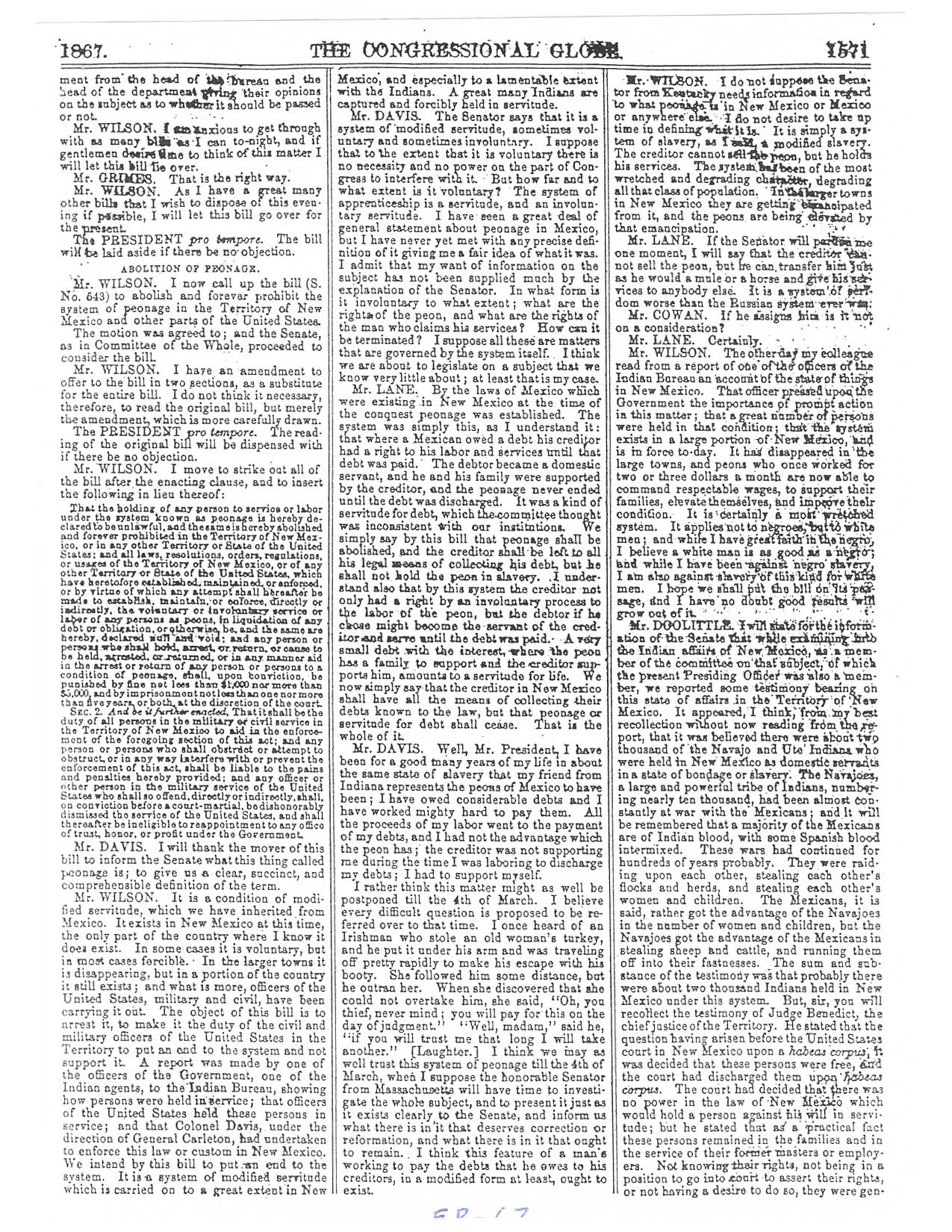
Congressional Globe,
39th Cong. 2d. Sess. p. 1571,
IV. CONCLUSION
For the reasons stated herein, the conviction should be vacated or reversed and the case remanded for further proceedings consistent with this Court’s findings.
Respectfully submitted this 20th day of August 2002.
__________________________
Roger W. Knight, pro se
If the back button does not take you there,
click Home to go
to the Index page of this Antipeonage Act Website,
click Enemies
for the main Enemies
page, click
Letters for the
Letters page, and click
Allies for the
Allies page.
Click 84199
to get to the
main page
for this case.
Or you can use the
Antipeonage Act Site Map.
[1] Violence Reduction Act, Laws 1994 1st Sp. Sess. c. 7 is highly vulnerable to challenge as a multi-subject bill. If declared void as a multi-subject bill, then Initiative 159, Laws 1996 c. 295, and Laws 1997 c 338 are also void as they amend a void statute, not the pre-existing statute that would be restored by an invalidation of the Violence Reduction Act as a multi-subject bill.
[2] “Where a general title is used, all that is required is rational unity between the general subject and the incidental subjects.”
[4]
RCW 26.23.080 prohibits discrimination in
employment on the basis of a child support wage garnishment. Presumably a requirement to pay child
support, however behind the noncustodial parent may be, does not disqualify the
parent from performing the essential functions of his job.