Louis XVI was dead.
Found guilty of treason by the Convention and guillotined in January of 1793, France's king had fallen to the blade, marking the shift of power during one of the most radical phases of the French Revolution: the Reign of Terror. A "relatively brief episode in a process that was begun in 1789 and really didn't conclude until Napoleon's coup d'etat in 1799,"(1) the Terror, nonetheless, was the Revolution's bloodiest and most unforgettable chapter. In one year's time, France was turned upside-down. Among the members of the Convention, the Girondists and the Jacobins, twelve men rose to power with the formation of the Committee of Public Safety. One man found himself standing on the uppermost rung, acquiring the position of a would-be dictator; the other, fighting vigorously for his voice to be heard above the rest, eventually seized the position of second-in-command. But who were these two revolutionaries, their words so earnest and fierce? Were they mere tyrants, thirsty for revolution at any cost, or were they simply na�ve in their images of an ideal society, swayed by the temptations of power?
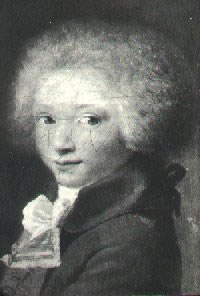 In Arras on May 6, 1758, Maximilien Robespierre was born within months after his parents, Francois Robespierre and Jacqueline Carrault, were married. His mother lay dead from childbirth when he was six, and shortly thereafter his father took to drinking. Eventually his father disappeared, abandoning him, his younger brother Augustin, and his two sisters, Charlotte and Henriette. Raised by his middle-class grandfather and two aunts, young Robespierre was a reserved child, recoiling from close contact with people - a trait that would persevere until his very last days in this world - and grew into a very introverted, self-centered, and prudent young man. When he was eleven years old, the Archbishop of Arras took notice of his academic achievements, offering him a twelve-year scholarship to the famous Parisian college, Louis-le-Grand. Those twelve years would change his life.
As one of his teachers at Louis-le-Grand stated, Robespierre was "stubbornly preoccupied with developing his mind. . His study was his God."(2) It was during those studies that he came across the writings of one of the great philosophes of the Enlightment, Jean-Jacques Rousseau. Rousseau was to become his inspiration, his drive, in everything that would follow. He was to become his idol. In his diary, Robespierre wrote this passage that clearly allows us a glimpse of his feelings for the man and his philosophy:
Divine man! It was you who taught me to know myself. When I was young, you brought me to appreciate the true dignity of my nature and to reflect on the great principles which govern the social order. . . I saw you in your last days and for me the recollection of that time will always be a source of proud joy. I contemplated your august features and saw there the imprint of those dark griefs which the injustice of men inflicted on you.(3)
But just a glimpse that was, for not only did Robespierre share Rousseau's passion for the People and the strengthening of society, but he also shared his jealousy and suspicion which, especially in the later years, grew to delusional depths.
Acquiring his law degree and license to practice, Robespierre returned home in 1781 to live with his two aunts and his sister Charlotte. Unfortunately, snubbed by his colleagues and the bar at Arras, his career as a lawyer was not promising. He had never lost his passion of the Rousseau-esque ideal, and it was at this time in his life when that passion would lead him to the world of politicians and power. In May 1789 he returned to Paris, throwing his attentions entirely into the rising power of the Jacobin Club. His growing influence and steadfast, unwavering attitude earned him the nickname "Incorruptible."
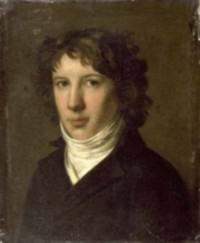 On August 25, 1767, the unruly boy who was to become Robespierre's most devoted follower was born. Louis-Antoine de Saint-Just was the "enfant terrible of the Revolution,"(4) a moody, fiery young man who would in future years become the youngest member of the Committee of Public Safety and, apart from Robespierre himself, the most feared. Living with his widowed mother and two sisters, Saint-Just ran away at the age of nineteen to Paris, taking with him some of his mother's money and squandering it. It wasn't long after that she ordered his arrest, placing him under a lettre de cachet, protective custody and restraint, letting him out only to study law. Law, however, did not keep his attentions. Fancying himself a poet, he again went to Paris in search of a publisher. In 1789, he anonymously published a lengthy, rather pornographic poem entitled Organt, but its appeal was far from popular. The Revolution had just begun, and Saint-Just craved a place in it. Determined, he shifted the manner of his writings two years later and, although most considered him too young to be taken seriously, his published L'Esprit de la R�volution quickly sold out. As he had wished, his voice was beginning to be heard.
As Rousseau was Robespierre's idol, Robespierre was Saint-Just's. In a series of letters to him, Saint-Just makes his devotion known before they even meet:
You who sustain the vacillating country against the torrent of despotism and intrigue, you whom I know as I know God by your miracles, I address myself to you, monsieur, to beg you to join with me in saving my poor region. I don't know you but
you are a great man. You are not merely the deputy of a province; you are the representative of humanity and the republic.(5)
With his debut speeches calling for the execution of Louis XVI without trial, Saint-Just purposely associated himself with the Jacobin Club in 1792, tying his loyalty once and for all to its leader, Robespierre.
The Convention at this time was in terrible disarray. Opposing political clubs worked against each other. The Jacobins and the Girondists commonly disagreed, with the Dantonists and the Hebertists, and the factions of the sans-culottes and the enrag�es following suit in a likewise confrontational manner. Distracted by the wars with Europe, the desperate situation of the French people worsened and the impossibility of the Convention as a whole was apparent. The clubs were constantly at competition with each other for power, and in April of 1793 the Committee of Public Safety was formed, its officials elected from the most respected and prominent men of the Convention. At first, Georges-Jacques Danton and Jean-Paul Marat headed the Committee and brought down the power of the Girondists, but with the July assassination of Marat by a young Girondist extremist named Charlotte Corday, Danton was dismissed a few weeks later and Robespierre replaced one of its members who had resigned because of his ill health. Robespierre had, in fact, been informed of the secret inner workings of the Committee for a full month before by two of its members under Danton, the crippled but determined Georges Couthon and Robespierre's devotee Saint-Just who had been appointed before him. Thus, already having insight on the inner cliques and oppositions, Robespierre easily adapted, soon winning great recognition within the Committee and rising to the position Danton had lost. Despite this, it was Danton who had previously prompted the beginnings of the Reign of Terror that was to follow; he had set up the revolutionary tribunals throughout the country, these same tribunals that would be widely used to facilitate the Law of Suspects that upheld the Terror's power.
 On October 16, Marie Antoinette, the executed king's widow, was herself guillotined. The aristocracy had officially lost its holdings. Saint-Just focused his attentions on the social issues in France. Writing the Ventose Decrees, he held that "the property of the people recognized to be the enemies of the revolution is sequestered for the sake of the republic. . ."(6) Thereafter, he proclaimed his dream of a Spartan utopia in The Republican Institution. Saint-Just's speeches were passionate and often possessed a theatrical flair. Driven by his violent and sensitive mind and avoided by nearly all of his colleagues, he painted himself a mask of apathy to hide behind. Not surprisingly, the Committee often chose this handsome young man to deliver the death sentences to the Convention. His heartless fa�ade swiftly arose the nickname "The Angel of Death." Many whispered accusations of narcissism, but only the very few who knew him well knew his sense of inner self-worth lacked greatly, fueled by his macabre nature and the many times he wished to commit suicide.
The issue of religion and national spirituality was also one heavily debated. In November of 1793, the Convention aspired to rid France of Christianity, which it believed was an unsound foundation. They proclaimed a new Religion of Reason, replacing the Roman calendar with their Revolutionary calendar, and closing down churches. Jacques-Ren� H�bert, an atheist, and his political club backed this decision, although the majority of the common French people heartily disagreed with it. Robespierre, realizing this radical movement could be the undoing of the entire Convention, fought against it. March of 1794 brought about the arrest and execution of H�bert and his followers. Danton's demise was soon to follow. When the time came for Danton himself to be arrested, Saint-Just implored Robespierre to allow him read the death warrant publicly at the hall of the Convention. Forever cautious, Robespierre feared an uprising amongst the clubs and refused him, upon which the young man promptly threw his hat in the fire and stormed out of the room. Danton was instead arrested at his home that night along with many of his associates. A one-sided trial followed a few days later and, with the convictions of Robespierre and Saint-Just, the Dantonists found their end at the guillotine like so many before them. Danton, the former "Titan of the Revolution," was dead, and the Terror was taking a turn for the worse. The number of executions of "enemies of the revolution" rose monthly, and Robespierre justified it, stating, "virtue, without which terror is fatal: terror, without which virtue is powerless."(7) The violence inherent in Saint-Just's speeches heightened with such public utterances as, "The vessel of the Revolution can arrive in port only on a sea reddened with torrents of blood."(8) The guillotine's blade remained crimson.
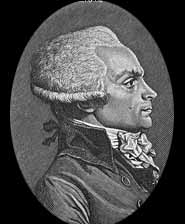 Again, the issue of religion surfaced, but this time Robespierre took it into his own hands. On May 7 he established the Cult of the Supreme Being, arranging its upcoming festival. His suspicion appeared to lessen at this time and his mood heightened as he dreamed of spiritual unity, but that was soon to change. On May 23 an assassin made an attempt on his life. The following day, a young woman made a similar attempt. Robespierre fell back into his old paranoia, but with the attempts it seemed only to increase. His nerves were unstable, apparent in "sudden fits of weeping. . and irrational terrors."(9) His health, both physically and mentally, was in a backslide. Saint-Just was often called to address the Convention for him, although the young man went off on another of his frequent "military missions" in June. His ill health growing worse and his absence at the Convention allowing his remaining enemies the time to join forces, Robespierre requested Saint-Just to return. The young man immediately did so, spending many of his last days with Robespierre at his residence on the rue St. Honor�. On July 24 (6 Thermidor), Saint-Just headed an urgent attempt at reconciliation in the Committee, but the political and personal wounds within were beyond any possible healing. After his lengthy disappearance, Robespierre finally returned to the Convention two days later (8 Thermidor) to deliver a speech, prompted by his now full-blown distrust, to deliver those he believed to be his last remaining enemies and traitors of the revolution to the guillotine. The Convention was in a panic, but, despite their cries for him to divulge the accused, Robespierre refused. Saint-Just would return in the morning with the report. It was that morning that would be their ultimate downfall.
On the 9 of Thermidor, Robespierre arrived at the hall of the Convention, flanked by his last two followers, Saint-Just and Couthon, who in the very beginning had been his first. All hell promptly broke lose. As Saint-Just began to read the report, he was greeted by an uproar. It was not long until the frantic mob demanded the arrest of Robespierre, the shouts moving as if a wave of fear and rage and taken up by nearly everyone present. Saint-Just seemed paralyzed in shock; Robespierre returned angrily with his own defense but was drowned out. In a haste, he, Couthon, Saint-Just, Augustin (Robespierre's younger brother), and Philippe Lebas (a friend of Saint-Just's) were arrested and convicted without trial.
In an upstairs room of the H�tel de Ville, they were imprisoned for a single day. Augustin leapt from a third-story window in an attempt at death, but merely lay broken below. Couthon crawled from his wheelchair to hide beneath a table, but was hurled down a flight of stairs by the enraged guards when they arrived. Lebas handed Robespierre a pistol, and then shot himself to death with another; when Robespierre attempted to do the same, the bullet instead missed and shattered his jaw. Saint-Just alone remained uninjured, not returning from the silence he had lost himself within at the hall of the Convention. When the guards gathered them up for execution before the next morning's dawn, he was the only one able to walk of his own accord. Robespierre lay half-conscious for the last hours, his jaw bandaged but bleeding profusely. Saint-Just was allowed to stand by his side, handcuffed and staring at him miserably, as if unable to cry. Couthon was brought, with the half-dead Augustin, and all four men were gathered for the last time to be taken to the guillotine. For a fleeting moment, Saint-Just regained his former self, looking upon the crowds coldly and declaring, "I despise the dust that forms me and speaks to you. This dust you may persecute and kill, but I defy you to rob me of that independent life I have given myself in the ages and in the heavens."(10) Couthon was the first strapped to the straight plank, and with much difficulty as his body had been twisted by the fall. Saint-Just submitted without a word. He was twenty-six years old. Robespierre, who had been his only real friend, soon followed him.
The Reign of Terror was ended, its few remaining leaders now in the grave. Robespierre and Saint-Just had envisioned a perfect France, had struggled to attain it, but it was not to be. With their flaws and their triumphs molding their every action and reaction in a period of great disturbance and upheaval, their dreams fell with them before the blade.

|

FOOTNOTES
(1) Hooker, Richard, "The Radical Revolution," World Civilizations [1996]
The Radical Revolution
(2) Loomis, Stanley, Paris in the Terror: June 1793 - July 1794
[Philadelphia and New York: J.B. Lippincott Company, 1964] (p.p. 266)
(3) ibid, Paris in the Terror: June 1793 - July 1794(p.p. 266)
(4) Palmer, R.R., Twelve Who Ruled: The Year of the Terror in the French Revolution
[Princeton: Princeton University Press, 1941] (p.p. 9)
(5) "Saint-Just: History," Garnet Sigma, Garnet Sigma
(6) Maskaliunaite, Asta, "Social ideas of Louis Antoine Saint Just," Sociumas [1998]
Sociumas
(7) "Robespierre: Terror and Virtue," Modern History Sourcebook,
Modern History Sourcebook
(8) Loomis, Stanley, Paris in the Terror: June 1793 - July 1794
[Philadelphia and New York: J.B. Lippincott Company, 1964] (p.p. 284)
(9) Ibid, Paris in the Terror: June 1793 - July 1794 (p.p. 353)
(10) Palmer, R.R., Twelve Who Ruled: The Year of the Terror in the French Revolution
[Princeton: Princeton University Press, 1941] (p.p. 367, 380)
Please see the Bibliography for the complete list of resources used.
Author's Note: �2002, written by Rene Weise ~ Feel free to use the above research paper for historical information, quotes, ideas, or facts. Please do not plagiarize. Use common sense and cite properly. Merci.
*hold cursor over illustrations for title
|
Robespierre and Saint-Just: The History
Speeches of Robespierre and Saint-Just
Timeline of the French Revolution
The Revolutionary Calendar
|