ANCIENT EGYPT SURVIVES UNTIL THE PRESENT DAY
An Alternate History Timeline
by Robert Perkins
PART SEVEN--1600 TO 1800 AD
c. 1600 onwards--Electricity had been known to science since
at least 600 BC,
when Thales of Miletus discovered static electricity can be produced by rubbing
amber. The knowledge had little practical application, however, and little more
research was done. That is not to say that NO research was done, however,
and by 200 BC, scientists in Mesopotamia were experimenting with the first
electric batteries, clay jars lined with copper, capped with asphalt plugs with
conducting wires hanging down into the interior, and filled with a saline
solution
to produce a small electric current, which were used for electroplating
purposes.
Over the 1800 years since that time, knowledge has come slowly. But by 1600
AD, the basic theories and laws of electromagnetism are known, and scientists
and inventors are tinkering with electromagnets, batteries and static
electricity
generators, trying to find practical uses for the knowledge thus gained. Thus
the
groundwork for another phase of the Scientific and Industrial Revolution has
been laid.
c. 1600 AD--The true flintlock firing mechanism is invented in Egypt. All major
armies will re-equip with flintlock firearms within the next two decades.
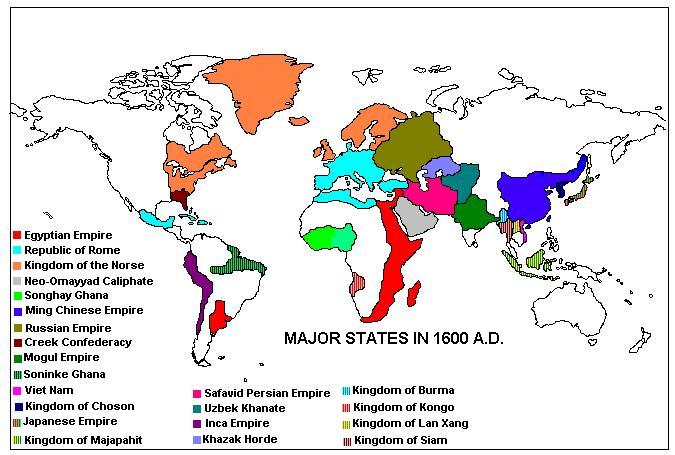
c. 1600 AD onward--Since the 1580s, Russian Cossacks have been migrating
into Siberia, beyond the control of the Tsarist government of Russia. When, in
1600 AD, Tsar Boris I sends his army to subdue the Cossacks and to establish
government control over them, the Cossack migrated eastward to escape the
authority of the Tsar. When a few years later the Tsar’s armies follow, the
Cossacks migrate again, and the process starts all over. By this process, the
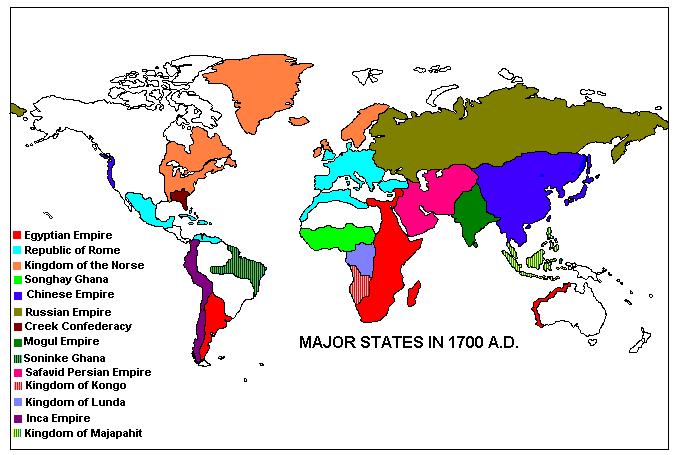
Russian Empire will expand all the way to the Pacific Ocean by 1700 AD.
1600-1700 AD--Colonial Expansion in the New World. In this TL, there has not
been anything like the mass exodus of people from the old world to the new
which occurred (especially to the English colonies in the New World) in the OTL.
This has resulted in somewhat slower expansion of population in the holdings by
the various powers in the new lands, and, as a result, slower expansion of the
holdings themselves.
--The Norse have followed the model of colonization used by the French in North
America prior to their defeat in the French and Indian Wars. They are heavily
settled on the eastern seaboard, but in the interior west of the Appalachian
Mountains are somewhat thin on the ground, despite having been in North
America (or Vinland, as it is known in this timeline) since shortly after 1,000
AD.
They have been primarily interested in trading, and for the most part, have
peacefully established trading settlements scattered through the interior among
the Skraeling tribes there. Of course, when one or another of the tribes has
made trouble for them, the Norse have not been above brutally suppressing the
outbreak even to the extent of exterminating the tribe in question. However, as
they have spread farther from their main population centers on the east coast,
and as the native tribes have recovered from the great epidemics and absorbed
old world technology and agriculture, they have found it more and more difficult
to expand westward. During this century, therefore, the Norse cross the
Mississippi, but they don’t expand much to the west beyond OTL Louisiana,
Arkansas, Missouri, Wisconsin and Minnesota, as they encounter strong native
resistance from the Great Plains Tribes, who have had both horses and
ironworking for a long time and now are a formidable military power in their own
right...or would be, if they could unite.
--The Romans have followed something liike the model used by the Spanish in
their colonies. They have established themselves as the ruling class in what
are,
primarily, native societies, and forcibly imposed a veneer of Roman culture over
the old native civilizations. The native religions are generally suppressed, and
Christian missionaries are busy saving the souls of the heathen. Latin is in the
process of replacing the various native tongues, much as Spanish did in the
OTL. However, unlike the Spanish, they are interested in more than just looting
the new lands of their mineral wealth, which has two effects on their
colonization...they don’t expand as rapidly as the Spanish did (they don’t
have
freebooting expeditions going off into unexplored areas seeking "Lost
Cities of
Gold," for example), and the areas they do occupy are more heavily settled
by
Romans. Thus, by 1700, the Romans have expanded north to the line of the Rio
Grande, Gila, and Colorado Rivers, where they have...in typical Roman
fashion...established a defensive line marking the northern frontier of their
holdings. They have also settled the northern coast of South America. In the
south beyond their province of Aztecaea, they do not expand, seeing the
steaming jungles of Honduras and Guatemala as not really worth having.
--The Ghanaese colony in Brazil was givven a major population boost by a large
exodus of Soninke and Mandinke people who followed their king into exile when
the throne of Ghana was usurped by the Songhay dynasty. However, since that
time, the colony has been in a state of "cold war" with the
motherland, and there
has been little immigration as a result. So the colony has expanded slower than
it might have between 1600 and 1700. They have expanded a little farther north
and south along the coast, but that is about it.
--The Egyptian colony in the Platte Rivver region of South America has also
expanded slowly to the south and west. However, the discovery of gold and
silver in the region has lead to something of a "gold rush" which has
brought an
influx of settlers from the Egyptian Empire into the new lands, which by 1700 is
fairly heavily settled. The Egyptians have also found the regions to the South
(the Pampas) well suited to cattle raising, and have established that industry
there.
1600 AD--Spurred by the success of the Choson Turtle Ships in the recent war
with Japan, the Ming Chinese Navy launches the first fully armored ironclad
warship, the MEN OF T’ANG. It is a broadside frigate, armed with 50 guns, clad
with 4 inches of iron plate, propelled by two powerful steam engines driving a
screw propeller. The new ship instantly renders obsolete all the wooden naval
vessels in the fleets of the various world powers, but this is not immediately
recognized. The Chinese will launch many more of these vessels, many of
which are more powerful than the MEN OF T’ANG, over the coming years.
1602 AD--Reports about the Chinese vessel, MEN OF T’ANG, reach Egypt and
Rome (via their ambassadors) at about the same time. Both nations
immediately begin work on similar vessels. The Norse soon follow suit.
1603 AD--The Emperor of Japan appoints Tokugawa Ieyasu as shogun, who
moves his government to Edo (Tokyo) and founds the Tokugawa dynasty of
shoguns. The Tokugawa Shogunate divides the subjects into five hereditary
classes of decreasing importance (lords, samurai, farmers, artisans, merchants).
Significantly, in accordance with the Tokugawa Shogunate’s Confucian beliefs,
the merchant class is at the bottom of the hierarchy because it is believed that
trade "produces nothing of value to society" and therefore merchants
are
"parasitical." This will have profound consequences later.
1603-1606 AD--In 1603, Shah Abbas I of the Safavid Persian Empire forms an
alliance with Sultan Akbar I of the Mogul Empire against the Uzbek Khanate,
and the two empires declare war on the Uzbeks. The Khanate is conquered
and divided between the two empires.
c. 1605 AD onward--Since earliest civilization, the primary source of lighting
in
homes has been lamps fueled with animal or vegetable oils (whale oil or olive
oil
being two popular fuels). Candles, of course, have also been available as a
secondary and more expensive means of illumination. Both of these means
give poor light, and the oil-fueled lamps produce foul smelling smoke. And both
whale and olive oil spoiled if left on the shelf too long. Meanwhile, for
centuries,
Egypt has been distilling petroleum for use in the manufacture of Egyptian Fire.
Two of the products of this process are gasoline and kerosene. Around 1605
AD, an anonymous brassworker in Egypt has the idea to use the less volatile of
these products, kerosene, as a lamp fuel, and in cooperation with a glassworker
in a neighboring shop, designs a lamp to burn said fuel. The lamp produces a
much brighter light than the old whale and olive oil lamps, there is no
unpleasant
smell from the burning fuel, and the fuel can be stored indefinitely. The
inventor
knows he has a winner, and arranges to get his new product demonstrated
before Pharaoh Rameses XXVII. The Pharaoh is suitably impressed, and
orders the new lamps for palaces and temples throughout the kingdom. This
presents the inventor with something of a problem...how to produce the large
number of lamps needed within a reasonable amount of time? He talks with
various other brass workers, mechanics, glass workers, and so on, and comes
up with the idea of assembly line manufacture using interchangeable parts. He
basically cuts his lamp apart, makes molds from the various sections, and
produces cast-brass copies of them. He then assembles a group of brass
workers, each of whose responsibility it will be to weld or screw another part
onto
a lamp, passing it down the line until it is fully assembled. Using this
technique,
the new lamp-making company is able to deliver the lamps well ahead of
schedule, and at significantly less cost to the manufacturer. The success of the
lamp-making firm inspires other manufacturers to imitate it’s manufacturing
process, and mass production is born. It will have profound influences on future
society.
1605 AD--Rome launches it’s first ironclad warship, a monstrous steam ship of
the line armed with 80 cannon and armored with a belt of 4 inch armor plate,
called the JULIUS CAESAR. Later that year, Egypt launches it’s own ironclad,
a steam ship of the line called the PHARAOH NECHO II, armed with 90 guns
and armored with a belt of 5 inch armor plate, and finally, near the end of the
year, the Norse launch the SEA DRAGON, a steam ship of the line armed with
85 guns and armored with a belt of 4 inch armor plate. This marks the
beginning of a new naval arms race among the great powers in which smaller
powers, such as Songhay Ghana and Soninke Ghana, will also participate (but
on a lesser scale, of course).
1608-1652 AD--Reign of the Inca Emperor Manco Capac III. Manco is a
far-sighted ruler who is aware of the growing power of the various old world
empires as they expand in the region. Manco has plenty of gold and silver, as
well trade profits from another product which, since it has been introduced into
the old world in the late 1500s by Egyptian and Soninke Ghana traders, has
proven increasingly popular and profitable....coca leaves. Manco uses these
financial reserves to take steps to modernize his empire. He establishes
relations with Egypt (his negotiations will eventually result in a mutual
defense
treaty between the two empires), and from them imports technicians and
machinery which he uses to build an industrial base, including firearms, cannon
and gunpowder factories (the gunpowder industry is greatly helped by the fact
that the Inca possess the huge nitrate reserves of the Guano Islands, off the
Peruvian coast), iron and steel mills, and other vital industries. He modernizes
the Inca military, and expands the empire north to the Isthmus of Panama and
south to Cape Horn. He also establishes, for the first time, an Inca Navy,
purchasing warships from Egypt and Soninke Ghana, and building shipyards
where Egyptian and Soninke Ghanaese shipwrights in the pay of the Inca
Emperor build additional ships for Manco’s growing navy. By the time of
Manco’s death in 1652, the Inca Empire has been greatly strengthened, and is
far better prepared to meet the challenges ahead.
1610 AD--Mass production using interchangeable parts first applied to the
firearms industry in Egypt. Other nations soon follow.
1612 AD--Roman chemist Quintus Lucius Galba discovers that electric current
heats metal strips to incandescence, a principle that would later be used in the
engineering of the light bulb.
1614 AD--Within a couple of decades after the first Egyptian ships began trading
in Japan in 1543, they were followed by the first Roman and Norse ships. And in
the wake of these ships came Christian missionaries. Since that time, these
have been basically tolerated, but now Shogun Ieyasu is becoming increasingly
worried about the effect Christianity is having on Japanese culture, especially
in
that it makes people question the rigidly stratified society which the Tokugawa
Shogunate has imposed on Japan. Accordingly, in 1614, Ieyasu bans
Christianity from Japan.
c. 1615 AD--The new kerosene lamps are proving increasingly popular, but the
oil for them is still expensive. Petroleum is being collected as seep oil in
various
places around the world, but production is limited...and therefore, the supply
of
kerosene is limited. Around 1615 AD, a Greek inventor named Agamemnon
Theopoulous living in Egypt designs a drilling machine, powered by a steam
engine, which he initially sells as a means of drilling water wells. But, while
drilling such a well in the Sinai peninsula, a strange thing happens....instead
of
finding water, he finds petroleum instead, deep under ground. Knowing that this
is liable to be MUCH more profitable than any water well could ever be,
Theopoulous tells the landowner (a small farmer, not very educated or worldly)
that there is no water on the land, neglects to mention the find of petroleum,
and
offers to buy the now worthless plot from the landowner. The landowner agrees,
and happily goes off to find other fields to till. Meanwhile, Theopoulous forms
his own petroleum company, and gets rich by pumping the "black gold"
out of
the ground and selling it to kerosene refiners. Others will follow in his wake,
and
the price of kerosene drops substantially over the next few years. Kerosene
lamps begin to make their way into the homes of the poor as well as the rich.
1615 AD--Shogun Ieyasu of Japan captures Osaka and destroys the Toyotomi
clan. His power in Japan is now absolute. Also in this year, an Egyptian vessel
returning to Egypt from the Kingdom of Majapahit is blown off course and
discovers the northwestern coast of Australia. Upon returning to Egypt, the
news is relayed to Pharaoh Rameses XXVII, who decides this might be a good
place to establish a trading colony, as it is close to Majapahit and the Spice
Islands, as well as being a convenient waypoint for ships trading with China.
1616 AD--Nurhaci unifies the Jurchen (Manchus) and creates the state of
Chin/Qing in northeastern China.
1616 AD onward--Egyptian colonization in Australia. In 1616, an
Egyptian colonization expedition sails for Australia. They land near the mouth
of
a river on the northwest coast (the OTL Daly River) of the continent, and a
settlement is established. Later expeditions will other establish settlements
along the coast between the sites of OTL Perth and Darwin by 1700 AD. The
Egyptians, of course, meet the aboriginal inhabitants of the continent, and an
uneasy relationship forms between the two groups which is, on the whole,
relatively peaceful. Egyptian settlers introduce cattle and sheep to the region,
and begin cultivating grain and cotton in regions where they find the climate
and
availability of water suitable.
1619 AD--Pharaoh Rameses XXVII dies, succeeded by Thutmoses XII. Also in
this year, the Wan Li Emperor of Ming China dies. He is succeeded by his son
Chang Luo, who takes the throne as the Tai Chang Emperor.
1619-1622 AD--Over the preceding centuries, the Neo-Omayyad Caliphs have
become increasingly weak and have retreated, more and more, into a life of
hedonism, which has caused much disaffection among the populace. In 1619,
there is a major rebellion against the Caliph, who is overthrown and killed in
the
major riots which take place in Mecca. The entire royal family is hunted down
and killed by the mobs, and the Arabian peninsula falls into chaos. Claiming to
be acting to preserve the sacred places of Islam, Safavid Shah Abbas I of Persia
sends an army to "restore order." The Persians take control of the
entire
peninsula, put down the riots, establish guards over the holy places...and then
stay. Arabia becomes part of the Safavid Empire.
1620 AD--The Tai Chang Emperor of Ming China dies, and is succeeded by his
son You Jiao, who takes the throne as the Tian Ji Emperor.
1620-1650 AD--Expansion of the Ghana Empire in Africa. In a series of
campaign lasting 30 years, the armies of Kings Askia IV and Musa III of
Songhay Ghana expand the empire eastward across the Sahel, following the
trans-Sahel rail line, until they come into contact with the expanding Egyptian
frontier.
1621 AD--Using the principles learned during his extensive studies of
electricity,
Roman physicist Lucius Quintus Galba constructs a primitive electric motor able
to convert electrical energy into mechanical energy using electromagnetic
induction.
1622 AD--The Roman railway across the Sahara from Carthage to Timbuktu is
completed, facilitating trade between the two empires.
1625-1629 AD--Shah Abbas I of the Safavid Persian Empire attacks the Khazak
Horde. The Persians destroy the main Khazak army, and absorb most of their
lands. Concerned about the fate of the Christian minority of Russian Cossacks
(who have, for some time, been migrating into the lands held by the Khazak
Horde, where they have been permitted to settle if they agree to pay homage to
the Khazak Khan) who live in the region, Tsar Dimitri III sends Russian armies
into the northern portions of the region. The Persians and Russians clash on
the border, but the fighting is inconclusive. Shah Abbas (now called "The
Great"
because of his expansion of the Persians’ domains) dies in 1629, and his
successor, Safi I, is content with his empire, and sues for peace. A treaty is
drawn up, establishing the border between the two empires, in 1629 AD, and
peace settles on the region.
1628 AD--The Tian Ji Emperor of Ming China dies, and is succeeded by his
brother, You Jian, who takes the throne as the Chong Zhen Emperor.
1629 AD--An Egyptian engineer named Neferkare demonstrates a practical
application of electromagnetism in metallurgy by constructing an electromagnet
capable of lifting ten times its own weight. His invention would later be
applied in
the development of practical electric motors and telecommunications devices.
1629-1635 AD--The Kingdom of Majapahit conquers the southern half of the
Malay Peninsula.
1630-1670 AD--Expansion of the Egyptian Empire in Africa. Over the preceding
1,300 years, Egyptian settlers and cultural influence have crept ever deeper
into
the interior of Africa, and, as mentioned previously, the peoples of the
interior
have formed numerous small city states as a result of this influence. Relations
between those states and the Egyptian Empire have, for the most part, been
peaceful, but in 1630, Pharaoh Thutmoses XII decides to follow the example of
his illustrious predecessor, Ahmosi VII, and extend Egyptian domination into the
political realm in these regions as well. In a series of campaigns lasting 40
years
(and completed by his successor, Necho XXI), Egyptian armies move inland,
and subdue large sections of the interior of southern and central Africa.
1633 AD--Concerned by the continuing influx of foreign ideas which are
undermining the rigid societal structure of Tokugawa Japan, Shogun Iemitsu
forbids Japanese citizens from traveling abroad and reading foreign books.
1637 AD--The Manchus, led by Nurhaci's son Abahai, invade the Kingdom of
Choson, which becomes a vassal state of the Manchus
1638 AD--Norse scientist Magnus Anderssen discovers that electric current may
be induced in a wire using a changing magnetic field--the principle of
electromagnetic induction that would later have such important effects on the
electronics industry. He does not publish his findings. Also in this year,
Shogun
Iemitsu forbids ship building in Japan.
1639 AD--Shogun Iemitsu of Japan restricts foreigners to Nagasaki. Also in this
year, applying the principles of electrochemical reaction, whereby electric
current
may be produced from the conversion of the chemical energy in fuel, Norse
chemist Sven Jorgensen invents the first fuel cell. Also, in this year, the
first
Russian Cossacks, moving west to avoid the control of the Russian Tsar, reach
the Pacific Ocean.
1641 AD--Shogun Iemitsu of Japan bans all foreigners, except Chinese and
Egyptians, from Japan. Egyptian and Chinese merchants are restricted to one
small trading post on an island in Nagasaki Bay. Japan now retreats into a
period of self-imposed isolation, from which it will not emerge for a long time.
1644 AD--The Manchus invade northern China, defeat the northern Ming army,
and besiege Beijing. In this time of crisis, the Chong Zhen Emperor is a
weakling who cowers in the Forbidden City and refuses to take command during
the crisis. However, the Prime Minister, Lee Kwan Zhu, is a strong man from a
military family with connections to the Imperial line, and he summons another
army from the southern provinces which lifts the siege and forces the Manchus
north of the Great Wall.
1645 AD--Lee Kwan Zhu, the Prime Minister of the Ming Chinese Empire who
was responsible for repelling the Manchu invasion of 1644 while the Ming
Emperor cowered in the Forbidden City, deposes the last Ming Emperor, with
support from the generals of the army. The Chong Zhen Emperor commits
suicide rather than accept the shame of exile, and the Ming Dynasty comes to an
end. Lee Kwan Zhu takes the throne, founding the Chong Xin Dynasty. Lee
Kwan Zhu is determined that his dynasty will not fall into effete weakness, as
it’s
Ming predecessor did. He according takes several significant steps. The new
Emperor finally settles, once and for all, the continuing struggle between the
Confucian scholars who urge isolation and eschew trade and expansion, and the
military and commercial classes, who of course want the opposite. Lee Kwan
Zhu, coming from a military family himself, orders the banishment of the
Confucian scholars from the court, and appoints all of his ministers from among
the military and commerical classes. To ensure that prospective future
Emperors are exposed to the world outside China, he also begins the practice of
sending imperial princes to be educated in Egypt, which has maintained a close
relationship with China since relations were established two centuries ago, and
in
Rome. The new Emperor also orders the destruction of the Forbidden City, and
the construction of a much more austere palace which is not isolated from the
rest of the city of Beijing. During his reign, the Emperor Lee Kwan Zhu will
also
pursue much more aggressively expansionist policies, both militarily and
commercially. He modernizes and expands, with Egyptian help, the Chinese
military (both army and navy), and greatly expands the Chinese trading fleet. A
sleeping giant is about to awake....
1647 AD--Independently of Magnus Anderssen, Roman chemist Gaius Flavius
Maximius discovers electromagnetic induction and realizes the potential of this
principle in the construction of electric power generators.
1649 AD--Using the principles of electromagnetic induction and electric signal
conduction through wires, Egyptian inventor Ptahkhemwy begins development
on his electric telegraph for relaying electric signals over long distances.
Also in
this year, after failing to publish his discovery of electromagnetic induction,
Magnus Anderssen discovers that an electric current may be produced in a
conductor that is disconnected from a battery--the principle of self-induction.
1650 AD--The pirate Koxinga founds a pirate kingdom in the South China Seas,
based on Formosa (Taiwan).
1650-1660 AD--War between the Russian Empire and the Norse Kingdom. IN
1650, Tsar Feyodor III of Russia, desiring to have access to the Baltic Sea,
declares war on the Norse Kingdom and invades the Norse provinces along the
Baltic Coast, starting an exhausting war which will last for a decade between
the
two powers. Finally, in 1660 AD, the Russians inflict a major defeat on the
Norse
outside the city of Riga, and Norse King Sven III sues for peace. In the treaty,
the Norse cede their provinces south of Lake Ladoga and the Gulf of Finland to
Russia. Russia now has a "window on the west" and begins to build a
fleet in the
Baltic.
1651-1663 AD--War between China and the Manchus. Emperor Lee Kwan Zhu
of China declares war on the Qing (Manchu) Kingdom in 1651 AD. In a series of
campaigns lasting over a decade, Chinese armies defeat the Manchus utterly
and destroy their kingdom. The Chinese Empire annexes both Qing and it’s
vassal, the Kingdom of Choson, in 1663 AD.
1652-1689--For a long time, pirates operating out of the archipelago which is,
in
the OTL, called the Philippine Islands, have plagued commerce between
Majapahit and China. In 1652, King Jayanagara IV of Majapahit decides to end
this problem once and for all by conquering these islands. In a series of
campaigns lasting almost 3 decades and concluded by Jayanagara’s successor,
Wijayara III, this is accomplished. Majapahit is now at the height of it’s
power.
1656--1664 AD--Emperor Lee Kwan Zhu, intrigued by reports he has heard of
the New World, decides to send a fleet of exploration to find the west coast of
the new lands. This expedition sails across the Pacific in 1656 and eventually
explores from Puget Sound all the way down to the Roman settlement of Nova
Ravenna (what in OTL is the city of Acapulco, Mexico) before returning to China.
The fleet returns to China in 1664 AD, laden with trade goods from the New
World and tales of the many strange and wonderful things they have seen.
1658 AD--Emperor Lee Kwan Zhu sends an invasion fleet to subdue the pirate
kingdom of Formosa. The Chinese conquer and garrison the island.
c. 1660 AD--Under pressure from the expansion of the Egyptian Empire into the
interior of Africa, several city states in central Africa unite under the
leadership of
the King of the city state of Lunda. Also at about this time, the Kingdom of
Kongo expands into the interior until it makes contact with the frontiers of the
Egyptian Empire. The Manikongo of Kongo makes a mutual defense treaty with
the King of Lunda, and together they are able to halt the expansion of Egypt to
the west.
1666 AD--A Russian inventor named Boris Vladinov invents the first practical
breech-loading musket. The idea does not immediately catch on, however.
1666 AD onward--Having digested the reports brought back by the fleet of
exploration to the New World, in 1666 AD the Chinese Emperor Lee Kwan Zhu
decides to send an expedition to establish a colony in the new lands. The fleet
lands in San Francisco Bay, and a settlement is established there, called
Shanghai Xin. Future expeditions will follow on a yearly basis, establishing
other
settlements along the coast. By 1700 AD, Chinese settlements will extend from
San Francisco Bay north to Puget Sound, including another major settlement at
the mouth of what in OTL would become the Columbia River, and on OTL
Whidby Island and the adjoining coast in Puget Sound.
1658--Egyptian inventor Ptahkhemwy successfully demonstrates his telegraph in
public. Independently of Ptahkhemwy, Roman mathematician and physicist
Publius Theodosius Scipio constructs his own electromagnetic telegraph using
two copper wires and a mechanism for detecting electric current. Both Egypt
and Rome begin to build telegraph systems linking the major cities of their
empires. Within the next three decades, the technology will spread throughout
the world.
c. 1665 AD--The first telegraph lines in the New World are built almost
simultaneously by the Romans, Norse, and Egyptians in their respective colonies
in the New World.
1666 AD--Pharaoh Thutmoses XII dies, succeeded by Necho XXI. Also in this
year, Egyptian engineer Sethotep designs an electrical generator powered by
electromagnets that can start itself using residual magnetism left on the
electromagnet. The so-called "self-excited" generator could be
produced in mass
quantities because of its reliance on electromagnets rather than steel magnets.
1667-1688 AD--War between China and the Mongols. In 1667, Emperor Lee
Kwan Zhu of China decides to end the Mongol threat to his northern borders,
once and for all, and Chinese armies are sent on campaigns to subdue these
troublesome nomads. It takes almost 20 years and has to be continued by the
succeeding Emperor, but by 1688, the Mongols are firmly subdued and the
region is ruled by a Chinese governor.
c. 1668 AD--the first telegraph lines are built in the Russian Empire.
1669 AD--Roman physicist Carolus Tiberius Cincinatus invents the earliest
electric storage battery, a device that would later be widely using in motorized
vehicles. Also in this year, Emperor Lee Kwan Zhu dies, and is succeeded by
his son, Lee Chin Jiang.
1670-1680 AD--Rome expands it’s holdings in north Africa, seizing the various
city states along the northwestern coast down to the city of Nouadhibou.
c. 1672 AD--the first telegraph lines are built in the Chinese Empire and in
Safavid Persia.
c. 1675 AD--Ever since the invention of the steam engine, various inventors have
been trying to produce a practical steam-powered vehicle for use on regular
roads. A number of slow, clumsy, unreliable, noisy, and dangerous vehicles
have resulted, but they have never been more than a novelty. Other inventors
have been tinkering with the idea of an internal combustion engine, powered by
various fuels (gunpowder, hydrogen, olive oil, kerosene, etc.) but none of these
have been very successful, either. Then, around 1675 AD, a Roman inventor
named Aemellius Paullus designs a practical internal combustion engine fueled
by gasoline, a byproduct of kerosene processing, fired by electrical sparks
produced by one of the new Cincinatus Batteries. Up to this time, most of the
gasoline being produced by kerosene refiners has gone to waste, and has
usually been destroyed by burning (except for small quantities the Egyptian
military uses in the production of Egyptian Fire). It will take a few decades
and
improved designs, but the first practical non-rail engine-powered vehicles will
soon follow, and once again, will revolutionize society. Also at about this
time,
the first telegraph lines are built in Songhay Ghana.
1675 AD--Pharaoh Necho XXI dies, succeeded by Psamtik XXIII. Psamtik
begins negotiations with the King of Songhay Ghana for a joint project to
construct a telegraph line across the Sahel, following the railroad line,
linking two
empires.
1675-1690 AD--For centuries, Japan has harbored pirates which have preyed on
Chinese shipping and made raids on the Chinese coast. Emperor Lee Chin
Jiang of China has sent several demands to the Shogun Ietsuna for the
eradication of these pirates, which have been not only ignored, but rudely
rejected by the Shogun. And so, in 1675, Emperor Lee Chin Jiang orders an
invasion of Japan. A Chinese fleet of 400 transports, escorted by a large fleet
of
Chinese men-o-war, crosses the Sea of Japan from Korea and lands at the town
of Tojimbo, on the west coast of the island of Honshu. The Japanese fleet tries
to intercept the invasion force, but, being composed of oar-driven galleys, is
easily smashed by the steam driven, modern Chinese warships. A Chinese
army of 250,000 men lands, and moves toward Edo (Tokyo). The Shogun’s
main army meets the Chinese force outside Edo, and is smashed. Edo is taken,
the Japanese Emperor is captured and executed, and the Shogun flees.
However, Ietsuna is not through yet, and rallies his forces in the countryside.
For
the next 15 years, the Japanese will fight a grinding, wearing campaign of
sieges and guerilla warfare against the Chinese, who are forced to reduce city
after defended city, castle after castle, subduing the Japanese piecemeal at
huge cost. But finally, by 1690 AD, the final Japanese strongholds are taken,
and the last significant Japanese military forces are defeated. A Chinese
viceroy
takes residence in Edo, and Japan becomes a province of the Chinese Empire.
1676 AD--After much negotiation, King Mansa Askia of Songhay Ghana
concludes an agreement with Pharaoh Psamtik XXIII for the joint construction of
a telegraph line linking his kingdom with the Egyptian Empire and running
alongside the railroad line through the Sahel. Construction begins later that
year, and the line will be completed before the end of the decade. Also in this
year, the first trans-Atlantic telegraph cable is laid by the Norse Kingdom,
linking Britain to the city of New Oslo in Vinland.
1679 AD--Norse engineer Lars Olssen designs the first high-voltage
direct-current generator practical for mass production and distribution.
1680-1700 AD--Emperor Lee Chin Jiang of China orders his armies to move into
southeast Asia. In a series of campaign lasting twenty years and concluded by
his successor, Lee You Zheng, the Chinese conquer the kingdoms of Vietnam,
Lan Xang, Siam, and the Khmer city states of Cambodia. Also during this time,
Chinese armies move into Tibet and central Asia, moving westward until they
encounter the frontiers of the Mogul Empire and Safavid Persia. After some
inconclusive skirmishes between these powers, a treaty is arranged establishing
the borders between them.
1681-1698 AD--The Second Great Maritime War. The ongoing naval arms race
between the great maritime powers in the west has increased tensions among all
of them, and there have been a number of border clashes between Egypt and
Rome, or between Rome and the Norse, over the preceding decades. All of
them have quickly fizzled out, however. But in 1681, a border skirmish between
Roman and Inca troops leads the Roman Senate to declare war on the Inca
Empire. Invoking their mutual defense treaty with Egypt, the Inca appeal for
aid,
and Pharaoh Psamtik XXIII declares war on Rome (aside from their treaty
commitments, the Egyptians have never been fully reconciled to the loss of the
city of Cyrene and it’s environs to Rome several centuries ago, and see this
as
an opportunity to "get back their own"). Rome declares war on Egypt,
and in
short order, the Norse Kingdom (seeing an opportunity to perhaps grab some
Caribbean colonies) declares war on Rome. The Russian Empire, which owes
it’s independence largely to Rome and which still harbors ill feelings against
the
Norse following their recent war with that kingdom, declares war on the Norse.
The war is is long and exhausting for all concerned, with little accomplished by
either side. The Inca and Egyptian fleets keep the Romans from probing into the
south Atlantic, and as a result the Egyptians are able to feed enough men from
southern Africa into South America in order to keep the Inca from being defeated
by Rome, and so combat stalemates there. In Europe, Russian and Roman
armies gradually beat down Norse resistance. Roman armies invade Syria from
Asia Minor, but dash themselves to pieces on Egypt’s strong defenses there.
Egyptian forces invade Cyrenacia repeatedly, but are repelled. In the Atlantic,
the Roman and Norse fleets battle, while in the Mediterranean the Roman and
Egyptian fleets clash. One historically significant feature of the conflict is
that
the first combats between fleets of steam ironclad warships are fought. But
cannon technology has not kept up with the development of armor, and the naval
battles, like those on land, accomplish little except to deny anyone clear
superiority at sea. The war finally concludes when, in 1696, a large
Romano-Russian army destroys the main Norse field army near Helsinki,
Finland, and over-runs the Norse Finnish possessions. Another Roman Army
crosses the Oceanus Britannicus and invades Britain, over-running the island up
to the line of the Humber River. In 1697, Norse King Harald Gustafssen sues
for peace, and in a humiliating treaty, cedes Finland to Russia and southern
Britain below the Humber to Rome. Having gained what it wanted from the war,
Russia drops out at this time, but the war between Egypt and it’s other allies
and
Rome continues. Later that year, the Egyptian navy finally establishes some
semblance of superiority in the Mediterranean, cutting off Rome’s African
provinces from resupply, and the Egyptian army defeats the Roman army near
Cyrene, and occupies the province. After that, everything pretty much
stalemates, and in 1698 the remaining powers agree to a peace treaty
recognizing the borders as they stand at that time.
1683 AD--Lars Olssen discovers that his generator may double as an electric
motor. Within the next few years, electrically powered industrial machines
spread
through the Norse Kingdom, and shortly afterward, to Rome and Egypt as well.
Also in this year, Roman scientist Licinius Marius Severus confirms the
photosensitivity of the conductive element selenium, an important discovery in
the later development of television picture tubes.
1689 AD--The Chinese Empire and the Russian Empire sign the treaty of
Nerchinsk, to settle the border between the two empires.
1696 AD--Emperor Lee Chin Jiang of China dies, and is succeeded by his son,
Lee You Zheng.
1697 AD--Russian engineer Vasily Kerensky demonstrates the first practical
"horseless carriage" powered by a gasoline-fueled internal combustion
engine.
However, the new vehicle is still slow, unreliable, and expensive. Few but the
very rich buy them, more as novelties than anything else.
1699--A Chinese chemist invents the first practical percussion cap. News of the
invention soon spreads to other empires, and within the next few decades, all
major armies will switch from flintlock to percussion firing systems.
--Colonial Expansion in the New World and elsewhere. In this
century, the pace of colonial expanision picks up for most powers.
--In 1720, Rome crosses the Rio Grande,, ostensibly in response to the
depredations of raiding Apaches and Comanches, and over the next two
decades has moved up into the central Plains region. However, the Plains
Tribes, under pressure from this Roman advance (and with Chinese and Norse
help, since both powers are concerned that the expansion of Rome northward
threatens their own colonial possessions in the region) have, by 1760, united
into
a confederation under the leadership of the powerful Mandan tribe. The
Chinese and the Norse both recognize the Mandan Confederation and make it
known that they will look unkindly on further Roman advances northward, and
the Romans are faced with the choice of either war or negotiation. They choose
the latter, and in 1765 a treaty is signed which fixes the borders of the
various
powers in Vinlandia (North America). The only territory on the continent which
is
not included in the treaty is a region which lies to the north of the Mandan
Confederacy and which is disputed between China, Russia, and the Norse.
Meanwhile, to the south, Rome absorbs the jungle city-states of central America,
and also expands it’s South American holdings. After another border clash with
the Inca Empire (which almost causes another war between Rome and Egypt),
another treaty is signed in 1778 in which the Inca agree to sell their
northernmost
province to Rome (allowing Rome to connect their holdings in North America with
those in South America).
--Egypt, Ghana, and the Incas also expaand their holdings in South America,
which by the end of the century is totally under the control of the various
colonial
and imperial powers.
--Egypt explores the rest of the Austraalian continent, establishing settlements
on
the south and east coasts, while leaving most of the Outback pretty much alone.
Egypt’s claim to the continent is uncontested by the other powers.
--China’s colonies on the west coast off Vinlandia expand to the north and
south,
as well as inland to the line of the Sierra Nevada mountains. By the end of the
century, China rules a strip running from OTL British Columbia to the tip of OTL
Baja California.
--Russia establishes it’s first coloniees in Vinlandia during this century.
1700-1709 AD--Revolution in the Norse Kingdom. In the aftermath of the
Second Great Maritime War, and the humiliating peace treaty which the Norse
were forced to sign, the Norse Althing (an elected Parliament which has existed
in the Kingdom for centuries but which up to now has played only an advisory
role in the running of the kingdom) demands a written constitution which
strictly
limits the powers of the King and places control of most of the government of
the
kingdom in the hands of the Althing. King Harald Gustafssen responds by
dissolving the Althing and attempting the arrest of it’s members. However, the
Althing is warned of this treachery on the part of the King, and flees from Oslo
into hiding before the King’s soldiers arrive to carry out his orders. The
Althing
sets itself up in Stockholm, declares that the King is deposed, and begins to
raise it’s own army. Thus begins the Norse Civil War, which lasts for nine
years.
The forces of the Althing are ultimately victorious, and King Harald is captured
and executed. His son, Bjorn, is offered the crown on condition that he agree to
a written constitution. Bjorn agrees to this (he had opposed Norse involvement
in
the Great Maritime War, and never approved of his father’s high-handed
response to the demands of the Althing), and takes the throne as King Bjorn IX.
After several months of negotiations, a constitution which is mutually agreeable
to all is adopted. It is fairly similar to the constitution of Egypt, in that
the King
remains Head of State, with the power to conduct foreign policy and with control
over how state revenues are spent. But the Althing gains the right to approve or
disapprove new taxes and other state activities which may infringe on the rights
of the people, as well as the right to veto any declaration of war or treaty
with a
foreign power proposed by the king.
1700-1730 AD--Beginning in 1700, Egyptian explorers chart the eastern coast of
Australia and discover the Great Barrier Reef. Settlement of these areas soon
follows. Also during this time period, they discover the Maori Islands (OTL New
Zealand) and establish Egyptian colonies there.
c. 1700 AD--For the past century, experiments have been going on by most of
the major powers aimed at the development of rifled artillery. However, these
have not been entirely successful, as the rifling process tends to weaken the
cannon barrels, leaving them prone to bursting. Around 1700 AD, inventors in
Rome, Egypt and China almost simultaneously invent practical rifled artillery
pieces. This will have dramatic impacts on both land and especially at sea,
where the higher velocity guns made possible by rifling will allow cannon to
penetrate ship-armor for the first time. Within twenty years, all of the world’s
navies will have either converted to rifled artillery completely, or be well
into the
process of replacing their old cannon with rifled pieces.
1701 AD--Pharaoh Psamtik XXIII dies childless. As there are no legitimate male
heirs in the royal house, Psamtik willed the throne to a nephew of his wife,
Queen Tiy. Thus Ahmosi XIII comes to the throne, and with him, the 34th
Dynasty. In this same year, gasoline powered horseless carriages are
independently designed in Egypt and Rome.
1703 AD--Up until now, almost all military firearms have been smoothbore
muskets. Rifles, while known for centuries, are difficult to load and have a
very
poor rate of fire, making them impractical military weapons. However, in this
year Russian gunsmith Yuri Molotov demonstrates his new bullet design, a
conical bullet which is smaller than the bore diameter of the musket from which
it
is fired, but has a hollow base which expands to grip the rifling. Using this
ammunition, a soldier is able to fire as rapidly with a rifle as with a
smoothbore,
but is able to fire accurately out to about 450 yards...four times the accurate
range of a smoothbore. The bullet is immediately adopted by the Russian army,
which immediately begins converting it’s smoothbores to rifles. Other armies
quickly follow suit, and within a decade, smoothbore muskets are no longer in
frontline service anywhere in the world.
1705 AD--As early as the 5th-4th Centuries BC, Chinese and Greek
philosophers had described the basic principles of optics and the camera. In
1620, Egyptian scientist Ipuwer had discovered the silver nitrate darkened when
exposed to light. Since that time, inventors have been tinkering with images
exposed on plates treated with silver nitrate, but with limited success. The
images they produce require up to eight hours of light exposure to acquire, and
then fade after only a few hours. But in 1705, Chinese inventor Chang Li Juan
demonstrates the first practical system of photography, using a solution of
silver
nitrate on a copper plate, developed over hot mercury until the image appears,
and then the image is fixed by immersing in a solution of sodium thiosulfate or
salt and toned with gold chloride. Images using this system can be acquired
with only 3-15 minutes exposure to light, and are permanent. Chang will
continue to develop the process, and within a short time will have the required
exposure time down to less than a minute, making portrait photography finally
practical. However, one major problem still remains...the Chang process only
allows a single image to be made...no copies can be produced.
1706 AD--Alexandros Kousouni, a Greek scientist living in Egypt, invents the
telephone, a device that transmits the human voice over wires using
electromagnetic signals. He calls it the "telephone."
1707 AD--Using the same electromagnetic principles as those used in
Kousouni’s telephone earpiece, Roman inventor Octavius Marcus Pliny
develops and patents the electric speaker.
1708 AD--Emperor Lee You Zheng of China dies, and is succeeded by his son,
Lee Chung Lo. Also in this year, Octavius Marcus Pliny patents the first really
successful sound recording device, a primitive electric phonograph.
1709 AD--Since the dawn of time, mankind has been fascinated by the
possibility of flight. Over the centuries, scientists have worked out many of
the
laws of aerodynamics, and various tinkerers have attempted to make a practical
flying machine. But, other than hot air balloons (which have been around for a
couple of centuries now), and a few semi-successful glider designs, not much
progress has been made, as there was simply no power source which was both
light and powerful enough to get a man-made contraption into the air. The
invention and continued improvement of the internal combustion engine changes
all of that, and in 1709 AD, Norse inventor Haakon Magnussen becomes the first
human being in the history of the world to ascend into the air aboard a powered
aircraft. The flight, made on a sandy beach not far from Cape Hatteras in what
is
OTL North Carolina, is less than 500 feet long. But it will prove the first step
of
an incredible journey for mankind.
1710 AD--Roman inventor Numerius Lucullus demonstrates the first practical
breech-loading rifle which uses the new percussion firing system. It has a rate
of fire approximately three times that of a muzzleloading rifle. The Roman
military is suitably impressed, orders the rifle into production, and begins
re-equipping it’s legions with the new weapon. Other armies follow suit. Also
in this year, a Jewish inventor living in the Greek city of Naukratis in Egypt,
Josephus Nicephoras, invents a negative/positive method of photography which
is capable of producing multiple copies of a photographic image.
1712 AD--Emperor Lee Chung Lo of China dies, and is succeeded by his son,
Lee Kung Zhi. Also in this year, the Norse Kingdom launches the KING OLAF
TRYGGVASSON, the first warship equipped with revolving gun turrets. It does
not attract much notice at the time, except as an oddity, and indeed is looked
up
by most navies as a rather weak craft, since it only carries six guns in three
armored turrets. However, the guns it carries are very large (12 inch bore)
rifles,
and are more powerful than the cannon on any other warship at that time.
1715 AD--Rome has been finding it’s occupation of the Norse lands in southern
Britain taken in The Second Great Maritime War, with a large Norse population
completely hostile to Roman control, anything but easy. The conquered area
seethes with rebellion, and it is proving very expensive for the Romans to
maintain control. And so, when in 1714 the new Norse King Bjorn IX offers to
purchase the conquered area back, the Roman Senate decides to negotiate.
By the terms of the Treaty of Stockholm, Rome agrees to withdraw from the
lands occupied during the late war, in exchange for the following concessions by
the Norse...1) The Norse are to pay 5 million gold Kroners to Rome in exchange
for southern Britain; 2) The Norse agree to allow Roman merchant ships to trade
at Norse ports in the New World; 3) The Norse are to withdraw from any New
World territories west of the Mississippi River, and renounce any future claims
to
those territories. The Norse Althing approves the treaty at the end of 1714, and
it is approved by the Roman Senate in early 1715. The Romans withdraw from
Britain, and the Norse withdraw east of the Mississippi, later that year.
1718 AD--Norse physicist Bjorn Nielssen demonstrates the first practical
incandescent light bulb. This electric "glow lamp" uses a carbon
filament.
1719 AD--Egyptian inventor Menkaure demonstrates the first practical
percussion revolving pistol (very similar to Samuel Colt’s design from the OTL).
It is adopted for use by the Egyptian military, where it is primarily used to
equip
cavalry and artillery crews. Similar designs...some copies of Menkaure’s
design,
other’s original...will appear in China, Russia, Rome, and the Norse Kingdom
within a few years.
c. 1720 AD onward--Photography has become a sensation all over the world,
and scientists and inventors in every country are working to improve the
processes. By 1720 they have gotten the required light exposure time down to
between 1 and 2 seconds, making photography almost practical for recording
"real-time" images. Within 2 decades after that, the switch from metal
and glass
plate negatives to paper and celluloid film will be made, and cameras will have
been reduced in size and bulk to the point where they can be, for the first
time, a
truly mass market item. Within a short time after that, the first motion-picture
cameras and projectors will be developed, which by the end of the century will
be
attracting mesmerized audiences into theatres around the world. Also by the end
of the century, the first color photographs will be produced.
1720 AD--Pharaoh Ahmosi XIII dies, and is succeeded by Ahmosi XIV. Also in
this year, an inventor in the Egyptian Ordnance Department invents the
interrupted-screw breech-locking system for artillery. Egypt begins to replace
it’s
muzzleloading cannon with breech-loaders, and other powers will follow suit
(having, via espionage, discovered the secret of Egypt’s system) over the next
20 years.
1720 AD and onward--The Chinese discover gold in their Vinlandia colonies (the
fields that, in OTL, became famous during the California Gold Rush). They do
not announce this to the world, but begin quietly funneling more people and
military personnel to the colonies to exploit and protect the new resources. As
a
result, the colonies grow much faster in population than they would have
otherwise, and by the end of the century are quite thickly populated.
1720-1724 AD--Since taking over the throne of the Ghana Empire, the Songhay
dynasty has ruled in a high-handed fashion which has caused much resentment
among the various subject tribes. Unlike the previous tolerant Soninke/Mandinke
regime, the Songhay regime is very ethnocentric. Only Songhay can occupy
high positions in the national government and military, and subject tribes are
liable for various taxes and other disabilities which the Songhay are not. There
have been some revolts by various subject peoples, but these have been brutally
suppressed. One of the subject peoples of the Songhay Ghana Empire is a
powerful people called the Bini, or Edo, who live in the coastal region with
their
capital at the city of Benin, near the mouth of the Niger River. In 1720, the
Bini
form an alliance with the Yoruba and the Hausa, as well as the remnants of the
Mandinke and Soninke who still dwell in the kingdom (most of those two tribes,
as mentioned earlier, fled to the New World colonies when the Songhay usurped
the throne) and lead a revolt against the Songhay. The rebels are secretly
provided with arms and equipment by Rome, which is concerned by the close
ties that the Songhay dynasty has developed with Egypt, and in a bitter civil
war
which lasts four years, the Songhay are defeated and their power is broken
forever. The leader of the revolt, King Oba Eresonyen of Benin, is wise enough
to see that if he claims the throne for himself, his Yoruba and Hausa allies
will
likely object, and the kingdom will fragment into squabbling states. Therefore,
with the agreement of his allies, he offers the throne to King Basi IX of
Soninke
Ghana (who is a direct descendant of the royal house which ruled Ghana before
the Songhay usurped the throne and thus can be seen as a legitimate ruler by
all). Basi accepts, and the return to Ghana of the Soninke royal house in 1724
AD is a cause of great rejoicing throughout the kingdom.
1721 AD--Bjorn Nielssen, in trying to find a way to keep soot from accumulating
inside his light bulb, inserts a metal plate inside. He observes that he can
detect
electrons flowing through the vacuum from the lighted filament to the metal
plate
mounted inside the bulb. This discovery, known as the Nielssen Effect (it would
be known in the OTL as the "Edison Effect," after Thomas Alva Edison,
who
discovered it in OTL), means that Nielssen, without realizing it, has created
the
first primitive diode, or electronic vacuum tube. But the effect, while
interesting
to Nielssen, has no immediate practical application that he can see, so he does
not pursue it further.
1724 AD--War between Russia and Safavid Persia. Claiming to act in defense
of Russian Christians who are supposedly "suffering" under Persian
rule in the
former Khazak lands taken by Persia in the last century, Tsar Nicholai of Russia
invades the Trans-Oxian provinces of the Safavid Persian Empire. The Persian
army, which is still armed with muzzleloading rifles, is severely defeated by
the
Russians (who are armed with breech-loading percussion rifles firing the new
Molotov bullets), and Russia over-runs these provinces. The war is notable as
the first in which airplanes play a role, being used for observation by the
Russians, as well as the first in which photographic journalists capture
battlefield
images (primarily pictures of dead bodies of Russian and Persian troops and
dismembered horses from the battlefields) with their cameras. The gruesome
images they produce are widely distributed, bringing the horrors of war into the
average person’s living room for the first time.
1725-1729 AD--The War of Russian Aggression. Tsar Nicholai, emboldened by
his easy victory over the Persians the year before, in 1725 sends Russian armies
into Iran itself. The Romans, who are not keen to see the Russians expand
southward into the middle east, demand that the Russians withdraw from
Persian territory. Tsar Nicholai haughtily refuses, and the Roman Senate
declares war. Seeing a chance to regain control of the lands lost to Russia in
the wars of the last century, the Norse conclude an alliance with Rome and
declare war on Russia. This is the first major clash between armies armed with
rifled artillery and breech-loading percussion rifles firing the new Molotov
bullets,and the huge casualties which result are shocking. The conflict is also
notable because it is the first in which aircraft were used on both sides, and
the
first in which aircraft played a active role in combat (when Roman aircraft drop
bombs on Russian positions outside Teheran). There are even attempts at
air-to-air combat, but not with any degree of success (one pilot does have the
extreme misfortune to catch a rifle slug, fired by the observer of an enemy
aircraft, in the head, becoming the very first air combat fatality). In the
naval arena, the first motor torpedo boats (similar to the OTL ACW Confederate
"David" craft, and like them, armed with spar torpedoes) are used in
the Caspian Sea by the Safavid Persian navy, where they manage to sink a Russian
battleship. And last but not
least, the Norse turret ship KING OLAF TRYGGVASSON sees its first trial in
combat, when it encounters the 50-gun Russian ironclad frigate TSAR IVAN I in
the Baltic Sea. The Norse turret ship quickly reveals it’s total superiority,
as it is
able to position itself where the Russian vessel’s guns cannot come to bear,
and
pound it’s enemy to pieces with it’s huge rifled guns, forcing the Russian
vessel
to surrender within 2 hours. It is soon apparent that Russia is not able to cope
with the combined power of Rome and the Norse Kingdom, and in a series of
grinding campaigns, Russian armies are pushed back in Iran and in Finland (the
two major fronts). Finally, Tsar Nicholai sues for peace in 1729, and a treaty
is
signed in which Russia agrees to withdraw to the line it held as of January 1,
1725, so the Russian conquest of the Safavid Trans-Oxian provinces is
recognized. Furthermore, Russia is to cede Finland to the Norse Kingdom, but it
gets to keep the former Norse Baltic provinces south of the Gulf of Finland,
which have been under Russian control for almost a century and are now heavily
settled by Russians. Rome gets Armenia (taken from it’s ostensible ally, the
Persians) and the southern Caucasus region. The poor Safavids are left
independent, but clearly reduced to second class power status, and are forced
into a client relationship with Rome.
1728 AD--Russian explorers discover the Bering Strait (which they name the
Strait of St. Nicholas) and the Alaskan coast, which they name Nova Rossiya.
Russian settlement of the new areas begins shortly thereafter.
1729 AD--The first electrically powered locomotive is demonstrated by electrical
engineer and inventor Sethotep in Egypt. His design will later be used in city
streetcars all over the world, the first of which will appear in Egypt within
the next
five years. Also in this year, Rus inventor Vladimir Chekov improves the
incandescent light bulb model developed by Bjorn Neilssen and demonstrates
his improved version in Moscow. Word of the new invention soon spreads to
Rome and Egypt.
1730 AD--Chinese inventor Cheng Hua demonstrates the first practical machine
gun. It is a multi-barrel weapon which fires paper cartidges, the cartridges and
percussion caps being gravity fed from a hopper mounted on top of the weapon.
It is still not perfect, though....the hopper feed system, especially for the
percussion caps, has a tendency to misfeed, causing jams and misfires. The
weapon is not immediately adopted, but is interesting enough that the Chinese
government agrees to fund additional research. And, based on the reports of
foreign military attaches who were present at the demonstration, the
governments of the other major powers begin their own research to develop a
similar weapon.
1730 AD onward--The success of the Norse turret ship KING OLAF
TRYGGVASSON in the recent war has caused something of a panic in the
world’s navies, and all and sundry are building turret ships to replace their
current fleets of broadside ironclads as fast as they can. A new naval arms race
is the result, increasing tensions between nations.
1735 AD--Roman and Egyptian physicists (several, working independently)
discover the piezoelectric effect while experimenting with quartz and other
crystals. Their discovery will have important applications in timekeeping
devices
as well as in electronics and telecommunications. Also in this year, electric
street lights are installed along the streets of Moscow, marking the beginning
of
a trend that would eventually illuminate every city in the world.
1736 AD--One year after the first electric street lights appear in Moscow,
Vladimir Chekov founds the first electric power company to provide electrical
power to subscribers in the city.
1738 AD--Egyptian scientist Amenkare shows that one of two wires used in
overland telegraphy could be dispensed with by using an earth ground.
Reporting his discovery in an Egyptian scientific journal, he looks forward to a
time that the second wire could also be eliminated, and 'wireless' telegraphy
could be used.
c. 1740 AD--Metallic cartridge ammunition is developed almost simultaneously in
Egypt, Rome, and China. The idea will spread to other nations within a few
years, and all armies will convert from using paper cartridges to metallic
cartridges within the next decade, most by converting their existing
breechloaders to fire the new ammunition. Also at about this time, an unknown
inventor in the Ghanaese colony in Brazil invents vulcanized rubber.
1741--Chinese Emperor Lee Kung Zhi dies, and is succeeded by his son, Lee
Ming Kao.
1742 AD--Pharaoh Ahmosi XIV dies, and is succeeded by Psamtik XXIV. Also in
this year, Cheng Hua demonstrates a new model of his machine gun which uses
the new metallic cartridges. The Chinese army immediately adopts the weapon,
and by the end of this decade, similar weapons will be adopted by most of the
other major world armies.
1743 AD--Yaholo, a scientist working in the Creek Confederacy, is issued a
patent for a proposed engine in which air would be compressed so much that the
temperature would far exceed the ignition temperature of the fuel (what in OTL
would be known as a Diesel engine). Yaholo wants to develop an engine to burn
burn coal dust, because there are mountains of useless coal dust piled up in
various industrial regions of the world. The first experimental engine uses high
pressure air to blast coal dust into the combustion chamber. This engine
explodes and almost kills Yaholo, and further experiments using coal dust as a
fuel fail, and Yaholo decides to try oil. A compression ignition engine that
uses
oil as fuel will eventually successful and a number of manufacturers will be
licensed to build similar engines. The major advantage of the new engine is that
it will burn practically anything, including the heavier, less explosive waste
elements of petroleum that are left over after gasoline and kerosene production.
Not only will this enable profits to be made from previously wasted oil
by-products, but the less explosive nature of these will mean the engine can be
operated more safely than the more common gasoline-powered internal
combustion engine. Other inventors will improve on the design, and by the end
of the century, Yaholo Engines will be in common use throughout the world,
powering trucks, railroad locomotives, and ships.
c. 1745 AD--Hippolytes Mantarakis, a Greek inventor living in Egypt, designs
the first pneumatic tire, made from the recently discovered vulcanized rubber.
1748 AD--Norse inventor Henrik Johanssen does experiments with ether, boiling
it into a partial vacuum, and produces the the first known artificial
refrigeration.
Johanssen does not use the result to any practical purpose. He does publish
his results in a Norse scientific journal, however.
c. 1749 AD--Twenty years after the invention of the streetcar by Egyptian
inventor Sethotep, electric street cars have spread to most other countries, and
everywhere they make the suburbs more accessible and cause a large
expansion of city populations.
c. 1750 AD--In this ATL, Ptolemy of Alexandria never existed, and so his
influential ALMAGEST, which would mislead scientists into thinking the earth is
the center of the Universe, and all the other heavenly bodies revolve around it,
was never written. Instead, astronomy has from the Classical times operated on
the basis of the theories of Aristarchus of Samos and Heraclides of Pontus, who
as early as the 4th Century BC had proposed that the Sun was the center of the
solar system, and the planets...including Earth...revolved around it. Therefore,
over the preceding centuries, scientists have been speculating that space travel
might be possible, if a vehicle powerful enough to escape the earth’s gravity
could be devised. Since gunpowder was discovered, scientists and engineers
have been tinkering with rockets, trying to create one powerful enough to do
this,
but they have been hampered by the limitations of gunpowder as a rocket
propellant and the lack of suitable alternatives. The beginnings of a
breakthrough take place about 1750, when scientists in Egypt, Rome and China
independently theorize that hydrogen and oxygen, if liquified, might make a
suitable propellant. However, research is stymied by the lack of technology
needed to produce liquified versions of these gases.
c. 1750 AD--Inventors in many different countries are experimenting with various
petroleum products, and a new industry is emerging...petrochemicals. Early
plastics are developed by 1750 AD, synthetic fabrics shortly thereafter, and
other petrochemical products will follow.
1754 AD--Roman inventor Julius Valentinian Luculus constructs the first
practical
steam turbine electric generator, a device which would later become the most
common generator in the electric power industry because of its applications in
fuel-burning power plants.
c. 1760 AD--Vehicles powered by internal combustion engines, which have been
greatly improved and are much more reliable, are becoming increasingly
common. The invention of vulcanized rubber and, subsequently, the pneumatic
tire, allows vehicles to provide a much smoother ride, which makes them even
more popular (previously, vehicles all had steel or wooden wheels). In some
major cities, motor cars are now in the process of displacing horses as the
primary mode of individual transport.
c. 1760 AD onward--For a couple of centuries at least, various inventors have
been experimenting with submersible craft. The main problem has been the lack of
a really suitable power source. With the development of the Yaholo engine, this
problem is finally eliminated, and the first submersible craft powered by what
in the OTL would be called the diesel-electric system is demonstrated in 1760.
The nearly simultaneous development of the self-propelled torpedo, invented by
Ivan Malenkov of Russia in 1763, will provide the new craft with a devastating
weapon. The various navies of the world soon take an interest in the new vessel.
1760 AD--A Ghanaese inventor named Obutu Kinte demonstrates the first
repeating magazine rifle using the new metallic cartridges. The design, a lever
action, is judged to be too delicate to stand the rigors of military use.
However,
it has a very impressive rate of fire, and research into repeating arms is soon
proceeding in most countries.
1762 AD--Sextus Tiberius, a Roman inventor, saw Henrik Johanssen’s article on
his ether experiments and began experiments of his own. He gives up on the
process used by Johanssen and comes up with his own method of refrigeration.
His basic principle--that of compressing a gas, cooling it by sending it through
radiating coils, and then expanding it to lower the temperature further--is the
one
most often used in refrigerators today. Sextus Tiberius begins to produce his
"Cooling Machines" in 1762, selling them to beer makers and meat
packers
initially for use in storing their perishable products.
1762-1768 AD--For the past few centuries, the kingdom of Majapahit has played
the role of middle-man between China and the western powers, greatly profiting
in the process. In 1762, Chinese Emperor Lee Ming Kao decides to end this
trade rivalry and declares war on Majapahit. In a series of campaigns lasting
six
years, the Chinese conquer Majapahit and absorb it into their empire.
1763 AD--Egyptian scientist Nakhtankh experiments with selenium and light, this
opens the door for inventors to transform images into electronic signals.
1764 AD--Roman scientist Marius Lucius Virgil makes sketches of a proposed
system of wireless telegraphy, consisting of a vertical top-capacity loaded
aerial
with a keying device and an indicator, all in series to ground. He writes a
brief
description of how the system would "emit shocks (to the atmosphere)
affecting
a distant reciprocating apparatus."
1765 AD--Roman inventor Appius Marcus Spurius invents the first gas-operated
machine gun, it has a very high rate of fire (over 600 rounds per minute, more
than twice as fast as the hand-cranked multi-barrel guns which are then in use
in
most armies), but quickly fouls with sustained firing and therefore jams
frequently
due to the black powder which is still the only propellant available. As a
result it is
not adopted by any of the world’s armies. Also in this year, Marius Lucius
Virgil
transmits wireless telegraph messages between two mountains in Italy. Virgil
uses two kites flown 18 miles apart, each carrying a 600 foot wire that reached
to
the ground. When he interrupts the flow of electricity from the atmosphere,
through the wire, to an earth ground, a galvonometer on the other kites wire
measured a change in current. However, dark clouds passing over his apparatus
cause too much electricity to be collected by the aerials...causing him to shut
down operations. Virgil’s system, while interesting, is not yet practical.
1766 AD--Roman scientist Antonius Castor puts forward drawings for what he
calls a "selenium camera" that would allow people to "see by
electricity." This is,
in fact, a early version of television. But it does not spark any immediate
interest,
and Castor does not develop the idea further.
1768 AD--Russian inventor Nikolai Kriminsky invents the first practical
alternating current electric motor. Over the next couple of decades, alternating
current (which can be transmitted for great distances over wires) will displace
direct current as the world’s primary source of electric power. Also in this
year,
the Ghanaese military adopts an improved version of Obutu Kinte’s repeating
rifle for military use, becoming the first army to adopt a repeating magazine
rifle
as it’s standard military firearm.
1770 AD--Pharaoh Psamtik XXIV dies, and is succeeded by Necho XXII. Also
in this year, Egypt and Rome both adopt repeating magazine rifles for their
militaries. By the end of the decade, all other armies will follow suit. Also in
this
year, Emperor Lee Ming Kao of China dies, and is succeeded by Lee Fu Yung.
Also in this year, Inca scientist Sulca Yanac reads of the wireless telegraphy
experiments conducted by Marius Lucius Virgil. He begins experiments of his
own.
1771 AD--Nebhotep of Egypt develops a somewhat more complex refrigeration
system which, unlike earlier compression-compression machines which used air
as a coolant, instead contains rapidly expanding ammonia. Ammonia liquefies at
a much lower temperature than water and is thus able to absorb more heat.
Nebhotep’s refrigerators are widely used, and vapor compression refrigeration
becomes the most widely used method of cooling. However, the cost, size, and
complexity of refrigeration systems of the time, coupled with the toxicity of
their
ammonia coolants, prevents the general use of mechanical refrigerators in the
home.
1775 AD--Inca scientist Sulca Yanac has abandoned the "wireless
telegraphy"
experiments he was conducting in favor of a more promising area of
research...radio waves.
1779 AD--Sulca Yanac successfully transmits a message in Universal Telegraph
Code (also known as "Scipio Code," after Publius Theodosius Scipio,
who
devised the code over a century ago) using radio waves over a distance of
twenty miles.
1780 AD--Chinese inventor Chang Lo Zhi invents the first caterpillar tracked
vehicle. He sells them to the timber industry in China’s Vinlandia colonies
for
hauling logs out of remote areas over rough country. They are not widely known
outside of Chinese lands, nor indeed inside Chinese lands. Also in this year,
Sulca Yanac transmits a message in Scipio Code to a receiver located in New
Thebes (OTL Capetown, South Africa) and receives a reply back.
1781 AD--The first cathode ray tubes are developed independently by Chinese
scientist Li Jiao Cong and Russian scientist Boris Roskov.
1782 AD--Norse inventor Harald Svenssen invents the first smokeless powder.
1784 AD--Egyptian scientist Sekehemet successfully transmits the human voice
via radio. Also in this year, Roman scientist Gaius Rufus Caper discovers that
electronic vacuum tubes, using the Nielssen Effect, can detect weak radio
signals and convert them into electricity. He begins working on improving the
basic design created by Nielssen.
1784 AD onward--Now that it is known that radio is a practical means of
long-distance, wireless communication, development begins in all countries. By
the end of the century, radio will be in use by militaries throughout the world,
and it will be making its way onto the market as a consumer good with the birth
of the first commercial broadcasting stations.
1785 AD--Appius Marcus Spurius demonstrates his gas-operated machine gun,
now modified to take cartridges filled with the new smokeless powder. In the
demonstration, his gun fires continuously (with brief changes of the ammunition
belt) for over four hours without a single malfunction. Besides having a
sustainable rate of fire of over 600 rounds per minute, the new gun as another
major advantage...it has only 1 barrel, and thus is much lighter and more
portable than the guns currently in use by the army. The Roman Army is
extremely impressed, and immediate orders are placed.
1785-1787 AD--War between the Kingdoms of Kongo and Lunda in Africa. The
Manikongo of Kongo invades the southern Lunda province of Katanga, and
seizes it. The Lunda are unable to retake it, and a treaty is finally signed in
1787
AD.
1788 AD--Egyptian inventor Hor-Aha demonstrates his recoil-operated machine
gun to the Egyptian army. His gun operates as flawlessly as, and has all the
advantages of, the weapon adopted by Rome three years earlier, and it is
immediately adopted by the Egyptian Army.
1789 AD--Emperor Lee Fu Yung of China dies, and is succeeded by Lee T’ang
Kuo.
1790-1800 AD--All other world armies adopt machine guns based on either the
Roman gas-operated or the Egyptian recoil-operated model by the end of this
decade.
1791 AD--Gaius Rufus Caper introduces a third electrode called the grid into the
vacuum tube. The resulting triode could be used as both an amplifier and a
switch. Many early radio transmitters will be built by Caper using these
triodes.
Caper’s triodes will revolutionize the field of broadcasting and are destined
to do
much more, because their ability to act as switches will have a tremendous
impact on digital computing.
1792 AD--Pharaoh Necho XXII dies, and is succeeded by Psamtik XXV.
1795-1799 AD--The Great Eastern War. For over a century the Russians and
the Chinese have been eyeing each other warily over a border with which neither
empire is entirely happy. Over this time, there has been much cross-border
settlement by Russian Cossacks on the Chinese side of the border and Chinese
and Mongol peasants on the Russian side. Both empires have, in some
measure, oppressed these immigrant minorities, increasing tensions on all sides.
Finally, in March 1795, Tsar Paul II of the Russian Empire, using the tried and
true pretext of "protecting Russian Christians from heathen
oppression," declares
war on the Chinese Empire, and sends Russian armies into Mongolia and
Manchuria. Both sides are initially able to field well-equipped armies of over
two
million men each, both sides are armed with repeating magazine rifles firing
metallic cartridges, gas or recoil operated machine guns, and modern, large
caliber breech-loading rifled artillery, and the casualties are stupendous...in
just
one battle near the coastal city of Chung Hua (OTL Vladivostok), Russia loses
150,000 men and China loses 120,000, and that is just one of the many battles
fought during the war. It quickly becomes apparent that direct assault of enemy
forces in prepared positions is simply suicide, and within six months after the
beginning of the war, huge trench systems scar the land on various fighting
fronts, running from Lake Balkash in the west to the Pacific Ocean in the east,
supported by extensive railroad networks and supply convoys of
gasoline and Yaholo-engined trucks. A war of stalemate and attrition results,
and
casualties continue to mount at a tremendous rate, for little battlefield gain.
At
sea, Russian and Chinese battleships fight several large battles in the Sea of
Japan during the first year of the war, but China has a much larger fleet in the
area, and the Russian Pacific Fleet is forced to take refuge in fortified ports
in
Nova Rossiya and east Asia, effectively giving command of the sea to the
Chinese for the rest of the war. However, Russian submarines operating from
Nova Rossiya will cause much damage to Chinese shipping until the end of the
war, and China is never able to completely put a stop to their activities. One
major development is in the field of aviation. In the decades since the War of
Russian Aggression, aircraft have developed considerably, and both sides are
now flying all-metal monoplane designs, including both fighters and bombers,
which make a great impact on the fighting. Russian bombers range into northern
China, Japan, and Korea, bombing cities and industrial sites, and cause much
damage even though they take large casualties from the swarms of defending
Chinese fighter aircraft. Chinese bombers reply in in kind, but because Russia
has few large cities in the region east of the Urals, China’s bombing effort
is less
effective, and, like the Russians, the Chinese bombers take large casualties
from
fighter opposition. The stalemate is finally broken when, in the spring 1798,
the
Chinese first introduce into battle their secretly developed landcruisers,
armored
vehicles on caterpillar tracks which they have been producing and stockpiling
for
the past two years in great secrecy. These landcruisers are capable of crossing
trenches and providing fire support to attacking infantry, although they are
slow,
ungainly, and prone to mechanical breakdown. Supported by large numbers of
Chinese fighter aircraft and medium bombers, hundreds of land cruisers
spearhead a massive infantry assault which pierces the Russian line in several
places, forcing the Russians to retreat in disorder. The Chinese do not allow
the
Russians to regroup and establish a new defensive line, and by the autumn of
1798 have forced the Russians completely out of Chinese territory and are
invading Russian soil. Only the arrival of winter allows the Russians (who are
much better at winter campaigning than the Chinese) to establish a new
defensive line, and even regain some territory by counterattack. But Tsar Paul
can see that the war is lost, and he sues for peace. Emperor Lee T’ang Kuo is
likewise ready for an end to the slaughter, and in May 1799, a treaty is signed
at
Beijing which ends the fighting. The terms of the treaty are as follows...
1) Russia agrees to recognize the frontier as it stood on March 1, 1795, as the
permanent frontier between the Russian and Chinese Empires.
2) All Russian settlers are to be removed from Chinese lands, and the Russian
government is to prevent any further migration by Russians into China.
3) Russia agrees to give equal protection under the law to Chinese settlers in
Russian territory, so long as these Chinese renounce their Chinese citizenship
and swear loyalty to the Russian Tsar (those who will not do this must remove to
the Chinese side of the border).
4) Russia will not be allowed to base bombing aircraft east of the Ural
Mountains.
5) Russia is to pay an indemnity of fifteen billion gold rubles to the Chinese
Empire.
6) Russia is to cede the southernmost section of their Nova Rossiya colony to
the Chinese (the border between the Chinese and Russian possessions is set at
the Taku River, just south of the location of the OTL city of Juneau, Alaska).
All in all, it is a rather lenient treaty for the losing side, and Tsar Paul
accepts the
terms, ending the war. Aside from the innovations in weapons technology, the
war is notable because it is the first conflict in which radio was used to a
significant degree in combat operations.
1795 AD--Russian inventor Andrei Chernekov, using recent advances in
refrigeration technology, sets up a large-scale plant for the production of
liquid
air.
1798 AD--Ghanaese scientist Kwame Asempapasasa patents a television camera
tube based on the cathode ray tube, which he calls the "electric eye"
and which becomes
the cornerstone for further television development.
1799 AD--Andrei Chernekov develops a method for separating
pure liquid
oxygen from liquid air that resulted in widespread industrial conversion to
processes utilizing oxygen (e.g., in steel manufacture). It will also have
consequences for rocketry. Also in this year, Kwame Asempapasasa develops
the first cathode ray display device, capable of receiving images scanned by his
"electric eye." It is, at the time, just a curiosity...

Egyptian clipart on this page is courtesy of

Copyright 2004 by Robert Perkins. All rights reserved. Last updated on June 15, 2004.