ANCIENT EGYPT SURVIVES UNTIL THE PRESENT DAY
An Alternate History Timeline
by Robert Perkins
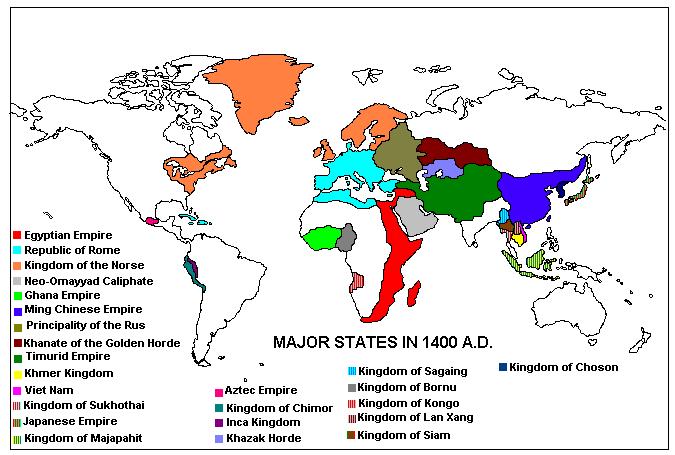
PART SEVEN--1400 AD TO 1600 AD
c. 1400 AD--Horses, pigs, and cattle find their way into the Valley of Mexico for the first time. The Aztecs adopt horses for military use.
c. 1400 AD onward--The Scientific and Industrial Revolution begins. Over the preceding centuries, scientific advancement has continued at a somewhat better pace in this TL than in the OTL. Pharaohs Psamtik IX ("The Great," reigned 340-329 BC) and Necho V (reigned 329-320 BC) had built the first great library in Sais, collecting the learning of Greek, Egyptian, Persian and Babylonian scientists, mathematicians, doctors, etc. in one central repository. This collection has grown over the years. The Pharaohs have always been great patrons of learning as well, beginning with their sponsorship of Greek scientists from the earliest years of the 26th Dynasty. As a result, for some time, the basic scientific knowledge base for an "industrial revolution" has existed in this alternate world, and indeed, in some areas where knowledge has immediate practical applications (medicine and metallurgy, or example), the world of the ATL is somewhat more advanced than the comparable time period of OTL. However, the existence of surplus labor in much of the world (much of it in the form of slave labor) has tended to stifle technological development as it relates to labor saving devices. Why put a steam engine to work draining the water out of a mine, when you have a gang of slaves working hand pumps that does the job? Why harness your looms to a water wheel when you have slaves who can run the looms manually? Why bother with a computing machine to tally the results of your imperial census when you have hundreds of trained scribes who can do the work? But the severe decreases in population due to the various disasters of the 14th Century (the great famines and the Black Death, above all) and the subsequent abandonment of slavery in Egypt and Rome have led to labor shortages in many industries, and this, along with the expanded trade network which earlier contact with the New World has created (which increases the demand for manufactured goods to meet the needs of the new markets), creates an incentive for inventors of labor saving devices to come forth with their ideas.
c. 1400 AD--By this year, China has been extending its power out to sea for 300 years. To satisfy growing Chinese demand for special spices, medicinal herbs, and raw materials, Chinese merchants have developed a rich network of trade that reaches beyond island southeast Asia to the fringes of the Indian Ocean. However, despite the fact that their ships have been trading in the same regions for several centuries, Egypt and China have had very little direct contact. No Egyptian ships have traveled as far as China, and no Chinese ship has paid a call on an Egyptian port. This is about to change. By the beginning of the Ming Dynasty, China has reached a peak of naval technology unsurpassed in the world. While using many technologies of Chinese invention, Chinese shipbuilders have also combined technologies they borrowed and adapted from seafarers of the South China seas and the Indian Ocean. Advances such as double-hulled ships divided into separate watertight compartments, the sternpost rudder, lanteen sails and the magnetic compass have combined to produce ships which are technically superior to anything produced in Europe or elsewhere in Asia. Both the Sung Dynasty, and it’s successor, the Mongol Yuan Dynasty, encouraged commercial activity and maritime trade, so the succeeding Ming Dynasty inherited large shipyards, many skilled shipyard workers, and finely tuned naval technology from the dynasty that preceded it. The Ming Emperor Ch'eng Tsu Chu Ti (who would be known to history as the Yongle Emperor) came to the throne in 1403 AD. The Yongle emperor wants to impress Ming power upon the world and show off China's resources and importance, so he gives orders to construct special "Treasure Ships," ships over 400 feet long, 160 feet wide, with nine masts, twelve sails, and four decks, large enough to carry 2,500 tons of cargo each and armed with dozens of small cannons. Accompanying those ships were to be hundreds of smaller ships, some filled only with water, others carrying troops or horses or cannon, still others with gifts of silks and brocades, porcelains, lacquerware, tea, and ironworks that would impress leaders of farflung civilizations. The Yongle Emperor selects Zheng He, a Muslim Eunuch, to command his new fleet of exploration, and thus the stage is set for a collision between the two very ancient civilizations that will have profound consequences for all future history....
Early 1400s AD--Expansion of the Aztec Empire in central Mexico. The Aztecs, with their iron weapons, quickly conquer most of the other city states in the region.
1400 AD--An Egyptian inventor named Imhotep (living in Amenophis, the capital city of the province of Ophir, and working on the basis of designs by a Greek inventor who lived in Naukratis about 65 AD) invents a practical steam engine. He sells these to Egyptian mine owners in Ophir, who have had a continuing problem with water seepage into their mines and whose slave labor force was nearly wiped out by the Black Death. He will also sell them eventually to mine owners in the Roman Republic and elsewhere in the region who suffer from the same liability. Other inventors and tinkerers will improve the design over the coming years.
1400-1600 AD--In Vinland, the Norse colonies continue to expand. By 1600 they have reached the line of the Mississippi River on the west, and have expanded their control to the north as well, deep into Labrador and the region along the south shore of Hudson Bay. At the same time, pressure from the Norse to the north has led to the formation of a Skraeling state to the south. This confederation of chiefdoms, called the Creek Confederacy, is a society based on the remnant of the Old southeastern Mississippian culture, with the addition of iron working and European domestic animals. The population in this region has recovered quite strongly from the epidemics brought by the Norse over the past few decades, and they receive help from a surprising source....Rome, which, having established it’s colonies in the Caribbean, finds the Creek Confederacy a useful buffer between it’s own colonies and those of the Norse to the north. The Romans supply firearms and ammunition, which strengthen the resistance the Creeks are able to put up against Norse intrusions into their territory. The Roman Republic also signs a treaty pledging it to defend the independence of the Creek Confederacy if the Norse attempt to take over. The Norse do not attempt to do so, and the Creeks are able to maintain themselves in somewhat uneasy peace for the next 200 years.
1401 AD--Pharaoh Rameses XXVI dies, succeeded by Psamtik XX.
1403-1424 AD--The Great Wall of China is expanded between by the Yongle Emperor of Ming China. While parts of the wall had existed since ancient China, it was only now built into the one continuous fortified wall we know today.
1405-1407 AD--First of the voyages of the Ming Chinese fleet under Admiral Zheng He. The fleet of 317 ships stops in Champa (central Vietnam) and Siam (today's Thailand) and then on to the island of Java, to points along the Straits of Malacca, and then proceeds to its main destination of the kingdom of Calicut on the southwestern coast of India.
1407-1409 AD--Second voyage of Ming Chinese fleet under Admiral Zheng He. This second expedition takes 68 ships to the court of Calicut to attend the inauguration of a new king.
1409 AD--Shah Rukh, who ascended the Timurid throne upon the death of Miran Shah in 1408, moves the Timurid capital to Herat.
1409-1449 AD--Period of intermittent warfare between Ming China and the Mongol tribes on the steppes north of China. Chinese troops conduct notably destructive punitive raids against the Mongols in 1409,1410,1414,1422, and 1424, and the Mongols themselves make serveral incursions into Northern China during this period as well.
1409-1411 AD--Third voyage of the Ming Chinese fleet under Admiral Zheng He, with 48 large ships and 30,000 troops, visiting many of the same places as on the first voyage but also travelling to Malacca on the Malay peninsula and Ceylon (Sri Lanka).
1413-1415 AD--Fourth voyage of the Ming Chinese fleet under Admiral Zheng He. In addition to visiting many of the same sites, Zheng He takes his 63 ships and over 28,000 men to Hormuz on the Persian Gulf.
c. 1415 AD--The Matchlock firing mechanism is invented in Rome. The innovation, which allows more accurate aiming by allowing the shooter to keep the target in his sights as he ignites the powder charge, soon spreads to Egypt, Rome, and the Rus Principality, all of whose armies replace their clumsy hand-cannon with the new matchlock muskets within the next 20 years. The matchlock also makes possible the development of two new firearms...the pistol and the carbine...which will eventually come to be essential cavalry weapons.
1417-1422 AD--Fifth voyage of the Ming Chinese fleet under Admiral Zheng He. On this trip Zheng He ventures even further, first to Aden at the mouth of the Red Sea, and then on to the east coast of Africa, stopping at the Egyptian cities of Nechopolis (OTL Mogadishu, Somalia), and Malindi (in present day Kenya). Egyptian officials invite Zheng He to visit the Pharaoh in his capital at Sais, and Zheng He accepts. The Chinese fleet sails through the Suez Canal, and into the Nile, arriving at Sais in 1420 AD. Zheng He is very interested to discover that Egypt boasts a civilization with an even longer history than that of his own empire, a fact that is reinforced when Pharaoh Necho XVIII takes the Chinese Admiral on a tour down the Nile on the royal barge. Zheng He sees the Pyramids, the Sphinx, and the great temples at Karnak and Abu Simbel, among other things, all of which impress him mightily. The Pharaoh, for his part, is very impressed with the huge Chinese ships, and especially with the fine porcelain and silks brought by Zheng’s fleet...both items have been available for several centuries in limited quantities through trade with Chinese merchants in India (and via a dangerous overland caravan route through central Asia known as the "Silk Road"), but now the dazzling prospect of large-scale importation presents itself, and the Pharaoh is very desirous of establishing formal relations, including trade. Therefore on his return, Zheng He takes with him an ambassador from Egypt. It will be the beginning of a long and mutually profitable relationship between the two powers.
1418 AD--Pharaoh Psamtik XX dies, succeeded by Necho XVIII.
1419-1423 AD--Costly rebellion in Annam (northern Vietnam) leads to temporary Ming Chinese withdrawal from the region.
1419 AD--The Kingdom of Choson (Korea) first uses "Turtle Ships" in action against Japanese pirates. These are flat-bottomed, oar-powered galleys, 100 feet in length with a 25 foot beam and two large masts rigged with large rectangular sails. The upper decks of these vessels are covered by an arched, wooden roof, intended to prevent boarding by enemy troops, and the ships are armed with cannon of various sizes. They devastate the pirate ships they encounter, but somehow, word of them does not travel to other powers in the region.
c. 1420 AD--A Roman inventor designs the first mechanical seed sower. Later that year, another Roman designs the first threshing machine. Both are quickly in demand from an agriculture industry whose slave labor supply has been decimated by the Black Death and recurring plagues.
c. 1420 AD and onward: Renewed Roman exploration in the New World. The Black Death, and repeated outbreaks of the plague in the succeeding decades, had stalled Rome’s explorations in the new world. Indeed, for a time, the very viability of the new colonies at Nova Palatina and Nova Capitolina was threatened by the recurring outbreaks of plague. But by the 1420s, the colonies (and Rome itself) have recovered enough that exploration can continue, and Roman ships begin setting out to explore the lands to the north, south, and west.
1420--Shah Rukh appoints his son Ulugh Beg as governor of Transoxiana. The new governor establishes his headquarters in Samarkand, where he builds the fabulous Registan and a magnificent astronomical observatory. He will become one of the greatest astronomers that the world has ever seen, and the calculations that he will make at his observatory will gain him fame in Europe as an eminent scholar.
1421 AD--Ming Chinese capital moved from Nanjing to Beijing. Shortly after the Forbidden City is built, a disastrous fire erupts and destroys much of it. The Yongle Emperor believes it is a sign from heaven and first asks for criticism, but soon he kills his opponents.
1422 AD--Arrival of Zheng He and the Egyptian Ambassador to the court of the Emperor of Ming China. Formal relations are established between the two powers, and trade agreements are reached. A Chinese ambassador is dispatched to Egypt.
1423 AD--A Roman exploration expedition discovers the coast of Mexico, and makes contact with the Aztec Empire. The Aztecs, who while living in Texas prior to their arrival in the Valley of Mexico had heard of "light skinned men from the east" and even met the occasional Norse trader, are not overly astonished at the arrival of the Romans on their shores (unlike in OTL, they definitely DO NOT think they might be gods returning from over the sea), and they greet the newcomers cautiously. The Romans discover that the Aztecs have a different strain of tobacco (nicotiana tabacum) which is far superior to the type introduced into Europe by the Norse (nicotiana rustica), are rich in gold and silver, and they have other products which will prove to be very popular in Europe...chili peppers, and especially chocolate. The Aztecs are very willing to trade for Roman manufactured goods (cloth, metalwork, pottery, etc.) and wine. The expedition brings this news back to the Roman colonial capital at Nova Palatina, and from there it passes to Rome. Also in this year, the first Egyptian trading ships call at Chinese ports, Chinese trade ships begin to regularly visit Egyptian ports, and the Chinese ambassador takes up residence in Sais.
1424 AD--First reports of the Chinese ambassador to Egypt reach the court of the Yongle Emperor. They include reports of Egypt’s governmental system. The Yongle Emperor has been considering reforms to China’s governmental system, and the new reports tip the scales in his mind toward reform. The Hongwu Emperor, founder of the Ming Dynasty, had increasingly concentrated power in his own hands and in 1380 abolished the Imperial Secretariat, which had been the main central administrative body under past dynasties, after suppressing a plot for which he had blamed his chief minister. When the Chinese Imperial throne became hereditary many hundreds of years ago, the Chinese had recognized this and established the office of Prime Minister. While incompetent emperors could come and go, the Prime Minister could guarantee a level of continuity and competence in the government. The Hongwu Emperor, wishing to concentrate absolute authority in his own hands, abolished the office of Prime Minister and so removed the only insurance against incompetent emperors. The Yongle Emperor, listening to reports of the success of the divided system of government in Egypt over many centuries, decides to revive the Imperial Secretariat and the office of Prime Minister. He selects Zheng He as his first Prime Minister, a post in which the eunuch will serve (under three different Emperors) with distinction for many years. The selection of Zheng He as Prime Minister also means a decisive end to a political struggle between the court eunuchs and the merchant classes (who favor the expansion of trade and contact with the outside world) and the Confucian scholars (who argue that China’s true source of wealth is agriculture, that merchants and traders are parasitical, and therefore China should isolate itself from the outside world). Where the Hongwu Emperor had heavily favored the Confucian scholars, the Yongle Emperor favors the eunuchs and merchants. The wealth (and imperial revenues) which this decision brings to China will serve to make this a permanent change of direction for the empire.
c. 1430 AD--An Egyptian inventor develops the first mechanical reaping machine. The innovation soon spreads to Rome and elsewhere.
1425 AD onward--Regular trade is established between Rome and the Aztec Empire. The Aztecs do not allow Romans to travel extensively within their Empire, and the Romans set up a small trading outpost (at the site of the OTL city of Veracruz) called Nova Aventina, where they conduct their business with the Aztecs. The Romans trade bronze and iron objects, fine cloth and wine for gold, silver, turquoise (gaudy silver and turquoise jewelry made by the Aztecs and other Mesoamerican peoples will become a fad in Rome during the next decade), tobacco, chili peppers and chocolate. They also get hold of Aztec tobacco seeds, which they transplant to the tobacco plantations in Cuba and Hispaniola.
1425 AD--The Yongle Emperor of Ming China is killed while on campaign against the Mongols on the Northern frontier. The throne passes to his son Gao Zhi, who takes the throne as the Hong Xi Emperor. He continues Zheng He in his post as Prime Minister and continues his father’s expansionist trade policies.
1426 AD--The Hong Xi Emperor of Ming China dies, and is succeeded by his brother, Zhan Ji, who takes the throne as the Xuan De Emperor. Like his brother, he continues Zheng He in his post as Prime Minister and the expansionist trade policies initiated by the Yongle Emperor.
1426-40 AD--Aztec Emperor Itzcoatl reorganizes the state to concentrate power in his hands.
1428 AD--Vietnamese king Le Loi (Le Thai To) defeats the Ming Chinese army and founds the second Le dynasty.
1429 AD--The Aztec Emperor Itzcoatl agrees to establish formal diplomatic relations with Rome. An Aztec ambassador travels to Rome, and a Roman ambassador is sent to Tenochtitlan.
c. 1430 onward--An indirect result of the increasing popularity of chocolate in the Old World is an increased demand for sugar. Chocolate, by itself, is extremely bitter and unpleasant, but of course, if sugar is added, it becomes not only very tasty, but almost addictive! Sugar at this time is an expensive product which has to be imported from India and, to a lesser extent, from Ghana. Rome and Egypt have tried producing their own sugar, but never with any great success, so they remain dependent on imports.
1430 AD--Rats traveling on a Roman trading ship (ironically, the very ship bringing the first Roman ambassador to the Aztec court in Tenochtitlan) introduce the Black Death to the Aztec Empire. The disease quickly spreads among the urbanized population of the empire, and from there to the non-Aztec states to the north and south. By the time it burns itself out two years later, well over 1/3 of the population of Mesoamerica are dead from the plague. This death toll is further augmented by the fact that the various native religions practice human sacrifice, and, concluding that the plague is the result of the anger of the gods, they all ramp up their sacrifices dramatically in an effort to appease their deities. Also in this year, a trading ship from the Ghana Empire is blown off course by a storm and lands on the coast of OTL Brazil. They make contact with the natives, and discover that they have abundant supplies of cacao beans, the ingredient for chocolate, which is rapidly becoming very popular in Rome and Egypt after being introduced by Roman traders They trade their cargo of Egyptian and Roman wine and cloth to the natives, and take the load of beans back to Ghana. They also bring word back of the technologically backwards native society witnessed there.
1431 AD: Siam invades Angkor and destroys the Khmer Empire. Also in this year, the Roman ambassador to the Aztec Empire witnesses a bloody spectacle. In one day, the Aztecs sacrifice over 10,000 captives to their gods at their capital at Tenochtitan. The Roman ambassador in Tenochtitlan sends news of the barbarity of the Aztecs back to Rome shortly thereafter. Also in this year, the ruler of the Ghana Empire decides to send a colonization expedition to Brazil.
1432 AD--The Ghanaese colonization fleet lands on the coast of Brazil, near the mouths of the Amazon River, where the settlement of Umboto is founded. They initially trade peacefully with the natives, and exploration begins of the Amazon River and it’s many tributaries.
1434 AD--Zheng He dies. His position as Prime Minister to the Ming Emperor is filled by another eunuch, Wang Zhen.
1435 AD--News of the bloody sacrifices being made to pagan gods in the Aztec Empire have inflamed Roman public opinion against the "barbarous" Aztecs (the Romans have, of course, quite forgotten by this time their own bloody past...now almost 1,000 years distant...of gladitorial games in the Colosseum and other amphitheatres throughout the empire). Most notably, the Bishop of Rome is calling for a "Crusade" to bring Christianity to these "bloody-handed barbarians," and to bring them under the civilizing influence of the Roman Republic. The Roman Senate takes no action at this time, however. Also in this year, the Xuan De Emperor of Ming China dies and is succeeded by his seven year old son, Qi Chen, who takes the throne as the Zheng Tong Emperor. As he is not yet of adult age, Prime Minister Wang Zhen serves as regent during the new Emperor’s early years on the throne.
1437 AD--By this time, there are several Ghanaese settlements
in the Amazon region of Brazil. There has been some military conflict with the
natives of the region, but after a few sharp defeats and punitive expeditions by
the superior Ghanaese military, the natives are pretty much subdued. Regular
shipments of cacao beans are going to Ghana, and from there, to the Egyptian and
Roman Empires and beyond.
c. 1438 AD--Inca emperor Viracocha dies; his successor Pachacuti expands Inca empire north to Ecuador.
1438 AD--Sukhothai is annexed into the Ayutthaya (Siam) kingdom.
c. 1440 AD--Automated spinning and weaving machines, operated by water power, are invented independently in Egypt and Rome. Also, at about this time, the Egyptian ambassador to Ming China obtains detailed drawings of the Chinese Treasure Ships, which he sends back to the Pharaoh at Sais. Over the succeeding decades, many features of Chinese design (especially double-walled hulls, watertight compartments, and centerline rudders) will be incorporated into Egyptian merchant and naval vessels, and shortly thereafter, in Roman and Norse vessels.
1440s AD--Incas build a great fortress at Cuzco. Also during this time, the Ghanaese introduce sugar cane production to Brazil, where they find the climate and soil very good for this crop. The first sugar plantations arise.
1440-52 AD--Reign of Aztec emperor Moctezuma; he and his warriors conquer large areas of eastern Mexico, taking many people prisoner to be sacrificed to the war god, Huitzilopochtli.
1440 AD--the Uzbeks move south to Transoxiana under Abu al-Khayr.
1443 AD--A dispute between Roman traders and the Aztecs leads to violence. Several Romans are killed, and several others are taken captive and sacrificed to the Aztec war god, Huitzilopochtli, despite protests from the Roman ambassador in Tenochtitlan. The Ambassador sends news of this to Rome.
1444 AD--News of the sacrifice of Roman citizens to a pagan Aztec god reaches Rome. The public is outraged, and calls for war soon fill the land. The Senate breaks relations with the Aztec Empire and recalls it’s Ambassador, and a declaration of war soon follows. A large invasion fleet is soon being readied in Roman ports.
1445-1452 AD--The Romano/Aztec War. The Roman invasion fleet, carrying an army of 70,000 men, sets sail in early 1443. It arrives in Cuba, where it resupplies and is joined by colonial troops, and then sails on to land at Nova Aventina. The initial encounter between the Roman and Aztecs armies takes place shortly afterward. The Aztecs have a formidable army...well organized into regiments and highly disciplined, clad in armor consisting of iron scales sewn onto quilted cotton and carrying shields, and including archers, javelin men (whose range...up to nearly 300 yards...is increased by the atlatls they use), slingers, swordsmen, and spearmen, all using iron weapons. They also have a force of armored cavalry armed with lances. But the Aztecs are severely handicapped by several factors. First, they fight to secure captives for sacrifice to their gods, while the Romans fight to kill. Second, the Romans have a force equipped with gunpowder weapons (matchlock muskets and bronze field cannon), which the Aztecs have never seen before. Third, the Roman cavalry are armed with composite bows as well as lances. And fourth and finally, the Roman armor and the quality of Roman steel is superior to anything the Aztecs have. And so, in the initial battle, the Aztecs suffer a devastating defeat, although they also inflict large casualties on the Romans. But once the initial shock of this defeat wears off, the Aztecs turn to guerilla tactics, and they prove to be stubborn, resourceful, and dangerous opponents. As a result, it will take seven years of hard fighting and a natural disaster before the Roman armies finally defeat the Aztecs and put an end to their empire.
1447: Shah Rukh of the Timurid Empire is succeeded by his son Ulugh Beg. Also in
this year, Rome launches the first all-gun man-of-war incorporating Chinese
design features (double hulls, compartments, centerline rudder). This 250-foot
long behemoth, called THE SENATE AND PEOPLE OF ROME, is armed with 80 cannon, of
which 60 are of large caliber, and is powered by three tall masts with two
square sails each and 1 smaller mast with a lanteen rig at the rear. It is, when
launched, the most powerful ship afloat anywhere in the world. This starts a
naval arms race between the Romans, Norse, and Egyptians, and to a lesser extent
the Ghana Empire, all of whom over the next few decades will compete with each
other to produce larger and more powerful ships. By the end of the century,
ships with 120 guns will not be uncommon in the navies of these powers.
1449 AD--Ulugh Beg is murdered by his own son, Abu Said. Abu Said takes over
rulership of the Timurid Empire. Also in this year, the Roman Senate abolishes
slavery. Also in this year, the Battle of Tumu is fought in northern China. The
20-year old Zheng Tong Emperor of Ming China, on suggestion by Prime Minister
Wang Zhen, goes on an expedition to the fight the Wa Ci, a Mongolian tribe on
the northwestern frontier. In a humiliating defeat, the Mongols surround the
Chinese army and capture the Emperor, who they will hold as a hostage for the
next seven years. Qi Yu, brother of the captured Emperor, assumes the imperial
throne as the Jing Tai Emperor.
c. 1450 AD--Inca city of Machu Picchu built on high ridge above Urubamba river
in Peru. Also, the Romans begin growing sugar cane in their Caribbean island
colonies.
1451 AD--Muhammad Shaybani becomes the khan of the Uzbeks. Also in this year, the first textile factory operated by steam power opens in Sais, Egypt. Within the next two decades, others will open in the Roman Republic and the Norse Kingdom.
1452 AD--In 1452, a flood devastates the Aztec capital of Tenochtitlan, and a two year period of famine follows. This finally breaks the back of Aztec resistance, and the Romans capture the city. The last Aztec Emperor, Moctezuma, is captured and taken to Rome, where he marches in chains in the triumph of the victorious Roman general, Marcus Julius Crassus, before being executed. The former Aztec lands are incorporated into the Roman Empire and the province of Aztecaea is born.
c. 1455-1500 AD--Ghanaese traders, moving inland from their colonies in Brazil, discover the Andes Mountains in about 1460 AD. Shortly afterward, they encounter outposts of the Inca Empire, and regular trading relations are established between Ghana and the Inca by 1470 AD. Through them, the Inca are introduced to iron-working, horses, cattle, gunpowder and firearms, which they incorporate into their society and and military. They also are introduced to the less welcome benefits of contact with the Old World...smallpox, Black Death, and other epidemics. Nearly half the population of the empire dies in epidemics between 1460 and 1475 AD. But by the end of the century, these have burned themselves out, and the population has recovered to a certain extent (although still smaller than it was in 1455, at first contact).
1457 AD--Qi Chen, the former Zheng Tong Emperor of Ming China, is released from captivity by the Mongols and returns to Beijing. His brother steps down, and surrenders the throne to the returned Emperor. Qi Chen abandons the now inauspicious name of Zheng Tong, and assumes the throne as the Tian Shun Emperor.
1460-1500 AD--Roman expansion in central America. By 1470 they have conquered the Maya States south of their new province of Aztecaea, and have moved north as far as the edges of the Sonoran desert. After consolidating their hold on the region, they have also managed to get the Aztec and Maya gold and silver mines in operation. The flow of Aztec mineral wealth into Europe will cause an initial economic boom, but will be followed eventually by inflation.
1460 AD--Pharaoh Necho XVIII dies, succeeded by Necho XIX. Necho XIX will be known as "The Navigator," as it was he who sent the first Egyptian ships to the New World. Also in this year, the Turcomans invade Persia and Mesopotamia.
1462 AD--Although the Rus Principality was restored in name after the War of the Second Grand Alliance, and the Princes of Moscow have claimed rulership of it, such has not been the case. Most city states, although technically acknowleging the overlordship of the Grand Prince in Moscow, continue to rule themselves virtually independently. In 1462, Grand Prince Ivan III becomes ruler of Moscow and sets about to change that, once and for all. He re-organizes Moscow as an absolutist state, and begins a series of campaigns against the other city states, deposing their rulers and annexing their territory to his own. It will take quite some time, but Ivan will eventually be successful in uniting the country under his rule.
1462 AD--Pharaoh Necho XIX issues an edict abolishing slavery. Despite some
opposition among the nemhu (especially in Ophir, where slavery remains somewhat
useful and important in the mining operations there), the measure is ratified by
the Council of the 400 Elders.
1463-1470 AD--Revolt of the Ophir Nemhu. The nemhu of the province of Ophir, which is, after Egypt, the single most populous region of the Egyptian Empire, have long resented being, as they see it, under-represented on the Council of the 400 Elders which advises the Pharaoh. The nehmu of Egypt-proper receive 200 out of 400 seats on the Council under the current Constitution, and the nemhu of all the other provinces share the remaining 200 members. Of those 200, Ophir, of course, receives the lion’s share, but nevertheless, it’s representation on the Council is not, in any way, shape, or form, analogous to it’s portion of the population of the Empire. The final straw was Pharaoh Necho XIX’s edict for the abolition of slavery, which was heavily favored by nemhu in Egypt proper and in most other provinces of the Empire, but completely rejected by the nemhu of Ophir. And so, in 1463 AD, the nemhu of Ophir rise in revolt, and they succeed in temporarily establishing the independence of their province from the Empire. Indeed, controlling the rich gold mines of the region as they do, they are able to (via merchants from Ghana, Bornu, and Kongo) import large quantities of arms and other military supplies (from Rome, Ghana, Bornu, and the Norse), and therefore they are able to field a sizeable field army. Of course the Pharaoh cannot allow Ophir, the foundation of his imperial treasury, to secede from the empire, and he sends his armies southward. The war lasts for seven years and is extremely destructive. Finally, in 1470 AD, the Pharaoh agrees to an amendment to the Imperial Constitution which portions out seats on the Council of the 400 Elders among the various provinces on the basis of population. He also promises to subsidize the installation of new steam engines at any mine whose owner cannot afford one, and gives a promise of amnesty to the rebels if they will surrender. The nemhu of Ophir accept this offer, and lay down their arms. Despite the promise of amnesty, however, the Pharaoh rounds up the ring-leaders of the rebellion and has them fed to the crocodiles. But Necho keeps his word regarding the steam engines, and most importantly, regarding the amendments to the Constitution, which he, like his predecessor Psamtik XVIII, has engraved for all time on the walls of the Temple of Karnak. The nemhu of Egypt-proper end up with 120 seats on the council, and the nemhu of Ophir with 100. The remaining 180 seats are apportioned among the other provinces of the empire.
1464 AD--Death of the Tian Shun Emperor of Ming China. He is succeeded by his son, Jian Shen, who reigns as the Cheng Hua Emperor.
1464-1485 AD--For centuries, the Songhay tribe which inhabits the region around the city of Gao (in the Ghana Empire) have chafed under the rulership of the Soninke and Mandinke rulers of Ghana. Several times over the past three centuries, they have rebelled, but they have never successfully established their independence. In 1464 the Songhay chieftain Sonni, with help from the King of Bornu, rebels, and this time, Gao achieves independence from Ghana. Sonni is a gifted military leader, and has created a hard-hitting military composed of armored cavalry and fast warships. Under his leadership the Songhay armies will, over the next two decades, defeat the Ghanaese imperial armies and wrest control of the empire from the Soninke/Mandinke dynasty which has ruled the state for the past 700 years. The King of Ghana, Tekanemin IV, flees to the Ghanaese colony in Brazil with most of his army in 1485, where he establishes a rival state with claim to the Ghanaese imperial throne. A state of intermittent warfare, mostly conducted between rival fleets at sea, will continue between the two rivals for several decades.
1466 AD--Dayan Khan unifies the Mongolian tribes again in Mongolia. Over the next few years they will become a major irritant to the Ming Chinese, who will fight numerous campaigns, not always successfully, against them.
1467 AD--Until now, the Japanese Empire has had little contact
with the outside world. However, in this year, civil war erupts in Japan and
Japan is split among feudal lords (daimyo). This chaotic state of affairs will
last for most of a century, and will lead to the end of Japan’s isolation from
the rest of the world.
1469 AD--Abu Said dies and the western Timurid empire (the Ilkhan) dissolves. In the wake of this collapse, Rome espands eastward into Armenia.
1470s AD--Inca armies capture the Chimu capital at Chan Chan. Collapse of Kingdom of Chimor, which is absorbed into the Inca Empire.
1472 AD--The first steam engines are imported into Ming China. They are initially used to run pumps to help irrigate fields and in the mining industry.
1475-1550 AD--The Ming Dynasty completes extensive renovation and improvements to the Great Wall of China.
1478 AD--Ivan III of Moscow annexes Novgorod, the last Russian city-state which does not acknowlege his overlordship.
1480 AD--Ivan III of Moscow assumes the title of Tsar of All the Russias. The
Rus Principality becomes known as the Russian Empire. Also in this year, the
Ming Chinese first import automated machinery for their textile and agriculture
industries (mechanical looms and mechanical sowing, reaping, and threshing
machines).
1485 AD--A Norse inventor named Bjorn Karlssen develops the first steam powered
boat. Also in this year, construction of a new Kremlin begins in Moscow.
1487 AD--Death of the Cheng Hua Emperor of Ming China. He is succeeded by his son You Tang, who reigns as the Hong Zhi Emperor.
1471-1493 AD--Emperor Topa Inca expands Inca empire into Bolivia, Chile, and Argentina.
1478 AD--Husayn Bayqara rules the Timurids from Herat.
1490 AD--Bjorn Karlssen has continued developing his nautical steam power designs, and in this year a large merchant vessel, powered by sail and steam-driven paddle wheels, is launched and makes it’s maiden voyage across the Atlantic to the colonies in Vinland. It completes the journey in record time (as it is able to use steam power at times when it otherwise would be becalmed by contrary winds), proving the efficacy and practicality of steam powered vessels.
1492 AD--Pharaoh Necho XIX sends the first Egyptian trading ships to the New World, thus gaining his sobriquet, "The Navigator."
1493--Death of Sonni, Songhay ruler of the Ghana Empire. He is succeeded by Askia I.
c. 1495 AD--The first prototype Flintlock firing mechanisms (actually closer to the OTL Snaphaunce lock) appear nearly simultaneously in Egypt and Rome. They are still rather tempermental and expensive to manufacture compared to the tried and true matchlocks, and do not gain immediate acceptance. Also about this time, the first factories to produce the mechanical wonders imported from the west (steam engines, power looms, mechanical farming machines) are built in Ming China, ending China’s dependence on imported machinery.
1497 AD--Babur, a descendant of both Genghis Khan and Timur, becomes the ruler of Ferghana and founds the Mogul dynasty.
1500-1600 AD--In Ming China, a number of factors are at work which in the OTL eventually led to the decline and fall of the Empire and it’s conquest by the Manchu in the next century. First, climatic changes, with falling temperatures and greater rainfall in some areas, caused harvests to fail and rivers to overflow their banks. These same climatic changes also affected the Mongol and Jurchen nomads to the north, prodding them to unite and raid into China. Large areas of the north were virtually depopulated as peasants, fleeing from famine and raiders, fled to the south. These migrations, in turn, caused disruptions and food shortages in the southern regions as well. Another factor which has caused problems is that the Ming policy of trade and contact with foreign nations has resulted in a large influx of gold and silver into China. While this has had many good aspects and has increased the wealth of the imperial government, it has also lead to inflation as Egyptian gold and Roman silver have poured into the economy. Fortunately, through their trade contacts, the Ming Emperors (or rather their Prime Ministers, since most of the Emperors since the Yongle Emperor have preferred to live in seclusion in the Forbidden City, engaging in the hedonistic pursuit of pleasure while leaving the actual government of China to the Ministers), have been able to import food supplies (Egypt has, for example, over the past century become a large producer of rice for export to China) to ease the suffering of the people. Due to the much higher trade profits the Ming are receiving in the ATL, they have been able to maintain their large and well disciplined army, so banditry in the countryside is well controlled. They have also been able to forego many of the burdensome taxes that, when combined with the other woes besetting the empire, eventually led to the peasant revolts which toppled the Ming regime in the OTL. And so, when the next century dawns, the Ming will be in a much better position to withstand the Manchu onslaught.
1500 AD--The Uzbeks cross the Syr Darya river and enter Transoxiana.
1500-1505 AD--Askia, the Songhay ruler of the Ghana Empire, declares war on the kingdom of Bornu in 1500 AD. In a series of campaigns lasting five years, Askia conquers Bornu and incorporates it’s territory into the Ghana Empire.
1500-1511 AD--Ismail I, the founding Shah of the Safavid
Dynasty in Persia, consolidates his rule over Persia.
1501 AD--Pharaoh Necho XIX "the Navigator" dies, succeeded by Thutmoses X. Also, in this year, the first steam-powered warship, the PHARAOH RAMESES II, is launched in Egypt. Like Bjorn Karlssen’s earlier vessel, it is a sidewheel and sail combination steamer. The vulnerability of the side wheels to cannon fire, however, limit it’s utility as a war vessel.
1502-1505 AD--War between the Russia and the Golden Horde. The Golden Horde is finally shattered, and Russia expands eastward in to Siberia.
1504 AD--Babur conquers Kabul. Also in this year, the Roman Senate adopts a mercantilist policy and passes laws to exclude Egyptian and Norse traders from Roman ports in the New World. Both protest, but take no other action at this time.
1505 AD--The Shaybanid Horde (Uzbeks) under Muhammad Shaybani expel the Timurids from Transoxiana and capture Samarkand. Also in this year, the Hong Zhi Emperor of Ming China dies, and is succeeded by his son, Hou Zhao, who reigns as the Zheng De Emperor.
1506 AD--The Uzbek Shaybanids capture Bukhara (Uzbekistan) and Herat (Afghanistan), bringing to an end the Timurid dynasty and forcing Babur to flee.
1508 AD--A Egyptian vessel traveling from southern Africa to Ghana’s colonies in Brazil is blown off course and discovers the coastline of Argentina.
1510 AD--A Roman named Quintus Publius Strabo demonstrates the first steam
"land ship" (locomotive). The Egyptian ambassador to Rome reports this
to Pharaoh Thutmoses X, who immediately orders Egyptian scientists to match it.
Also in this year, Pharaoh Thutmoses decides to send an expedition to colonize
the new lands found by the Egyptian ship blown off course in 1508. He does this
in view of the Roman mercantilist policies, which are cutting into Egyptian
trade, which makes it seem a good idea to have a foothold in the new lands for
Egypt.
1510 AD--The Uzbek Khan Muhammad Shaybani dies in battle
against the Safavids at Merv.
1512 AD--The first Egyptian land ship is built (largely on the basis of stolen
plans and drawings of the Roman original). Pharaoh Thutmoses X is pleased, and
orders the construction of the first railroads in Egypt. Also in this year, Shah
Ismail I of Persia invades Mesopotamia, seizing all of it from the Egyptians and
Neo-Omayyads.
1512-1600 AD--The Egyptian colonization expedition sails from the city of New Thebes (OTL Capetown, South Africa) in 1512 AD and heads for the New World. They found a settlement called New Tanis near the mouth of the Platte River (near the site of OTL Buenos Aires). Successive expeditions will enlarge Egypt’s holdings as they expand inland along the rivers. By 1600 AD they will also, like Ghana, be in contact with the Inca Empire to the east, and trade between the two empires will have begun.
1513-1522 AD--Egypt and the Neo-Omayyad Caliphate renew their old alliance and declare war on the Safavid Persian Empire. Despite yearly campaigns spanning nearly a decade, however, the Persians are not dislodged from Mesopotamia, and in 1522, a treaty is signed which establishes the boundary between the three empires on the Euphrates River.
1514 AD--Pharaoh Thutmoses X dies, succeeded by Seti XII. Seti XII will continue his father’s railroad development policies, including beginning of a rail line which will link the important Egyptian cities, mining and industrial areas of the south with the Egyptian heartland in the north. Another line will be pushed westward through the Sahel to link Egypt with it’s trading partners in Ghana. This proposal is enthusiastically supported by King Askia of Ghana, who agrees to supply labor and land for the proposed line.
1520-1527 AD--The Great Maritime War between the Norse Kingdom and the Roman Republic. Norse King Olaf VII decides to try to invade the Roman colonies in the Caribbean, seeking to take the rich tobacco and sugar plantations there. A Norse invasion fleet from Vinland swoops down, but is met by a Roman fleet off the Florida Keys. In the first ever clash between the new model men-of-war, the Norse are defeated and forced to retreat. The succeeding years see other clashes at sea between the two powers, and several inconclusive land battles both in Europe and in the New World. But neither side is able to gain much of an advantage, and the war finally peters out in 1527. No formal treaty is signed, however, and the naval and colonial forces of the two powers will clash intermittently for the next five decades.
1521 AD--Death of the Zheng De Emperor of Ming China. He is succeeded by his son, Hou Cong, who reigns as the Jia Jing Emperor.
1522 AD--Babur captures Kandahar.
1525 AD--A Greek inventor working in Naukratis, Egypt, develops the screw propeller. The innovation is put to work on merchant shipping, and Rome and the Norse soon copy the design.
1526 AD--Babur captures Delhi from Ibrahim, the sultan of Delhi, and founds the
Mogul empire in India
1530 AD--Babur dies and his son Humayun succeeds him.
c. 1530 AD--Rome, Egypt, and the Norse nearly simultaneously launch their first steam warships powered by screw propellers.
1531 AD--Tabinshwehti founds a dynasty with capital at Toungoo in Burma.
c. 1535 AD--The first Ghanaese merchant steamships powered by screw propellers are launched. Within a year, the first Ghanaese man-of-war so equipped will also appear.
1538 AD--Abdullah Shaybanid II expands the Shaybanid (Uzbek)
empire and moves the capital to Bukhara
1539 AD--China launches an expedition against Vietnam.
1540 AD--Completion of the Egyptian Sais to Ophir rail line. Also in this year, the first Egyptian steam warship visits a Chinese port. The Ming order their designers to begin work on a competitive design.
1540 AD--Babur's son Humayun loses the empire to Afghan Leader
Sher Shah and goes into exile in Persia.
1541 AD--Tabinshwehti unifies Burma.
1542 AD--Firearms (matchlock muskets) and gunpowder are introduced to Japan by Egyptians who were captured at sea by Japanese pirates and taken to Japan while heading home from a trading mission to China. Also in this year, the first clash between steam powered warships with screw propellers (a Roman frigate versus a Norse one) takes place.
1543 AD--Egyptian ships, searching for the ship lost in 1542, discover Japan and begin small scale trading there soon afterward. The warring Daimyo are eager for shipments of gunpowder and firearms, which the Egyptians provide.
1543 AD--Dayan dies and the Mongol empire disintegrates again
1544 AD--Pharaoh Seti XII dies, succeeded by Necho XX.
1545 AD--Pharaoh Necho XX dies, succeeded by Psamtik XXI.
1550 AD--By this time, there are rail lines linking many of the cities of the Roman Republic and Egyptian Empire, and railroad development has started in the Norse Kingdom and the Rus Principality as well. Also in this year, the first Ming Chinese man-of-war powered by sail and steam, the EMPEROR YONGLE, is launched. It is the equal of any vessel in the navies of the West, and the first of many such vessels.
1554 AD--For the past century, the coasts of the Ming Chinese Empire have been beset by raids from Japanese pirates. Whole towns have been destroyed, and Chinese merchant shipping has suffered greatly. Up until now, the Ming forces which have been sent to deal with the problem have been insufficient and of poor quality, but in 1554 this changes, and Ming Chinese General Yu Dayou defeats the Japanese Pirates at Wushongsuo. This begins a campaign which will see the final expulsion of the Japanese pirates from the coasts of China.
1555 AD--The Mogul king Humayun reconquers India.
1556 AD--The Mogul king Humayun dies and his son Akbar becomes the ruler of
India.
1558 AD--Burma invades the kingdom of Siam in Thailand.
1562 AD--Completion of the rail line from Sais (Egypt), via the Sahel to Bornu City and Timbuktu in Ghana. Trade between the west African empire and Egypt is greatly facilitated.
1563 AD--Ming Chinese Generals Qi Jiguang and Yu Dayou expel the Japanese Pirates from Guangdong and the rest of southeastern China. 20,000 Japanese troops are killed. Ming China will be virtually free from the predations of these pirates for many years.
1566 AD--Death of the Jia Jing Emperor of Ming China. He is succeeded by his son, Zai Hou, who reigns as the Long Qing Emperor.
1568 AD--In Japan, the Daimyo Oda Nobunaga enters Kyoto and ends the civil war.
1569 AD--Burmese king Bayinnaung invades and conquers the
kingdom of Ayutthaya (Siam).
1570 AD--After learning of the railroad through the Sahel linking Egypt with Ghana and Bornu from Roman caravan traders, the Roman Senate decides to construct a rail line linking their north African provinces with Ghana. The line will run from Carthage on the north African coast, and like the Egyptian line, terminate in the Ghanaese city of Timbuktu. The rail line through the burning sands of the Sahara will prove very difficult to build and will not be completed for many years.
c. 1570 AD--The first railroads in Ming China are built. At this time the Ming have to import Egyptian or Roman landships (locomotives), but this will change within the next two decades.
1571 AD--The Mongols end their 300-year old war with China.
1572 AD--Death of the Long Qing Emperor of Ming China. He is succeeded by his son, Yi Jun, who reigns as the Wan Li Emperor.
1573 AD--The Daimyo Oda Nobunaga extends his control over all of Japan.
1574 AD--Burma invades the kingdom of Lan Xang (Laos).
1575 AD--In Japan, the Daimyo Oda Nobunaga defeats the rival Takeda clan in the
battle of Nagashino by employing modern warfare (matchlock firearms).
1580 AD--Pharaoh Psamtik XXI dies, succeeded by Psamtik XXII.
c. 1580 AD--Egypt, Rome, and the Norse Kingdom begin building railroads in their colonies in the New World.
1580 AD onwards--Nurhaci, a Jurchen chieftain, begins the process of uniting the Jurchen tribes of Manchuria.
1581 AD--Russian Cossacks begin colonizing Siberia.
1582 AD--In Japan, Oda Nobunaga is murdered and is succeeded by Toyotomi Hideyoshi.
1584 AD--King Naresuen regains Siam's independence from Burma, with capital at Ayutthaya.
1588 AD--Admiral Yi Sun-Sin of the Kingdom of Choson revises the design of the Choson "Turtle Ships." The new ships are twice as long as their predecessors, the arched roof is covered in iron plate with long spikes protruding from it (serving the dual purposes of deflecting enemy cannon shot and repelling attempts at boarding), the small cannon on the ships are replaced with large ones, and a smoke generator (intended to screen the vessel from enemy eyes as well as intimidating enemy sailors) is installed. The vessels are also now steam powered, an innovation borrowed from Ming China. The finished product is one of the most formidable warships existing in the world at that time.
1591 AD--Toyotomi Hideyoshi reunifies and pacifies Japan.
1592-1593 AD--Japanese Daimyo Toyotomi Hideyoshi tries to conquer Choson (Korea) and China, but fails. Hideyoshi’s plan was to cross the sea at the head of a large expeditionary force and form an alliance with Choson's King Sonjo. Japan would then march northward up the Korean peninsula with Choson troops in the vanguard and conquer the Chinese Ming Empire "as easily as a man rolls up a mat." King Sonjo refused, and in the summer of 1592 Hideyoshi sent an army of 51,000 men, commanded by three of his best generals, aboard a fleet of 700 ships to invade Choson. The Japanese, surprising the Koreans, landed and were successful in conquering virtually the entire kingdom of Choson on land, but the Turtle Ships of the Choson Navy, under Admiral Yi Sun-Sin, devastated Japanese fleets bringing supplies and reinforcements to the Japanese Army in Choson, which was soon in dire straits. Guerilla resistance by Korean peasants and soldiers, as well as a Ming Chinese Army (which intervened on the petition of King Sonjo to the Ming Emperor) of over 50,000 men under one of China’s best generals, Li Ju-Sung, eventually defeated the Japanese, most of whom were finally forced to retreat from Choson in the summer of 1593.
1595 AD--Pharaoh Psamtik XXII dies, succeeded by Rameses XXVII.
1598 AD--Hideyoshi dies. Japan falls back into civil war. With Ming Chinese help, the kingdom of Choson expels the last Japanese invaders shortly thereafter. Also in this year, Abdullah Shaybanid II of the Uzbeks dies and the Astrakhanid dynasty inherits power in Transoxiana, retaining Bukhara.
1600 AD--At the battle of Sekigahara Tokugawa Ieyasu, a friend of Hideyoshi and Nobunaga, defeats the other contenders to the leadership of Japan.

Egyptian clipart on this page is courtesy of

Copyright 2004 by Robert Perkins. All rights reserved. Last updated on June 15, 2004.