ANCIENT EGYPT SURVIVES UNTIL THE PRESENT DAY
An Alternate History Timeline
by Robert Perkins
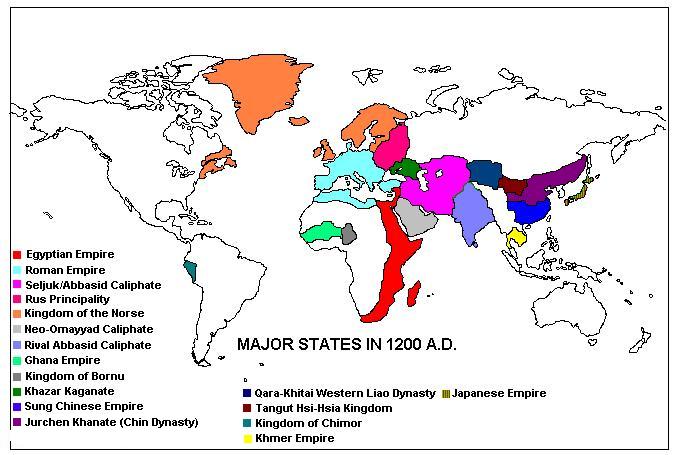
PART SEVEN--1200 AD TO 1400 AD
c. 1200 AD--The Incas in Peru emerge from obscurity, and establish their capital at the growing settlement of Cuzco. Also, at about this time the Aztecs, a small tribe originally native to the plains of what is OTL Texas, arrive in the Valley of Mexico from the north. While in the north, the Aztecs had learned the art of ironworking, which gives them a decided military advantage over the native inhabitants of the region. They become eagerly sought by the local city-states as mercenary warriors.
1200-1300 AD--Norse expansion in the new world. Norse settlements are founded all the way down the coast southward to Cape Hatteras. Also, Norse settlements now extend all the way down the St. Lawrence River to Lake Ontario, and Norse explorers are by 1300 discovering the outlines of the other Great Lakes. Due to the ravages of smallpox, the Skraeling populations in the newly acquired areas are quite small, and the Norse conquer the interior areas in back of their coastal and river settlements easily. Also during this time period in Africa, the Ghana Empire and the Kingdom of Bornu expand southward to the coast, conquering the various city states which have arisen there. They are now positioned to engage in sea-borne trade with Rome, Egypt, and even the Norse, and they do so, vastly increasing the treasuries of both empires.
1201 AD--Ala al-Din Tekesh, a former Seljuk slave who had been appointed governor of the province of Khwarazm (south of the Aral Sea, centered on the city of Urgench) in 1193 AD, rebels against the Seljuks. He establishes the independence of Khwarazm and installs himself as Emir. He is killed in battle against the Seljuks later that year and is succeeded by his son, Ala ad Deen Muhammed. Also in this year, Pharaoh Seti X dies, and is succeeded by Psamtik XIX.
1205-1212 AD--The Emirate of Khwarazm rapidly expands its rule. In 1210 it takes Samarkand from the Qara Khitai and this becomes the capital. By 1212 it rules from the Caspian Sea to Bukhara and Samarkand, and controlling all of modern Iran and Afghanistan.
1208-1212 AD--Pharaoh Psamtik XIX, learning of the trouble the Seljuk Turks are having with the Khwarazm Emirate, declares war on the Seljuks. Egyptian armies advance into Mesopotamia, where they capture Baghdad in 1210 AD. By 1212 AD, Egypt is in control of all of Mesoptamia. Rome enters the war in 1210 AD, and gobbles up Armenia and the Seljuk possesions in the Caucasus. The Seljuks are eliminated as a power in the region, and the border between the three empires (Rome, Egypt, and Khwarazm) now runs along the Zagros mountains.
1206 AD--Temujin (Genghis Khan) unifies all Mongol and Tatar tribes. Over the next few years, he welds them into a devastating military machine.
c. 1210 AD--Smallpox crosses the Mississippi and begins spreading across the Great Plains.
1210 AD--Temujin (Genghis Khan) conquers the Tangut kingdom of Hsi Hsia.
1215 AD--Temujin (Genghis Khan) conquers the Jurchen Khanate and the Chin Empire
in northern China.
1215-1219 AD--War between Egypt and Khwarazm. In 1215, Emir Ala ad-Deen Muhammed of Khwarazm declares war on Egypt and invades Mesopotamia. His army is defeated and forced to retreat to Iran. However, no treaty is signed, and the Khwarazm will invade the new Egyptian province each year for the next four years. The war finally ends when Khwarazm faces a new threat from the east...
1216 AD--Temujin (Genghis Khan) builds a new citadel, Karakorum.
1218 AD--the Mongols conquer the kingdom of Qara-Khitai ( Western Liao Dynasty).
1219 AD--Temujin (Genghis Khan) defeats the the Khwarazm empire. Emir Ala ad
Deen Muhammed flees into exile.
1220 AD--the Mongols conquer the Khwarazm province of Merv (Turkmenistan).
1221 AD--the Mongols conquer the Khwarazm province of Herat (Afghanistan). Also
in this year, Ken Angrok (Rajasa) founds the Singhasari kingdom in Java
(Indonesia) with capital in Kediri.
1221-1231 AD--Khwarazm is reduced to its western part (northern Mesopotamia and western Persia) in the Mongol campaigns of 1220 and 1221. After that, Mongol attention is focused elsewhere, and under a new Emir, Jalal al-Din Mingburnu, Khwarazm reflourishes for a decade. It even briefly conquers Georgia and Azerbaijan in the Caucasus.
1223 AD--a Mongol horde defeats a coalition of Russian princes
on the Kalka river, then withdraws eastward.
1225 AD--Pharaoh Psamtik XIX dies, succeeded by Necho XVII.
1226 AD--Genghis Khan attacks the Sung Chinese Empire, but is defeated and forced to retreat northward.
1227 AD--Genghis Khan dies and is succeeded as Great Khan by Ogodai. For ease of
administration, the empire is split among khanates which, although locally
ruled, acknowledge the supremacy of the Great Khan (Batu's Blue Horde, Orda's
White Horde, Chaghatay's khanate in Mughulistan). Ogodai moves the imperial
capital to Karakorum.
1231 AD--the Mongols invade Korea and bring it under their control. Also in this
year, the Khwarazm Emirate is finally conquered by the Mongols under Batu.
1237 AD--the Mongols, led by Batu, invade the Rus Principality.
1238 AD--The kingdom of Sukhothai is founded in Thailand.
1240 AD--Batu's Mongols ("blue horde") destroy the Khazar Kaganate. They move on to take Kiev, capital of the Rus Principality. The Rurikid princes becomes subjects of the Mongols. Meanwhile, in the north, the Norse are also invading Rus, but are defeated by Alexander Nevsky, Prince of Novgorod, at the Battle of the Neva River.
1241 AD--Batu's "Blue Horde" attacks the eastern frontier of the Roman
Empire. The Mongols breach the Roman defenses and pour into the province of
Polania (as the region formerly known as Polska is now called). Once in Polania,
they defeat a Roman army near the city of Warsaw and penetrate the Vistula
defense line, but are halted by the second line of Roman defenses on the Oder
River. It is then that news arrives of the death of the Mongol Great Khan Ogodai.
In the wake of that news, Batu’s Mongol horde retreats from Europe.
1248 AD--The Mongols install Alexander Nevsky as Prince of Vladimir.
c. 1250s AD--Kingdom of Chimor (Chimu people) expand their empire along northern
coast of Peru. Also at about this time, in Chile, metalworkers discover the
formula for bronze. Also about this time in Mexico, the Aztecs accept the
overlordship of the King of the Tepanecs. Using Aztec shock troops, the Tepanecs
establish a large realm in central Mexico. Meanwhile, in southern Mexico, there
is a Maya revival; following collapse of Chichen Itza, a new capital is built at
Mayapan.
1251 AD--Hulegu leads the Mongol invasion of Persia and establishes the Ilkhanate.
1255 AD--Hulegu, the Ilkhan, invades the Middle East and captures Bagdhad, which becomes the capital of the Ilkhanate. He completes the conquest of Mesopotamia over the next two years.
1257 AD--Mongols led by Kublai conquer the Sung Chinese Empire and push the
frontier of the Mongol Empire all the way to Hanoi. Also in this year, Pharaoh
Necho XVII brokers a treaty of alliance with the Neo-Omayyad Caliphate against
the Mongols, who are seen as a threat by all both empires.
1258 AD--Mongols led by Hulegu invades Syria. They are met near Damascus by a combined Egyptian and Neo-Omayyad army and severely defeated. Hulegu is killed in the fighting, and for a while, the Mongols in the middle east are thrown into chaos. Meanwhile, in China, Kublai becomes the Great Khan of the Mongol Empire and declares Buddhism the state religion.
1259-1261 AD-- In 1259, taking advantage of the temporary confusion among the Mongols of the Ilkhanate following the death of Hulegu, Egyptian and Neo-Omayyad forces invade Mesopotamia. They recapture Baghdad in 1260, and by 1261 have pushed the Mongols back beyond the Zagros Mountains. Finally, a treaty is agreed with the new Ilkhan Abaqa which establishes the frontier at the Zagros Mountains. An uneasy peace will reign in the region for a few years. The Egyptians and the Neo Omayyads divide the conquered region between them.
1261-1262 AD--Meanwhile, the Roman Republic, at the urging of the Bishop of Rome, who is the acknowledged leader of the Christian Church, is negotiating it’s own treaty of alliance with Grand Prince Alexander Nevsky of the Rus Principality (who has been chafing under Mongol domination for the past decade) and with King Haakon IV "The Old" of the Norse. The Grand Alliance of Christendom, as the treaty will be called, takes the field in 1262. However, the Christian coalition does not do as well against the Mongols of the Golden Horde (formerly Batu’s Blue Horde). In battle near Kiev, the Roman contingent under Consul Varus Paulinius Gracchus, being mostly armored cavalry archers and light cavalry archers, proves well suited to fighting the Mongols on their own terms, and the right flank held by the Romans initially does well. But the Rus and Norse contingents which hold the Christian center and left are mostly infantry, and the Mongols cut them to pieces. Both King Haakon and Prince Alexander are cut down in the fighting. The Mongols then outflank and surround the Roman cavalry (who are a bit slower moving than the more lightly armored Mongols). But the disciplined Roman legionaries cut their way out of the trap, and most of the Roman force makes it back to the Roman frontier. The Mongols do not attempt an assault of the Roman defense lines, but instead turn east to punish their traitorous vassals, the Rus.
1262-1275 AD--The Golden Horde ravages the land of the Rus in punishment for their part in the Grand Alliance of Christendom. The great cities of Kiev, Suzdal, Vladimir, Novgorod, and Moscow are all razed to the ground, the people within them slaughtered, man, woman, and child. Most of the lesser towns and villages meet the same fate. Large areas of the land are completely depopulated, and the Principality of the Rus ceases to exist. Their allies, the Romans and the Norse, can do nothing but watch in horror.
1263 AD onward--Norse King Magnus VI imports Roman officers to teach cavalry tactics to his army, and begins to build a force of armored horse archers with which to oppose the Mongols.
1267 AD--Kublai Khan moves the Mongol capital to Dadu (Beijing) and founds the Yuan dynasty.
1274 AD--Kublai Khan invades Japan, but is defeated.
1277-1287 AD--the Mongols invade Burma and finally conquer it.
1279 AD--Sukothai king Ramkamhaeng extends the kingdom to
Vientiane (Laos) in the east and to Pegu (Burma) in the west.
1280-1285 AD--War between the Ilkhanate and Rome. The Mongols push the Roman frontier in Asia Minor back to the Halys River. Armenia falls to the Ilkhanate.
1282 AD--the new Shaybanid khan Uzbek (a vassal of the Chagatay Khanate) converts the Shaybanid horde to Islam and his horde becomes known as the Uzbeks.
1288 AD--the Vietnamese army of Tran Hung Dao defeats the Mongols.
1290 AD--Pharaoh Necho XVII dies, succeeded by Ahmosi XI. Also in this year, Singhasari king Kertanegara conquers Bali, Java and Sumatra (Indonesia).
1293 AD--Kublai Khan’s Mongols attack Singhasari with help from warlord Wijaya, but Wijaya (Kertarajasa Jayawardhana) betrays Kublai, defeats both the Mongols and the Singhasari, and founds the kingdom of Majapahit with capital at Trowulan in Java (Indonesia).
1294 AD--Kublai Khan dies and the empire fragments in khanates: Sarai in the west (descendants of Batu, the "golden horde"), Beijing in the east (the Yuan), Sultaniyeh in Persia (the Ilkhan Sultanate, descendants of Hulegu) and the Chaghatai Khanate in the center.
1295 AD--Ghazan, the Ilkhan, converts to Islam.
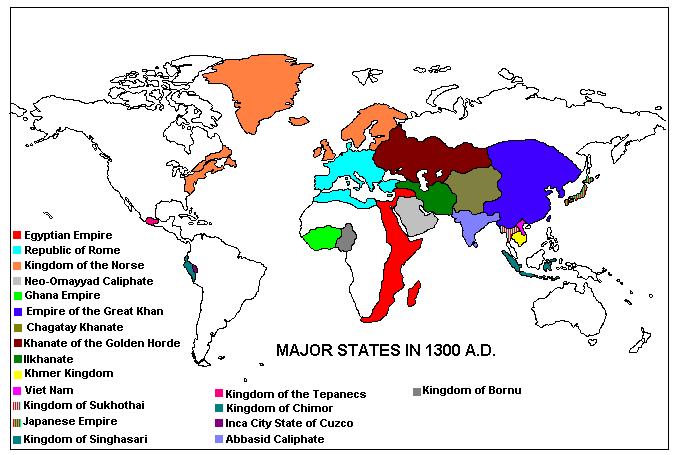
c. 1300 AD--The Incas begin to expand their empire throughout the central Andes. Also, at about this time, horses, cattle, and pigs are introduced to the tribes west of the Mississippi River. The new domesticated animals will spread rapidly over the next century. Horses will prove especially useful for the nomadic tribes who live by following the buffalo herds as they migrate over the Great Plains, while pigs and cattle will join wheat to revolutionize the agriculture of the settled Pueblo tribes of the southwest. Also, at about this time, smallpox reaches the Valley of Mexico, devastating many of the city states there.
1300-1350 AD--Continuing expansion of the Norse colonies in Vinland. By 1350 Norse settlements have spread throughout the entire Great Lakes region and the Norse have also discovered and settled the southern shore of what in OTL would be Hudson Bay (called Thorfin’s Bay in this TL). The Norse do no expand further southward than Cape Hatteras, however, as the hot, semi-tropical Southern climate is not congenial to them, and the iron-using Skraeling tribes in this region were less devastated by the smallpox epidemic, and thus better able to resist Norse encroachment.
1300 AD--Beginning of Roman exploration in the New World. In the previous decades, much speculation has been going on in the Roman Empire (and elsewhere) as to the source of the tobacco which the Norse are peddling all over Europe and the near east. The Norse have, so far, managed to keep their new colonies in Vinland pretty much secret. This has been helped by the nature of the Norse trade route, which goes north up the coast of North America to Greenland, then to Iceland, then to Britain or Norway. Most of the trade route is thus deep within Norse territory, and only Norse ships are allowed to make the transatlantic journey (the Norse fleet makes sure of this). However, it is impossible to keep such a secret indefinately, and tavern stories from indiscreet Norse merchants eventually alert the Romans that there are lands to the west, far across the sea, which the Norse are exploiting. The Norse fleet, of course, prevents Rome from attempting a voyage along the established trade route, but in 1300 AD, they begin sending yearly expeditions westward across the Oceanus Atlanticus. Most of these early expeditions find nothing noteworthy, and some of them will never return. But the Romans will persevere.
c. 1300-1400 AD--In the region between the Congo and Loje Rivers in south western Africa, the city states of Kongo, Luba, Kuba, Lunda have arisen by 1300 AD. By 1400 AD these will be consolidated into a state by the king of the city of Kongo, whose king becomes known as the Manikongo. The new Kingdom of Kongo has rich copper deposits, and a strategic position in between the Egyptian lands to the south and the kingdoms of Ghana and Bornu to the north. So the Manikongos will live by trade, and grow rich over the succeeding decades.
1301-1305 AD--War Between the Golden Horde and the Norse. In 1301, the Mongols, under Khan Toqta, invade the Norse lands along the Baltic Sea (OTL Latvia, Lithuania and Estonia), causing much devastation, and then move north into the Norse province of Finland. They are brought to battle by the main Norse army, under King Haakon V, near Helsinki. The Roman training and reorganization of the Norse army initiated by King Magnus VI and continued by his successors has not been in vain, and the Norse defeat the Mongols, forcing them to retreat from Norse territory. The Norse follow up with an invasion of their own the next year, but they run into a problem. The Mongols, they find, have so thoroughly devastated the Rus lands during their punishment of the Rus two decades earlier that the Norse are unable to find food or forage as they advance through the enemy country. They penetrate as far as the ruins of Novgorod (which, being the home city of the traitorous Grand Prince Alexander Nevsky, the Mongols have not permitted to be rebuilt as an example to those who might think of rebellion in the future) before they are forced to turn back, harassed all the way by the Mongols. The war continues for another three years, with small scale raiding by both sides, before a treaty is finally signed in 1305.
1304 AD--Mongols under Ali Beg invade India but are repelled by the Abbasid Caliphate. Also in this year, an Arab scientist working in Baghdad, in the Neo-Omayyad Caliphate, invents a cannon, consisting of a bamboo tube, reinforced with iron bands. Knowledge of the invention soon spreads to Egypt and Rome.
c. 1315 AD--The first iron and bronze cannon are invented almost simultaneously in Egypt and Rome. Experiments with hand-held gunpowder firearms begins shortly afterward in both empires.
1315 AD--Pharaoh Ahmosi XI dies, succeeded by Ahmosi XII. Also in this year, the Shans found the kingdom of Sagaing in Burma.
1315-1325 AD--The Great Famine in Europe. The relative stability and prosperity of the Roman and Norse Empires have resulted in a steady increase in population, to the point where harvest shortfalls can have severe consequences. This has been mitigated to some extent by the availability of wheat, barley, oats and maize from the Norse colonies in Vinland and wheat and barley from Egypt, but it still remains a problem because by 1300 AD, populations in Europe are half again as large as in OTL. However, the weather in Western Europe has been gradually been getting colder and wetter for the past few years, and in 1315 particularly wet Spring makes it impossible to plow all of the fields that were ready for cultivation, and heavy summer rains rot much of the seed grain before it can germinate. The harvest is far smaller than usual as a result, and many people starve. The pattern continues in 1316, leading to yet more starvation and misery. The Spring and summer of 1317 saw the return of good weather, but in the meantime, much of the grain set aside for seed had been eaten by starving people, so harvests remain below normal even so. Then the cool, wet weather returns, and grain production plummets even further, and indeed, will not reach pre-1315 levels again until 1325. As much as 1/10 of the Roman and Norse population (less than in OTL, but still a huge number) will die of starvation and disease exacerbated by malnutrition during that single decade.
c. 1320 AD--The Black Death first appears among rats in the Gobi Desert region.
1320 AD--The Romans discover the Azores and the Canary Islands. They return the next year and occupy the islands, establishing permanent outposts there which will form vital waypoints for their future exploration of the western seas.
c. 1325 AD--The Aztecs found city of Tenochtitlan on an island in Lake Texcoco. Because of their knowledge of ironworking (which they have jealously guarded), they are able to establish themselves despite having a lower population (due to the ravages of smallpox) than in OTL.
1326 AD--A Roman expedition sights the shores of the island which would, in OTL, be called Hispaniola, which they explore. They land, meet the native Carib Indians, and take some of the natives back to Rome with them. The Caribs tell the Romans of other lands to the north and west of Hispaniola.
1327 AD--Chagatay Khan Tarmashirin converts to Islam.
1328 AD--the Mongols invade India but are repelled by the Abbasid Caliphate.
1330 AD--A Roman expedition explores the coast of southern Florida. They find nothing of interest.
1330-1332 AD--War of the Second Grand Alliance. The new Bishop of Rome has, like his predecessor, urged a "Crusade" against the heathen Mongols to liberate the oppressed Christians of Rus, and the Roman Republic has concluded a new alliance with King Magnus VII of the Norse. The Romans and Norse negotiate with the rulers of various recently rebuilt Rus city-states, but most are not eager to incur the wrath of the Mongols a second time. The one exception is Ivan, Grand Duke of the the city-state of Moscow. This Second Grand Alliance of Christendom takes the field in 1330 AD, and heads for Moscow, hoping to link up with Grand Duke Ivan’s forces. It’s army is much better suited to fighting the Mongols than the army of the first Grand Alliance had been, and the Norse experience in their recent war teaches them to bring along a supply train to enable them to fight deep inside enemy territory. The Roman army also includes a small force equipped with the new cannon as well as a few cohorts of hand-gunners, both of which will be primarily used to defend the supply train. The Mongols are brought to battle about 60 miles west of Moscow. The Mongols are still somewhat more mobile than the armored Roman and Norse cavalry, and a force manages to slip around the Christian flank and fall on the wagon train (which, for defense, had been formed in a lager, with the cannoneers and handgunners inside). They charge the seemingly defenseless wagon lager, and get a rude surprise when Roman cannon give them a dose of gravel, nails, and lengths of broken chain at close range. The handgunners then open up, and the slaughter is terrible to behold. The Mongols retreat in disorder, and the wagon lager is saved. Meanwhile, the Roman and Norse armored horse archers have put the rest of the more lightly equipped Mongols to flight, and the battle is won. The Romans and Norse enter Moscow and link up with Grand Duke Ivan’s forces 2 days later. In the wake of this victory, the princes of the various Rus city states rise up in revolt in support of the Grand Alliance, and the Christian armies follow up with campaigns to liberate the southern regions of the former Rus principality. Finally, Khan Muhammed Ozbeg of the Golden Horde sues for peace in 1332 AD. A treaty is made in which the Golden Horde agrees to withdraw from Rus. The frontiers of Rus are set by this treaty at the North Dvina, Kama, and Ural Rivers (farther east than the original Rus Principality...but the Mongols, being defeated, have little choice but to agree). Grand Duke Ivan of the city-state of Moscow, with Roman and Norse support, proclaims himself the first Grand Prince of the newly re-established Principality of Rus. His rule is not universally accepted by the other Rus rulers, however.
1331 AD--A Roman expedition discovers Cuba. The expedition finds not only tobacco, but gold.
1331-1353 AD--The Black Death devastates China. Up to two-thirds of the population dies or is severely incapacitated, and social order in the country breaks down. The Mongol Empire in China is severely weakened.
1333 AD--The Roman Senate votes to send a colonization expedition to secure the newly discovered regions in the New World for Rome, and a fleet is sent out.
1335 AD--The Roman colonization fleet arrives in the Caribbean. The fleet lands in Guantanamo Bay, Cuba, and the settlement of Nova Palatina is founded. Another settlement is founded on Hispaniola, and named Nova Capitolina. Successive yearly expeditions will strengthen the new settlements.
1338 AD--Pharaoh Ahmosi XII dies, succeeded by Seti XI.
1340 AD--The first major shipments of tobacco and gold from the new colonies reach Rome. The Norse monopoly on the tobacco trade is broken.
1343 AD--The Kingdom of Majapahit conquers Bali (Indonesia).
c. 1345 AD--The Black Death is in India. Again, huge death tolls result. Worse still, plague-carrying rats board trade ships in Indian ports, to be carried back to their home ports by the traders.
c. 1347-1352 AD--In 1347, trade ships carrying plague infested
rats from India arrive in various ports in the Egyptian and Roman Empires. Both
empires suffer less from the plague than did the OTL nations occupying these
regions. Roman and Egyptian habits of cleanliness and advanced civil engineering
and sanitation systems limit the spread of the disease. And Egypt, as it turns
out, has a secret weapon which results in even lower death rates than those
suffered by Rome...the cult of Bast, the cat goddess of Egypt, remains alive and
well in Egypt, and cats are considered sacred there. So there are several
million of the felines available in the empire to keep rat populations low, thus
preventing the plague from spreading to the same extent it does in other
regions. Nevertheless, both Rome (which loses 1/4 of its people) and Egypt
(which loses 1/6 of it’s population) suffer greatly.
c. 1350 AD--Smallpox devastates the Maya states in central America. The epidemic finally peters out in the sparsely inhabited jungles of what is OTL Costa Rica, and thus the disease does not penetrate into South America at this time. Meanwhile, in the Andes, the formula for bronze has spread north from Chile to Peru, and it is being worked in the Chimu capital of Chan Chan by 1350 AD. Chimu and Inca armies are gradually re-equipping themselves with bronze weapons.
1350 AD--Majapahit under prime minister Gajah Mada conquers northern Sumatra (Indonesia) and most of Borneo. Also in this year, the Black Death reaches the European portions of the Norse Kingdom and the Rus Principality. Huge death tolls (exceeding 1/3 of the population of both states) result.
1350 onward--The large death tolls from the Great Famine and from the Black Death in the lands of Europe have profound effects on the economic and social structures of those regions. In Rome, a very large proportion of the deaths was among the slave population of the Republic, who are generally less well fed and have less medical attention than the citizenry of the Republic and are thus more susceptible to food shortages and disease. As a result, more and more work has to be done by free labor, and job opportunities and wages for freemen increase throughout the Republic. This, along with the continuous drain of slaves into the military (the laws enacted by Emperor Trajan II are still in force), reduces the importance of slavery in Roman society ever further, and by the middle of the next century, the Republic will abolish slavery altogether. In the Norse Kingdom and Rus Principality, where slavery does not formally exist, the institution of serfdom is likewise weakened, and peasants gain many more rights and privileges over the succeeding century. The Black Death will also deal a death blow to slavery in Egypt, where it was never a large institution to begin with, and where, like in other regions, slaves are disproportionately affected by the Plague. Egypt will abolish slavery not many years after the Roman Senate does so.
1351: King Rama Thibodi I founds the Siam kingdom in Thailand with capital at Ayutthaya. Also in this year, trade ships carry the Black death to the Roman colonies in the Caribbean, as well as the Ghana Empire and Bornu Kingdom in Africa. The Roman colonies are only moderately affected (about 5% mortality), but Ghana and Bornu are devastated with nearly half the population succumbing to the disease within three years.
1352 AD--Trading ships carrying the Black Death reach the Norse colonies in Vinland. The more widely scattered nature and less concentrated population of the Norse settlements in Vinland limits the spread of the disease, but even so, before the epidemic burns itself out two years later, over 1/5 of the population of the colonies will be dead. Norse expansion in Vinland is greatly slowed as a result. The disease does not affect native Skraeling populations to any great extent. These populations, devastated by smallpox, are still relatively small and scattered (although recovering by this time), so the disease does not spread well and quickly burns itself out when it leaves the borders of Norse-held lands.
1353 AD--the kingdom of Lan Xang is founded in Laos by Fa Ngoun, who introduces Theravada Buddhism into Laos.
1365 AD--The Turkic-speaking chieftain Timur the Lame overthrows the Chaghatai khanate and conquers Persia, establishing his capital in Samarkand.
1368 AD--In the chaos following the Black Death in China, the Ming dynasty is founded by a Chinese peasant and former Buddhist monk turned rebel, Chu Yuanchang, under whose leadership China regains independence from the Mongols. Shortly after, the Kingdom of Koryu (Korea) does likewise.
c. 1370 AD--The Aztecs have recovered from the smallpox epidemic, and Acampitchtli is chosen king of Aztecs. Acampitchtli defeats and overthrows the Tepanec overlords of the Aztecs, and the Aztec Empire is founded.
1370 AD--A scientist in Egypt discovers the secret of producing granulated gunpowder. A scientist working in Rome will make the discovery independently two years later. In both empires, imperial powder and firearm factories are set up at about this time (prior to this, production of both powder and firearms had been primarily done in small, privately owned shops).
1375 AD--Pharaoh Seti XI dies, succeeded by Rameses XXV.
1384 AD--Timur the Lame conquers the Ilkhanate.
1385 AD--Timur the Lame invades Mesopotamia. He is met by a combined Egyptian and Neo-Omayyad army near Baghdad and defeated. Timur is killed in the fighting (decapitated by an Egyptian cannonball), and his empire will fall into chaos on his death while his relatives fight over the succession.
1388 AD--The Ming defeat the Yuan (Mongols) and destroy Karakorum. Also in this year, Umar Shayk, son of Timur, establishes himself as the sole ruler of the Timurid Empire. Umar, being more interested in art and architecture than in warfare, is content to rule the empire inherited from his father, and a relative peace settles on the region for a few years.
c. 1390s AD--Viracocha becomes eighth Inca ruler; an Inca myth tells how he travelled to the Pacific and never returned.
1392 AD--General Yi Song-gye overthrows the King of Koryu and usurps the throne. The capital is moved from Kaesong to Seoul, and the kingdom is renamed the Kingdom of Choson.
1394 AD--Umar Shayk of the Timurid Empire dies, and is succeeded by his brother, Miran Shah.
1395 AD--the Khazak horde seizes Khazakstan from the Golden
horde.
1396 AD--Pharaoh Rameses XXV dies, succeeded by Rameses XXVI.
1398 AD--Miran Shah of the Timurid Empire invades India and sacks Delhi, causing demise of the Abbasid Caliphate. India breaks up into a collection of small, warring states.



Egyptian clipart on this page is courtesy of

Copyright 2004 by Robert Perkins. All rights reserved. Last updated on June 15, 2004.