ANCIENT EGYPT SURVIVES UNTIL THE PRESENT DAY
An Alternate History Timeline
by Robert Perkins
PART SIX--700 AD TO 1200 AD
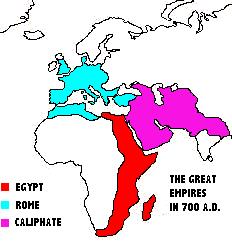
c. 700 AD--Over the previous millennium, the Norse peoples of Scandinavia have been slowly developing sleek, double-ended boats. These are oar powered, and carry only small crews, and are capable of only short coastal voyages in sight of land. Even in these limited craft, the Norse have made themselves a nuisance with raids on Rome’s northern frontiers. However, about 700 AD, two innovations (the T-shaped keel, which strengthens the vessel against heavy seas as well as allowing a mast and sail to be mounted, and the sideboard rudder) are made by Norse shipbuilders in Norway which will enable the Norse to leave their home waters and become not merely a nuisance, but a plague. However, it will be a few decades still before these designs are perfected, and the fearsome Viking longship makes it’s appearance on the world scene.
700-730 AD--period of relative peace in the Middle East as the Omayyad Caliphs, now based in Damascus, Syria, consolidate their gains. Conquered peoples are treated somewhat tolerantly, being allowed to continue to practice their own religions if they pay a special tax. Most people in the conquered regions convert to Islam rather than pay the tax. The Jews in the province of Yehud and elsewhere are a major exception, however, and there are other groups scattered through the Caliphate who do not convert, as well (some Christians, Zoroastrians and Manichaeans in Persia and Mesopotamia, for example). North of the Caucasus, however, a new power is rising...the Khazar Kaganate. The Khazars had already made their presence felt a few years earlier, when they forced the Bulgars westward against the Roman defenses on the Vistula and the Danube. They also are a very tolerant people, and many Jews and Christians who do not wish to pay the Muslim tax on their faiths will flee to the Khazar lands over the succeeding decades. The Khazars will become a major player in world affairs in the centuries to come.
702 AD--Pharaoh Sesostris IV dies, succeeded by Amenemhet V.
729 AD--Pharaoh Amenemhet V dies, succeeded by Rameses XXI.
730-731AD--Khazar troops commanded by Barjik destroy an Arab army at the Battle of Ardabil, then conquer Azerbaijan, Armenia and northern Iraq for a brief time. However, Caliph Hisham I rallies his forces and drives the Khazars back north of the Caucasus the next year.
731-740 AD--War between Egypt and the Caliphate. Taking advantage of the temporary weakness of the Arabs following their defeat by the Khazars, Pharaoh Rameses XXI decides to attempt to retake Egypt’s lost possessions in Asia, and invades Palestine. The local Jews rise against their Muslim overlords when the Pharaoh’s armies cross the border, and with their support, Rameses is able to clear the Muslims out in short order. He follows up with an invasion of Syria, and by 733 AD, has pushed the frontiers of the empire back to the Euphrates. Caliph Hisham I, forced from his capital at Damascus, attempts to reconquer the areas by invasion every year, but finally, in 740 AD, signs a peace treaty recognizing the new frontiers. The Omayyad Caliphate re-establishes it’s capital at Mecca.
737--The Arabs defeat the Khazars. The Khazars are forced to convert to Islam. However, both the conquest and the conversion are short-lived.
740-753 AD--Pharaoh Rameses XXI orders construction of new fortifications to defend the Asian possessions of the Egyptian Empire. Many new fortresses are built, and old ones re-vamped. Egyptian Fire projectors are installed in all fortifications.
740-1000 AD--Muslim expansion in India and central Asia. By 780 AD, the Caliphate has pushed its borders in the east to the line of the Jaxartes River, Hindu Kush Mountains, and the Himalayas. The conquest of the Indian subcontinent takes longer. Resistance by the Hindu kingdoms of southern India, which are protected by dense jungles and mountain ranges, continues until approximately 1000 AD, when the last of the kingdoms falls to the Caliphate. The island of Ceylon is also taken at about this time. This will mark the furthest extent of the Caliphate’s borders in the east, as the formidable terrain barriers and the formidable tribes of nomadic horse archers in the north halt the Arab drive eastward.
749-750 AD--Abbasid Revolution topples the Ommayad Caliphate. The revolution arose from several factors. One major impetus was the secularism of the Omayyad caliphs. The Omayyads had always been outsiders—as a wealthy clan in Mecca, they had opposed Muhammad—and the secularism and sometime degeneracy that accompanied their caliphate delegitimized their rule for many devout Muslims. The Abassids took their name from al-'Abbas, a paternal uncle of Muhammad and early supporter of the Prophet, and their close kinship to Muhammad and the position of al-'Abbas as a Companion of the Prophet served them well in gaining support. A final impetus was the exclusion of non-Arabs from the highest levels of Islamic society under the Ommayads, which lead many non-Arab converts to Islam, especially in Mespotamia and Iran, to support the rebels. In a bloody uprising, the Abbasids massacre almost all of the Omayyad House and sieze power, their leader, Abu al Abbas, being declared Caliph in 750 AD. A few surviving Omayyads flee westward to Egypt, where they are given sanctuary and maintain a sort of "Caliphate in Exile," with the support of the Pharaohs (who see the potential to use them to forment instability in the Caliphate, thus weakening a dangerous enemy).
c. 750 AD--In west Africa south of the Sahara, various petty kingdoms and city states have arisen, influenced by trade with the empires to the north and east. The area is rich in gold, and supplies other exotic goods obtained from the coastal forests to the south. In about 750 AD, the king of the city of Kumbi Saleh unites the various city states in the region, forming the Kingdom of Ghana. Over the next few centuries the Ghanaites expand their holdings until they have a substantial empire in western Africa.
750 AD--Muslim armies attempt to move north from the Caucasus onto the plains of what will one day become Russia, but are defeated by the Khazars.
751 AD--Arab armies meet the armies of the T’ang Chinese Empire at the Talas River, in central Asia southwest of Lake Balkhash. The Chinese are defeated, halting their expansion into central Asia. However, the Arabs do not pursue the retreating Chinese, and their empire will expand no further eastward, either. Chinese prisoners taken at the battle introduce the art of paper making to the Arab world. It will spread quickly along the trade routes, reaching Egypt (where it fails to make much of an impression in a culture where papyrus-making has been an art for over 3,000 years by this point) and Rome (where it becomes very popular as an alternative to imported Egyptian papyrus) by the end of the century.
753 AD--Pharaoh Rameses XXI dies, succeeded by Sesostris V. Sesostris continues his father’s policy of building fortifications in Palestine and Syria.
755-757 AD--War between Rome and the Caliphate. The Romans are pushed back in Asia Minor to the line of the Halys River. However, the Muslims are not able to make any further gains, and a treaty is signed.
760 AD--Pro-Omayyad rebellions in Arabia, formented by the Omayyad exiles in Egypt, with Egyptian support. The Abbasids brutally crush these rebellions. The sacred Kabaa in Mecca is burned to the ground, creating much shock and resentment among the Arabs.
762 AD--War between the Caliphate and the Khazars. The Khazars invade the Caucasus regions under control of the Caliphate, but are forced to retreat.
764 AD--Recognizing that the base of support for the new Abbasid regime is not in Arabia (which is still quite pro-Omayyad) but in Mesopotamia and Iran, Caliph Abu Jafar al Mansur founds a new city on the Tigris river in Mesopotamia, called Baghdad, and established a new capital there.
777 AD--Pharaoh Sesostris V dies, succeeded by Sesostris VI.
c. 790 onward--Persecutions of Jews in the Roman Empire. Many Jews flee to the Khazar lands, where the Kagans grant religious freedom to everyone. Others flee to the Egyptian Empire, which follows similarly tolerant policies.
795 AD--Norse raiders begin ravaging the coasts of Roman Britannia and Ireland.
795 AD--Pharaoh Sesostris VI dies, succeeded by Seti VIII.
c. 800 AD--The first Norse settlements are made on the islands off the coast of Pictland and Scottia (the region north of the Firth of Forth on the island of Britannia which is not held by Rome). Also at about the same time, Norse traders begin moving down the rivers which penetrate the interior of the continent from the Baltic coast. They meet and trade with the native Slavic people who live along major rivers such as the Don, Dneiper, and others, and many of them settle down. Beginnings of Norse settlement in the region.
c. 800-1200 AD--In the aftermath of the Muslim conquest of the Indian subcontinent, there is a large migration of Hindu and Buddhist Indians into the Indonesian Archipelago. Hinduism had been introduced into the region several centuries ago, so these people are absorbed by the various city and island states in the region with no major disruption of historical developments there from OTL. The main change will be that the Hindu kingdoms there, already richer than in OTL due to Egyptian trade, will with this boost in population be better able to resist Muslim encroachment, and Islam will never get a foothold in the region.
801 AD--Pharaoh Seti VIII dies, succeeded by Rameses XXII.
805 AD--Norse raiders attack the coasts of Gaul and Hispania for the first time.
807 AD: In the years after their arrival in the region north south of the Carpathians and north of the Danube, the Bulgars have mixed with the Huns, Avars, Goths, and Slavs who live in the region, and by 800 AD have even adopted the local Slavic language as their own. However, they have not proven to be much of a threat to Rome, living peacefully most of the time. However, this is about to change. In 807, Krum becomes king of the Bulgars. Krum is very aggressive, and the plunder available in the Roman lands south of the Danube looks very tempting...
810 AD: Bulgars, under King Krum, attack the Roman Danube defenses. They are repulsed. Also in this year, the Roman navy clashes with the Norse in the Oceanus Britannicus (OTL English Channel) off the coast of Cantia (OTL Kent). The Romans have never established a true ocean-going navy, using poorly adapted Mediterranean warship designs, and the swift, agile Norse vessels decimate the Roman fleet. From this time onward, the Norse will control the western seas. Communication between Roman Britain and the portions of the continental Roman Empire becomes very problematic.
811 AD: The Roman Emperor Honorius III decides to punish the Bulgars for their raiding, and leads an army across the Danube. Krum's Bulgars defeat the Romans and kill the Emperor in battle. Less than two thousand of the 70,000-man Roman army escape across the Danube.
813 AD: Krum of the Bulgars again assaults the now-weakened Danube defenses. He breaks through and sacks Hadrianopolis. Other cities in the region pay tribute to avoid a similar fate.
814 AD: While on his way to storm the important trading city of Byzantium, which has refused to pay tribute, Bulgar King Krum dies and is succeeded by his son Omurtag. Omurtag’s army is severely defeated by a Roman army outside of Byzantium and forced to retreat north of the Danube. The Bulgars will pose no threat to Rome for quite some time to come.
820 AD--The Norse begin settling on the coast of Pictland and Scottia. They quickly overcome the Picts and Scots in battle, and establish control over large areas. Within 50 years, they will (by conquest and intermarriage with Scottish and Pictish ruling houses, who, like the Norse, are pagans) bring all of Scottia and Pictland under their control. Also in this year, pro-Omayyad rebellions again break out in Arabia. Once again, they are brutally suppressed by Persian troops loyal to the Abbasid Caliph.
825 AD: the Arab mathematician Al Khwarizmi of Baghdad writes a book on "Hindu numerals" that spreads the use of "Arabic" numerals
830 AD--The Norse begin settling in Ireland and in Roman Britannia. In Ireland, they establish towns at Cork, Dublin, and other places on the coast, and quickly subjugate the Irish tribes living nearby. In Britain, Roman power initially limits the Norse to small coastal enclaves, and the Romans are able to maintain control over most of the island. This situation will continue for many years.
840 AD--Pharaoh Rameses XXII dies, succeeded by Amenemhet VI.
849 AD: Caliph al-Mutawakkil deposes the patriarch of the Christian Church and persecutes Christians.
c. 850 AD--Driven by the Turkic Pechenegs, the Magyars (a Finno-Ugrian nomadic tribe living in the region north and east of the Black Sea and allied to the Khazars) migrate west. They reach the plains east of the Roman defenses on the Vistula by 860 AD. These lands are inhabited by a Slavic tribe called the Polanie, who call the area Polska. The Magyars settle among the Polanie and establish themselves as a ruling class in the region. Also at about this time, Roman missionaries convert the King of Ghana to Christianity. Ghana thus becomes the first Christian state outside of Rome.
850 AD-The Persian mathematician Khwarazmi invents Algebra.
860 AD--The Norse discover Iceland.
861 AD--Pharaoh Amenemhet VI dies, succeeded by Amenemhet VII. Also in this year, the Khazar Kagan, Bulan, converts to Judaism.
862 AD--The Magyars raid Roman territory, breaching Roman defenses on the Vistula and causing much damage before they are finally forced to retreat by pursuing Roman armies. Over the next 30 years, the Magyars will continue to periodically raid into Roman territory, but they are not interested in territorial gain, just plunder...for now. The Romans are able to buy relative peace most of the time by making large payments in gold to the Magyar. Also in this year, the Norseman Rurik becomes ruler of Novgorod, founding the State of Rus. Rurik becomes the first Prince of Rus.
863 AD--Boris, King of the Bulgars, converts to Christianity and allies his kingdom to Rome.
869 AD--Pharaoh Amenemhet VII dies, succeeded by Seti IX.
870 AD--All of Ireland has been brought under the control of the Norse. However, the control is somewhat tenuous. Irish kinglets still reign over most areas of the island, but swear allegiance to Norse overlords in Dublin. This situation, of course, could change at any time. However, as in Scottia and Pictland, the pagan Irish (who had no St. Patrick to convert them to Christianity in this TL) and the pagan Norse actually have a great deal in common, culturally, and the two groups get along quite well most of the time. Gradually over time, intermarriage will erase the few differences that exist between them.
872 AD--The Norse kingdoms in Scandinavia are united by a chieftain from Norway named Harald Fairhair, who takes the throne as King Harald I. Harald asserts his claim to rule over all the Norse lands, and his claim is accepted by Norse in Britain, Scottia, Pictland, and Ireland. The Norse in the land of the Rus do not, however.
874 AD--Iceland is settled by the Norse.
875-880 AD--In 875 King Harald I of the Norse leads a large army to Roman Britain with the aim of conquering the island. The Norse establish a large enclave on the island, centered on the city of Eboracum (York). The Romans, who are at this time very pre-occupied with the Magyars on their eastern border, and over the course of the next 5 years, the Norse continue to expand their enclave. By 880 AD, they have overcome the last Roman resistance, and the entire island is under their control.
877-879 AD--War between Egypt and the Caliphate. In 877, Muslim armies invade Syria, but are unable to take the Egyptian fortresses in the region. Frustrated, the Muslims lay siege to Damascus. An Egyptian army arrives in 888 to confront them, and in a bloody battle, the Muslims are defeated and forced to leave Syria. A peace treaty is signed the next year.
879 AD--Prince Rurik of the Rus dies, succeeded by Oleg.
882 AD--The Rus, under Oleg, conquer Kiev, siezing it from the Khazars. Oleg moves his capital there from Novgorod.
888 AD--Pharaoh Seti IX dies, succeeded by Rameses XXIII.
889 AD--The Magyars, under King Arpad, have migrated from the plains east of the Vistula to the lands south of the Carpathians, in the Danube basin. They are met by the armies of the Boris, King of the Bulgars, and soundly defeated. The Magyars retreat back to Polska.
897-899 AD--In 897 King Arpad of the Magyars breaches Rome’s Vistula defenses, and this time the Magyars sweep all the way to the Oder River before they are finally stopped at the old Roman defenses on said River (which the Romans have kept in repair as a second line of defense ever since the frontier was pushed east to the Vistula). These the Magyars are unable to breach, and the front stabilizes. The Romans counterattack the next year, and two Roman armies are defeated and severely mauled as a result. Accepting the fait accompli, the Romans sign a treaty with the Magyars in 899, ceding the area between the Oder and the Vistula to the Magyars.
875-1000 AD--Slow disintegration of the Abbasid Caliphate. Various areas, including Persia, Afghanistan, and the Indian subcontinent, establish themselves as virtually independent of the Caliphate, while still officially acknowledging the hegemony of the Abbasid Caliph in name, if not in fact. The Caliphs, who have over the years fallen into degeneracy and weakness, allow this to happen with little protest.
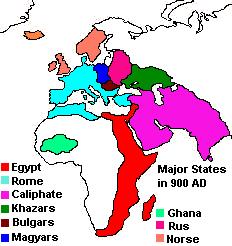
907 AD--Oleg of the Rus leads a fleet across the Black Sea and attacks the city of Byzantium. With the help of a Roman fleet, the city withstands the assault. Oleg signs a treaty with Rome later that year.
910-915 AD--War between Rome and the Norse. In 910 AD , a Roman fleet crosses from the Jutland peninsula and lands an army in southern Norway while King Harald and the main Norse fleet are off raiding the Gallic coast. Before a messenger ship can reach Harald, the Romans have established control over most of the Scandinavian portions of Harald’s kingdom. Harald’s response is to rally the Norse of Britannia and Ireland, raise a huge army and fleet, and then invade Norway himself in 912 AD. Harald defeats the Roman general Maximus Aurelius and utterly destroys his army, and Scandinavia is once again safely Norse. The war sputters on for another three years, mostly consisting of inconclusive clashes between the rival fleets in the Baltic and North Seas. Finally, a treaty is signed in 915 in which Rome recognizes Harald’s claim to his conquered territory in Britain and elsewhere, in exchange for a guarantee of an end to Norse raiding on Roman territories. Harald will keep his agreement until his death. His successors will not.
913 AD--Pharaoh Rameses XXIII dies, succeeded by Sesostris VII.
918-920 AD--War flares up between Rome and Egypt. For centuries, there has been ongoing tension between the two powers in the disputed lands separating their respective holdings on the northern coast of Africa. In 918 AD, Pharaoh Sesostris VII decides to resolve the simmering conflict by siezing the disputed lands. However, Sesostris is killed in battle against the Romans in 920 AD, leaving no heirs. There are several legitimate and not-so-legitimate contenders for the throne, however, and Egypt falls into civil war for three years, during which time Rome siezes not only the disputed lands but the city of Cyrene on the Libyan coast as well. Brief Interregnum in the line of Pharaohs.
922 AD--The Magyars under King Zoltan break through the Danube defenses and raid into Italy, causing much damage. They are finally beaten by a Roman army and forced to retreat back across the Danube.
923 AD--The Royal Vizier of Sesostris VII has emerged victorious in the three-year civil war following the death of the Pharaoh in battle. The Vizier is a commoner with no links to the old royal family, and needs to legitimize his rule. He comes from Memphis, former capital of Egypt under the Old Kingdom, and he declares his descent, in long line, from the great Pharaohs of the Old Kingdom (using a fabricated genealogy, of course). He takes as his own the name of the Pharaoh who built the Great Pyramid, and thus, Khufu II comes to the throne of Egypt, beginning the 32nd Dynasty. The new Pharaoh moves the capital to Memphis later that year. He also signs a treaty with Rome, recognizing Roman title to the disputed North African lands, and purchasing Cyrene back with a hefty payment in gold.
925 AD--Pharaoh Khufu II enacts laws to dramatically raise taxes. This is to pay for the huge construction project Khufu has started in Memphis, as he rebuilds the city to match his own ideas of imperial splendor. The nemhu (land-owning bourgeosie), who are most dramatically impacted by these laws, are very resentful. Their resentment grows even more when Khufu starts arresting recalcitrant nemhu who refuse to pay the new levy and feeding them to the crocodiles. Khufu also resurrects the ancient practice of marrying one’s sister and forbidding royal princes to marry outside of the royal house. This causes widespread consternation in Egypt, where the practice had been largely abandoned for almost 1000 years.
930 AD--King Harald I Fairhair of the Norse dies. His son Erik, known as "Blood Axe," takes the throne as King Erik I. Erik abrogates the treaty with Rome, which he opposed at the time it was adopted. Norse raids against Roman Territory resume with full force.
935 AD--King Erik Bloodaxe is killed by the Romans during a raid on the Gallic coast. His cousin, Haakon, asends the throne. Haakon is a Christian, one of a growing number of Norse Christians converted by Roman missionaries who have been travelling north for the past several decades. However, King Haakon does not force his subjects to embrace the new faith, and when he dies, the succeeding Norse ruler will be a pagan.
939 AD--War between the Khazar and the Rus. The Rus armies under Prince Igor are defeated by the Khazars, and a treaty is signed shortly afterward.
948 AD--Roman missionaries convert King Bulcsu of the Magyars to Christianity. Bulcsu signs a new peace treaty with Rome later that year. However, the conversion and the treaty will be short lived. When Bulcsu dies two years later, the new Magyar King Tacsony will be a pagan, and will resume warring against Rome.
955 AD--Pharaoh Khufu II dies, succeeded by Khafre II. Khafre II will continue the oppressive policies of his father, causing further resentment among the nemhu, who had hoped for some relief from the new Pharaoh. Also in this year, the Magyars under King Tascony suffer a major defeat at the hands of a Roman army while raiding in Germania. So badly decimated are the Magyars that they will no longer pose a threat to Rome after this date.
965 AD--Pharaoh Khafre II dies, succeeded by Pepi III. Also in this year, the Rus under Prince Sviatoslav defeat the Khazars at Sarkel. The Khazar fortress at that location is captured.
970 AD--Pharaoh Pepi III is slightly mad, probably due to the inbreeding going on in the royal house since the reign of his grandfather, Khufu II. Pepi claims a right which is unheard of in Egypt (but which would be called droit du seigneur in OTL Europe)...the right to demand the favors of the daughters of any of his subjects on their wedding nights, or payment of a large fine by the bride’s husband in lieu of said favors. Pepi rarely partakes of the favors of his subject brides, using the law as a way to squeeze money out of wealthy nemhu without having to formally raise taxes. However, the few times he does partake are enough, and lurid rumors spread throughout the land of the depravity of the mad king. This touches off rebellions in different parts of the kingdom, but the army for the most part remains loyal, and the rebellions are put down. Pepi will remain uneasily on his throne, mad as ever, until his death 28 years later.
975 AD--King Geza of the Magyars accepts Christianity. This time it will be a permanent conversion for the Magyars.
982-985 AD--Erik the Red explores and names Greenland, after being outlawed for three years on account of manslaughter in Iceland.
986 AD--Southern Greenland is settled by Erik the Red as he leads the first settlers from Iceland. Erik the Red settles in Brattahlid (today's Qassiarsuk) which becomes the center of the Eastern Settlement.
988 AD--Prince Vladimir of the Rus converts to Christianity. The first church is built in Kiev.
990 AD--Bjarne Herjulfson is blown off course while sailing from Iceland to Greenland, discovers land to the west of Greenland, but does not investigate further. He instead proceeds to Greenland, where he relates his story to Leif, son of Erik the Red.
992 AD--The Seljuk Turks invade Transoxania (Ilkhan) and convert to Islam.
995 AD--King Olaf I Tryggvason, who converted to Christianity before ascending the Norse throne, declares that his kingdom shall be Christian. By a combination of force and persuasion, Olaf sets about converting his pagan subjects. There is of course much resistance, but Olaf is ultimately successful, and the Norse Empire becomes a Christian realm.
998 AD--Pharaoh Pepi III dies, succeeded by Khufu III. However, Khufu will reign for less than a year before being toppled in a coup by an army general who claims descent from a house related to the Saite 26th Dynasty. The people of Egypt, who have always considered the Memphite kings of the 32nd Dynasty as usurpers and have groaned under their oppression for decades, support the rebellion wholeheartedly, especially the nemhu, or land-owning bourgeosie. The new Pharaoh takes the throne as Psamtik XV, and thus begins the 33rd Dynasty. The new Pharaoh moves the capital back to Sais.
1000 AD--The Quiet Revolution in Egypt. For centuries, the nemhu, or land-owning bourgeosie, have been quietly gaining influence in Egypt. Their sons make up the majority of the rank and file of the military, and they themselves serve in all sorts of posts in the royal administration. But they crave a larger voice in the affairs of the empire, and the new Pharaoh owes them, in part, for his own place on the throne. So, when a council of the leading nemhu demands to be heard, Psamtik listens. The council bemoans the abuses of power which took place under the Memphite Dynasty, and demands that a written constitution be drawn up to clearly delineate the powers of the Pharaoh and to protect the rights of the Egyptian people (especially the nemhu, of course). Psamtik agrees, and a committee, composed of the Pharaoh and representatives from the nemhu, meets to craft the document. After several months of hard negotiating, a document is crafted which is acceptable to all sides. The Pharaoh retains his powers as head of state and chief High Priest of the state religion, including complete control of how state revenues are spent. However, he is to be advised by a Council of the 100 Elders, who will be elected from among the nemhu once every four years. The Council has the power to approve or disapprove new taxes and other measures which may imfringe on the rights of the people, such as changes to criminal law, property siezures, etc. It also must approve of any decision by the Pharaoh to declare war on a foreign power. Psamtik XV signs the document, and the first Council of the 100 Elders is elected shortly thereafter. What emerges is the world’s first constitutional monarchy. It is not a democracy, or anything close to it. But Egypt has taken it’s first steps in that direction. Also in this year, Leif Eriksson leads an expedition from Greenland to explore the lands sighted by Bjarne Herjulfson ten years before. His expedition discovers what is in OTL the regions of Labrador (which they call Helluland--Stone Land), Newfoundland (which they name Markland--Forest Land), and Nova Scotia (which they name Vinland). They winter in Vinland, then return to Greenland.
1003 AD--Thorfin Karlsefni leads an expedition to Vinland from Greenland, where they found a settlement. His wife, Gudrid, will give birth later that year to the first European child born in the new land, a boy named Snorri.
1006 AD--After conflicts with the Skraelings (the native inhabitants of Vinland...either Amerindians or Eskimos) and internal dissentions among themselves, the Norse abandon their settlement in Vinland and return to Greenland. However, they will return...
1010 AD--Word of the discovery of new lands west of Greenland has reached the court of Norse King Olaf Tryggvason. King Olaf orders a colonization expedition to be fitted out and sent to Vinland. Olaf will send successive fleets to Vinland each year for the next ten years with new settlers and fresh supplies, and his effort will ensure that the Norse settlement in the new lands are a permanent one.
1011 AD onward--The first Norse colonization fleet reaches Vinland in 1011 AD. They found the town of New Oslo, which will prove to be the first permanent European city in the New World. Later that year, another settlement is made in Markland, where it is planned to exploit the timber available there. Successive expeditions sent by King Olaf Tryggvason will establish other towns in Vinland and Markland, as well as farther south along the coast, all the way down to Cape Cod. By the end of the century, the Norse are firmly established in the coastal regions of the new lands, and are gradually pushing inland as well. However, news of these settlements does not filter out to the rest of the world for a long time.
1011-1200 AD--In the New World, the Norse settlements become firmly established, and Norse control is gradually extended inland. But, due mainly to the relatively small population in the Norse settlements, they will not have moved very far by 1200 AD. The Norse settlements initially thrive by shipping wheat, furs, and timber home. They have, of course, had much contact, mostly peaceful, with the Skraelings (native inhabitants), and within a few years are introduced to two new crops...maize and tobacco. Both of these items become very profitable trade items, especially tobacco, and thus smoking is introduced into Europe. It’s popularity quickly grows, and the immense profits which the Norse earn by being the sole supplier of tobacco into Europe enable them to give up their old piratical habits and to concentrate on the more peaceful pursuit of trading. The Skraelings have also profited from the trade, gaining wheat, horses, pigs and cattle, and knowledge of iron-working, all of which diffuse along the native trade routes throughout the lands east of the Mississippi. By 1200 AD knowledge of iron-working has crossed the Mississippi, and is being practiced as far west as OTL eastern New Mexico. Wheat has also reached those areas by that date. The new livestock (horses, cattle, and pigs) take longer to disseminate, and will not cross the Mississippi for another century. However, the Norse have also introduced two things to the Skraelings which are much less beneficial to them...alcohol and disease. Beginning shortly before 1100 AD, epidemics spread like wildfire southward and westward along the native trade routes, devastating the Skraeling populations east of the Mississippi River. Whole settlements have been depopulated, and even the vast city at Cahokia is nearly a ghost town by 1200 AD. The "Mississippian Culture," which never politically unified the region east of the Mississippi River but has become a common culture through most of the region, collapses as smallpox and other diseases ravage the towns, and priest kings are overthrown by people who have lost faith in their power to intercede for them with the gods. The spread of alcohol is less rapid, but as the Skraelings learn to brew rotgut liquor from their native maize, it becomes a plague on their culture whose only virtue is to make them forget, temporarily, the devastation wrought by the epidemics raging around them.
1012 AD--Over the preceding years, trade with Ghana has significantly increased the gold reserves available to the Roman Empire. In 1012 AD, the Emperor Trajan II assumes the throne of the Roman Empire, vowing to restore Rome to it’s old greatness. Trajan initiates many reforms in the Empire aimed at rebuilding Roman military power. Trajan enacts a law which allows any slave to gain his freedom by joining the army, with the imperial treasury to compensate the owners of said slaves (the number of slave manumissions, however, is limited by the available places in the ranks of the legions). He also makes changes to the tax laws which encourage Roman citizens to consider a military career. He also reforms the army, reducing the term of service from 25 years to 7, with bonuses for those soldiers who re-enlist for a second term, and a land grant for those who complete at least 2 terms of service. Taken together, these measures provide a huge surge of new recruits for the army, which Trajan nearly doubles in size. Trajan also reorganizes the army, changing many infantry legions into cavalry units. The composition of Trajan’s new army is now 50% armored legionary cavalry (armed with lance and bow), 20% light cavalry archers, and 30% armored legionary infantry (mainly used in defense of fortifications). The Roman army is now very mobile, highly disciplined, and packs a signicant missile punch as well as great shock power. It is a truly formidable force. Trajan also reorganizes the Roman navy, particularly the Atlantic and Baltic Sea fleets. Roman naval vessels in these areas are now incorporating many features of Norse design, and Roman fleets are fully capable of taking on a Norse fleet and winning.
1016-1020 AD--War between the Rus and the Khazars. The Rus push the Khazars out of the Crimea and establish their southern border on the Black Sea.
1020-1030 AD--War between Rome, the Magyars, and the Bulgars. Emperor Trajan II, in a series of brutal campaigns, conquers the Magyars and Bulgars and pushes the eastern frontier of the Roman Empire to the line of the Nieman and Bug Rivers and the Carpathian Mountains. Trajan orders construction of a series of strong fortifications to defend the new frontier.
1020-1039 AD--The Great Rebellion in the Egyptian Empire. One of the compromises which allowed the new constitution to be adopted in Egypt was that the new constitution only applies within the borders of Egypt proper, as it was the nemhu of Egypt itself who supported the rebellion which brought Psamtik XV to power. In the imperial provinces, direct rule by the Pharaoh still persists, and Psamtik has taken advantage of his free hand in these areas to keep taxes high. He is not quite as brutal about it as the Memphite Pharaohs were, but nevertheless the nemhu in the imperial provinces, both those who are ethnically Egyptian and those who are Egyptianized natives, consider this situation a gross injustice. Therefore, dis-satisfaction is seething in many of the provinces, and in 1020 AD rebellion breaks out spontaneously (or not so spontaneously...although it is not known at the time, it will be later discovered that agents of Rome and the Caliphate had a significant hand in formenting many of these rebellions) in many places. The rebellions are not coordinated, however, and the Pharaoh’s armies are able to deal with them individually as they occur. But economic life in the empire is severely disrupted, and there is large loss of life as a result of the revolts. Further revolts will flare up intermittently over the two decades, taxing the military resources of the empire.
1021 AD--Pharaoh Psamtik XV dies in battle while leading one of the armies suppressing a revolt in Nubia, and is succeeded by Psamtik XVI. Also in this year, King Olaf Tryggvason of the Norse Empire dies, and is succeeded by his nephew, Olaf Haraldson, who takes the throne as King Olaf II. The new king continues the policies of his great precedessor.
1021-1023 AD--War between Egypt and Rome. Taking advantage of the chaos in the Egyptian Empire caused by the Great Rebellion, which they are partially responsible for formenting, Roman Emperor Trajan II declares war on Egypt. Roman armies invade Cyrenacia and Syria. In Cyrenacia, Rome once again takes the city of Cyrene and the surrounding region. In Syria, the system of Egyptian fortifications stymies them, as it has earlier attempts at conquest. Pharaoh Psamtik XVI sues for peace, and Rome agrees. Rome’s terms are severe...she is to keep Cyrenacia, and Egypt is to pay a yearly indemnity of 10,000 talents of gold each year for 20 years. Egypt is also to lower it’s tolls on Roman shipping passing through the Suez canal. After much hand-wringing, Psamtik agrees.
1031-1032--War between Rome and the Norse. Emperor Trajan II leads a Roman army across the Oceanus Britannicus in an attempted reconquest of Britain. However, the Norse prove to be a tougher opponent than the Magyars and Bulgars, and Trajan is killed in battle in early 1032 AD outside Londinium. The Roman army in Britain is withdrawn shortly after. Britain remains in Norse hands.
1032-1072 AD--The Time of Troubles in the Roman Empire. Unfortunately, one thing Trajan did not reform was the Roman system of succession, and upon his death, civil war breaks out in the empire. No less than 25 weak emperors will claw their way to the throne over the next 40 years, only to be overthrown by the next, no less weak, successor.
1038 AD--The Seljuks, led by Toghrul Beg, invade Persia, moving their capital to Isfahan.
1039 AD--Pharaoh Psamtik XVI dies, succeeded by Psamtik XVII. The new Pharaoh declares that the Constitution of 1000 AD will apply to nemhu in the imperial provinces, as it does to the nemhu in Egypt proper. The Constitution is amended, and the Council of the 100 Elders becomes the Council of the 400 Elders, with 200 Elders representing nemhu in Egypt proper, and the remaining 200 representing nemhu in the rest of the empire. The Great Rebellion finally ends, and normality begins to return to the Egyptian Empire.
1055 AD--The Seljuks invade Mesopotamia and install themselves in Baghdad under the suzerainty of the Abbasids.
1064 AD--The Seljuks invade Asia Minor but are defeated by the Romans.
1071 AD--The Seljuks defeat the Roman army in Asia Minor, killing Emperor Romulus Augustus III, and establish a Sultanate in Anatolia. The Romans manage to hold on to most of the coast, but lose the interior.
1072 AD--Revolution in Rome. Following the death of the Emperor Romulus Augustus III in battle with the Seljuk Turks, a Roman Senator, Septimus Cato, siezes power in Rome. Cato is allied with a Roman general of Magyar descent, one Stephanus Flavius, and together they form a potent combination. Cato is a student of the old Roman Republic, and in cooperation with Flavius, decides to take the extraordinary step of reviving it. The office of Emperor is declared permanently null and void, and a new constitution is drawn up which gives legislative power to the Senate (now expanded to include representatives from all provinces of the empire), which will be elected by the people. Executive power will be exercised by two Consuls, who, as in the old Republic, will hold power on alternate days. The Consuls will be elected by the Senate. The franchise is extended to all male Roman citizens who are property owners, as well as to all Roman soldiers, regardless of whether they are property holders or not. Cato and Flavius are elected as the first Consuls of the new Republic. One of the first laws enacted by the new Senate is that all Roman soldiers, from the highest general to the lowliest legionary, must take a holy oath swearing allegiance to the Roman state. The new law also specifies that pay for Roman soldiers will come directly from a new civilian department created by the Republican government, rather than from army paymasters under the control of the army generals. This will serve to create loyalty to the new regime, rather to their generals, among the rank and file of the army, making it more difficult for army generals with imperial aspirations to engineer revolts in the future. The new Republic will be the most stable government Rome has enjoyed in centuries.
1076 AD--The Seljuks invade Syria and Palestine, sparking war with Egypt. The Egyptian field army is crushed near Damascus, but the Seljuks are unable to take the many Egyptian fortresses and walled cities. The Seljuks lay waste to the land and then retreat back to Asia Minor. It will take many years for these regions to recover their former prosperity.
1080 AD--Pharaoh Psamtik XVII dies, succeeded by Necho XV.
1080-1100 AD--Expansion of the Norse Empire in the Baltic. The Norse conquer the pagan proto-Latvians, Lithuanians, Estonians, and Finns along the Baltic coast and in Finland and convert them to Christianity.
1091--The Seljuks move their capital to Baghdad and depose the Abbasid Caliph installing one of his younger sons as a puppet ruler. The Caliph’s eldest son, Ahmad, manages to escape and takes ship to India. There he finds support among the virtually independent Muslim rulers there, who are opposed to the upstart Seljuks, and establishes a rival Caliphate in India.
1092-1095--The people of Arabia never liked being ruled by the Abbasid Caliphs, who they view as usurpers and whose pro-Persian policies have irked them. They like even less being ruled over by an Abbasid puppet controlled by the upstart Turks. The Omayyad "Caliphate in Exile" takes advantage of this to forment another revolt in Arabia, with significant Egyptian help, and this time, the rebellion is successful. Omar ibn Yazzid, the head of the Omayyad house living in Egypt, comes to Arabia to assume his throne as Caliph Omar III. The new Omayyad Caliph declares his intention to purify Islam of the degeneracy which has arisen under the effete Abbasid Caliphs and to restore Arabs to their rightful position as the chosen people of Islam. He gains almost fanatical support from Arabs in Arabia and elsewhere.
c. 1100 AD--In the region around Lake Chad, various city states are united by the king of the city of Bornu to form the Bornu Kingdom. Like Ghana, it prospers by the trans-Sahara trade in salt, gold, and other exotic goods from the African interior which are readily marketable in the cities of the Roman and Egyptian empires. It also will periodically clash militarily with Ghana along their mutual border. Also around this time, small city states begin forming in the forests south of Ghana. Over the succeeding years, these will begin to combine into larger states.
1100-1105 AD--War between Rome and the Rus. The conflict is inconclusive, and a treaty is signed establishing the borders and basically re-affirming the status quo antebellum.
1104 AD--Pharaoh Necho XV dies, succeeded by Ahmosi X. Ahmosi is a conservative who deeply disapproves of the power-sharing with the nemhu which the Pharaohs must now endure, and with the backing of certain army generals, declares martial law, dissolves the Council of the 400 Elders and reinstates direct rule by the Pharaohs. The nemhu throughout the empire are very resentful and begin plotting his downfall.
1105-1107 AD--Pro-Omayyad revolts among the Arab population in the Seljuk empire. The Seljuks brutally repress the revolts. Thousands of Arabs flee to the Neo-Omayyad Caliphate.
1109 AD--Revolt in Egypt and elsewhere in the Egyptian Empire. The nemhu, with support from most of the army, revolt and overthrow Pharaoh Ahmosi X. The Pharaoh dies in mysterious circumstances while in army custody shortly afterward, and is succeeded by his son, Psamtik XVIII. Psamtik, who never approved of his father’s actions, reinstates the Constitution of 1000 AD, and a new Council of the 400 Elders is elected. The new Council demands, and receives, amendments to the Constitution which make it impossible for the Pharaoh to dissolve the Council and to declare martial law without the approval of the Council. To show his commitment to the new Constitution, Psamtik has the full text of it engraved on a wall of the great temple at Karnak, one the holiest sites in all Egypt.
1110-1115 AD--War between the Seljuks and the Neo-Omayyads. The war is inconclusive.
1118 AD--Arabs import gunpowder from China, but they do not learn the formula at this time. It is used in magic tricks and fireworks, but has no military applications as yet.
1120-1130 AD--War between Rome and the Norse Empire. The war is mainly fought at sea, with several large naval battles being fought in the Oceanus Britannicus, the Baltic Sea, and the North Sea. No advantage is gained by either side, although Norse and Roman raids on each other’s coastlines cause much destruction. Finally, a treaty is signed in 1130 AD.
1141 AD--Pharaoh Psamtik XVIII dies, succeeded by Necho XVI.
1150 AD--The Seljuks attack the Khazars in the Caucasus. The Khazars defeat the Turks and a treaty is signed shortly afterward.
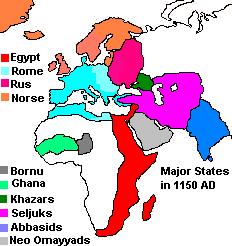
1152-1160 AD--War between the Rus and the Norse Empire. The Khazars ally themselves with the Norse and re-capture the Crimean region. The Norse gain a strip of territory connecting their Baltic Sea territories (in OTL Latvia, Lithuania, and Estonia) with their territories in Finland.
1157 AD--Pharaoh Necho XVI dies childless, leaving no heirs. Not wishing the land to fall into civil war again, Necho has left a will, bequeathing the throne to a boyhood friend from Sais who is also a distant cousin (descended from a bastard son of Psamtik XVII), who takes the throne as Rameses XXIV. Thus begins the 34th Dynasty.
1160-1165 AD--War between the Seljuks and the Abbasid Caliphate in India. The Seljuks invade India in an attempt to oust the rival Abbasid Caliph, but are defeated by the Caliph’s army near Delhi. The Caliph responds with an invasion of his own, and reaches almost to the eastern Seljuk capital at Isfahan before his army is finally defeated and forced to retreat back across the Indus. A treaty is signed in 1165, establishing the border between the two empires.
1170-1179 AD--Rome allies itself with Egypt, and together, the two powers push the Seljuks out of Anatolia. Rome and Egypt divide the newly conquered lands between them, setting the border at the Taurus Mountains and the Euphrates. This begins a period of cooperation between the two empires which will prove very profitable for both over the next couple of centuries.
1190 AD--Pharaoh Rameses XXIV dies, succeeded by Seti X. Seti will gain fame as "The Builder" due to his many large construction projects throughout the empire, which exceed in scope even those of his famous predecessor, Rameses II "The Great."
c. 1200 AD--Arabs learn the formula of gunpowder from the Chinese, but it’s military potential is not immediately recognized. Within five years, Egyptian scientists also learn the formula, and it passes from there to Rome.

Egyptian clipart on this page is courtesy of

Copyright 2004 by Robert Perkins. All rights reserved. Last updated on June 15, 2004.