ANCIENT EGYPT SURVIVES UNTIL THE PRESENT DAY
An Alternate History Timeline
by Robert Perkins
PART FIVE--225 AD TO 700 AD
227--Mani, a Persian mystic born near Babylon in 215 AD, and who has remained in Mesopotamia after the region passed into the control of Egypt, has the first of two visions which will lead him to found the religion of Manichaeism.
229-238 AD--King Ardashir I of Persia declares war on Rome in 229 AD. Egypt remains neutral, but secretly finances both sides, which results in a protracted war which is exhausting for both empires, but inconclusive.
230 AD--Pharaoh Psamtik XII dies, succeeded by Ahmosi VI.
240-260 AD--During the period of peace between Rome and Persia, Rome expands it’s holdings in Europe at the expense of it’s barbarian neighbors. Roman armies push the borders of the empire to the line of the Vistula and Bug rivers, and also take the Crimea and the region north of it in the southern Ukraine.
241 AD--Mani has his second vision and begins preaching in Mesopotamia. The tolerant Egyptian authorities do not impede him. Over the next few decades Mani will travel throughout both the Egyptian and Persian Empires, and his new religion will gain many followers. In Egypt it becomes simply one among many competing faiths, all tolerated by the Empire, and never becomes a threat to the established State religion. However, in Persia, Mani comes into conflict with the priesthood of the official Zoroastrian state religion.
241-250 AD--War between Persia and Egypt. King Shapur I invades Mesopotamia in 241. Egyptian forces are defeated in 242 outside Babylon, and Mesopotamia falls to Persia. Shapur follows up with yearly invasions of the Egyptian holdings in Syria and Palestine, but the Egyptians are successful in holding these areas. A treaty of peace is finally signed in 250 AD.
258-260 AD--Shapur I of Persia invades Armenia, sparking war with Rome. Roman Emperor Valerian is defeated and captured in battle in 260 AD, and Armenia falls to the Sassanids. Egypt is still recovering from it’s recent war with Persia, and remains neutral.
271 AD--King Shapur I of Persia dies, the Sassanid Empire experiences a period of dynastic struggle and is thus self-absorbed for a while . Relative peace reigns in the rest of the Middle East. Also in this year, Mani, who with the death of Shapur I has lost his protector, is crucified in Persia. The new King, Bahram I, severely persecutes Mani’s followers.
275 AD--Pharaoh Ahmosi VI dies, succeeded by Ahmosi VII.
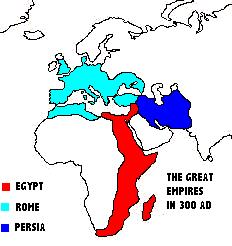
280-320 AD--Expansion of Egyptian holdings in Africa. Over the previous centuries, Egyptian settlers had gradually drifted west from Egypt’s coastal holdings, and a large area of the African interior had come under the cultural, if not the political, domination of Egypt. Ahmosi VII decides to make that domination political as well, and his policy is continued by his successors, Necho XII and Thutmoses VII. Egyptian armies push westward from the coast. The various petty kingdoms of the interior fall to the might of Egyptian arms, and a force of Egyptian marines conquers Madagascar. Thus, by 320 AD, the Pharaohs have added significantly to their realm. With these new conquests come new resources, such as diamonds and exotic woods, spices, animals, ivory, and many others. Egypt’s wealth reaches unprecedented levels.
290 AD--Pharaoh Ahmosi VII dies, succeeded by Necho XII.
300-700 AD: Christianity continues to grow, especially in the Roman Empire, where it is gradually besting it’s main rivals, the cults of Mithra and of Isis, and will eventually become the state religion. In Egypt, it continues to be integrated into the native Egyptian religion, and by 400 AD is virtually unrecognizable by Christians in other lands. Indeed, various synods and councils over the course of the next few centuries will declare the Church of Egypt to be heretical, effectively casting Egyptian Christians out of the fold of Christianity. Meanwhile, Manichaeism also continues to grow, spreading to India, China, and the Roman Empire. In Rome, it is at first tolerated, but eventually will be persecuted (especially after Christianity becomes the State religion) with such severity that it will eventually be exterminated. The rulers of Persia continue to persecute the Manichaens, and as a result the religion does not flourish there, either. Egypt, with it’s tolerant policies, is another matter. Large Manichaean communities arise, but as with Christianity, they never become large enough a factor to threaten the state religion. However, it is in Egypt where Manichaeism survives to the present day, having been exterminated in all other places where it once took root.
304 AD--Pharaoh Necho XII dies, succeeded by Thutmoses VIII.
311 AD--Constantine I defeats his rivals and becomes Emperor of Rome. He converts to Christianity soon afterward, and makes it the official religion of the Roman Empire.
333 AD--Pharaoh Thutmoses VIII is overthrown by a descendant of Wahibre II ("the Usurper"), who takes the throne as Wahibre III, restoring the 29th Dynasty. Wahibre III ruthlessly hunts down and slays all the remaining members of the family of the 28th Dynasty who he can find, earning the name "Bloody Hand."
337-370--Period of intermittent warfare between Sassanid Persia, Rome and Egypt. Wars are inconclusive, but exhausting for all powers concerned.
340-363--The Great Persecution of the Christian church by King Shapur II of the Sassanid Persian Empire, who is a devout and evangelical Zoroastrian.
350 AD--Pharaoh Wahibre III dies, succeeded by Ahmosi VIII. Ahmosi VIII, however, is killed in battle against the Persians later that same year, and is succeeded by Wahibre IV.
360 AD--Julian "the Apostate" becomes Emperor of Rome, revokes Christianity’s official status within the Empire and attempts to revive paganism. Christians are persecuted.
363 AD--Roman Emperor Julian "the Apostate" is killed in battle with Persia. His successor, Jovian, continues the persecution of Christians.
364 AD--Emperor Jovian is overthrown by Valentinian, who becomes Emperor Valentinian I. Christianity is restored as the official religion of Rome. Persecutions of Christians end.
376AD: Huns, led by Uldin, reach the Black Sea and the Danube, conquering the eastern Goths. They also eject the Romans from their lands north of the Black Sea.
380-399--Persecution of Christians in the Sassanid Persian Empire by Kings Ardashir II, Shapur II, and Bahram IV.
395AD: the Huns raid Armenia.
396 AD--Wahibre II’s attempt to eradicate the old dynasty was not totally successful, and a line descended from a distant cousin of Thutmoses VIII still lives in Sais. This family rises in revolt against Wahibre III, and overthrows him. Wahibre and his entire family are put to death. The new family takes power as the 30th Dynasty. The new king takes the royal name of Necho XII.
399 AD--King Yazdagird I of Sassanid Persia ascends the throne. Persecutions of Christians end.
408 AD--Pharaoh Necho XII dies, succeeded by Necho XIII. Also in this year, King Uldin and the Huns raid into Roman Territory. They cross the Danube but are defeated by Rome. However, Rome is forced back to it’s fortifications on the lines of the Vistula and the Danube. All territories east of the Vistula and north of the Danube are lost to the Huns.
409--Yazdagird I of Persia issues an Edict of Toleration for Christians, permitting them to publicly worship and build churches.
412AD--the new Hun leader Donatus is murdered by the Romans and is succeeded by Charato (Karaton), who unifies all Western Huns.
416-420---Yazdagird I of Persia revokes his Edict of Toleration, persecutions of Christians begin again. Many Christians flee to Egyptian and Roman territories.
420 AD--Pharaoh Necho XIII dies, succeeded by Necho XIV.
420-427 The White Huns (an Indo-Iranian tribe from Central Asia not related to the Mongolian Huns which are at this time troubling Europe) raid Persia as far west as modern Tehran. They are severely defeated and forced to retreat from Persia by King Bahram V in 427 AD. Beginning of a long period of struggle between Sassanid Persia and these nomads from central Asia.
425AD--Huns are hired by a western Roman general (Aetius) to fight in Italy during a political crisis.
430AD: The new Hun leader Rugida (Rua) signs a peace treaty with the Roman empire (annual salary in return for peace). The Huns permanently establish themselves in Dacia (OTL Romania).
434 AD--Rugida (Rua) dies and is succeeded by Attila (a friend of Aetius) and his brother Bleda.
437 AD--Pharaoh Necho XIV dies, succeeded by Seti VII.
441AD: The Huns raid Roman outposts along the Danube. Later that year, the Huns sign a peace treaty with the Roman Empire
445AD: By murdering his brother, Attila becomes sole leader of the Huns.
447AD: the Huns and their vassals, the Goths, attack the Roman empire in the Balkans. They break through the Danube defenses and cause extensive damage.
448 AD onward---Christianity is again persecuted in the Sassanid Persian Empire.
449AD: Attila signs a new treaty with the Roman Empire.
450AD: The new Roman Emperor Marcian reneges on the Hun-Roman treaty.
451AD: Huns attack the Danube fortifications but are held at the frontier by Aetius. A new treaty is signed, and the Huns retreat to Dacia, where they collect a yearly tribute from Rome.
453AD: Attila dies. After his death, the Huns are never again much of a threat. By 500 AD they have basically amalgamated with the Goths and settled down in Dacia to stay.
454--Sassanid Persians are defeated by the White Huns. However, the White Huns are not able to make any significant territorial gains.
457-459--Civil War in the Sassanid Empire. King Yazdagird II faces rebellion by Prince Peroz, who has allied himself with the White Huns. Peroz overthrows Yazdagird and takes the throne in 459.
464-475--White Huns attempt to overthrow King Peroz of Persia, but after a decade of exhausting war, are finally persuaded to withdraw from Persia in exchange for a large tribute. An uneasy peace will reign for the next few years.
484--Peroz attacks the White Huns, and is killed in battle. Sassanid Persia is invaded by the White Huns in the aftermath of this defeat, and most of it is conquered. The White Huns will rule Persia through puppet Sassanian Kings for the next 40 years.
c. 500 AD onward--A couple of centuries after the arrival of the Egyptians in Madagascar, which they found to be virtually uninhabited, a new people calling themselves the Malagasy began arriving on the island. The Egyptians allow them to settle, so long as they acknowledge the Pharaoh as their overlord, and through them learn of a vast island archipelago to the east, beyond India with lush forests and fields of spices. The Egyptians have been trading with India for centuries, but now they know where many of the exotic spices which they have been obtaining there actually originate. The Pharaohs consider the area to be too far away to make military conquest practicable, but they begin sending trading ships to the "Spice Islands," as they come to be called, before 600 AD. Egypt’s profits and prosperity increase accordingly.
500 AD--Pharaoh Seti VII dies, succeeded by Thutmoses IX.
520-531 AD--King Khusro I of Persia, in alliance with Turkish tribes from Central Asia, makes war on the White Huns, finally defeating them and re-establishing full independence.
533 AD--Pharaoh Thutmoses IX dies, succeeded by Rameses XIX.
540-662--War between Rome and Sassanid Persia.
552 AD--Pharaoh Rameses XIX dies, succeeded by Psamtik XIII
558 AD: the Avars (another Hunnic tribe from Central Asia) invade the Russian steppes and push the Slavs to the west. Within a few years, these Slavic refugees begin attacking the Roman fortifications on the Vistula and Danube. Most settle in Dacia, where they amalgamate with the Huns and Goths currently living there.
560 AD: the Roman Emperor Justinian hires the Avars to fight the Huns and Slavs. The Avars conquer Dacia, and like the Huns before them, settle there.
568 AD: the Avars attempt an invasion of Roman Territory, but are unable to get past the strong fortifications and naval patrols on the Danube. 590 AD: the empire of the Avars extends from the Volga to the Danube to the Baltic Sea
570 AD--Pharaoh Psamtik XIII dies, succeeded by Psamtik XIV.
571 AD--Mohammed born in Arabia. Also in this year, the Roman Empire signs a treaty with the Avars. The Avars now control an area extending from the Roman frontier on the Danube and Vistula lines to the Volga and the Black Sea.
584: Kubrat unifies the Bulgars (a Turkic vassal tribe of the Avars, living in the region of the southern Ukraine and Crimea). They revolt and establish their independence from the Avars.
596 AD--Pharaoh Psamtik XIV dies, succeeded by Rameses XX.
599--The Avars defeat a Roman army in battle, capturing 12,000 prisoners, which they execute. The Avars get past the Danube fortifications and into the Balkans, where they cause extensive damage before they are finally defeated and forced to retreat back to Dacia.
603-630 AD--Period of warfare between Rome, Persia, and Egypt. Wars are inconclusive, but severely deplete the resources of all three powers. They are thus ill-prepared for the onslaught of the new enemy which is rising to the south, in Arabia.
626 AD--War between Rome and the Avars. The Avars are unable to breach the Danube lines, and accept a Roman peace offer. This will prove to be the last major incursion by the Avars against Roman Territory.
610-634 AD--Mohammed founds the new religion of Islam. The Muslims (as Mohammed’s followers are called) gradually, through a series of wars, bring the entire Arabian peninsula under their control.
615 AD--Pharaoh Rameses XX dies, succeeded by Ahmosi IX.
632 AD--Death of Mohammed. Hadrat Abu Bakr becomes Caliph.
634---Omar ibn l-Khattab becomes Caliph, founding the Ommayad dynasty. Also in this year, a Greek scientist working in the city of Naukratis (Greek colony city in Egypt), while experimenting with petroleum, sulfur, and other inflammables, discovers a liquid substance that adheres to surfaces, ignites upon contact, burns fiercely, and cannot be extinguished by water alone. The scientist has also invented a pumping machine, which enables the mixture to be projected in streams nearly 100 feet long. He demonstrates his discovery to Pharaoh Ahmosi, who recognizes it’s potential as a weapon. He orders Egyptian navy vessels and fortifications to be equipped with projectors for the new substance, which will come to be called "Egyptian Fire."
634-700--Period of Muslim expansion. Muslim invasions of Syria, Mesopotamia, Palestine, and other surrounding regions. Egypt loses it’s Asian possessions to the Muslims, but in 642 AD the Arabs are stopped at the Suez fortifications (where the Egyptian Fire makes its first dramatic appearance in warfare) and are unable to advance into Africa via land, while the Egyptian navy (also equipped with Egyptian Fire) keeps them from crossing by sea, either. Rome is able, with great difficulty, to hold them out of most of Asia Minor. Thwarted in the west by Rome and Egypt, the Arabs move east, where the Sassanid Persians are not so lucky, their empire falling to a wave of Arab invaders by 650 AD. The Muslims continue to move East, expanding into central Asia and over-running the northern portion of the Indian subcontinent by 700 AD. They also move north, taking most of the Caucasus region.
650--The Bulgars are driven westward by the Khazars. They will eventually end up in Dacia, where they overcome the now weakened Avars and establish their own kingdom.
651 AD--Pharaoh Ahmosi IX dies, succeeded by Necho XV.
677 AD--Pharaoh Necho XV dies childless. As there are no male heirs in any closely related branch of the royal family, the throne passes to the family of Necho’s Queen, Neferhari, whose family comes from Thebes. The new ruler is Neferhari’s nephew, a general in the Army. The new King is determined to restore Thebes to its old imperial glory, and decides to take a royal name from the Middle Kingdom period of Egypt (which was also ruled by a dynasty from Thebes and whose literature he especially admires). Thus Sesostris IV ascends the throne as the first Pharaoh of Egypt’s 31st Dynasty.
681 AD--The Bulgars under Kubrat's son Asparuch attempt to cross the Danube but are defeated by the Romans.




Egyptian clipart on this page is courtesy of

Copyright 2004 by Robert Perkins. All rights reserved. Last updated on June 15, 2004.