ANCIENT EGYPT SURVIVES UNTIL THE PRESENT DAY
An Alternate History Timeline
by Robert Perkins
PART EIGHT--1800 TO 1900 AD
c. 1800 AD--Scientists have been formulating theories about the structure of the atom since the 5th Century BC, when Democritus of Abdera formulated the first known atomic theory. Progress in this arena has been slow. Some discoveries have already been made...for example, uranium is known, radioactivity is known, x-rays were discovered in the last century and are already being used for medical purposes, and last but not least, the basic atomic theories, such as the Theory of Relativity (as per Albert Einstein in OTL, in the ATL set forth by Hieros Themopoulous, a Greek scientist working in the city of Miletus, as far back 1620 AD). Up until recently, research has been hampered by the fact that there have been few ways to test these theories, since the appropriate equipment was not available. But as the new century dawns, research is accelerating as scientists in several countries, armed with an array of recently invented equipment, are busy unlocking the secrets of the atom. The more daring of them are beginning to speculate that there might be a potential energy source which can be released by splitting the atom...
c. 1800 AD onward--In the aftermath of the Great Eastern War, all the great powers digest the lessons learned. All of them begin programs to develop landcruisers, and tactical doctrine is re-written to take into account the devastating effects of the machine gun, magazine rifles and long-range heavy artillery. All of them also begin research into means of detecting approaching aircraft from a distance, and of detecting submarines while submerged.
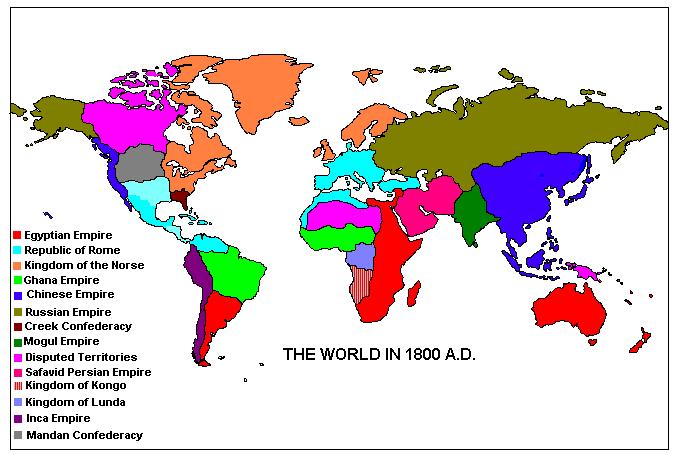
c. 1800 AD--Petroleum reserves are discovered in several places (southern Iran, Mesopotamia, and the Arabian peninsula) controlled by the Safavid Persian Empire, which, since the defeat in the wars of the last century, has been in a state of steady decline. Since Persia does not have the financial resources or the technical know-how to develop these resources itself, it invites foreign petroleum concerns to submit bids. A joint bid by the Egyptian and Chinese national petroleum companies wins, and are given exclusive rights to develop Persia’s oil fields.
1800-1805--The Russian Civil War. In the aftermath of the defeat in the Great Eastern War, unrest against the Russian Tsar (which has been bubbling beneath the surface of Russian society for at least a century, but has been efficiently squashed by the Tsar’s secret police) bursts forth into open rebellion in the capital. Enraged by the high casualties of the war (Russia and China lost over six million men each during the late conflict) and the increased taxes which are now being demanded to pay for the indemnity imposed on Russia by the terms of the Treaty of Beijing, a mob of peasants and factory workers storms the Imperial palace in Moscow. Tsar Paul is dragged from his bed and hacked to death, along with most of the rest of the Imperial family. The triumphant crowd carries the severed heads of their former rulers through the streets on pikes, hunts down and kills all members of the imperial family they can find throughout the city, and all order breaks down in the capital as the Tsar’s officials flee for their lives. When news of this makes it out into the rest of the country, rebellions flare up throughout the empire. In the power vacuum which results, several army generals declare themselves Tsar, and fighting breaks out between armies loyal to the various claimants. Other army units mutiny, murder their own commanders, and ally themselves with the local workers and peasants in the regions in which they are stationed. Last but not least, Tsar Paul’s cousin, Grand Duke Alexei, survived the massacre in Moscow and has rallied many army units to his standard as the legitimate Tsar of All the Russias. Five years of confused and bloody civil war follow, which finally resolves itself when in mid-1805, Grand Duke Alexei defeats the last of the rebel generals near Minsk, and shortly afterward, is crowned as the new Tsar at Moscow. Alexei proves to be a wise ruler, and works to address the causes of the unrest which caused the rebellion in the first place. He, for the first time in Russian history, meets with leaders of the bourgeoisie, the nobility, the church, and other influential groups within the empire, and he works with them to create a constitution. The new document is similar to the constitutions of Egypt and the Norse Kingdom, and creates an elected parliament, called the Duma, which will have the right to approve or disapprove new taxes, treaties, and declarations of war. A bill of rights is adopted for the protection of the people, and the Duma is given veto power over any actions by the Tsar which may infringe on the rights of the people. The Tsar remains head of state, with the power to conduct foreign policy and to dictate how State revenues are spent. The first elections in Russia are held the next year. However, representative government is still a novelty in Russia, and there are many groups within the country which prefer government by a strongman to democracy in any form. This will have ominous consequences later in the century.
1801 AD--Andrei Chernekov successfully produces liquefied hydrogen. Inventors in Egypt, Rome and China will follow suit later that same year.
1802-1808 AD--One of the less desirable by-products of the petrochemical industry which arose in the last century has been the production of various toxins, especially various noxious gasses, which have unfortunately gained the interests of the militaries of the major powers. Military research into poison gasses, which has been going on for a decade now, results in the deployment of the first gas-filled artillery shells and aircraft bombs in Rome, Russia, Egypt, the Norse Kingdom and China. China is first, deploying chlorine gas shells in 1802. The rest of the major powers will follow suit by 1808.
1803 AD--Roman inventor Titus Minucius Felix invents what would, in OTL, be known as AM Radio (previous radio operated on the "spark" system, which was much more prone to interference and which used more bandwidth than AM, limiting the number of stations operating in a single area). Also in this year, Ivan Sikorski invents the first practical helicopter in Russia.
1804 AD--The Mogul Empire has, for the past two centuries, been in a state of steady decline. The Mogul Dynasty has produced a string of weak rulers, and the local Princes have, in most regions of the Indian subcontinent, become virtually independent of the Mogul Emperor by this time. Egypt and China have, in the same manner as the British, French, Dutch, and Portuguese in OTL, been exploiting the weak Mogul government in the various provinces, establishing exclusive trade concessions for themselves. But since Egypt and China have had close relations for centuries, neither power wants to risk war with the other, and so neither has wanted to try to do as the British did in OTL and take over completely. In 1804 AD, the last Mogul Emperor dies without heirs, and to prevent the region from dissolving into chaos, Egypt and China establish a joint "protectorate" over the subcontinent. Rome and Russia protest this action, but since these powers have only limited access to India anyway (Egypt, which controls the Suez Canal, Cape Horn and the Cape of Good Hope, controls all the major sea routes from Europe to the Indian Ocean), they take no other action.
1805 AD--Mingo, an inventor living in the Creek Confederacy, successfully launches the first rocket fueled by liquefied hydrogen and oxygen. It is a small rocket, and only reaches an altitude of 1,000 feet before running out of fuel. But the successful launch demonstrates that the theories proposing that liquefied hydrogen and oxygen might make a satisfactory rocket propellant are in fact correct. Other inventors and scientists will soon follow his lead. Also in this year, Egypt launches the SPHINX, the world’s first purpose-built aircraft carrier. This formidable vessel carries an air wing of 75 combat aircraft (mixed fighters, dive bombers, and torpedo bombers). Prior to this time, experiments have been conducted in many countries with the practicality of launching aircraft from ships, but there has been little interest in the world’s militaries, who, up until the experience of the Great Eastern War, were not entirely convinced of the actual utility of aircraft in warfare for purposes other than observation. Other navies will soon follow suit with similar vessels.
1805 AD onward--Economic chaos in Russia. The turmoil caused by the late Civil War in Russia has caused severe disruption in the economy. Many farms were abandoned during the civil war, and as a result food shortages are causing starvation. Russia’s currency is rapidly declining in value as the specie reserves which back it (of which Russia has never been plentifully supplied) are shipped out to China in payment of Russia’s war debt, or used to purchase grain abroad to stem mass starvation at home. Damage to Russian industry caused by the war with China and the subsequent civil war is only slowly being repaired, and there is large unemployment. The conditions are ripe for the rise of extremist movements, and the new democratic constitution gives such groups a realistic chance for power.
1806 AD onward--The Great Depression. The economic chaos in Russia is causing a cascade effect which spreads through the world economy. The first to be affected is Rome, whose situation is made worse by it’s own domestic policies. In the latter half of the 18th Century, a reformist party had taken power in the Roman Senate, which has remained in power now for several decades. This party, called the Neo-Gracchi, has followed various socialistic policies ("socialism," as such, has never come into being in this world, but the basic "socialist" idea of income redistribution by means of heavy taxation of the wealthy and government spending to benefit the "needy," unfortunately, has) which have severely weakened the Roman economy. As a measure to help pay for their extravagant spending programs, the Neo-Gracchi governments have been gradually debasing the Roman currency, causing inflation and loss of consumer confidence. The collapse of the Russian economy has also had a great impact. Russia was Rome’s largest trading partner, and the loss of most of that trade due to the continuing economic chaos in Russia following the Great Eastern War and subsequent Russian Civil War, plus the imminent threat that Russia might be forced to default on debts to Roman financial institutions, has created a state of extreme nervousness in Roman financial markets. The final straw comes in 1806, when the Neo-Gracchi push through yet another large tax and spend program through the Roman Senate, and announce yet another debasement of the currency. Consumer confidence collapses, there is a run on the banks, and the stock markets panic. The Roman Republic is plunged into a deep economic depression, and it will take quite some time for a full recovery to be made. In order to protect Roman industry during this time of economic crisis, the Neo-Gracchi push through a series of high protective tariffs, which leads other nations to raise their own tariffs in retaliation. The result is a worldwide trade war, which severely disrupts international trade. Financial markets in Egypt, China, and the Norse Kingdom, which are already jittery as a result of threatened Russian defaults on international loan obligations, experience panics, and the economies of these powers, as well, fall into recession. The hard economic times will provide a fertile ground for the rise of extremist groups in various nations, especially in the two hardest-hit nations...Russia and Rome. This will have dire consequences in the years to come.
1809 AD--The Mandan Confederacy, which has been (with Norse and Chinese help) developing an industrial base, including an aircraft industry, since it’s independence was recognized in 1765, makes it’s first contribution to the field of aeronautics when Lakota inventor Wapasha demonstrates a crude jet engine, the first anywhere in the world. It does not excite much immediate interest.
c. 1810 AD and onward--For the past couple of centuries, scientists and inventors have been trying to design a practical automatic calculating machine (computer). Indeed, mechanical calculating machines, used to calculate the motion of various heavenly bodies as an aid to navigation at sea, had been designed by the Greeks as early as the 1st Century BC, and other inventors through the years have designed mechanical "difference engines" and "analytical engines" for calculating large numbers and producing mathematical tables. But none of these has been truly automatic, and the practicality of large machines composed of delicate gears and wheels has left much to be desired. But in 1810, Egyptian scientist Hekhemmut begins work on a binary digital calculating machine using the new triode vacuum tubes designed by Gaius Rufus Caper. Scientists in other countries will soon be following similar lines of research.
1810 AD--Unemployment in the Roman Republic stands at 28 percent. A new party, the Julian Party, is gaining support. The Julian Party, named after Julius Caesar, is militarist and nationalist, advocating military buildup and overseas expansion as a means of curing Rome’s economic woes. Party members wear black shirts, with white armbands emblazoned with the party emblem...a profile likeness of Julius Caesar flanked by two fasces. Because of this emblem, the Julian Party has another, unofficial name...The Fascist Party.
1812 AD--The militarist and nationalist Redemption Party, one of the various extremist groups which has arisen amid the chaos in Russia, makes a very strong showing in the biennial elections, becoming the second largest single party in the Duma. The party, like the Julian Party in Rome, advocates military buildup, and expansion overseas "to take the resources which, by right, should be ours." Also in this year, Pharaoh Psamtik XXV dies, and is succeeded by Ahmosi XV.
1814 AD--The Julian Party wins a significant number of seats in the Roman Senate. They are now the second largest party in the Senate, after the Neo-Gracchi.
1816 AD--In the biennial elections in Russia, the Redemption Party wins a majority of the seats in the Duma. Vladimir Pushkin, the leader of the Redemption Party, becomes Prime Minister of Russia. Pushkin loudly declares that it is time for Russia to "take it’s rightful place in the world" and "avenge ourselves on those who have wronged us." Fortunately, Tsar Alexei still controls foreign policy, but he is getting older and sicker with each passing year...
1817 AD--Inca engineer Chinguan Topa, who has been working with the jet engine designed by Wapasha back in 1809, comes up with a much improved model. More development will follow.
c. 1818 AD--Since the end of The Great Eastern War, Egypt, China, Rome, Russia, and the Norse Kingdom have experimenting with various forms of sonar (for detection of submersible craft) and radar (for detection of approaching aircraft). By this date all of these powers have deployed primitive systems.
c. 1820 AD--Radio is in it’s heyday. The price of radio receivers has dropped to the point that they are affordable to nearly everyone, and radios have become a fixture in homes the world over. There are hundreds of commercial radio stations in most countries, broadcasting news and entertainment to a mass audience.
1820 AD--The Julian Party has been growing by leaps and bounds as the Roman Depression lingers on, year after year. In this year’s Senate Elections, the party wins a majority of the seats. The two Consuls elected, Flavius Cornelius Tertullus and Gnaeus Domitius Cyprianus, are both Julian Party men. Later that year, arguing that the continued Depression constitutes an emergency which requires stronger measures than the Senate has, heretofore, been willing to countenance, the Julian Party majority in the Senate pushes through a bill to revive the old office of Dictator. Flavius Cornelius Tertullus is installed in the new office, and begins a crackdown on members of the political opposition. He also orders a military buildup to begin. This does have, at least temporarily, some effect in alleviating the high unemployment caused by the ongoing Depression, increasing the popularity of the Julian Party with the public. Also in this year, Egyptian physicist Seqenenre first proposes the idea of nuclear chain reaction, and files several patents based on this idea. Seqenenre argues that nuclear chain reaction could be used for power production, or with a correct "critical mass" of chain-reacting substance, "explosion." He publishes his theories in an Egyptian scientific journal.
1821 AD--Tsar Alexei of Russia dies in an automobile accident. His only surviving son, Prince Mikhail, is a child of only three years old. According to the Russian Constitution, the Duma will have the power to select a regent to rule the country during the minority of any Tsar who has not reached the age of eighteen at the time of his ascension to the throne. The Redemption Party majority in the Duma (along with it’s extremist allies from other parties who, together, make up almost 2/3 of the Duma by now) votes to make Vladimir Pushkin the new regent. Like his counterpart in Rome, Pushkin begins his own military buildup, which has the effect of dramatically reducing unemployment. The popularity of the Redemption Party increases. Also in this year, Seqenenre urges Pharaoh Ahmosi XV to keep his nuclear chain reaction patents secret, as they could be used to produce a "terrifying weapon of awesome power." But it is too late...researchers from several other countries have already read Seqenenre’s article in the EGYPTIAN JOURNAL OF SCIENCE, and patent researchers have already viewed Seqenenre’s patents in the Egyptian Imperial Patent Office. Research into the possibility of nuclear chain reaction and, ultimately, nuclear explosives, has already begun, albeit with limited funding, as most powers are not convinced of the true potential of the new technology.
1822 AD--Emperor Lee T’ang Kuo of China dies. He is succeeded by his son, Lee M’ing Hua. Also in this year, the biennial elections return a still-larger majority of Redemption Party members to the Duma. Imperial Regent Pushkin now feels strong enough to make his play for true power. He arranges to have arsonists burn the Potrovski Cathedral (on what would, in OTL, be called Red Square), and then arrests a Chinese immigrant for the crime. In a speech the next day, Pushkin proclaims that the burning is a "symptom of a great foreign conspiracy against the Russian people," and he declares a state of emergency. With the support of the Redemption Party-dominated Duma, Pushkin declares the Constitution is suspended for the duration of the "emergency." There will be no more elections, and the inconvenient Bill of Rights will no longer be enforced. At Pushkin’s direction, the Duma obediently passes a series of draconian "emergency measures." Foreigners, and most especially ethnic Chinese, are arrested and interned in large, unsanitary Camps located in the more barren regions of Siberia, or Gulags, as they are called. A new secret police force, the Oprichna, is formed to keep watch on "subversives," which in practice means anyone suspected of disagreeing with the policies of the Imperial Regent. These, too, will find their way into the Gulags. There they, along with the Chinese, will be slowly worked to death, or simply murdered. The Russian military buildup accelerates. Also in this year, an aircraft powered by Chinguan Topa’s jet engine becomes the first non-prop-driven aircraft to make it into the air. However, the engine is still very unreliable, and consumes large amounts of fuel, making the aircraft impractical. But it is a start.
1823 AD--Russian Imperial Regent Vladimir Pushkin, noting the similar ideology and aims of his Redemption Party and the Julian Party in Rome, begins negotiations with the Julian Party leadership with the aim of a possible alliance. Late that year, a secret treaty will be signed between the two powers.
1824 AD--Vladimir Pushkin of Russia and Flavius Cornelius Tertullus of Rome, in secret discussions, reach an agreement to jointly invade and conquer the decrepit Safavid Persian Empire, where rich sources of petroleum have recently been discovered. The two leaders also agree, in principle, on future joint action against the Norse and the Chinese, both of whom possess New World territories which are coveted by Rome and Russia. Preparations for the invasion begin.
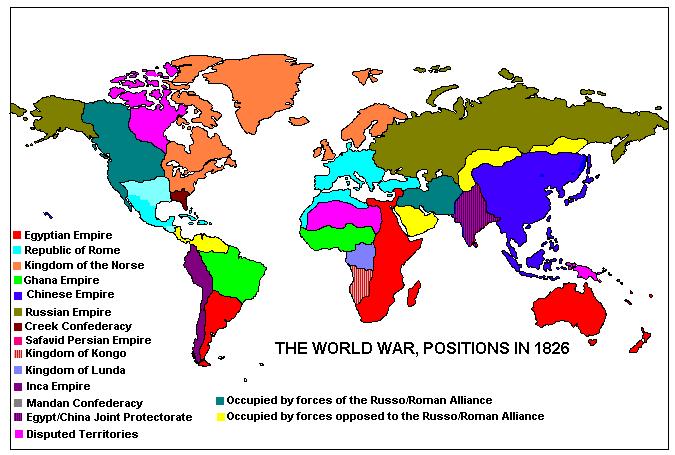
1825-1831 AD--The World War. In April 1825, a staged "border incident" leads to escalating "tensions" (or so it seems) between the Safavid Persians and Russia. Russia issues an outrageous ultimatum to the Persian Shah, which is, of course, refused. Egypt and China issue statements of their own indicating that they would look at any invasion of Persia...which would threaten their oil concessions there...as a serious matter, and Flavius Cornelius Tertullus of Rome issues a statement in support of Russia’s "right of redress for the insult suffered at the hands of the Persian Shah." When the deadline for the ultimatum passes on May 1, the Russians invade. Russian armored columns move rapidly southward, crushing weak and ineffectual Persian opposition. After conferring on the issue, Pharaoh Ahmosi XV of Egypt and Emperor Lee M’ing Hua of China issue a joint ultimatum demanding the withdrawal of Russian forces from Persian soil. When the deadline for this ultimatum also passes without reply, Egypt and China declare war on Russia. Flavius Cornelius Tertullus of Rome thereupon declares war on Egypt and China. And the following day, invoking the mutual defense treaty between his empire and Egypt, Emperor Atahualpa IV of the Inca Empire declares war on Rome. The only major powers which have not, at this point, committed itself to one side or the other are the Norse Kingdom and Ghana, and both of them are receiving feelers from both sides, attempting to draw them in. The minor powers (Kongo, Lunda, the Creek Confederacy and the Mandan Confederacy) are also sitting on the fence, having declared themselves neutral.
This war will be notable for several reasons. It will be the first in which combat between massed formations of landcruisers will take place, the first in which radar and sonar will make their presence felt, and the first in which hollow-charge anti-landcruiser rockets will be used, the first in which helicopters (used primarily as troop transports and med-evac craft) and jet aircraft (fighters and bombers, both introduced in the final year of the war) are used, and the first in which poison gas (chlorine and mustard gas primarily) will be used. Both sides will also fund research into long range rockets, and Egypt and Rome will deploy systems similar to the OTL German V-1 and V-2 by the end of the war. However, other than as a terror weapon, long-range rockets will make no significant impact on the war. They are simply too inaccurate to be valuable for destroying military targets, and the conventional high-explosive or poison gas warheads they carry are of only limited effectiveness. Researchers in Egypt and China will develop the first true electronic binary digital computers (huge machines, composed of tens of thousands of vacuum tube switches and cathode ray tubes for random access memory, which each fill up a large warehouse, but have less computing power than a modern desktop PC in OTL), which are used to calculate artillery ranging tables. Egypt, Rome, Russia, and China will all fund programs aimed at the development of atomic weapons, but none of them will succeed prior to the end of the war. Last but not least, the first anti-biotic drugs (based on penicillin) will be introduced in China, and will begin to revolutionize medicine.
Combat rages on nearly every continent of the world. In the mid-east, Russian and Roman armored columns rapidly occupy Iran and Mesopotamia by the beginning of June 1825. Rome also invades Egypt’s Syrian provinces, but is met by heavy resistance from Egyptian forces there and makes little progress. Meanwhile, the Egyptians land an expeditionary force on the Arabian coast in mid-May 1825, and rapidly occupy the Arabian peninsula. They are reinforced by a Chinese expeditionary force which lands in mid-June 1825, and establish a defensive line in the Arabian desert which finally halts the Russo/Roman advance southward. In the far east, China invades Russian Central Asia. Huge armored battles take place between Russian and Chinese armies, but neither side gains much advantage despite heavy losses on both sides. In North Vinlandia, Russian and Roman forces invade the Chinese colonies and Mandan Confederacy, and occupy them after heavy fighting. They also invade the disputed territories north of the Mandan Confederacy, and seize most of these as well. By the end of the year Egypt sends an army to South Vinlandia, where, in cooperation with the Incas, they invade the Roman Vinlandia colonies from the south, occupying the Roman colonies on the northern coast of South Vinlandia. However, the Romans establish a defensive line in the jungles of Central America, and fighting bogs down there. In Africa, Roman and Egyptian armies clash in the North African desert as Rome invades Cyrenacia, but is repulsed. At sea, the first battles between fleets including aircraft carriers take place, as Egyptian and Roman carrier fleets collide in the Atlantic, and Chinese, Egyptian, Roman and Russian carriers clash in the Pacific. Losses are heavy, and neither side is immediately able to achieve naval supremacy. Submarines of all navies prey on enemy shipping, and are countered by destroyers which hunt them using the new sonar equipment, and for the first time, submarines take significant combat losses. Roman, Egyptian, Russian and Chinese air forces begin strategic bombing of population centers and industrial targets. They are met by fighter and anti-aircraft artillery opposition which is guided by primitive radar, and suffer significant losses. Their operations do not significantly disrupt the military production of either side. One particularly horrid feature of these operations is the use of bombs filled with chlorine and mustard gas against enemy civilian population centers (first carried out by Roman bombers attacking the Egyptian city of Memphis and Russian bombers attacking the Chinese city of Mukden in July 1825). Hundreds of thousands die in these raids, which cause worldwide outrage. Egyptian and Chinese bombers will retaliate in kind later that year.
For the next three years, the fighting drags on, with neither side gaining a clear advantage. It is finally submarine warfare which tips the balance in the conflict...by bringing some of the heretofore neutral powers into the war. Egypt and China have declared that their submarines will not attack neutral shipping, but the dictators ruling Rome and Russia have declared a policy of unrestricted submarine warfare, and warned that neutrals trading with Egypt, China and the Incas do so at their own peril. In late 1828, after a series of sinkings of Norse and Ghanaese merchant vessels by Roman or Russian submarines, King Haakon XII of the Norse Kingdom and King Abrafo Adana III of Ghana declare war on Rome and Russia.
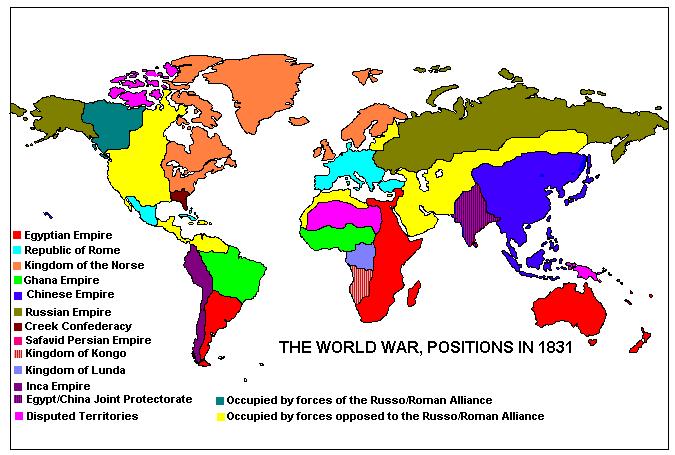
In 1829, Norse, Ghanaese and Egyptian fleets combine to take control of the Atlantic, and Chinese, Egyptian, and Inca naval forces in the Pacific also finally destroy most of the Russian and Roman fleets in the Pacific. Russian and Roman forces in Vinlandia are thereby effectively cut off from supply and reinforcement from that point onward. Ghanaese and Norse armies cooperate with those of Egypt and the Incas in Vinlandia, and the Roman and Russian provinces in Vinlandia (including the captured Chinese colonies) are mostly occupied by the end of 1830. Ghanaese armies also add their weight to those of Egypt in Africa, and most of Rome’s north African possessions are occupied by the end of 1830. A Norse invasion of Russia in 1829 makes good progress and forces Russia to withdraw forces from it’s central Asian and middle eastern fronts. Chinese and Egyptian forces punch through the weakened lines, and by early 1831 they have pushed Russian and Roman forces completely out of former Safavid territory and are moving into Russian and Roman territory itself. In March 1831, Vladimir Pushkin of Russia is toppled by a military coup, and a junta of generals, headed by General Georgi Scheranski, takes power. General Scheranski immediately sues for peace, and Russia drops out of the war. Left in the lurch by it’s ally, Rome finds itself in an untenable situation, but Dictator Tertullus does not immediately recognize this, and vows to continue fighting. In early April 1831, the various opposition parties in the Roman Senate unite with dissident members of the Julian Party to take control of the Senate and topple Flavius Cornelius Tertullus from power, and Rome also sues for peace. On April 22, exhausted by the fighting, the other powers agree to an armistice, and peace settles over the world.
1832 AD--General Scheranski declares the suspension of the Russian Constitution and dissolves the Duma. He declares that he is ruling as regent for Crown Prince Mikhail, and will relinquish power when Mikhail comes of legal age.
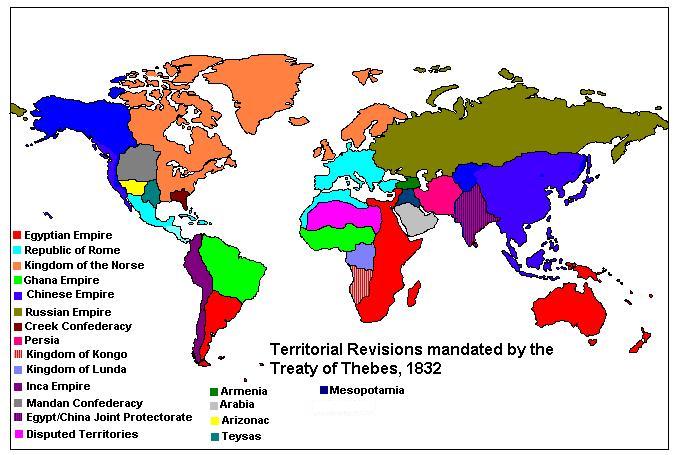
1831-1832 AD--The Congress of Thebes. The armistice which ended the fighting was not a formal treaty, and it is agreed by the various powers to hold a Congress in the Egyptian city of Thebes, where the final peace treaty will be worked out. This Congress will last for over a year, and several times during the intense negotiations, hostilities almost break out again. But finally, on July 1, 1832, a treaty is signed, officially ending The World War. The terms of the treaty are as follows...
1) A Council for International Peace is created, to be composed of representatives from each of the great powers (Egypt, Rome, Ghana, the Norse Kingdom, China, Russia, and the Inca Empire). This council will serve as a forum for the arbitration of disputes between nations.
2) The Safavid dynasty is removed from the throne of Persia. The former Persian Empire is divided, with Mesopotamia and Arabia being given independence. Persia itself is also to be independent. Elections are to be held within one year in Persia, Mesopotamia and Arabia to determine if they will become constitutional monarchies, or republics. If the monarchy option is chosen, rival claimants to the throne will submit their cases to arbitration by the Council for International Peace, whose decision will be final.
3) Rome will cede it’s territory in Asia Minor east of the Halys River. This territory, along with some territory taken from the former Safavid Persian Empire, will become the State of Armenia. Like Persia, Mesopotamia, and Arabia, Armenia will hold elections within one year to determine whether it will be a constitutional monarchy or a republic. If monarchy is chosen, rival claimants will submit their cases to the Council for International Peace, whose decision will be final.
4) Rome is to cede Cyprus to Egypt.
5) The Roman provinces in north Africa will remain under joint occupation by Egypt and Ghana for a period of ten years. During that period, Rome will pay an indemnity of 10 billion gold denarii, payable in yearly installments of 1 billion denarii each year, to both Egypt and Ghana. Once said indemnity is paid in full, the north African provinces will be returned to Rome.
6) Russia will cede the Trans-Oxian provinces seized from the Safavid Persian Empire in 1824 to China (China has a historical claim to the area, going back the T’ang Dynasty).
7) Russia will cede the colony of Nova Rossiya to China.
8) The Mandan Confederacy will be restored to independence.
9) Rome will withdraw to the line of the Colorado, Gila, and Rio Grande Rivers, ceding the territory it seized in the last century. Said territory will be divided into two independent states, ruled by confederations of the native peoples within each area...Teysas and Arizonac. As in the other new independent states created by the Treaty of Thebes, elections will be held within one year to decide whether the governments thereof shall be constitutional monarchies or republics. If the monarchy option is chosen, rival claimants will submit their cases to arbitration by the Council for International Peace, whose decision will be final.
10) The Norse Kingdom gets back it’s former territories west of the Mississippi River, which it had ceded after the Second Great Maritime War.
11) Rome will cede it’s colonies on the northern coast of South Vinlandia, said colonies to be divided by Ghana and the Inca Empire.
12) The status of the disputed territories in Vinlandia and the Pacific Ocean region are decided. Egypt gets New Guinea and the other disputed islands in the Pacific. China and the Norse agree to a division of the disputed territories in North Vinlandia, and set the border between them. The only disputed territories left in the world now are the Sahara Desert regions of north Africa, which are disputed between Egypt, Rome, and Ghana. These are placed under the administration of the Council for International Peace.
13) Vladimir Pushkin and Flavius Cornelius Tertullus are to be surrendered for trial by a military tribunal appointed by the Council for International Peace for war crimes...particularly ordering bombing raids using poison gas bombs against the cities of Memphis and Mukden in 1825. This is the first time in history that such a trial will be held, and thus this provision of the treaty sets a significant international precedent.
1833 AD--In accordance with the terms of the Treaty of Thebes, elections are held in Persia, Armenia, Mesopotamia, Arabia, Teysas, and Arizonac to determine the form of government each of these new states will have. Persia and Arabia choose constitutional monarchies, while the rest choose republics. Also in this year, the war crimes trials of Vladimir Pushkin and Flavius Cornelius Tertullus are held. Chilling pictures of the poison gas dead in Memphis and Mukden are introduced, which sway the tribunal heavily against the defendants (incidentally, their defense attorneys introduce footage showing the poison gas dead in the Roman city of Capua and the Russian City of Omsk...results of the retaliatory raids by Egypt and China. These pictures, however, are declared immaterial, as the Egyptian and Chinese raids "would not have been carried out if Rome and Russia had not acted first."). Both former dictators are convicted, and sentenced to death by firing squad, said squads to be composed of one soldier from each of the victorious powers. The sentences are carried out on August 1, 1833 AD.
1834 AD--Chinese and Egyptian physicists independently produced the first sustained and controlled nuclear chain reactions. Also in this year, Norse researcher Heimdall Bjornssen invents the first transistor, a device which will revolutionize electronics by eventually replacing bulky, unreliable vacuum tubes.
1835 AD--In the aftermath of the war crimes trials of Vladimir Pushkin and Flavius Cornelius Tertullus, the first of several international conventions is held in the city of Oslo, capital of the Norse Kingdom, to codify international law with regard to conduct in war. This will result, eventually, in the Oslo Accords, which be ratified by all major powers by the end of the century, greatly restraining the increasing tendency toward barbarism in warfare which has been increasing for the last century.
1836 AD--Ever since Kwame Asempapasasa of Ghana developed the first picture practical scanning and display devices based on the cathode ray tube, various inventors have been working on improving the system. In this year, Inca inventor Quillis Sachac demonstrates the first true television system. Later that year he first broadcasts television pictures through the airwaves, and the first television broadcasting station is opened shortly thereafter. Also in this year, Crown Prince Mikhail of Russia comes of legal age for ascension to the throne. But General Scheranski refused to relinquish power. Crown Prince Mikhail goes into self-imposed exile in the Norse Kingdom.
1837 AD--The first practical hard disk drive is invented.
1839 AD--Egyptian scientist Paibekkamen develops the first magnetic drum memory for computers. In this year also, the Roman Senate passes an amendment to the Roman Constitution which specifically denies the existence of the office of Dictator and bars such an office from ever being created again. It also states that the two Consuls cannot be drawn from the same political party.
c. 1840 AD onward--In the aftermath of The World War, world politics continue to be dominated by conflict between the old wartime alliances. Russia and Rome maintain an alliance, called the Central Alliance, and cooperate on many issues. The alliance between Egypt, China, the Norse Kingdom and the Inca Empire, known as the Pacific and Atlantic Treaty Organization (or P.A.T.O.), does likewise. Ghana follows a more independent course, and forms, along with the smaller nations such as the Creek and Mandan Confederacies, Teysas, and the Kingdom of Kongo, the League of Non-Aligned States. The conflict will not, however, flare into open warfare for the remainder of the century, but will instead consist of scientific and economic competition and proxy warfare between client states of the major powers. A rough stability, although often a tense stability, settles on the world.
1840 AD--China creates the first economically practical nuclear reactor for the production of electric power.
1841 AD--Egypt’s first nuclear reactor, producing electric power, goes on line.
1842 AD--Rome pays the last installment of the indemnity required by the Treaty of Thebes. Egypt and Ghana withdraw from Rome’s north African provinces, which revert to Roman control.
1843 AD--Emperor Lee M’ing Hua of China dies, and is succeeded by his son, Lee K’ang Tse.
1848 AD--Egypt detonates the world’s first atomic bomb, a small fission device producing 10 KT of explosive power, at a remote location in the Sahara Desert. News of this electrifies the world, and all major powers jack up funding to their own nuclear research programs. Also in this year, the first transistor-based computer is built in Rome by Claudius Julius Aggrippa. It is equipped with a hard-disk drive. Also in this year, General Georgi Scheranski, ruler of Russia, dies. In his will, he specifies that Crown Prince Mikhail is to be recalled, to rule under the aegis of the Russian Constitution, which Scheranski declares to be unsuspended while on his deathbed. Prince Mikhail, now a handsome and hardy man of 30 years, returns to Russia and assumes the throne as Tsar Mikhail V amid mass jubilation. A new Duma is elected later that same year.
c. 1850 AD--Television is rapidly displacing radio as the primary form of home entertainment worldwide. Inventors in all countries have come up with competing systems to, or copies of, Quillis Sachac’s television system, and variants of all of these are being mass-produced in all countries. Also, research into rocketry has been proceeding by all of the major powers, and significant improvements have been made over wartime designs.
1850 AD--Pharaoh Ahmosi XV dies, and is succeeded by Thutmoses XIII. Also in this year, China detonates it’s first fission bomb.
1851 AD--Rome launches the first artificial satellite into orbit. It is a simple device which broadcasts a radio signal playing Rome’s national anthem to disbelieving listeners around the world. Egypt, China, Ghana and the Norse Kingdom all accelerate their rocketry programs.
1854 AD--The first integrated circuit board (precursor of the microchip) is invented in Ghana by Sese Ompo. With development, this will, like it’s predessor, the transistor, revolutionize the electronics industry...especially computers.
1855 AD--Rome detonates it’s first fission bomb. Also in this year, Emperor Lee K’ang Tse of China dies, and is succeeded by his son, Lee Cong Tsu.
1856 AD--China and Egypt both launch satellites into orbit.
1857 AD--Russia and the Norse Kingdom detonate fission bombs.
1858 AD--The Norse Kingdom and Russia each launch a satellite into orbit. Also in this year,
1860 AD--Ghana and the Inca Empire detonate fission bombs. Russia astounds the world by announcing that it intends to land a man on the moon. As a first preparation for this, it launches a dog into orbit aboard a primitive space capsule.
c. 1860 AD--The first colour television broadcasts are made in several countries. However, colour television receivers will be rare for some time to come, due to their high cost. Also, research into missile guidance systems has been proceeding by all powers. By this date, heat-seeking and radar-seeking anti-aircraft missiles have been introduced, and medium range ballistic missiles, tipped with nuclear warheads, will make their way into the inventories of all of the various nuclear powers by the end of this decade.
1861 AD--Pharaoh Thutmoses XIII dies and is succeeded by Seti XIII. Pharaoh Seti proclaims that Egypt will meet Russia’s challenge and work toward the goal of landing a man on the moon. Ghana and the Inca Empire launch satellites into orbit.
1862 AD--Egypt makes an agreement with China and the Norse Kingdom to work jointly on the moon-launch project. Thus the Tripartite Astronautical and Space Agency (TASA) is founded. Later that year Egypt launches a cat into space aboard a primitive space capsule. Also in this year, Rome successfully tests an intercontinental-range ballistic missile (ICBM) which can be equipped with a nuclear warhead and which can hit targets anywhere in the world. Tensions between the great powers rise dramatically as a race to equip themselves with the new weapon results.
1863 AD--In this year, inventors in Egypt, Rome, and China independently invent both the computer mouse and the floppy disk for portable data storage. Also in this year, the first communications satellite is launched by TASA.
1865 AD--In this year, Russia launches the first human into low-earth orbit. Yuri Vlasov, upon his safe landing, is lauded as an international hero.
1866 AD--TASA duplicates the feat of Russia the year before, launching Norseman Lars Johannssen into low-earth orbit from a rocket base outside of New Oslo, Vinlandia. Egypt tests it’s first ICBM. China follows suit later that year.
1867 AD--The first computer modem is invented by Egyptian inventor Dua-Cheti. Later that year, he demonstrates that multiple computers can be networked using these modems. The Norse, the Inca, and Ghana all test ICBMs.
1868 AD--Rome and Russia agree to work jointly on their moon-launch projects and form the Central Alliance Space Project, or CASP. Also in this year, what would be known in OTL as GPS (Global Positioning System) but in the ATL is known as Worldwide Standard Positioning (WSP) becomes a reality with the launch of a system of geo-synchronous satellites by TASA. This is a godsend for navigation both at sea and in the air, and will be widely adapted by militaries around the world for use in guidance systems for missiles and other aerial munitions.
1869-1878 AD--Border war between Kongo and Lunda. In the years since The World War, the major powers have not dared to go to war with each other, remembering the horrid casualties and destruction of that conflict. But that has not kept them from arming client states whose conflicts serve as a form of proxy conflict between the great powers, allowing them to test their latest weapons systems against each other. The simmering conflict between the Kingdom of Lunda (a client of Rome) and the Kingdom of Kongo (a client of Egypt) is one example of this phenomenon. The Kingdom of Lunda still resents the siezure of the province of Katanga by Kongo, and, with Roman help, is planning to take it back. Lunda invades in 1869, sparking a nine year war between the two kingdoms. Lunda is finally successful in defeating the Kongoese Army, and takes the province back. But when Lunda invades Kongo proper in 1878, Egypt and Ghana demand an end to the war, and Rome, not willing to go to war itself on Lunda’s behalf, does not back it’s client. Sullenly, the King of Lunda withdraws his forces from Kongo, but keeps Katanga. The war comes to a halt...for now.
1869 AD--TASA launches the first human into full-earth orbit. Egyptian astronaut Hesire will circle the planet ten times before landing safely. Also in this year, the first spy satellites are launched by Egypt, China, Rome and Russia. The Norse, Incas, and Ghanaese will follow suit by the end of the next decade.
1870 AD--Jet propulsion technology has continued to advance, albeit at a somewhat slower rate than in OTL (All of the major powers suffered large amounts of damage in the late war, and the cost of rebuilding has limited the amount of funds which could be expended for scientific research). Nevertheless, more powerful jet engines have been developed, and along with the introduction of swept wing technology in the aftermath of The World War, have dramatically increased aircraft speed until, finally, in this year, an Egyptian fighter aircraft becomes the first to break the sound barrier in level flight. All other major powers will introduce supersonic fighter aircraft by the end of the decade.
c. 1870 AD--Concerned by increasing levels of radioactivity in the atmosphere caused by the fallout from testing of nuclear weapons, scientists the world over are urging a ban on above-ground nuclear testing. Also, by this date, nuclear power reactors are producing significant amounts of electric power in all the major countries, and in some of the minor ones as well (Kongo and the Mandan and Creek Confederacies, notably). Environmentalists have noted a significant reduction in air pollution as coal and oil fired power plants are phased out in these countries. Colour television receivers are becoming less expensive, and become more common in households around the world.
1871 AD--The first joint Russo/Roman attempt at full-earth orbit launched by CASP...also the first attempt at a multi-man mission...fails spectacularly, when their spacecraft disintegrates upon re-entry into the atmosphere. However, before their unfortunate demise, co-pilots Vasily Korshikov and Maximus Aius Locutius circle the earth twenty times. People the world over mourn the loss of the intrepid explorers, and the CASP space program is put on hold while an investigation is conducted into the cause of the accident.
1872 AD--Egypt and Rome detonate the world’s first fusion (i.e. hydrogen) bombs. The other nuclear powers will follow suit by the end of the decade.
1873 AD--The first company providing what would, in OTL, be called internet service, is founded in Egypt. Other, similar companies will soon be founded in other nations. The primary customers of these companies are governmental organizations and banks. Also in this year, TASA launches the first exploratory satellite toward the moon. It goes into lunar orbit and transmits pictures of the cratered surface of the moon which, when broadcast over television, fascinate audiences worldwide.
1874 AD--TASA launches it’s first spacecraft carrying more than one astronaut. Three crewmen, one Egyptian, one Chinese, and one Norse, make the historic journey, orbiting the earth 28 times. Unlike the CASP attempt three years ago, the TASA craft lands safely.
1875 AD--The first automatic banking machine (basically the ATM of OTL) is demonstrated in Rome. The use of these machines, which can dispense only paper currency, will hasten the final phaseout of gold and silver coinage as the primary medium of exchange in the world.
1876 AD--CASP launches another attempted full-earth orbit. This time, co-pilots Oleg Tchaikovski and Aemillius Vipsanius Antony return safely to earth after orbiting 30 times. The Russo/Roman space program begins again in earnest.
1877 AD--The first International Conference on Nuclear Weapons is held in the Inca capital of Cuzco. Representatives from the various nuclear powers work out an agreement which bans testing of nuclear weapons in the atmosphere or in the oceans of the world, and an agreement to work to limit the spread of nuclear weapons technology to other powers in the interest of worldwide stability. Several of the smaller powers (Kongo and the Mandan and Creek Confederacies, notably) protest the latter agreement vigorously, and refuse to ratify the accord. Others (such as Arabia and Persia) will ratify the accord, but will continue to conduct their research in secret. Also in this year, the first true micro-processor is invented in the Norse Kingdom. Development will proceed rapidly over the succeeding decades.
1879 AD--The last television show broadcast exclusively in black and white anywhere in the world, "The Gnaeus Marcus Domitius Comedy Hour," is canceled by the Republic Broadcasting Network in Rome. The final ascendancy of colour television over black and white broadcasting is confirmed. Of course, the old black and white shows will continue to be re-run in syndication for decades to come. Also in this year, the first cable television service is introduced in Egypt. Similar systems will soon arise in other countries.
1880 AD--The Kingdom of Kongo launches a communications satellite. Commentators of various world news agencies note that the same rocket which launched the satellite could be use to carry a nuclear weapon...if Kongo had one. The Kingdom of Lunda begins clandestine research to develop nuclear weapons and ballistic missiles.
1881 AD--TASA launches the first manned mission to the moon. This week-long mission simply places the astronauts in lunar orbit for the first time...no landing is attempted. Several other such missions will be completed during the next two year. Also in this year, TASA launches exploratory satellites to Venus, Mars, and Mercury, which will, within the next year, send back the first close-up images of those planets.
1882 AD--Emperor Lee Cong Tsu of China dies childless. He is succeeded by his nephew, Lee Chang Zhi. Also in this year, the first video-cassette recorders are introduced onto the consumer market.
1883 AD--The first CASP lunar mission successfully places men in lunar orbit. But later that same year, a TASA mission successfully lands on the surface of the moon. Egyptian astronaut Khasekhemwy steps down from the lunar lander to become the first human being to walk on the surface of the moon, followed closely by his crewmates, Norse astronaut Viggo Olafssen and Chinese astronaut Mao Ling Kwan.
1884 AD--The first successful lunar landing by the CASP space program is made.
c. 1885 AD and onward--Automatic Banking Machines are becoming increasingly common in the world’s cities. In 1885, Rome becomes the first nation to formally withdraw gold coins from circulation, replacing it with paper currency with a value pegged to gold. Silver and bronze coins, up to the value of one denarius, continue in circulation, since they provide a convenient means of making change. Everything over one denarius, henceforth, will be paper, however. Other nations will follow suit by the end of the century.
1886 AD--TASA announces plans to build an orbiting space station. CASP makes a similar announcement later that year.
c. 1890 AD and onward--Continuing improvement of micro-processors and memory chips has allowed increasingly smaller computers, with increasingly large memories and increasingly fast computing speeds, to be developed. In 1890, the first computer small enough to be practical for home use is invented by Atepa, an engineer working in the Creek Confederacy. Inventors in other countries will soon follow suit. However, the devices still suffer from major problems. They are not user-friendly at all...one basically has to know a computer language to operate one...and they are VERY expensive. So no mass market in computers immediately develops. But the door has been opened to the Computer Revolution...
1890 AD--Pharaoh Seti XIII dies and is succeeded by Rameses XXVIII. Also in this year, the Kingdom of Lunda detonates a fission device in the South Atlantic. The explosion is detected by seismologists around the world, but Lunda does not admit to being the source. The rest of the world is left scratching it’s collective head, wondering who has just joined the Nuclear Club, and what their motives are. Tensions increase worldwide as a result. The remaining non-nuclear powers capable of doing so, especially Kongo and the Creek and Mandan Confederacies, dramatically ramp up their nuclear programs. Also in this year, construction begins on the TASA and CASP space stations. TASA announces that it is suspending further missions to the moon while construction proceeds on the station.
1891 AD--CASP announces that it is abandoning construction of it’s orbiting space station in favor of a more ambitious project...the first permanently manned moon base. Actually, this announcement is a face-saving measure...the Central Alliance Powers have run short of funds, and cannot afford to continue with construction. But research does begin in Russia and Rome into the technology needed for a lunar base. Also in this year, Emperor Lee Chang Zhi of China dies, and is succeeded by his son, Lee Kwan Pao.
1892 AD--Ch’ung Tse, a Chinese computer programmer, develops the first relatively "user-friendly" computer operating system. It is similar to OTL Microsoft DOS. It becomes known as C.T.S. (for Ch’ung Tse System).
1895 AD--The first commercially successful computer video game, a crude, black and white depiction of a fight between two Roman Gladiators called "Coliseum," is introduced by a computer company in Rome. It quickly becomes popular worldwide, and creates a new industry. Video arcades will become one of the most popular forms of entertainment worldwide over the next decade, and home video game terminals (similar to OTL Atari and Intellivision) will be introduced shortly and likewise, will be wildly popular.
1898 AD--The Kingdom of Lunda launches a commuications satellite into orbit. Of course, this rocket is also to be the basis of a medium range ballistic missile to carry Lunda’s secretly developed atomic bombs.
1899 AD--The Kingdom of Kongo detonates a fission bomb in the South Atlantic. Like Lunda’s detonation a few years before, Kongo does not admit to being the culprit, and this serves to once again escalate tensions in the world. Like Lunda, Kongo begins to equip medium range ballistic missiles with atomic warheads. Also in this year, the TASA Space Station becomes operational. It is still very incomplete, and much construction remains to be done. But human astronauts take up permanent residence in space for the first time.
c. 1900 AD--Personal computers running a variant of the C.T.S. operating system are becoming increasingly popular, and are slowly making their way into homes around the world.

Egyptian clipart on this page is courtesy of

Copyright 2004 by Robert Perkins. All rights reserved. Last updated on June 15, 2004.