ANCIENT EGYPT SURVIVES UNTIL THE PRESENT DAY
An Alternate History Timeline
by Robert Perkins
PART EIGHT--1900 AD TO 2004 AD
1900 AD onward--As the Twentieth Century dawns, nuclear power has almost completely supplanted coal and oil-fired power plants for the generation of electricity. For the most part this has been a positive process, reducing pollution of the atmosphere and overall consumption of fossil fuels, while providing clean, cheap, and reliable power. However, there have been some problems. A few nuclear accidents have occurred, causing some fatalities. And the fission reactors in use produce highly toxic wastes which remain highly radioactive for hundreds of thousands of years. Scientists have been researching the possibility of a viable fusion reactor now for almost 20 years. However, results have been disappointing. The only fuel sources available in sufficient quantity are Deuterium and Tritium, and the fusion of these two elements produces huge amounts of radioactivity which would make fusion reactors highly dangerous and require even more expensive shielding than that required by conventional fission reactors. In addition, the amount of energy required to be expended to produce the fusion of these two elements is only slightly less than the energy released by the fusion reaction itself. Scientists have had promising results from the isotope Helium 3, which produces almost no radioactivity when fused with Deuterium and which releases much more energy than is required to make the reaction work. It is estimated that just 25 tons of Helium 3 (roughly one OTL space shuttle cargo bay load), burned in fusion reactors, would supply the electrical needs of a major country like the Egyptian Empire or Rome for a year. But, Helium 3 is almost non-existent on earth, where it can only be obtained, and then only in minute amounts, as a byproduct of nuclear fission...the process which fusion is supposed to eliminate.
1900-1910 AD--Continuing exploration of the solar system by TASA (the joint Egyptian, Chinese and Norse space project). Probes are sent to Mars, to the asteroid belt, as well as to Jupiter, Saturn, Uranus and Neptune.
1901 AD--Uba Yobachi, a computer programmer living in Ghana, designs a very user-friendly interface (similar to OTL Windows) which operates as an overlay to the C.T.S. operating system (again, similar to OTL Windows). He sells licenses for the program to distributors in all of the major countries, and his program is soon wildly popular worldwide. Computer sales skyrocket, and by the end of the decade they will be found in most homes.
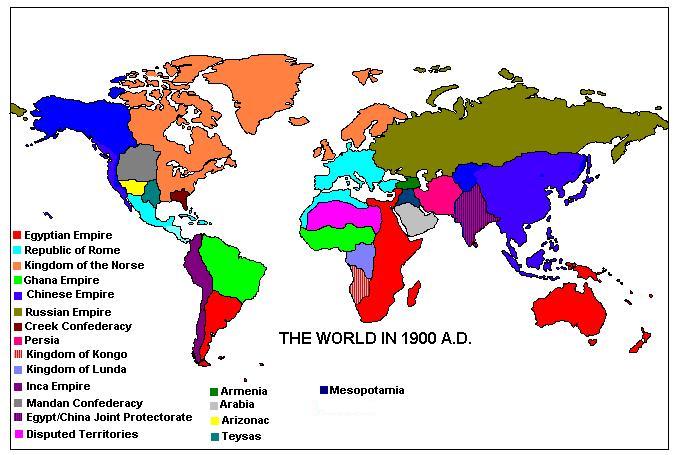
1902 AD--On March 2, 1902, a border skirmish between the kingdoms of Kongo and Lunda leads to the outbreak of war between the two powers. On March 3, the Kongoese inflict a sharp defeat on the Lundaese army at the border and advance toward Lunda’s capital city. Facing defeat, on March 4, Lunda launches a short range missile, tipped with an atomic warhead, and detonates it above the advancing Kongoese army. The Kongoese army is incinerated by the atomic fireball. Later that same day, the enraged Manikongo of Kongo responds by launching an atomic-tipped missile at Lunda’s capital city. The missile detonates, and a mushroom cloud marks the funeral pyre of over 200,000 civilians. In reply, the King of Lunda, who had been moved to a protected bunker outside of the capital at the outbreak of war, orders the launch of Lunda’s remaining atomic stockpile (ten weapons), targeted at Kongo’s largest cities. Kongo, detecting the launch, does the same, and within 2 minutes all eight of Kongo’s remaining atomic weapons are airborne. Three of Lunda’s warheads and one of Kongo’s malfunction and do not detonate. The rest do not. When it is all over, over three million people are dead, and most of the major cities of both countries are piles of radioactive ruins. Fallout covers much of both countries for the next several weeks, and some of it is blown by the winds onto Egyptian soil as well. Thousands more people will die of radioactivity over the next few months, not to mention the thousands who will die of cancer and other illnesses in the succeeding decades. In the final exchange of weapons, both the Manikongo and the King of Lunda were killed. Organized government in the two countries collapses, and a multi-national peacekeeping force, under the auspices of the Council for International Peace (or C.I.P.)...the first of it’s kind deployed anywhere in the world...is sent to restore order and to make possible joint relief efforts by the Central Alliance and the Pacific and Atlantic Treaty Organization (P.A.T.O.). Kongo and Lunda cease to exist as nations, and the territory formerly occupied by them is administered by the Council for International Peace, until such time as the people within them are capable of self-government once again. Gruesome pictures of the devastation are beamed, via satellite and in living colour, to television sets around the world. The world is horrified by what has happened, and public outcry for an end to the "insane competition between the nuclear powers" is heard throughout the world. These events will strongly influence two soon-to-be leaders...Crown Prince Peter of Russia, and Crown Prince Psamtik of Egypt...which will have profound effects on future history.
1903 AD--Tsar Mikhail V of Russia dies. He is succeeded by his grandson, who takes the throne as Tsar Peter III. Tsar Peter is an idealistic young man of 25, who sees the continuing rivalry between the Central Alliance (Russia and Rome) and the Pacific and Atlantic Treaty Organization (Egypt, China, the Norse Kingdom, and the Inca Empire) as dangerous, non-productive and an impediment to world progress. He begins to work to build closer relations between the various nations which comprise these alliances. Also in this year, the compact disk is invented, revolutionizing portable data storage for computers. Within a few years, an improved version (the equivalent of the OTL DVD) will also be available. Also in this year, the second International Conference on Nuclear Weapons is held at Beijing, sponsored by the Council for International Peace (C.I.P.). Agreements are drawn up to establish "hotlines" between the leaders of the major powers, with the aim of defusing possible situations which could lead to the outbreak of nuclear war between them.
1903-1910 AD--To assess the potential viability of a lunar base, CASP (the joint Romano/Russian space project) sends a series of unmanned exploratory vehicles to the moon. Some probes photograph the entire lunar surface from orbit, others land and do tests of lunar soil and rocks. What these probes reveal is very exciting. Water ice is discovered in craters on the dark lunar north and south poles. And, additionally, it is found that lunar soil and rocks contains high concentrations of many valuable minerals and other materials, including the isotope Helium-3, which is relatively rare on earth and which nuclear engineers believe may be the key to creating a viable nuclear fusion reactor...seen as essential to meet humanity’s future energy needs. The discovery of these materials...which is not announced to the rest of the world...convinces CASP to go forward with it’s moon base project.
1905 AD--Tsar Peter III of Russia makes the first of several proposals that the TASA and CASP space programs pool their resources and work together, instead of competing and duplicating efforts, as is happening now. His proposal is rejected by both the member nations of the P.A.T.O. alliance, as well as by his own ally, Rome. Also, for the past several decades, concern about air pollution caused by motor vehicles powered by fossil fuels has lead to various experiments with engines powered by alternative fuels. The most promising of these is hydrogen. Two technologies have emerged as leading contenders...an internal combustion engine which runs on liquid hydrogen instead of gasoline, and an electric vehicle powered by a hydrogen fuel cell. Both technologies have problems. The hydrogen fuel cell, in order to keep fuel cell operating temperatures and size low enough to make installation in a motor vehicle practical, requires platinum catalysts to promote the reaction of hydrogen and oxygen, which produces electricity to power the vehicle. The cost of these platinum catalysts is simply prohibitive, and no effective substitute will ever be found. The hydrogen-burning internal combustion engine is a more practical approach, but is limited by the fact that there is no infrastructure in place for the distribution of hydrogen fuel, and such an infrastructure would be very expensive to build. Nevertheless, in this year, Zheng Xing Motors of China decides to take the plunge into a new technological era, and introduces a hybrid vehicle whose internal combustion engine is capable of being run by gasoline or liquid hydrogen. Demand for the car is slow at first, limited by the lack of a hydrogen fuel infrastructure. But as more of them are sold, consumer demand will lead to various entrepreneurs investing in the establishment of such an infrastructure, and as the infrastructure slowly goes into place, demand for the car will increase...which of course will increase consumer demand for more infrastructure. Within 30 years, hydrogen-burning vehicles are being offered by manufacturers in most countries, and are becoming very popular. By the end of the century, they will completely supplant fossil-fueled vehicles as the primary mode of transportation worldwide.
c. 1905 AD--Continuing improvement of microprocessors have increased computing speeds to the equivalent of OTL 2000 AD, with no end in sight. Commercial internet service companies are reaching out to the consumer market, and by 1905, more than half of the computers in the world are hooked up to the worldwide internet, exchanging information, email, and opinions freely across international borders. The number of computers hooked up to the system will increase every year, and by the end of the next decade, there will be very few computers left which are not part of the network. One interesting facet of this phenomenon has been the rise of internet bulletin boards and discussion forums. In one such forum, devoted to discussion of an obscure topic called "alternate history," the topic of one of the more popular threads is, "What if Pharaoh Necho II of Egypt had not sent forth the fleet which re-discovered Ophir?"
c. 1905 AD onward--The reduction of demand for petroleum because of the world-wide switch-over to nuclear power for generation of electricity has caused those of the world’s nations whose economies depend heavily on oil exporting (especially Persia, Mesopotamia, Arabia, and Teysas) to fall on hard times, leading to widespread unrest in those countries. In Mesopotamia and Teysas, there are coups which topple the democratically elected governments there. In Arabia and Persia, where strong constitutional monarchies reign, the governments there are able to stave off attempted coups against them. But because extremism is thus denied a political outlet, it instead begins to take a religious form. Extremist mullahs begin to preach a doctrine of Pan-Islamism (the unification of all Muslims under the protection of a powerful Islamic State, able to compete on equal terms with the great Christian and pagan states which the mullahs argue are controlling the world for the benefit of non-Muslims). Inspired by these mullahs, "Jihadist" groups arise among the Muslim populations of those countries and other predominately Muslim areas, sparking widespread international terrorism. This problem will continue for many years.
1908 AD--The TASA space station is completed. The permanent stationing of astronauts aboard the space station is revealing problems with long-term human exposure to zero and low gravity locales, such as bone decalcification (approximately 1 percent per month in zero gravity, estimated at approximately 1/6 of one percent per month in lunar gravity) and muscle atrophy. Research has begun on how best to counteract these effects. TASA has also developed a relatively low cost "taxi service" to ferry astronauts and light cargoes to and from the station. A space plane, capable of low-earth orbit but not of reaching the space station itself (which is at a higher altitude than the space plane is designed to reach) and which takes off with standard jet engines like a normal airplane from a landing field on earth, is developed. The space plane climbs to an altitude of 50,000 feet, where it is loaded with rocket fuel from two tanker aircraft (one carries hydrogen, the other oxygen). The space plane’s rocket motors then carry it into low earth orbit, where it meets and docks with a rocket-powered transport shuttle launched from the space station itself. Astronauts and cargo are transferred between the craft, and then either taken to the space station by the transport or returned to earth by the space plane. The space plane then lands at an airport, just like a conventional aircraft. In Teysas, a military coup brings General Quanah Misae to power. He will establish an authoritarian dictatorship in place of Teysas’s democratic government.
1909-1912 AD--War between Teysas and Arizonac. Teysas dictator Quanah Misae, who overthrew the democratically elected government in a coup the previous year, covets the rich mineral resources (especially gold, silver, and copper) possessed by his neighbor to the west. In early 1909 he declares war on Arizonac. Teysas troops cross the border and move rapidly toward the Arizonac capital, but are halted at the Pecos River. Teysas is a Roman client state, and Arizonac is a Chinese client, and both powers funnel arms and supplies to their respective proteges, and fighting bogs down. Neither of these countries is a nuclear power, and so their conflict does not receive undue international attention initially. But the Mandan and Creek Confederacies are concerned by the conflict, happening, as it does, virtually on their doorstep, and in 1912 they appeal to the Council for International Peace to intervene. They are supported in this appeal by Egypt, Ghana, Russia, and the Inca Empire (Rome, China, and the Norse...who are also profiting by selling weapons to both sides...vote against intervention), and the C.I.P. issues an ultimatum to Teysas...withdraw from Arizonac or face sanctions up to, and including, possible multi-national military intervention. Quanah Misae approaches Rome for support, but is refused and advised to back down, which he does, reluctantly. A C.I.P. peacekeeping force is placed on the border between the two countries to prevent future outbreaks between them.
1909 AD--A military coup topples the democratic government of Mesopotamia. General Hassan al-Majid declares himself President for Life, and establishes an authoritarian dictatorship over the country. The dictator, who hopes to one day establish himself as the President of a unified Islamic country, will secretly support the Pan-Islamist movement in India, Persia and Arabia with funds and weapons. He will also secretly (since Mesopotamia is a signatory to the Non-Proliferation Treaty signed at the International Conference on Nuclear Weapons in 1877) fund efforts to develop nuclear weapons. At a secret meeting with Mesopotamian nuclear physicists, al-Majid declares, "As there are Christian bombs and pagan bombs, so there must be an Islamic bomb, and I am determined that Mesopotamia will have that bomb." Work begins immediately.
1910 AD--One area where Pan-Islamism has firmly taken root is in India, which for over a century, since the death of the last Mogul Emperor, has been ruled by a collection of weak native princes under a joint Egyptian and Chinese protectorate. In the summer of this year, a series of suicide bombings are carried out against Egyptian and Chinese troops, military bases, and administrative facilities in India, marking the beginning of a widespread revolt. Emperor Lee Kwan Pao of China and Pharaoh Rameses XXVIII are divided over how to respond. The Chinese Emperor wants to move aggressively to put down the revolt, but his Egyptian ally is urging against that, as it would doubtless mean large numbers of civilian casualties. Rameses argues that it would be better to establish a framework for eventual Indian independence, and try to work with moderate opposition leaders within India to establish a new government. After much cajoling, the Chinese Emperor agrees to this. As a first step, Egypt and China jointly announce that they are turning over the administration of India to the Council for International Peace, which will oversee the transition to a democratically elected government in India within ten years. By the end of the year, the Egyptian and Chinese occupation troops have been replaced by peacekeepers from the Council for International Peace (C.I.P.), and negotiations between the C.I.P. and local Indian leaders has begun with the aim of establishing a native government for India.
1911 AD--Emperor Lee Kwan Pao of China dies, and is succeeded by Lee Zheng Xi.
1912 AD--Quanah Misae of Teysas is overthrown by a military coup. The army commander who lead the coup, General Winema Urika, announces the re-establishment of the old democratic constitution, with elections to be held early the following year for a new President and Legislative Council.
1913 AD--In planning for the eventual construction of a lunar base, CASP plans to send a series of unmanned "cargo vessels" full of supplies (several each year, full of food, fuel, water, tools and construction machinery, prefabricated and pre-pressurized habitat modules, and the other items they will need to establish a base) to the moon, where they will remain in orbit. These vessels will be designed to dock with each other by remote control, and each successive ship will dock with the last to form a continuous chain. Several launches will be made each year for several years, until the desired stockpile of supplies has been established. It is also planned to design a lunar shuttle which will be used to ferry the supplies down to the lunar surface when the time comes to begin construction of the lunar colony. However, these plans are not immediately put into operation. Also in this year, elections are held in Teysas. The newly elected President and Legislative Council take power peacefully as General Winema Urika, as promised, steps down.
1914 AD--Since taking over the administration and security of India, the Council for International Peace has been primarily concerned with the suppression of the continuing Pan-Islamist revolt. Finally, in 1914, the C.I.P. considers the situation stable enough to begin the process of establishing a native government for the country. Under the auspices of the C.I.P., the first of several conventions is held in India for the purpose of drawing up a constitution for an independent India. Leaders from the majority Muslim and minority Hindu and Buddhist populations are represented at these conferences, which will meet yearly for the next four years. Also in this year, Pharaoh Rameses XXVIII dies, and is succeeded by Psamtik XXVI. Psamtik was, as a young boy, horrified by the television images of the devastation wrought by the nuclear exchange between Kongo and Lunda, and will, like Russian Tsar Peter III, work to build closer relations between the various great powers, and promote joint exploration of space.
1915 AD--For the past three decades, both TASA and CASP have been working to develop a nuclear space propulsion system. In this year, TASA successfully tests a nuclear thermal rocket (similar in concept to the OTL NERVA rocket) which uses a nuclear fission reactor to heat hydrogen to extremely high temperatures before expelling it through a nozzle at the rear of the engine. This design has several advantages over traditional chemical rockets. Unlike a traditional chemical rocket, this engine cannot produce the high levels of thrust needed to escape earth gravity, but once in space, would be able to accelerate continuously over a much longer period of time than would be possible with a chemical rocket, enabling it to achieve a much higher final speed (over twice as fast as a chemical rocket). Such speeds would make trips to the moon possible in 1 day, and trips to Mars possible in 3 months. The nuclear rocket is also reusable, unlike the chemical rockets currently in use, as it’s hydrogen tanks would simply need to be refilled periodically...which could be done in space...and this would dramatically reduce the number of expensive launches of chemical rockets. In addition to providing propulsion, the nuclear reactor would also provide electric power for a manned spacecraft. And finally, the engine is capable of being refueled with alternate materials (including methane, ammonia, and carbon dioxide) which are plentiful in the atmospheres of other planets and moons in the solar system, so the engine is capable of "living off the land," so to speak. All in all it is a very promising design.
1916 AD--Russian Tsar Peter III and Pharaoh Psamtik XXVI issue a joint statement calling for the unification of the TASA and CASP space programs into one effort, and issue an invitation to all space-faring nations to attend a summit with the aim of hammering out such an agreement. The summit is to be held the next year in Moscow. Also in this year, test flights of the prototype CASP lunar shuttle are successful.
1917 AD--The International Space Policy Summit is jointly hosted by Tsar Peter III and Pharaoh Psamtik XXVI in Moscow. Representatives of all the major space-faring powers attend, except two...Rome and China, both of which boycott the summit. Tsar Peter announces the discovery of significant deposits of Helium 3 on the moon, as well as the other discoveries made by the CASP lunar exploratory probes, which stuns the listening audience. He proposes that a joint effort to exploit these resources be made. Pharaoh Psamtik XXVI strongly supports Tsar Peter, and they are joined by King Erik XIII of the Norse and Emperor Viracocha VII of the Incas. These powers agree to form the International Space Exploration Project (ISEP) to oversee their joint efforts.
1918 AD--After much cajoling by their allies, Rome and China agree to take part in the International Space Exploration Project. At a summit held in Rome later that year, an international treaty for the sharing of space resources is signed. Also in this year, a constitution is agreed upon for India. The document calls for a bi-cameral legislature (one house for Muslims, and the other for Hindus, Buddhists, and representatives of the various other minor religious groups which inhabit India), with the President to be a Muslim, and the Vice President a Hindu, with the President and Vice President to have joint command of the armed forces...neither can order the military into action without the consent of the other. An interim government is selected by the C.I.P., which will continue in power until democratic elections can be held. Elections are scheduled for 1920.
1919 AD--The first Roman, Russian and Inca astronauts are sent to the ISEP (former TASA) space station, where they join the Egyptian, Chinese, and Norse astronauts already there to begin joint operation of the station. Also in this year, a plan for the construction of a lunar base for purpose of Helium 3 mining operations is approved by ISEP. The main base will be located just outside the Mare Tranquillitatus, where it is known that supplies of Helium 3 sufficient to supply the needs of earth for several hundred years exist. Satellite bases, connected to the main bases by rail lines, will be located near the lunar poles, where workers responsible for mining the lunar ice will reside. The former CASP plan of sending unmanned "cargo vessels" into orbit around the moon in preparation for the actual manned missions is adopted, with one major alteration. Instead of using chemical rockets, the newly designed nuclear thermal rocket will be used instead, as this will cut both costs and trip times to and from the moon dramatically. The nuclear rocket will be launched into orbit by a chemical rocket, where it will rendezvous with the ISEP space station. There it will be married up with cargo containers, also launched into earth orbit aboard chemical rockets, and take them to the moon (the first ten of these containers will contain liquid hydrogen, from which the rocket will refuel itself, when necessary, for the return trip to earth. It is planned that, once the lunar base is operational, hydrogen will be produced on the moon and placed in orbit from there for use by the nuclear rocket). The use of the nuclear thermal rocket will dramatically reduce the cost of these missions, and enable them to be completed faster. Once a sufficient quantity of supplies has been amassed, astronauts will be sent to the moon (aboard spacecraft to also be propelled by nuclear thermal rockets) to begin construction of the base. First priority will making the base independent of re-supply from earth. Habitat areas (to be initially composed of pre-pressurized modules brought from earth, later to be constructed from lunar materials); a nuclear reactor to provide power for the base; and greenhouses for food production, will all have to be built first. After that is completed, facilities for harvesting water, oxygen, hydrogen and other materials (nitrogen, various metals) from the lunar soil and rocks as well as for processing ice mined from the lunar poles (which will be used to provide drinking water, as well as being split into hydrogen...for use in fueling the nuclear thermal rockets...and oxygen) will be built. Once all these are in operation, the base will be self sufficient, and Phase One of the plan will be completed. It is planned to have the base fully established on a self-supporting basis within ten years. After that, Phase Two of the plan...establishing the Helium 3 mining operation....will begin.
1920 AD--ISEP places ten nuclear thermal rockets in orbit. Shipments of cargo to lunar orbit begin this year. Also in this year, elections are held for the new democratic government of India. The new government takes power in July of this year, and the last C.I.P. peacekeepers are withdrawn by the end of the year.
1921 AD--The full initial allotment of cargo for the establishment of the lunar base has been placed in orbit around the moon by June of this year. In July, the first astronauts are sent to the moon and begin construction of the lunar base. The habitat areas are established, the nuclear reactor is assembled and activated, and the greenhouses are set up and begin operations by the end of this year. In order to counteract the deleterious effects of low lunar gravity (bone decalcification and muscle atrophy primarily), the astronauts are given a calcium rich diet, including calcium supplements, and are required to regularly exercise. They are also put on a regular rotation schedule, with colonists living on the moon for up to three years, then returning to the earth for at least six months before going back to the moon.
1922 AD--A facility to produce water by heating lunar rocks is established. Production is slow at first, but gradually increases, reducing the dependence of the base on water shipped up from earth. The first female colonists arrive at the lunar base. Also in this year, Islamist violence breaks out again in India, this time aimed at the minority Hindu and Buddhist populations of India.
1922 AD onward--Ever since shortly after the introduction of the first practical telephone by Alexandros Kousouni in the early 1700s, various inventors have been trying to produce a truly practical mobile telephone. Indeed, the first of these, a battery operated telephone which could be hooked up to any available telegraph or telephone line by means of electrodes attached to long poles, was patented only five years after Kousouni’s invention. But these early, non-wireless systems were not really practical. In the mid-1800s, the first crude, bulky, vacuum-tube filled mobile telephones operating via radio signals were introduced. These early models were limited by their short range and never were commercially successful, and they mainly were used as car phones by wealthy businessmen or government officials. With the advent of inexpensive microprocessors and digital switching systems, a truly practical wireless telephone network is finally possible, and in 1922, the first cellular phone systems are opened for business almost simultaneously in Egypt, Rome, and China. The new cellular phones become wildly popular, but will never replace the old, reliable land-line phone, which has none of the cell-phone’s problems (concerns over security due to the ability of criminals and government agencies to intercept cell-phone signals from the air, as well as poor sound quality and dropped calls due to poor signal strength in many areas).
1923 AD--By the end of the year, water production is sufficient to fully supply the needs of the base, as well as to provide feed stock for an electrolysis facility which splits water into hydrogen and oxygen. Also, the first solar-electric arrays are built to supplement the electric power produced by the nuclear reactor. The first human conception on the moon (by a Chinese couple) takes place. Doctors are concerned about the possible risks of carrying a baby to term in lunar gravity, and the mother is sent to earth during the period of gestation. She demands that she be allowed to return to give birth on the moon, and this request is granted. In India, President Mohammed ibn Khalid and Vice President Mohandas Desai issue a joint statement condemning the Pan Islamist attacks on non-Muslims in India, and the military is ordered to crack down on Pan-Islamist extremist groups.
1924 AD--The Electrolysis facility for splitting water into hydrogen and oxygen is built. All production is initially turned into liquid form for storage. As with the water production facility, production is slow at first, but gradually increases. Refrigerated storage tanks for liquid hydrogen and oxygen are built and slowly begin to be filled. In this year, the first human child born on the moon...a baby girl...is born to a Chinese couple living in the lunar base. They name her Chan Juan ("beautiful moon"). Also in this year, the first satellite base at the lunar north pole is established. Construction of a rail line (on which electric locomotives will haul supplies, lunar ice, and personnel between the two bases) connecting the satellite base to the main base begins.
1925 AD--The first of several specialized cargo vessels, designed to convey liquid hydrogen from the lunar surface to the hydrogen storage containers in orbit around the moon (from which the nuclear thermal rockets are fueled), is launched into earth orbit and then taken to the moon by a nuclear thermal rocket. The vessel is designed to land on the moon, be filled with liquid hydrogen, blast off from the lunar surface, go into lunar orbit, dock with an orbiting hydrogen container, refill it, and then return to the lunar surface to repeat the process as needed. The vessels themselves will be propelled to and from the lunar surface by chemical rockets...also fueled by lunar hydrogen and oxygen. Also transported to the moon are three electric locomotives and other railroad rolling stock for use on the rail line connecting the two lunar bases. Also in this year, small scale production of various metals begins (iron, titanium, manganese, copper, aluminum, and others), which will be used, eventually, to create the machinery necessary for Helium 3 mining. Also in this year, President Mohammed ibn Khalid of India is killed by a car bomb, which explodes outside the Presidential Palace. Although nobody claims responsibility for the attack, Pan Islamist extremists are strongly suspected. Vice President Mohandas Desai vows that the perpetrators will be brought to justice. Elections for a new President are scheduled for the following year.
1926 AD--The rail line connecting the satellite base at the lunar north pole with the main base at the Mare Tranquillitatus has been completed, and mining of the lunar pole ice begins. This dramatically increases the production of oxygen and hydrogen. Production of oxygen is now sufficient to begin diverting some of it to the needs of the lunar base itself. By the end of this year, the lunar base will no longer be dependent on oxygen shipped from earth. Also in this year, the first shipments of liquid hydrogen from the lunar surface to the storage containers in lunar orbit take place. A special Animal Husbandry Dome is constructed, with the aim of raising domestic animals for meat and dairy production. This will enable a welcome supplement to the largely vegetarian diet which the settlers have been consuming so far. In India, Hussein Abdullah is elected to the Presidency. He is secretly in sympathy with the Pan Islamist movement, and will, behind the scenes, work to undermine efforts to suppress the movement in India. Publicly, however, he joins with Vice President Desai in condemning the continuing violence.
1927 AD--The first domestic farm animals (cattle, pigs, and chickens) are transported to the moon. Metals production is increasing, and substantial stockpiles begin to be accumulated.
1928 AD--There are now 2,500 people (Egyptian, Roman, Inca, Chinese, Norse and Russian) living at the lunar base. The base is fully self-sufficient, and with the construction of new habitats, the population is increasing yearly. Elections in India. Vice President Desai and President Abdullah are re-elected.
1929 AD--Industrial equipment is transported from the earth, which will be used to establish a factory for producing mining machinery which will be used for Helium 3 mining operations, as well as rail, locomotives and railroad rolling stock. By the end of next year, construction on the factory will be nearing completion.
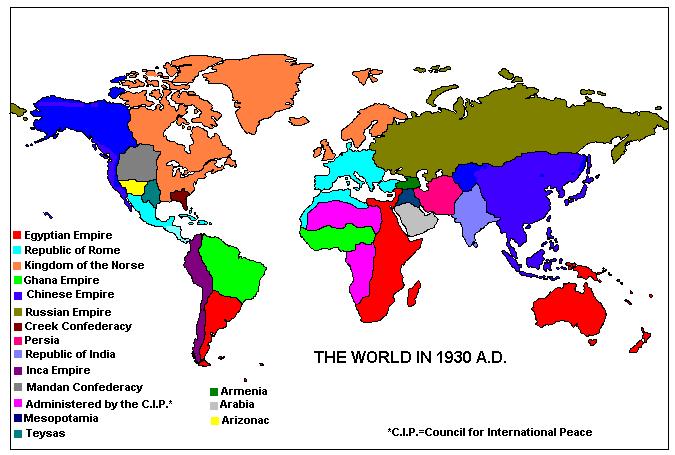
1929-1935 AD--The Indian Civil War. In early 1929, Vice President Desai discovers incontrovertible evidence that President Abdullah has been secretly funneling money and arms from military stocks to the Pan Islamist terrorist groups which have been plaguing India for almost 2 decades. Desai denounces Abdullah before a joint meeting of the two houses of the Indian Congress, and demands his resignation. Instead of resigning, Abdullah claims that the evidence presented by Desai is fabricated, and is part of a "Hindu Plot to subordinate the followers of Allah, the One True God, to rule by pagan infidels." Abdullah calls on the Muslim officers of the army (who make up most of the army command structure) to support him in overturning the government, and a majority of them do so. Desai calls on the remaining loyal officers of the army (many of whom are Muslim) to support the government, and fighting breaks out between the two factions. By it’s charter, the Council for International Peace is powerless to intervene in the conflict (the C.I.P. is only authorized to intervene in situations involving armed conflict between two or more nations, or to mediate between two or more sovereign nations when requested to do so by all parties involved. The Civil War in India, despite the horror and brutality it has caused, is a purely "internal affair," as defined by the C.I.P. Charter), and so it rages on, unchecked, for six years. The civil war that results will be bitter, with massacres and atrocities committed by both sides on a regular basis. Abdullah receives much support from Pan Islamist groups in other countries, and in the end, this support tips the balance. In 1935, Vice President Desai is captured and brutally beheaded on national television, and without his strong leadership, the anti-Islamist faction collapses. President Abdullah issues a proclamation declaring that henceforth, India will be an Islamic Republic, and non-Muslims will be required to either convert to Islam or leave the country by the end of the year. A mass exodus of Hindus and Buddhists results, with an estimated 20,000,000 people leaving the country. Most settle in Egypt and China.
1930 AD--Construction begins on the first of several Helium 3 processing facilities...each capable of processing approximately 500,000 tons of lunar soil a year (enough to produce approximately 40 tons of Helium 3). The plan is to build one such facility for each of the individual ISEP member nations, to be run by that nation for the production of Helium 3 to meet it’s own energy needs.
1931 AD--Construction of the factory for producing mining and railroad equipment is completed. The factory begins to produce robotic mining machinery and railroad rolling stock. Construction of the first Helium 3 processing facility is completed. Construction begins on the second and third plants. On earth, construction begins on the first fusion reactors which will be fed with lunar helium 3. Also in this year, the Creek Confederacy, which is not a signatory to the Nuclear Non-Proliferation Treaty, detonates an atomic bomb. It does follow the dictates of the Atmospheric and Oceanic Test Ban Treaty signed in 1877, and it’s test is done in a specially prepared cavern deep beneath the surface of the earth. Nevertheless, the announcement of the successful test is met with worldwide denunciation. In response, the Mandan Confederacy resumes funding for it’s own nuclear program, which had been suspended during the tide of public horror at the devastation caused by the nuclear exchange between Kongo and Lunda. Teysas and Arizonac also begin clandestine work toward development of atomic weapons.
1932 AD--Helium 3 mining and processing begins. The first load of 30 tons of Helium 3 will be transported to earth by the end of the year. It is equally divided between Egypt, Rome, China, Russia, the Norse Kingdom, and the Inca Empire, all of which have constructed their first fusion reactors and are just waiting for the arrival of Helium 3 fuel. Also by the end of this year, the second Helium 3 processing facility is completed on the moon.
1933 AD--The third lunar processing plant for Helium 3 production is completed. Construction begins on the fourth, fifth, and sixth plants. In January 1933, with the recent arrival of the first Helium 3 fuel from the moon, the first fusion reactors are activated in the ISEP nations (Egypt, Rome, China, Russia, the Norse Kingdom and the Inca Empire). Once fueled, the new plants work exactly as advertised, producing power with no residual radiation and no radioactive wastes. The ISEP nations begin preparations to phase out their existing fission reactors.
1935 AD--There are now over 5,000 people living in the two lunar bases. The fourth and fifth Helium 3 processing plants are completed. Construction begins on a rail line from the main lunar base to the lunar south pole, in preparation for the establishment of the second satellite base. Also in September of this year, Ghana applies for, and receives, admission into ISEP. The first Ghanaese astronauts take their places in the ISEP space station shortly afterward, and the first Ghanaese colonists will be transported to the lunar base by the end of the year.
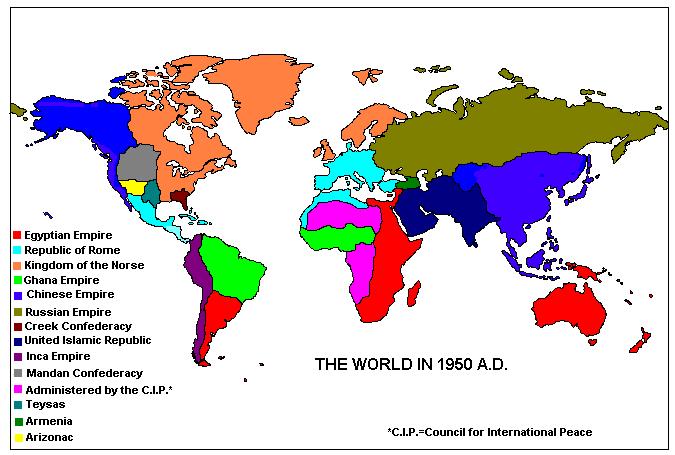
1937 AD--Presidents Hussein Abdullah of India and Hassan al-Majid of Mesopotamia meet to discuss the possibility of an alliance based on their shared ideology of Pan-Islamism. The result is a treaty by which Mesopotamia and India agree to merge, creating the United Islamic Republic. Secretly, Abdullah and al-Majid begin plotting the overthrow of the monarchies in Arabia and Persia, as well as cooperating on the development of "The Islamic Bomb." Also in this year, Ghana activates it’s first fusion reactor, and the sixth Helium 3 processing plant is completed on the moon. The ATL equivalent of HDTV is introduced and begins replacing analog television sets.
1939 AD--Revolutionaries, secretly funded and armed by the United Islamic Republic, topple the Shah of Persia from power. The Shah flees to exile in Egypt. The revolutionary government "applies for admission" to the U.I.R., and is "accepted." Arabia is now the only Muslim land not under the control of the Pan-Islamists.
1940 AD--Co-President Hassan al-Majid of the United Islamic Republic dies of a heart attack. According to the terms of the treaty between the two dictators, President Abdullah of India becomes the sole ruler of the U.I.R. Also, widespread interest in the lunar base has generated consumer demand for a lunar tourism industry. In this year, ISEP grants a charter to a private multinational consortium which will develop a lunar hotel, to be called "The Lunar Palace," with regular flights to and from the moon to be made available to the general public. It is planned to have the hotel up and running within five years. Tourists will take the space plane up to the ISEP space station, where they will board a lunar shuttle (propelled by a nuclear thermal rocket) which will carry them to the moon. ISEP will lease three of it’s nuclear thermal rockets to the consortium for use in running this shuttle service. ISEP will also profit by assessing sales taxes on tickets for passengers to and from the moon, as well as levying a sales tax on goods and services sold (rooms, food, entertainment activities) at the hotel itself. Finally, by this date, nearly half of the fission reactors in the ISEP nations have been deactivated, or are in the process of being deactivated, as replacement fusion plants come on line.
1941 AD--An attempted coup against King Faisal of Arabia is crushed by Arabian security forces. President Abdullah of the U.I.R. vows "revenge for the martyrs" slain by Arabian security. Also in this year, Pharaoh Psamtik XXVI dies, and is succeeded by Necho XXIII. His death is mourned worldwide, and he (along with Tsar Peter III of Russia) is acclaimed as one of the greatest leaders of all time...a man whose tireless efforts on behalf of peace and unified space exploration have resulted in the great achievements of mankind in the Twentieth Century. Also in this year, construction of the lunar hotel begins. It is announced that the hotel will have 500 luxury suites, a casino, fine restaurants, and will offer lunar "safari excursions" where guests will tour some of the more scenic features of the lunar landscape in electric shuttle busses.
1942 AD--The rail line to the lunar south pole is completed. Construction begins on the second satellite base for polar ice mining. Also in this year, the first Virtual Reality Arcades are introduced, where people can experience almost anything through the magic of computer generated imagery and specialized "sensation suits." Like video game arcades before them, this new form of entertainment will become wildly popular and spread over the world over the next decade.
1943 AD--Pan-Islamists riot in all the major cities of Arabia. When King Faisal’s security forces begin firing into the crowds, killing hundreds of protesters, President Abdullah of the U.I.R. begins massing troops on the Arabian border. When Faisal protests this aggressive action by the U.I.R., Abdullah calls him a "traitor to the holy cause of Islam" and demands that the King abdicate. Faisal, of course, refuses, and on August 1, the U.I.R. invades Arabia. Faisal’s military is no match for that of the U.I.R., and Arabia is quickly occupied by fast-moving U.I.R. armored columns. King Faisal manages to get to out of the country on August 5 (just before the entry of U.I.R. troops into the Arabian capital of Mecca) and flee to Egypt. On August 20, Faisal petitions to the Council for International Peace for redress, but his appeal is rejected. Although the Council issues a statement condemning the aggression of the U.I.R., the member states do not consider the issue important enough to warrant an ex-post-facto intervention, especially since it is apparent that there was a lot of pro-U.I.R. sentiment and dissatisfaction with the rule of King Faisal in Arabia. Arabia is formally "admitted" into the U.I.R. later that year. The Pan-Islamist dream of a unified Islamic state is realized. The satellite base at the lunar south pole is completed. Mining of the ice at the south pole begins.
1944 AD--President Abdullah announces the formal withdrawal of the United Islamic Republic from the Nuclear Non-Proliferation Treaty of 1877. Later that year, the U.I.R. successfully detonates an atomic warhead beneath the Indian Ocean. His action is condemned by the Council for International Peace and by nations around the world, but otherwise, no action is taken. Meanwhile, another benefit of the lunar colony and the manned space station is made apparent when the first drugs produced under conditions of zero and low gravity are introduced onto the market. Physicians are also considering the possible benefits of performing certain procedures in microgravity conditions. The International Medical Association (established two hundred years ago to establish uniform standards for healthcare the world over) recommends that a research into the possible benefits of treatment in microgravity conditions, both surgical and non-surgical, be conducted. This research will revolutionize the treatment of many illnesses, and partly as a result of this, the average human lifespan will rise from the 1944 level of 80 to an average of 90 by the end of the century.
1945 AD--Emperor Lee Zheng Xi of China dies, and is succeeded by Lee K’ung Xi. "The Lunar Palace" lunar hotel has been completed and is opened for business. Among the first guests is Pharaoh Necho XXIII, who becomes the first Egyptian monarch to visit the moon. The hotel is wildly successful, even though the cost of a "lunar vacation" is quite high...more than six months wages for most people. Plans for additional hotels are soon announced by the hotel consortium. Approximately 8,000 people now call the moon home.
1947 AD--Emperor Lee K’ung Xi of China dies, and is succeeded by Lee Chang Lo. Also in this year, President Abdullah of the United Islamic Republic announces the expulsion of all non-Muslims from the republic. This action is widely condemned. Christian refugees generally go to Rome or Russia, while pagans and other non-Christians (Jews primarily) go to Egypt.
1948 AD--Tsar Peter III of Russia dies, and is succeeded by Ivan XIV. Like Pharaoh Psamtik XXVI seven years before, Tsar Peter is mourned around the world, and it is widely acknowledged that mankind’s achievements during this century have been largely due to his tireless efforts to promote cooperation between the Great Powers.
1949 AD--The Emperor of China, as one of the world’s last three absolute monarchs (the others are the Inca Emperor and the King of Ghana), is feeling increasingly isolated in a world dominated by democracies, republics, and constitutional monarchies. Therefore, in this year, the new Emperor Lee Chang Lo announces the introduction of a Constitution, patterned on that of China’s long-time ally, Egypt. His decision is lauded as a positive step by nations around the world. Elections for the first Chinese House of Delegates (as the legislative body will be called) will be held the next year. President Abdullah of the U.I.R. begins secretly funding Pan-Islamist terrorist organizations among the Muslim populations in Egypt, China and Russia.
1950 AD--Pharaoh Necho XXIII is assassinated by a Pan-Islamist terrorist, who shoots him as he exits his limousine outside his palace at Sais. He is succeeded by Necho XXIV. The assassin and other members of a Pan-Islamist terror cell are quickly arrested. Although it cannot be proven, the involvement of the U.I.R. in the assassination plot is strongly suspected. Tensions rise between Egypt and the U.I.R. Construction begins on the second lunar hotel, called "The Constellation." It will have 1,000 rooms, with an even bigger casino than the one at The Lunar Palace. By this year, Helium 3 production is such that surpluses are available to be sold to non-ISEP nations. Construction of fusion reactors begins in the Creek Confederacy, the Mandan Confederacy, Teysas, Arizonac, and the U.I.R. The final fission reactor in use for electrical power generation in any of the original ISEP nations, a plant located in the Norse Vinlandia colonies, is deactivated as it’s replacement fusion reactor is brought on line. Elections are held for the Chinese House of Delegates. Like the Council of 400 Elders in Egypt, the body will have the power to approve or disapprove new taxes, treaties, and declarations of war, as well as any other measure which infringes on the rights of the people as detailed in a lengthy bill of rights. And, as in Egypt, the Emperor remains head of State, with the right to conduct foreign policy and determine how state revenues are spent.
1951 AD--The United Islamic Republic successfully launches a communications satellite. Of course, the rocket on which the satellite is launched will also be the basis for the U.I.R.’s nuclear weapons delivery system.
1952 AD--The Mandan Confederacy successfully detonates an atomic weapon. Like the Creek Confederacy, the Mandan Confederacy conducts the test according to the terms of the Atmospheric and Oceanic Test Ban Treaty, but it’s action is nevertheless condemned by nations around the world. Teysas and Arizonac both increase funding to their own nuclear research projects.
1953 AD--One major accomplishment of the international conventions held in the 1830s and 1840s which culminated in the signing of the Oslo Accords was an agreement to ban the production and use of poison gas weapons. Inspectors working under the auspices of the Council for International Peace presided over the destruction stockpiles of poison gas munitions worldwide, and the destruction of the last such stockpile (in 1863) had been hailed as a great victory for civilization over barbarism. No poison gas has been used in warfare since that time. But in 1953, President Hussein Abdullah of the United Islamic Republic begins secretly assembling a stockpile of chemical weapons (made from byproducts of his country’s petroleum industry). He also begins work on biological weapons (also banned by the Oslo Accord).
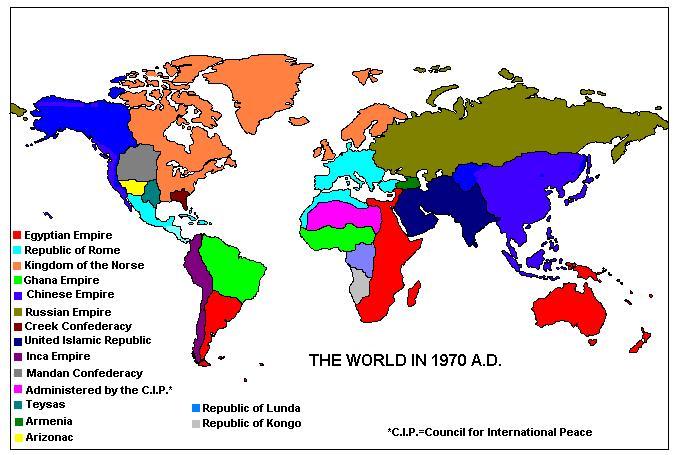
1954 AD--The Council for International Peace announces that self-government is to be restored to the regions formerly comprising the Kingdoms of Kongo and Lunda, with elections to be held the following year in each region for a new government. Kongo and Lunda will be restored with their borders as they existed prior to the 1902 war.
1955 AD--Elections are held in Kongo and Lunda, and the new governments take power in March 1955. The Council for International Peace withdraws it’s peacekeeping forces from the region.
1956-1957 AD--The Armenian War. Since gaining independence in the aftermath of The World War, the Republic of Armenia has been following a foreign policy based on armed neutrality (very similar to OTL Switzerland). It has made no alliances with any of the major powers, and maintains a sizeable army by universal conscription. Of course, it cannot hope to compete with the military might of any of the major powers, and has placed it’s main reliance on it’s ability to play one power off against another. But the government run by the majority Armenian Christian population has, unfortunately, been following another policy...persecution of the Muslim minority living in Armenia. In 1956, President Hussein Abdullah of the U.I.R. uses this as a pretext for the declaration of war on Armenia. U.I.R. forces soon find themselves bogged down, forced to attack strongly fortified positions in the Armenian mountains, where the U.I.R. advantage in armor is nullified by the terrain. To break the deadlock, in April 1957, President Abdullah orders the use of the U.I.R.’s stockpiles of chemical weapons. Armenian fortifications are blanketed with mustard gas and nerve agents, causing horrendous casualties to the unprepared defenders. The U.I.R. forces punch through the Armenian lines, and the Armenian capital falls before the end of the month. The use of chemical weapons by the U.I.R. is universally condemned by the international community. At the urging of Pharaoh Necho XXIV, the Council for International Peace adopts a resolution ordering the withdrawal, within 30 days, of U.I.R. forces from Armenia, the immediate surrender of the U.I.R.’s illegal stockpiles of chemical weapons, and the verifiable dismantling of the U.I.R.’s production facilities for said weapons. President Abdullah, in a televised statement, refuses these "unholy demands," and threatens to respond with nuclear weapons if any "infidel army" invades the "sacred soil" of the U.I.R. Egypt, Rome, China, and Russia begin massing armies on the borders of the U.I.R. The deadline for U.I.R. compliance with the C.I.P. resolution comes and goes, and Abdullah does not back down. On June 2, 1957, the allied armies invade the U.I.R. The U.I.R. forces are pushed steadily back, and Abdullah issues his own ultimatum...withdraw from the U.I.R. by June 5, or face an all-out nuclear strike by the U.I.R. When the allies do not comply, Abdullah orders the launch of the U.I.R.’s nuclear weapons. But the weapons are never launched. Instead, General Ahmed Rasfanjani, commander of the U.I.R.’s Strategic Rocket Force, refuses to comply with Abdullah’s order, and leads a coup which topples Abdullah from power. Abdullah is captured as he attempts to flee the capital at Teheran. Rasfanjani immediately communicates the surrender of the U.I.R. to the Council for International Peace, which orders a cease-fire by the allied armies. Rasfanjani agrees to comply in all respects with the C.I.P. resolution, and evacuation of U.I.R. forces from Armenia immediately follows. The Council for International Peace demands, and receives, custody of former President Abdullah, who is to be put on trial for war crimes.
1957 AD--Emperor Tupac Amaru III of the Inca Empire, following the example of Emperor Lee Chang Lo of China, announces the introduction of a constitution, based on that of the Inca Empire’s long-time ally, Egypt. Elections for the Inca General Assembly (as the legislative body will be called) are scheduled for the following year.
1958 AD--The war crimes trial of former President Abdullah is held in Rome. Abdullah is convicted and sentenced to death. The sentence is carried out (by hanging) on May 1, 1958. Meanwhile, General Rasfanjani surrenders the U.I.R.’s chemical weapons stockpiles and dismantles the U.I.R.’s chemical weapons production facilities, as per the terms of the surrender agreement. Also in this year, elections for the Inca General Assembly are held, and the new Inca constitution goes into effect. Ghana is now the world’s last remaining absolute monarchy.
1959 AD--Baako Nyankomago, a Ghanaese inventor, patents a practical voice interface system for computers. By the end of the century, computer keyboards and mice will be all but obsolete.
1960 AD--General Rasfanjani, leader of the United Islamic Republic, is a pragmatist, and he knows the course the U.I.R. had been following under the Abdullah regime could only have lead to disaster for the U.I.R. Rasfanjani is therefore trying to repair the U.I.R.’s international image. Rasfanjani has never been a die-hard Pan Islamist, and he cuts the U.I.R.’s support of Pan Islamist extremists, which results in a significant decrease in terrorism around the world. He also applies for membership in ISEP (the International Space Exploration Project). However, bitter feelings left over from the recent war cause the application to be rejected. By this year, over 15,000 people are living on the moon. A second major lunar base, to be located on the northern shore of the Mare Serenitatus, is under construction.
1961 AD--The withdrawal of their lifeline of money and weapons from the United Islamic Republic has not, unfortunately, meant the demise of Pan Islamist terrorist organizations in other countries. Instead, it has lead them to organize on a multi-national level and seek alternate means of funding. At a secret meeting held in the Republic of Kongo, leaders of the various terror organizations agree to create a united organization, to be called The Sword of Allah. The organization’s cells will maintain contact with each other via email, which will allow them to recruit and coordinate their activities worldwide. The organization will be primarily funded by trafficking in illegal narcotics (as in OTL, most nations of the world have laws forbidding the recreational use of narcotic drugs, which of course has created a large and lucrative illicit market in those substances), as well as by phony "charitable organizations" whose real purpose is to collect donations from sympathetic Muslims and funnel them to The Sword of Allah. Also in this year, Roman inventor Junius Modestus Filus patents the first practical video telephone, which will replace non-video models by the end of the century.
1962 AD--The second major lunar base on the Mare Serenitatus is completed and begins to accept colonists. A third major hotel is planned to be built near this base, to be called The Aurora. It will have 5,000 rooms, and like the other hotels, will feature a casino. It will also feature an amusement park with rides taking advantage of the moon’s low gravity to provide special thrills to the hotel’s guests.
1963 AD--Tsar Ivan XIV of Russia dies, and is succeeded by his son, Alexander IV. General Rasfanjani of the U.I.R. applies, once again, for membership in ISEP. This time, the application is accepted.
1964-1966 AD--Border war between Teysas and Arizonac. In early 1957, tensions between Teysas and Arizonac, whose border has never been settled to the satisfaction of either nation, are on the rise. Both countries demand the withdrawal of the Council for International Peace (C.I.P.) peacekeepers from their border region, and reluctantly, the C.I.P. does this. In May 1957, a border clash between troops from the two powers leads to war. Neither side is able to gain an advantage, and after two years of inconclusive fighting, they agree to an armistice based on status quo antebellum.
1964 AD--The first astronauts from the U.I.R. arrive at the ISEP space station.
1965 AD--Pharaoh Necho XXIV dies, and is succeeded by Seti XIV. Also in this year, the first U.I.R. colonists arrive at the lunar base.
1966 AD--The new lunar hotel, The Aurora, opens for business. With the addition of more and more hotel rooms, the cost of a lunar vacation has been dropping steadily, and although it is still very expensive, is becoming affordable to the middle classes on earth. As demand has increased, ISEP and the international space hotel consortium have also expanded the fleet of nuclear thermal rockets and lunar shuttle ships to accomodate it. By the end of the decade, over 2,000,000 people a year will be vacationing on the moon.
1967 AD--At a special conference held in honour of the 50th anniversary of the creation of the International Space Exporation Project (ISEP), Pharaoh Seti XIV proposes that mankind take it’s next step into space...the exploration and possible colonization of Mars. He is joined by Tsar Alexander IV of Russia and Emperor Tupac Amaru III of the Incas. It is decided to send probes to Mars to test the soil, rocks, and atmosphere to determine the suitability of the planet for colonization.
1968 AD--ISEP begins to discuss contingency plans for a spacecraft to carry out the proposed Mars Mission. Concern is being expressed about the transit time required to reach Mars. The longer the crew is in space, the more exposure to dangerous cosmic radiation will impact their health. Also, a shorter trip would mean less supplies would have to be carried along to sustain the crew. While the proven nuclear thermal rockets could make the journey to Mars in about three months, which would be an acceptable amount of time to prevent exposure of the crew to dangerous levels of cosmic radiation, obviously, the shorter the transit time, the better. ISEP design boards go to work to find an alternate.
1969 AD--The first of a series of Mars Surveyor probes are launched. Some of these probes are designed to orbit Mars and photograph the surface. Others carry sophisticated instruments, such as gamma ray spectrometers, to survey for water and other important elements on the Martian surface. Yet others are designed to land on the Martian surface and do tests on the soil and rocks to determine what resources are available.
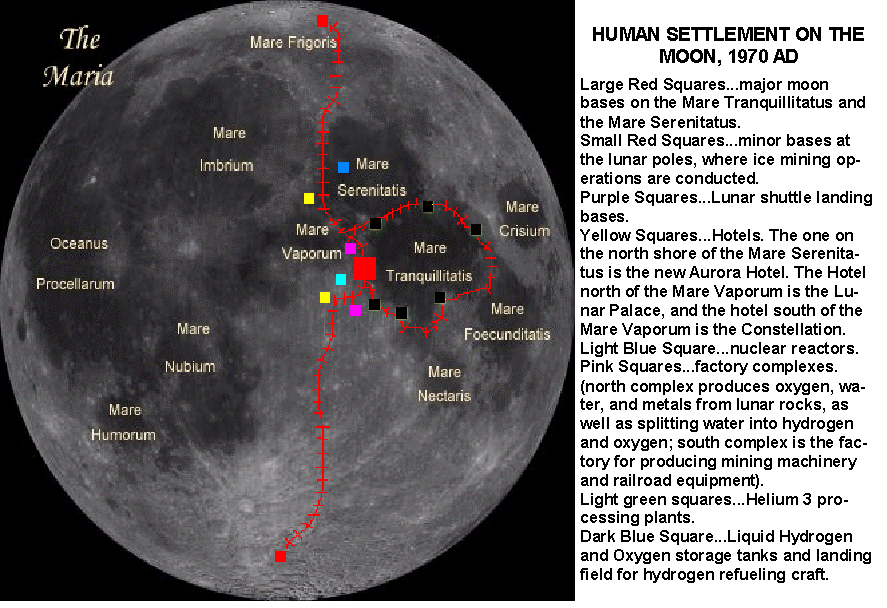
1970 AD--Emperor Lee Chang Lo of China dies, and is succeeded by Lee Kai Wang. Also in this year, results from the first Mars Surveyor probes come in. The orbiting probes confirm the presence of water ice over large areas of the Martian surface at depths of between 4 and 6 cubits below the ground. They also confirm that the polar ice caps are largely made up of water ice. The landers confirm the presence of many valuable materials in the Martian soil and rocks. Over 30,000 people now live on the moon.
THE WORLD IN 1970 AD...A SNAPSHOT. In the following paragraphs, the political, economic, and religious structure of the various nations of the world will be discussed, giving some idea of how society has developed in the preceding centuries.
--Politics. Egypt’s constitutional monarchy has seen quite a bit of development since the last formal amendment of the constitution several centuries ago. The enfranchised segment of the population, which once consisted only of the nemhu (property owners), has been gradually expanded over the centuries, and now encompasses nearly everyone in the Egyptian Empire. The power and influence of the Council of the 400 Elders has also increased, to the point where Pharaohs...who under the Egyptian Constitution have the power to spend state revenues as they see fit...now customarily seek the approval of the Council before making large expenditures out of the treasury. China, Russia, the Inca Empire, and the Norse Kingdom have very similar political systems (indeed, those of China and the Inca Empire are modeled on Egypt’s, with Constitutions adapted, almost word for word, from that of Egypt). Rome, on the other hand, serves as the model for the other major political system in the world...the Republic. Rome’s system, like Egypt’s, has seen much development over the centuries. The franchise, which originally only extended to property owners and soldiers, has been expanded, and like in Egypt, now includes nearly everyone in the country. Other countries whose political systems are based on that of Rome (although most have a single President instead of Rome’s system of two Consuls) are the Creek and Mandan Confederacies, Teysas and Arizonac, Kongo and Lunda. Ghana is the world’s only remaining absolute monarchy, with a Soninke royal house which has ruled continuously since c. 750 AD (although in exile in Vinlandia for part of that period). However, the Ghanaese King is advised by a council of the kings of the various subject tribes which make up the empire (Mandinke, Hausa, Ibo, Yoruba, Bini, Songhay, and many others). This council, although it holds no formal power, exerts a powerful restraining influence on the actions of the Ghanaese King...who realizes that if he upsets enough of the subject kings, his empire will quickly fall apart. And finally there is the United Islamic Republic, which is an authoritarian military dictatorship.
--Economics. The world of this ATL is much more integrated, economically, even than the modern world of OTL. All countries are industrialized, and international trade, facilitated by low tariffs, is the lifeblood of the world economy. This economic integration has accelerated since the founding of ISEP (the International Space Exploration Project), which has linked all of the major nations of the world in a joint effort requiring huge levels of economic cooperation and mutual support. One area where cooperation on this project has had a major impact is on the currency systems in use by ISEP nations. In order to facilitate economic exchange between them the various nations have standardized their currency systems...they all still have their own separate national currencies (the Egyptian Deben, the Roman Denarius, the Norse Kroner, the Russian Ruble, the Ghanaese Cedi, the U.I.R. Dinar; so on and so forth), but they are traded at the same value...and indeed, there is some talk about establishing a new international currency which would replace the various national currencies in the ISEP countries.
--Religion: Egypt, of course, continues to practice it’s old polytheistic religion. The great temple at Karnak has been continually expanded by Pharaohs over the centuries, and has grown into a virtual religious city in and of itself, the holiest place in Egypt. The cults of Osiris and Isis have emerged, over many centuries, as supreme, but most of the old gods are still worshipped in some form. There are also communities of Christians (although Egyptian Christians are generally considered heretics by the main church because of their unusual interpretation of the Holy Trinity...which they identify with Osiris, Isis, and Horus...and other unusual doctrines) and Manicheans (the last such community in existence anywhere in the world). China also is a polytheistic state, where a mixture of Taoism, Buddhism, and (in the Indonesian Archipelago especially) Hinduism is practiced. The Romans, Norse, Armenians, Russians and Ghanaese are all "Christian." Basically this is the Catholic Church, although not exactly the same as OTL, as the church has not been influenced by conflict between the main church and the proponents of various Eastern heresies (Nestorianism, Arianism, etc.) which never arose in this world (most of these arose in lands which are under the control of Egypt, and they thus do not arise in this TL). There was never a "Great Schism" (i.e. the split between Rome and the Eastern church which created the Orthodox Church in the OTL) in this world, as the Great Schism arose in great part because of a conflict for power between the Byzantine Emperor and the independent Pope at Rome. Since there was never a Byzantine Emperor or an independent Pope at Rome in the ATL, this never occurred, and the church remained united. And, since the Bishop of Rome has never been in a position to contend for temporal authority, and has been, to a large degree, regulated by the Emperor/Senate of Rome, the abuses which finally lead to the Reformation never occurred. There is no Martin Luther or John Calvin or equivalent figure in this world as a result. Kongo and Lunda practice a mixture of Christianity, native animism, and Egyptian polytheism. The Incas, Creeks, and Mandans all practice their own native religions, although of course missionaries from Rome and the Norse have made many converts in those lands, and the native religions themselves have been very modified by contact with the faiths espoused by the major powers (for instance, the Inca no longer practice human sacrifice). Islam is practiced in the United Islamic Republic...where it is the only religion allowed to be practiced...and has adherents in Egypt’s Syrian provinces, Rome’s Asia Minor possessions, Armenia, southern Russia, and China as well.
1970-1980 AD--For several decades now, intensive research has been conducted by the major powers into the possibility of an anti-missile defense system. A number of different proposals have been tried, but the one which seems to have the most potential is a system based on high-powered laser beams. Lasers have been known for a long time, and low-powered lasers have been used for weapons guidance, in computers, and in medicine for nearly a century. But there have been several problems which have prevented deployment of such systems. First, to be useful as a weapons system, the beams must be generated with much more power than has, up until recently, been possible. Second, the most powerful lasers developed so far, which derive their energy from interactions within large vats of dangerous chemicals, have been not suitable for deployment because of the problems of size, weight, and the hazardous nature of the chemicals needed to power the laser. And third, they suffer from the problem of limited range (laser beams are absorbed and dissipated as they pass through the atmosphere). But an alternative technology has been developed, the free-electron laser. This laser has a high power level and excellent optical quality (which enhances it’s range) but uses only water and electricity...no dangerous chemicals...to produce it’s laser beam. Furthermore, the laser itself is much smaller than comparable chemical lasers, making it much more suitable for large-scale deployment. By 1970 both the Egyptians and the Romans have a working model of a free-electron laser that can shoot down ballistic missiles, unguided artillery rockets, aircraft and even artillery shells. Both powers realize that such a weapon has the potential to dramatically shift the balance of power by making the nuclear arsenals of the world’s nations virtually obsolete (by removing any practical means of delivering them to their targets). Pharaoh Seti XIV realizes this, and therefore, in May 1970, calls a meeting of the Council for International Peace. At this meeting the Pharaoh makes a startling proposal...he offers the Egyptian laser system to the C.I.P., for use in establishing a space-based and ground-based system which will end the threat of nuclear weapons permanently. Roman Consul Claudius Mucius Crispus, upon hearing the announcement of Egyptian possession of a viable laser weapons system, announces that Rome also possesses this technology, and also places the Roman system at the disposal of the C.I.P. After much debate, the C.I.P. votes to adopt Pharaoh Seti’s proposal. All nations of the world are presented with an offer to have ground-based C.I.P. laser installations based within their borders which will protect them from nuclear strikes by short range missiles, aircraft, or cruise missiles, to be paid for by the nation in which the weapons are to be based. Most nations accept this offer without delay (the exceptions are Kongo and Lunda, which decline on economic grounds). Meanwhile, the C.I.P. deploys, in a process that will consume the rest of the decade, a space-based system which will intercept medium-range and long-range missiles. The completion of this system in mid-1980 will be hailed as a major victory for the cause of peace worldwide, and all of the major countries will begin dramatically cutting the size of their nuclear arsenals (but not totally eliminating them) shortly thereafter.
1971 AD--ISEP’s Spacecraft Design Bureau has been considering a radical new
engine design...a Nuclear Fusion Rocket. The general idea of the fusion drive is
to sustain an onboard fusion reaction of Deuterium and Helium 3 and fire some of
the energy created...in the form of plasma...out the back of the spacecraft to
generate thrust. The system would have a very high specific impulse (Specific
impulse, or Isp, is a measure of how many seconds one pound of propellant could
produce one pound of thrust. The higher the specific impulse, the longer the
engines can continuously accelerate the spacecraft before running out of fuel).
The proposed nuclear fusion rocket has a theoretical maximum Isp of
100,000...compared to about 450 for a chemical rocket and about 1,000 for the
nuclear thermal rockets which make up the backbone of ISEP’s space fleet. It
is conceded that the theoretical upper limit is unlikely to be reached in the
foreseeable future, but, given the experience mankind has acquired with fusion
reactors over the preceding decades, it should easily be possible to design a
fusion rocket with an Isp of 2,000...twice that of the existing nuclear thermal
rockets. This would allow the Earth-Mars journey time to be slashed to less than
six weeks...half the time it would take with the nuclear thermal rockets
currently in use, and 1/4 of the time necessary with a chemical rocket.
Moreover, it would enable missions to depart at any time without waiting for
"shortest journey" launch windows. The experience gained worldwide
with creating sustainable nuclear fusion reactions worldwide for generation of
electric power has amply demonstrated the basic feasibility of this engine, but
some technical issues remain to be resolved. The concept is promising enough,
however, that ISEP decides to focus it’s research on this proposal.
1972 AD--ISEP has decided to use the moon as the construction and supply base for the spacecraft which will make the journey to Mars...launch of these craft from weak lunar gravity will be much easier and more cost effective. Construction begins on a Lunar Shipyard which will build the vessels, which will be launched into lunar orbit by chemical rockets. Once in orbit, the vessels will be married to their propulsion units (which will be built on earth and will already be in lunar orbit). Crew and cargo for the journey will then be loaded using chemically fueled lunar shuttles.
1973 AD--ISEP begins sending cargo containers (full of hydrogen and oxygen, Deuterium and Helium 3, construction equipment, pre-pressurized habitat modules, the parts for a fusion reactor, food, water, and other supplies necessary for the establishment of a Mars colony) to Mars. Like those of the lunar colonization expedition, they are designed to be placed in orbit around Mars, where they will be docked together and await the arrival of the colonists who will use them. They are conveyed to Mars by nuclear thermal rockets. The initial containers contain non-perishable items and hydrogen, primarily...food and other perishable items will be sent as the actual date for the manned expedition grows nearer.
1974 AD--On September 11, 1974...a day which will be remembered for years to come as a day of infamy...a bomb is detonated in the casino of the Lunar Palace Hotel. The bomb shatters one of the large, reinforced glass picture windows and exposes the casino to the vacuum of space. Over 800 people are sucked out of the building and are instantly killed as the atmosphere rushes out through the jagged opening. Fortunately, the emergency airtight doors separating the casino from the rest of the hotel work as designed, and catastrophic loss of pressure in the rest of the hotel is prevented. Later that day, a video-taped announcement is dropped off at major news organizations in several countries. In it, Suleyman Ismail, the leader of the Pan-Islamist terrorist organization, "The Sword of Allah," claims responsibility for the attack. "This attack shows that the Sword of Allah can slay the infidel wherever he may be. Beware the wrath of Allah....God is Great!" Later that same week soldiers, sent by ISEP to provide security, arrive on the moon. They will be a permanent presence hereafter...a stark reminder that human conflict has not remained confined to the surface of the earth.
1975 AD--Construction of the lunar shipyard is completed. It begins to build pre-fabricated sections for the Mars spacecraft, which will be stored until the time comes to assemble and launch them into lunar orbit. The yard also builds the chemically powered shuttles that will be required to ferry cargo from Mars orbit to the planet’s surface. Also in this year, a memorial to those killed in the Lunar Palace attack is dedicated on the moon. Leaders from all of the ISEP nations, including Pharaoh Seti XIV, attend the ceremony (Seti is only the second Egyptian ruler to visit the moon). In the aftermath of this ceremony, an international conference on terrorism is held at Moscow, attended by leaders of most of the world’s nations (Kongo, Lunda, and Teysas do not attend). A treaty of cooperation against international terrorism, called the Moscow Accord, is signed, which pledges the various nations to cooperate to root out terrorist organizations, wherever they exist.
1976 AD--Teysas and Lunda sign the Moscow Accord. Also in this year, the first holographic television is introduced. Instead of viewing the picture on a screen, a three-dimensional image is projected inside an open box. The new sets are extremely expensive and do not immediately become popular. But the technology will be further developed with time.
1977 AD--ISEP tests a nuclear fusion rocket, but the test fails. It is clear that more design work is needed. Also in this year, General Ahmed Rasfanjani, President of the United Islamic Republic, dies. In his will, he has directed that his Vice President, General Mohammed al-Sadr, will succeed him. General Al-Sadr takes power, peacefully, on November 5, 1977.
1978 AD--Kongo signs the Moscow Accord. President Al-Sadr of the U.I.R. announces that the U.I.R. is to have a constitution, and that free elections will be held. He calls on leaders from the various ethnic groups within the U.I.R. to meet with him to draw up a constitution, which they do. After several months of negotiations, the constitution is agreed upon, and elections are scheduled to be held the next year.
1979 AD--Anti-terrorism efforts under the Moscow Accord have been very successful. The police computer files of the various signatory nations have been linked, making it much easier to track terrorists across international borders. A multi-national joint commando force has been created to fight terrorists on their own terms, and joint commando operations against terrorist training camps, police infiltration of terrorist cells (made possible by large-scale cooperation by the security forces of the United Islamic Republic), and crackdowns on "charitable organizations" which are really only a means of funneling money to "The Sword of Allah" have all had their effect. These efforts are crowned in July 1979 by the capture of none other than Suleyman Ismail himself during a commando raid on his hideout in the jungles of south India. By the end of 1979, The Sword of Allah is effectively broken, and, except for a few isolated and minor incidents, terrorism ceases around the world. Also in this year, free elections are held in the United Islamic Republic for the first time. President Al-Sadr is elected by a wide margin to serve as the country’s first democratically elected President. His inauguration ceremony is attended by dignitaries from around the world, including Pharaoh Seti XIV of Egypt, King Harald XI of the Norse Kingdom, Tsar Alexander IV of Russia, and Emperor Wayna Capac VI of the Inca Empire.
1980 AD--Tsar Alexander IV of Russia dies, and is succeeded by his son, Feyodor V.
1981 AD--In April of this year, ISEP tests a re-designed version of the nuclear fusion rocket. This time the test is successful. After several other successful tests are conducted later this year, the concept is considered proven, and ISEP orders it into production. Like their nuclear thermal predecessors, the fusion rockets will be built on earth and launched into orbit by chemical rockets. It is planned to establish a fueling station in orbit around the moon, where the rockets will "tank up" on Deuterium and Helium 3. The fusion rockets will be ferried to the moon by ISEP’s nuclear thermal rockets and deposited in orbit around the moon. They will then dock with the proposed fueling station and take on fuel for the journey to Mars. Also in this year, with the completion of the C.I.P. Missile Defense System, both Teysas and Arizonac formally announce the abandonment of their nuclear research programs and invite inspectors from the C.I.P. to verify the dismantling of their facilities. This is accomplished by the end of the year. There will be no further proliferation of nuclear weapons. Also in this year, hydrogen-powered vehicles outnumber those fueled by petroleum products for the first time worldwide. In the more advanced countries (Egypt, China, and Rome, particularly), hydrogen vehicles have almost completely replaced older, petroleum-fueled models.
1982 AD--The lunar orbital fueling station for the nuclear fusion rockets is constructed. It is made of sections built on the moon, which are launched into orbit and then docked together (similar to the orbiting cargo containers used in the original lunar colonization expedition). The station will be stocked with fuel produced and stored on the lunar surface by the same type of craft which have been used to keep full the orbiting hydrogen containers used to fuel the nuclear thermal rockets. Later that year, the first nuclear fusion rockets arrive and are fueled at the station. They are used initially to transport cargo containers from lunar orbit to Mars, greatly speeding up the process of building up the required stockpiles.
1983 AD--The Mars Colony Ship is assembled in lunar orbit from the pre-fabricated sections made at the Lunar Shipyard. It is a huge vessel, capable of carrying 1,000 colonists to Mars, along with all the supplies necessary to sustain them during the month-and-a-half journey. The crew section of the ship is designed to rotate, thus simulating gravity, which will reduce the deleterious effects of space travel and allow the colonists to arrive at Mars in good physical condition. The speed of the rotation will gradually decrease during the journey, thus acclimating the crew to Mars gravity before their arrival on said planet. The vessel will be propelled by four nuclear fusion rockets.
1984 AD--The Mars Colony Ship is launched from lunar orbit on March 13, 1984. It arrives in Mars orbit and docks with the waiting supply containers approximately six weeks later, on May 3, 1984. The first Mars landing takes place on May 11, 1984...exactly 101 years to the day after the first human foot touched the surface of the moon. Televised pictures of this event are broadcast to captivated audiences around the world. The first priority of the colonists, of course, is to establish the basics for living on Mars. Living quarters are brought down from orbit and assembled on the surface. The nuclear fusion reactor is assembled and activated to provide power for the base. Food, oxygen, water, and other supplies are brought down from orbit to supply the base. Construction begins on a facility for extracting water from the Martian permafrost layer, as well as on an Agriculture Dome where food will be grown. All of this work is well advanced by the end of the year.
1985 AD--The water extraction facility and the Agriculture Dome on Mars are both completed by the end of this year. Also in this year the governments of Kongo and Lunda, which have been negotiating in secret for some time, announce a treaty of unification between their two countries. The devastation wrought by the disastrous nuclear war between the two nations early in the century has caused massive cross-border migration of population, and by now the two are virtually identical culturally and very interdependent economically. So a union makes good sense. Elections for a government for the new nation...which will be called Zaire...are scheduled to be held next year.
1986 AD--The Martian colonists begin to supplement their food supplies brought from earth with crops grown in their newly completed Agriculture Dome. Construction begins on a facility to split water into hydrogen and oxygen by electrolysis. Solar-electric arrays are constructed to supplement the power produced by the fusion reactor. Also in this year, Pharaoh Seti XIV announces that, in commemoration of the 70th anniversary of the founding of ISEP, Egypt will return the island of Cyprus to Rome next year. The forced cession of Cyprus to Egypt following The World War has long been a sore point between the two powers, and Seti’s announcement is applauded in Rome and elsewhere. Elections are held in Zaire. The new government takes power in August, 1986.
1987 AD--Water production is now sufficient to supply the needs of the Martian colonists, meaning no further imports will need to be made from Earth. The facility for splitting water into hydrogen and oxygen is completed and goes into production. Also in this year, Egypt withdraws from Cypress, and the island is returned to Roman rule.
1988 AD--The production of food on Mars has reached the point where the colony is self-sufficient in that item for the first time. Oxygen production is increasing, but imports of this item are still needed. Also in this year, buoyed by the feelings of international amity which have resulted from the Egyptian cession of Cyprus to Rome last year, the governments of Egypt, Rome and Ghana agree on a division of the Sahara Desert Region. The Council for International Peace removes it’s peacekeeping forces from the region shortly thereafter, and another potential flashpoint between the powers is removed.
1989 AD--Oxygen production is now sufficient to supply the needs of the Martian colony, which is now basically self-sufficient of re-supply of the basic elements of life from earth. Construction of additional living quarters, using Martian materials, has begun, in anticipation of an eagerly awaited new shipment of colonists....
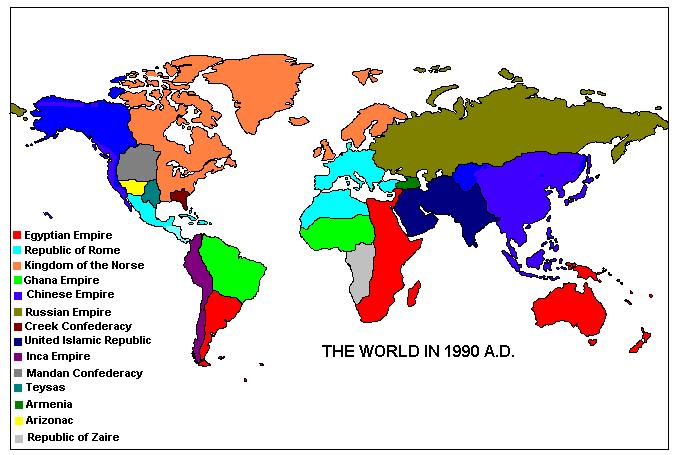
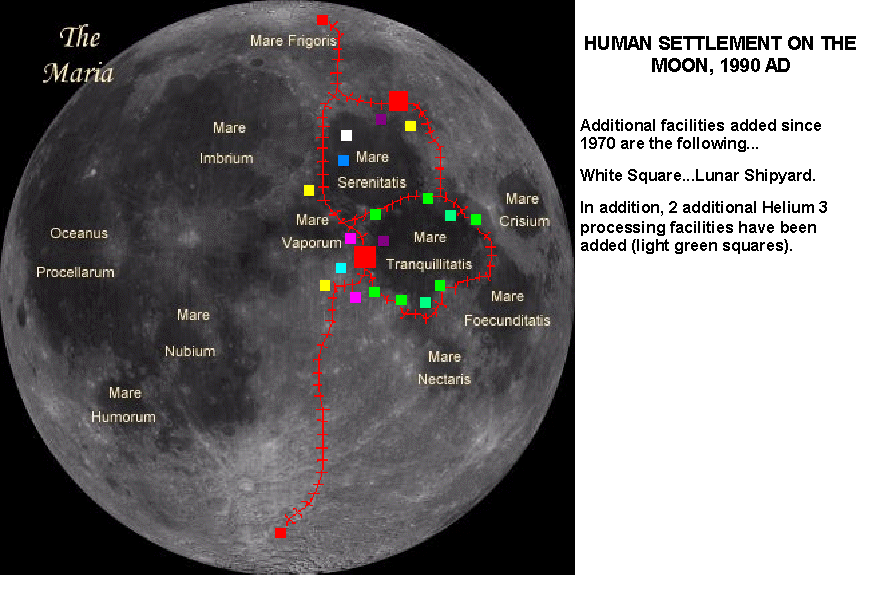
1990 AD--In February 1990, the first female colonists arrive on Mars. Their arrival is greeted with great enthusiasm by the long-deprived male colonists, and several of the women quickly conceive. The first human baby born on Mars, an Egyptian boy-child named Ramose, is born on December 11, 1990.
1991 AD--Now that the Mars Colony is mostly self-sufficient (at least in the basic necessities of life), construction begins on industrial and other facilities which will make the Red Planet economically viable as well. Factories are built to produce various equipment, and mining of the Martian surface for metals of various kinds begins. Scientific research also begins to answer a question which has fascinated mankind for ages...was there, at some point, life on Mars? And does life still exist there? On the moon, construction has begun on a third major base, to be located on the northeast shore of the Mare Nubium.
1992 AD--In the years since meat animals were introduced on the moon, some problems have arisen. It has been found impossible to produce enough feed for the animals on the moon itself, making imports from earth necessary. And, because of this factor, no meat animals have been introduced on Mars as of yet, except fish, which are relatively easy to maintain in a large tank and do not require large amounts of feed. As a result, the population there lives on a very monotonous vegetable and fish diet, supplemented occasionally by frozen meat transported from earth in small quantities. In response to these problems, scientists have been working on an alternate means of producing meat...without having to raise live animals...called the Bio-Reactor. It has been found that fresh muscle tissue, if treated with a special growth serum and electrically stimulated (to simulate the effect of exercise), can be kept alive and will grow. It has taken a couple of decades of work to make the process work and the product thus produced palatable, but in mid-1992, the first artificially produced meat is secretly introduced into the restaurants on the moon in a test, and the consumers there notice no difference between beef, chicken and pork produced in the Bio-Reactor and that produced by conventional means. With the success of the new product, the lunar animal population is reduced to the point where it can be supported by feed produced on the moon itself, and the moon is now totally self sufficient. Teysas and Arizonac both launch communications satellites. They apply for admission to ISEP later that year, and are accepted.
1993 AD--The first Bio-Reactors are transported to Mars and begin production of meat there, allowing a very welcome supplement to the Martian diet. Also in this year, an international economic summit is held in Ocmulgee (OTL Macon, Georgia), capital of the Creek Confederacy. At this summit, a treaty is agreed upon which creates a world-wide currency system. All national currencies are to be gradually phased out and replaced by the international currency within 20 years.
1994 AD--Ten years after the establishment of the Mars colony, there are now over 5,000 humans living on Mars. Additional living quarters and agricultural facilities have been built, as needed, to accommodate the growing population. In May, the Creek Confederacy applies for admission to ISEP, and is admitted. The Mandan Confederacy will follow suit later that same year. The only nation left which is not a member of ISEP is Zaire, which is also the most economically depressed nation in the world and thus does not have the funds for a space program.
1995 AD--At a conference held in Kumbi Saleh, capital of the Ghana Empire, the future of mankind’s exploration of space is discussed. It is agreed that the primary value of the Martian colony will be as a base for the launch of missions to the asteroid belt and Jupiter, and that preparations for these missions will need to begin. A proposal is made to investigate the possibility of terraforming Mars with the aim of eventually producing a planet-wide earthlike environment there. After much discussion, this proposal is also adopted.
1996 AD--Scientists discover the first fossilized lifeforms on Mars. It seems that much of Mars was once covered by a shallow sea, and fossils of simple single-celled (similar to earth bacteria) and multi-cellular plant and animal life (similar to algae and sponges on earth) are discovered. However, nothing more advanced will ever be found...apparently shortly after those life-forms came into existence, the great disaster...whatever it was...which caused Mars to lose most of it’s atmosphere and liquid surface water occurred, and life was extinguished on the planet. Sadly, scientists will never find evidence that native life still exists on the planet (it had been hoped that simple bacteria-like life might still survive in the permafrost layer or in the icecaps, but none is ever found).
1997 AD--Emperor Lee Kai Wang of China dies, and is succeeded by his son, Lee Ching Ho. On Mars, construction begins on a space port, from where eventually missions will be launched to the asteroid belt (where high-value, almost pure platinum-group metal ores can be mined) and Jupiter (whose atmosphere is rich in Helium 3 and which is planned to eventually replace the moon as the Earth’s primary source of Helium 3), and a shipyard to build spacecraft. On the moon, the third major base, on the Mare Nubium, is completed. Also in this year, construction begins on a second Mars settlement.
1998 AD--It is realized by ISEP that the current rockets available are probably not adequate for a manned mission to the asteroid belt, let alone to Jupiter. The distance from Mars to the asteroid belt is nearly as much as the distance from Mars to the Sun...about 140,000,000 miles. And Jupiter lies another 200,000,000 miles beyond the asteroid belt. Even the currently available nuclear fusion rocket would take about four to five months to reach the asteroids from Mars, and almost a year to reach Jupiter. Such long exposure to the cosmic radiation of space would certainly be detrimental, and possibly deadly, to the crew. So in 1998 research into alternate methods of propulsion begins, as well as research to improve the Isp produced by the nuclear fusion rocket (whose theoretical, probably unreachable maximum Isp would be 100,000, so there is plenty of room for improvement of this technology). It is recognized that this project will take quite a few years to complete.
1999 AD--Construction begins on a fourth major base on the moon. It will be located on the south shore of the Mare Imbrium. Additional industrial complexes will be built there as well (mining and agriculture).
2000 AD-- As the new millennium dawns, over 75,000 people now live on the moon. Over the past decade, a political movement has taken root there, seeking independence from ISEP control and the formation of a local government for the moon. This movement is opposed by ISEP, but no formal crackdown has been made.
2001 AD--The first Lunar General Assembly is held, composed of representatives elected by the people of the various lunar bases. This gathering, which does not have the sanction of ISEP, votes to petition the individual ISEP member governments for support in allowing the people of the moon to assume self-government. Representatives are sent to Earth later that year and begin negotiations in many nations.
2002 AD--At a meeting of the ISEP governing council called by King Tekanemin XI of Ghana to discuss the developing political situation on the moon, Inca Emperor Capac Yupanqui X sponsors a resolution calling for local self-government for the people of the Moon. He is supported by Egypt, the Norse Kingdom, Ghana, and Teysas, the Creek Confederacy, and Russia. Rome, China, Arizonac and the Mandan Confederacy vote against. The United Islamic Republic abstains. The measure passes. Negotiations begin with the Lunar General Assembly on the conditions on which lunar independence will be based.
2003 AD--An agreement has been reached between the ISEP nations and the Lunar General Assembly as to the basis for lunar independence are concluded. Official elections for a new Lunar General Assembly are to be held next year. Ownership of the Helium 3 mines and processing plants on the moon will remain in the hands of the terrestrial powers, but they will pay a small excise tax on all Helium 3 shipped from the moon to earth (this tax will be the lunar government’s primary source of revenue, along with taxes on lunar hotel rooms and related items). ISEP will withdraw it’s security forces, to be replaced by forces of the new government. The new "nation" will be called The Republic of Luna.
2004 AD--In Egypt, preparations are underway for a huge celebration marking the 40th anniversary of the accession of Pharaoh Seti XIV to the throne. Meanwhile, in July 2004, elections are held in the new Republic of Luna. In September 2004, Luna applies for admittance to, and is accepted into, ISEP as a member with full rights and privileges...the first extraterrestrial member of the organization. Twenty years after the establishment of the Mars Colony, there are now over 10,000 people living on the Red Planet.

Egyptian clipart on this page is courtesy of

Copyright 2004 by Robert Perkins. All rights reserved. Last updated on June 15, 2004.