 |
 |
 |
 |
 |
|
 |
| HILLMAN IMP & HUSKY |
| Imp History
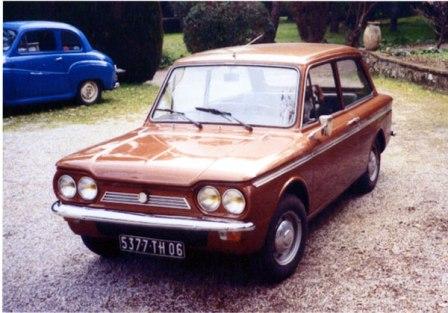
Rootes' small car was designed by Michael Parkes (a development engineer for Ferrari) and Tim Fry more or less from 1955 on. It was made in the purpose-build Linwood factories in Scotland. Launched in 1963, it sported many new and untried ideas, like an aluminium alloy engine, and overhead camshaft; a pneumatic throttle and king-pins running in sealed plastic bearings. It was produced for more than 12 years, until 1976. Once upon a time In 1955 a small car project was begun, not so much to come up with an economy car in the Suez Crisis days (like the Mini), but to provide an idea of what sort of affordable car could be made and what its performance would be. Parkes and Fry proposed a �2 adults - 2 children car�, that could do 60 mph and manage 60 mpg (which made aerodynamics a priority). Looking at the competition (Fiat 500, BMW 700, Citroen 2CV) and considering costs, they opted for a rear engine. Other aims of the team included that the small car be fun to drive. No bubbles After having been presented with two prototypes, the Rootes board members (used to Hillman or Humber solid, well-made quality cars) made it clear they were not interested in any bubble-car of sorts, nor in a design that cut costs at all costs. At the same time they appeared willing to go ahead with a Rootes small car, but it had to be a proper motor car with a water-cooled four-cylinder engine. It should be able to compete with the small Fords and BMCs, including the Mini. Proper motor At the time Coventry Climax were building an aluminium alloy engine that Tim Fry thought might fit, so he wrote them to get the installation drawings. Coventry Climax co-operated and Fry succeeded to fit both it and a radiator into the tiny engine compartment. The 750cc Coventry Climax racing engine was tamed and just about every component was changed. But it remained unlike most car engines, being made of aluminium, with an overhead camshaft. The size was increased to 875cc, producing 39bhp. More proper still After a few visits to Bob Saward's styling department, the Imp (project name: Apex) was quite sophisticated by the end of the 1950s. The shape owed much to the Chevrolet Corvair. And the refinement continued. The opening rear window was another innovation, unheard-of as hatchbacks were in those days. Together with the fold down rear seat, it improved (access to) luggage space. A superior rear suspension was added, coupled with a basic front suspension to effectively neutralise the 'tail-happy' handling of a rear-engined car. Praise the gear A gearbox, cased in aluminium, was specially designed to match the lively engine, with synchromesh on all four gears (unlike the 1959 Mini). It had the third and fourth gear set rather high, to reduce noise and improve economy. The new transaxel was technically advanced. At that time, it may have been the best gearbox ever produced, and it still does not have too many equals. |
 |
| THE IMP |
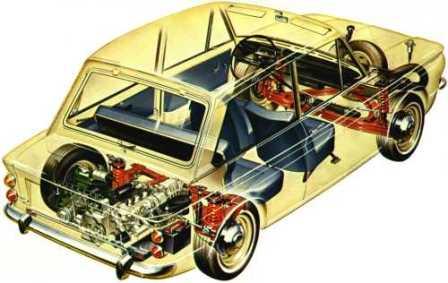
| Cut away drawing of the Hillman Imp |
| It was launched on schedule: a neat, refined little four seater. The year was 1963.
________________________________________ |
| Hillman Husky
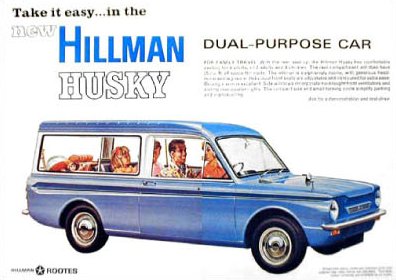
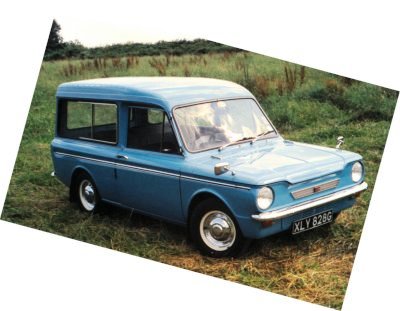
The Tardis Commonly known as the Imp Estate, this little vehicle has been much maligned by many. The loading space in the rear is a very sensible shape due to the 'square' design, and much can be carried along with a full compliment of passengers. Production began in April 1967 and continued until July 1970, the final production year for many models after Chrysler's takeover. (The Van was discontinued then, too). 4777 Huskies were made until October 1968. Then they got a 'face lift' together with the rest of the Imp range. Afterwards around 6000 were built. The raised roofline (4" / 10cm higher than saloons) gave it lots of space above the engine compartment: 50cu.ft / 17.5 dm3 (which is a better loading potential than most estate cars and any hatchback). The roofline had to be raised because the engine caused a high load level. An early attempt to produce an Imp Estate with a conventional roofline was dropped in favour of the Van body-shell because the load capacity would have been reduced and the cost of tooling to the factory prohibitive. Unlike the Van (which made do with the low compression version of the 875cc), it was equipped with the 42bhp engine found in most Imps and Chamois'. The only alterations being made to the oil filter, the radiator and the dipstick to allow routine maintenance without lifting the engine hatch (retained by two 'Zeus' fittings). The Husky has sliding side windows, which allow free passage of fresh air on hot days without draughts. Unfortunately these are also the source of leaks in many cars. In its standard form it has the spartan interior of the Imp de Luxe. No glove compartment, no temperature gauge and usually only shaped rubber mats for the floor. Of course many owners have added Super Imp or Chamois trim to their cars by now to improve the creature comforts. Huskies (mainly older models) enjoyed an assortment of colours for interior trim, including blue, red and green. Because of its load carrying potential the Husky was always fitted with radial ply tyres on standard Imp wheel rims (12" x 4�"). This was to offset any handling problems encountered with a 'tail heavy' car. Up-rated rear shock absorbers and rear springs were fitted, together with the Sport's strengthened wishbones and trailing arms. This gives the car the handling characteristics rather alike a rally car (which will raise eyebrows, when the unsuspecting see you take a corner). The handling is superior to that of a standard Imp. You might try to run Husky rear suspension on your Imp and enjoy it. Huskies are a very viable everyday classic with outstanding qualities in respect of road-holding and load-carrying. |
| Although it is 46lb heavier than the saloon, and the aerodynamics are worse due to the higher roofline, Autocar got 79mph out of it! (It's supposed to have a top speed of 72). They found it accelerated better than the saloon. (Rootes did not tune the cars that were meant for the press any differently.) Some standard cars have been known to do over 90mph without damage.
Now that the Imp is looked at as a collectors item, the Husky is still overlooked. The same happened to the Austin A35 pickup, until there were only a handful left and those are now worth a fortune. So next time you make fun at a 'high top' Imp, you had better find out if it's for sale. They are getting to be quite rare. |
| THE HILLMAN HUSKY |
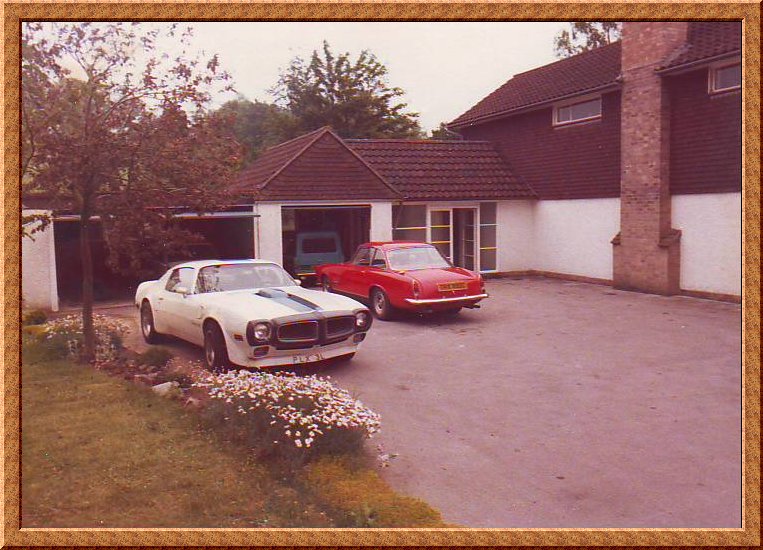
| Mother's Husky can just be spotted in the garage at Coombe Bissett with the Keeble & Trans Am outside |
| Mother was looking for a small car that she could easily throw all her golf bags and paraphernalier into. She was the captain of the Wiltshire ladies team at the time, and used to travel quite a lot to attend tournaments. A friend of mine had this Husky for sale in Southampton and as it was in good condition, I suggested to Mother that it would be a suitable vehicle for her use. We bought the car and it went on to do sterling service. The Imp engine could be a bit unreliable if the car was driven hard but I felt assured that at the rate of knots that my mother used to drive, no harm would come to it, which proved correct! |