| THEN CAME THE GORDON KEEBLE |
| 100 of these fabulous supercars were built between 1963-66 with over 90 units surviving around the globe though mostly in the UK. Designed by John Gordon and Jim Keeble using current racing car principles with the bodyshell designed by 21 year old Giorgetto Giugiaro at Bertone, the cars were an instant success but the company was ruined by supply-side industrial action with ultimately only 99 units completed, even after the company was relaunched in May 1965. Final closure came in February 1966 when the factory at Sholing closed and Jim Keeble moved to Keewest. |
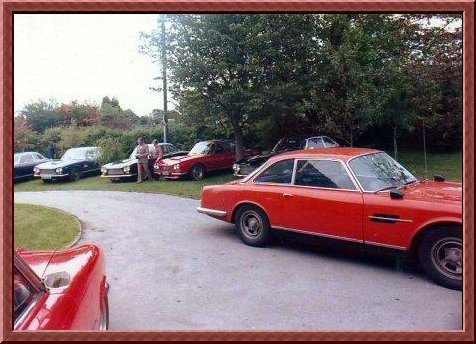
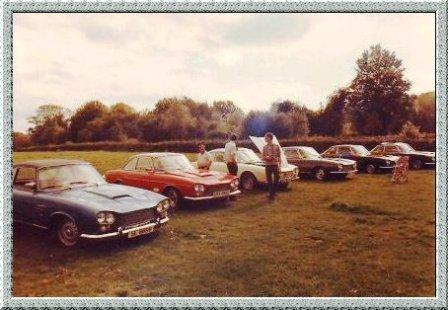
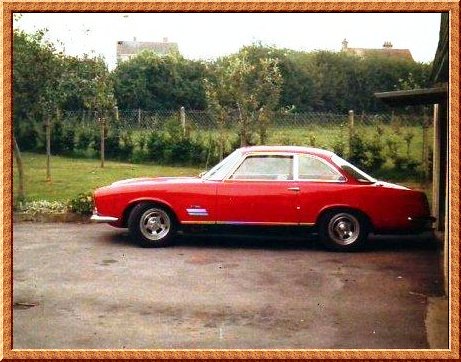
| These two photoes were taken at club meetings. From memory the top picture was taken at a meeting near Bracknel. The red Keeble is the family car and one of my long standing friends, Simon Fleming is sauntering by! This photo was taken at the family home at Coomb Bissett, just outside Salisbury. I remember it was the first time we had shown the car after I had fitted a GM auto box. Some of the other owners tried the car and all agreed that it was far better than the manual box. (see more details below). |
| The Gordon-Keeble History
Following on from the Gordon GT which was designed by Jim Keeble and John Gordon, work was commenced on the production of the Gordon-Keeble. Some detail changes were introduced, the 300 hp Corvette engine of 5.3 litres was chosen. There was some difficulty in obtaining firm supply commitments from some manufacturers in the UK owing the high torque figures (350 ft.lb.) that were produced by this engine. The steering box was the recirculating ball type by Adwest and not the rack and pinion type that had been originally intended. The Warner gearbox was retained with its close ratios and high first gear. The final drive was raised to 25mph/1000 revs. and the front/rear divided disc brake system changed to Girling. The body shell was to be constructed with double skinned glass reinforced plastic instead of alloy and was to be built in Slough as this would be more suitable to small production numbers. They were trimmed in plastic instead of leather to cut down on cost but the finished cars weighed in at 1400Kg giving over 200bhp/ton. The cars were initially priced at less than �3000 which created cash flow difficulties, but the biggest problem encountered was a prolonged strike by Adwest who were supplying the steering boxes and at its worst, there were 16 cars completed except for the steering box which clearly could not be sold. When the steering boxes started to come through again, the cash flow problems were so acute that before long, the company had to liquidate. By March 1965, the work force was laid off unpaid and George Wansborough who had presided over the demise of Jowett Cars was left in sole charge - both John Gordon and Jim Keeble having previously resigned. By May 1965, Harold Smith approached Geoffrey West and between them, they purchased the factory from the liquidators and after many initial difficulties, production was resumed. The new company - Keeble Cars Ltd - was incorporated in July 1965. Later, the company moved to Sholing and the first car produced there was Chassis No.92 and the last was No.98 in the summer of 1966. Keewest Developments Ltd took over the servicing of the cars. One further car was built in 1967 and given Chassis No.99. A further (and final) car was completed from parts and known as Chassis No.100. Ernie Knott, who owned a coachworks and repair establishment in Brackley, came on the scene in 1969 and organised a repair and development facility based at Brackley. He also established the Gordon-Keeble Owners Club in 1970 and managed to trace all the 100 cars that had been produced. The combined servicing and healthcare provided by Key West and Enotts Coachworks is primarily responsible for the very high survival rate of these cars with over 95% still in existance after 40 years with 40 of them being driven down to Southampton to celebrate the 40 years anniversary in 2004 |
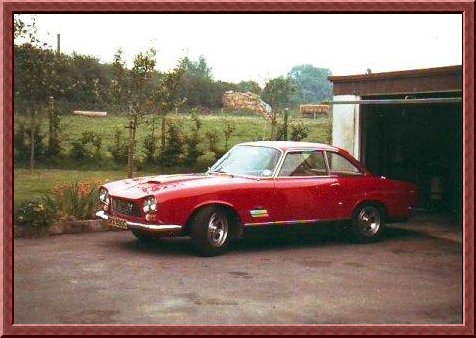
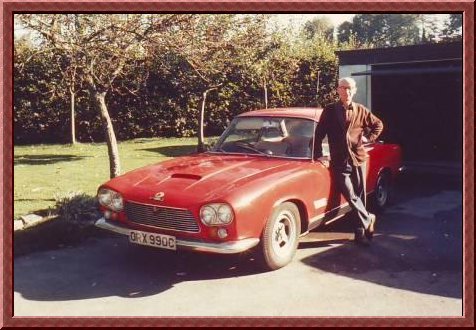
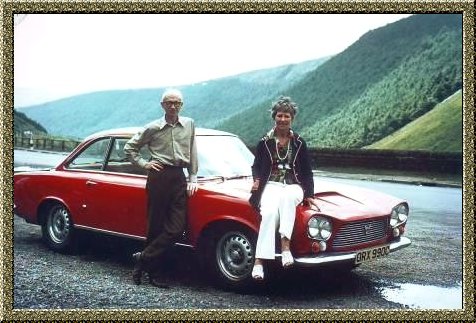
| My Father's Gordon Keeble shown here was bought from Jim Keeble at his new outlet called Keewest Developements. It was the first car that Keewest, partially stripped, rebuilt and marketed as an almost new car again. My Father, was again influenced by my own built-up Keeble race car. (see racing section) The Keeble did lack development, and the worst problem was the steering which suffered from quite violent 'bump steer'. Every time the car hit an undulation in the road it would tend to dive off left or right. However a kit of parts were made available to correct this problem (the main faulty item was the steering arm, it was about one inch too short which upset the steering geometry). Two other items that my Father thought could be improved were the heavy steering and the difficult, rather clumsy gear change . The gearbox was designed for a left hand drive car so it was a bit of a stretch to reach the gear lever. The heavy steering was corrected by changing the Michelin tyres for a set of Avon's, the difference was quite dramatic. After lengthy discussions it was decided that I would try and find a suitable auto box to fit the engine. I decided the way to go was to find a 350 Turbo hydro GM box that had been originaly designed for the 327 Chevrolet engine. We bought a stripped down box complete with torque converter. It all arrived in a cardboard box and I was worried that there might have been some missing parts. A rebuild kit,with a new set of clutch plates, was purchased and the box successfuly assembled. With some hard work and a bit of ingenuity the Auto box was duly fitted in the Keeble. The change was well worth the effort as the car was well suited to the Auto box and some other Keeble owners wanted me to modify their cars but I did not have the time to help them due to other work commitments. I do remember one memorable trip I did in the car one Xmas. It was actually on Xmas day. Mother, Father and myself were going to spend a few days over Xmas with my sister and brother-in-law, Pat and Malcolm, in Hayfield near Buxton. Trying not to get bogged down in pre- Xmas traffic we decided to travel early Xmas morning. Once we reached the M6 near Glouscester I took over and drove North up the M6 and M5. There was almost no traffic and I did the whole length of the motorways cruising between 100 and 120 mph. The Keeble was designed for this type of motoring as it had a high axle ratio and the engine's revs at this speed were still quite low. My Mother, in the back, had been relaxing and dossing but at one point she woke up and looked at the speedo and saw 125 mph on the clock. She nearly had a fit and said I would surely be stopped by the police. So I dropped back to 90, but after about ten minutes I built the speed up again to over 100. Mother remained quiet, lit another cigarette, and seemingly actually enjoyed it. We completed the journey in 2hrs 45mins as against the usual 3 and a half hours. It gave Mother something to boast about to her golfing friends! The picture below was taken in the Derbyshire hills on that Xmas visit. |
 |
 |
|
 |
 |
 |
|
 |
 |
 |
 |
| DECEMBER 1984 |
 |