Newly hatched baby brine shrimp(bbs), also known as artemia, is the best food for young angelfish fry. There are many alternatives out there but none work as good as the live baby shrimp. The movement of the bbs as they swim around help attract reluctant eaters and gives the young fry the much needed strength they need during that delicate part of their life. Beginners sometimes don't have much patience when it comes to raising baby brine shrimp for the newly free-swimming fry. This is another reason why I am devoting a whole page to this topic because I know how frustrating it can be at first. Do what works best for you but I'll also share my way of doing it with you.
There are several varieties of brine shrimp eggs and all have different hatch-out rates. The better types have an approximately 80-90 percent hatching rate and are usually referred to as "Class A Eggs." These hatching rates are also only under OPTIMAL conditions. The only bad part of buying brine shrimp eggs is the price. They are usually quite expensive and sell at about 50 to 60 dollars a pound. But unless you breed angels or other fish on a large scale, only a small amount is needed.
After you have purchased some brine shrimp eggs, here are a few other essential supplies that you will need to get.
A jar just a little bigger than a quart
Un-iodized salt(look in canning and pickling section of grocery store)
9 inches of rigid airline tubing
Regular airline tubing
A small air pump
A 24 hour light source(15 watt bulb)
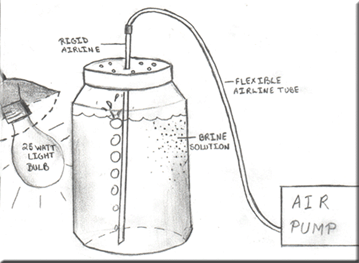
STEP 1: Take the lid of the jar you are using and drill a hole just big enough for the rigid airline tubing to go through. (I use a peanut butter jar, that's been cleaned and washed out, because of the plastic lid. This makes the drilling easier.) Then make several smaller holes for air to escape out. STEP 2: Dissolve 1 Tablespoon of the salt in one quart of de-chlorinated water. If the particular type of bbs eggs you have say to add a different amount of salt then do so. Pour this water into the jar. Another way to measure the quantity of salt is to check the specific gravity of the water. It should be around 1.015 or 1.020. STEP 3: Using an airline tube connecter, connect the rigid airline tube and flexible tube together. Next fix a light bulb in a holder so it is very close to the jar. It can even touch the jar if you're using a 15-watt bulb. This serves to heat the water and provide light, both of which are essential for hatching brine shrimp. The temperature of the water should be around 85 degrees F. You are now ready to add the brine shrimp eggs. STEP 4: You will only need about 1/4 to 1/2 teaspoon of eggs per day for the average sized spawn. I have found that soaking the bbs eggs in regular tap water for about an hour greatly helps with the hatch-our rate. This might be because of the chlorine in the water that helps dissolve the outer layer of the artemia egg shell making it easier for it to hatch. After this is done, put the eggs in the jar with the warm salt water. Stick the rigid airline tube inside the jar and connect the other end to an air pump.
Brine Shrimp eggs need high oxygen levels and movement to hatch properly. The point is to not let any eggs settle on the bottom, and keep them all in constant motion. After about 24 hours, more or less depending on temperature, the eggs should start hatching. I usually wait about 36 hours before harvesting. At this time, the water will have turned orange with all the hatched artemia. To harvest, remove the airline tubing and let everything settle for about 10 minutes. The empty shells of the hatched artemia will float to the surface and unhatched eggs will sink to the bottom. And if there is no light source, most of the bbs will swim just above the bottom. But since there is a light bulb, you should see the bbs swarm around the light, to which they are very much attracted. You can either siphon them out with a piece of airline tubing or use a turkey baster to suck the artemia out. Whichever way you use, pour the water with the live bbs into a handkerchief or brine shrimp sieve. Rinse this in warm fresh water for a few seconds and then feed them to the fry. I find it fun to look closely at the fry when they first see the bbs swimming around and try to catch them.
After the live artemia are siphoned out of the jar, don't add new eggs to the same solution as this can cause bacteria build up. You can however, add the air and light and see if anymore of the unhatched eggs hatch. The brine(used salt solution) usually turns bad after about 3 days and gets cloudy. If you want to have a constant supply of live bbs, it is necessary to have 2 or 3 hatching jars and use them in a cycle. Look at the diagram below to get a better idea of the hatching setup. Live baby brine shrimp can be fed for the first several weeks of the fry's life and then decapsulated shrimp eggs can be used. I switch to powdered flake food only when the juvenile angelfish are about 1 1/2 to 2 months old.
|