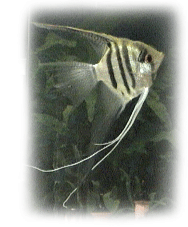
| Angelfish are among the most beautiful freshwater fish. A bonus attribute is that they have interesting characters and behaviors. While their care and maintenance is not difficult, it might be a little challenging for the beggining quarist. Lets discus some of the basic requirements of angelfish keeping first. TANK SIZE An adult angelfish does best if given 10 gallons of tank space. So when you buy juvenile fish, keep this in mind since angelfish grow very fast. This way, you will also have room for a few other species to add variety to the aquarium. I'm assuming that you are setting up a community show tank with gravel, decor, etc. It would be best to give the angels lots of free space where they can dash around, and a few hiding places for the timid fish. FILTRATION / LIGHTING / PLANTS A regular power filter will do if stocking rates are at 1 angel per 10 gallons. If there are more fish, an airstone should be also added to provide ample oxygen. Undergravel filters will also work, but are not the best option since the dirt never leaves the aquarium but is just drawn to the bottom. Angelfish will do fine with 12-14 hours of light a day. The light does not have to be extremely bright unless there are live plants in the aquarium. I find my angels are a lot less tense if their tank light is no too bright. For the begginer(and expert) plastic plants will work. Angelfish tend to become quite territorial and a few might stake a territory for themselves claiming certain plants as landmarks. After your tank is completely set up, let the filter cycle the water for a few days. Bring the water temperature to 80 F with a heater. If your tank is a 20 gallon, a 75 watt should do; 29 gallon-100 watt, and so on. It is important that you get a reliable heater that keeps the temperature constant. You are now ready to get your fish! If this is your first time buying angelfish, you might try to find the prettiest or largest fish. This is not always the best choice. First observe the fish and buy only the ones that seem healtheir and more active. For beginners, the best place to buy angelfish is from your local petstore. The reason for this is that the water conditions of the store will be similar to your own. The fish will recieve less shock in the transfer. In my experience, angelfish that undergo a change in water conditions, especially P.H, are likely to die. If your local petstore doesn't sell angels(and a lot of them don't) then you will have to buy from out of town and just hope for the best. My male zebra veil angel is the only survivor out of several that I bought from a store with a drastically different Ph than mine. Don't buy any other types of fish at this time but wait a few days to get the angels settled into their new home. Now comes the fun part of fish keeping, just sitting down and watching them! Wait about 12 hours before feeding the new fish because it is likely that they will not eat yet and the food will pollute the water. A staple flake such as TetraMin should be fed once or twice a dayonly as much as they can eat in about 1 to 2 minutes. Later on, you can expirement with other types of foods such as pellets, frozen, freeze-dried, and live foods. For more Information on foods, Click Here. OTHER SPECIES IN THE ANGEL TANK If you want to add other fish to the aquarium, make sure they have similar requirements as angelfish. Some fish do not do well in the high water temperatures that angelfish thrive in. Avoid fin nippers such as tiger barbs. Fish like the the barbs that swim extremely fast and are very active should not be kept with angels. Very small fish such as neon tetras should also be kept away from angels since adult angelfish are fully capable of swallowing a neon. Peaceful yet hardy fishes do bes with angels. An excellent choice are small catfish species such as corydoras. They help clean the gravel and dirt of the bottom that the angelfish usually neglect. MAINTENANCE Doing a 10 to 20 percent water change a week will help your aquarium greatly. Use a gravel siphon to clean the gravel. Dirt and bacteria build up fast and it won't hurt to do this weekly as well. Make sure to add the dechlorinator to the water before pouring it into the tank, and check if the temerature is close to that of the tank's water. As you get to know your fish, you will develope your own methods and techniques of raising, feeding, and caring for them. The most imporant thing to remember is not to give up if things don't go right at first. I regret to say how many angelfish I killed before I could get them to live in my aquarium. Most of all, enjoy your fish, and keep learning! |
 |
 |
 |
|
 |
 |
 |
 |
 |
 |
 |
 |
 |
 |
 |
|
|
 |
|