|
|
Rhode Island Kodokan
Okinawan Goju-Ryu Karate |
|
|
|
Rhode Island Kodokan
Okinawan Goju-Ryu Karate |
|
|
TONFA |
|
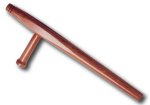
Tonfa: From Kobudo Weapon to Modern Police Tool It's seen on the belts of cops across the USA, but its roots lie in ancient Okinawa. It's the tonfa, a simple stick that has evolved as a martial arts weapon for centuries. The tonfa is a simple, flattened stick, around 15 to 20
inches long, with a handle sticking out at 90 degrees to one end. That handle
was the first use of the tonfa, as a means to rotate the heavy cylindrical
stones used to grind rice into flour. As with many other weapons of kobujutsu,
the art of Okinawan weapons fighting, the tonfa also proved to have effective
martial uses. Kobujutsu is the Okinawan art of fighting with weapons, and is related to karate, open-hand fighting. Today, the more combat-oriented -jutsu orientation has been largely supplanted by a martial way, or -do, form of this martial art. Most kobudo weapons were simple farming implements or tools: the bo, for example, was a staff used for assistance while walking, or to suspend two parcels over the user's shoulder. The eku was a fisherman's oar. And the now-ubiquitous nunchaku was used as a flail when dehulling rice. Villagers, forbidden from owning "more advanced"
weapons like swords or naginata, adapted their everyday tools to defensive
purposes. Techniques that worked were archived in kata, or special sequences of
movements, allowing kobudo fighters to train and pass along their knowledge. Tonfa were used in pairs, one in each hand. By gripping the
handle in a fist with the shaft lying along the forearm,the tonfa wielder could
use the same techniques used in empty-handed arts like karate. Measured
properly, a tonfa would extend beyond the user's elbow when held by the handle.
Dual weapons allowed the user to simultaneously block with one tonfa and strike
with the other; the dense hardwood could protect even against sword cuts. Tonfa techniques remained largely unchanged until the
1970's, when Lon Anderson developed single-tonfa techniques for police officers.
The result made the tonfa perhaps the most widely used kobudo weapon today. In 1971, Lon Anderson adapted the tonfa to police work.
Anderson sought to improve on the police impact weapons of that era; the billy
club, night stick, and riot baton--all still fundamentally bludgeons. Monadnock
Corporation of New Hampshire released the first Prosecutor PR-24 baton in 1974.
The new side-handle baton soon gained popularity across the United
States. These days, it's not unusual to see a patrolman walking a beat with a
tonfa slung on his hip, but when the weapon was first introduced it was
moderately controversial. Those were the days when the martial arts were still
new to most people; when Bruce Lee ruled the cinema and news of warring schools,
like the dojo of the notorious Count Dante, was front-page news. Equipping
police officers with "funny karate sticks", equated in the public's
mind with the popular nunchaku, was alarming. The same public outcry occurred recently in Britain, when
police officers there began adopting the side-handle baton. As before, the new
weapon was foreign and untested. As martial arts become more mainstream though,
adoption of traditional weapons for modern uses will become easier. Side-handle baton techniques are largely similar to those used with traditional tonfa, except that since only one tonfa is used, the other hand is used as a guard or to reinforce blocks and strikes.
|
|
Home | History | Sensei | Katas | News | Enroll | Photos | Guestbook | Contact | Reference | Miscellaneous |
©2004 RI Kodokan