
 Much of Burkina Faso is populated by descendants of the Mossi empire, founded when a band of horsemen from nearby Ghana galloped through at the turn of the 15th century. Unlike other African countries that governed through non-hierarchical village systems, the Mossi organised a blue-blooded empire that even The Firm at Windsor Castle would be hard pressed to match. They developed courts of law, administrative bodies, ministerial positions, and a cavalry to protect the realm. The later proved to be critical in resisting the hostile advances of their Muslim neighbours and explains why, even today, Burkina Faso is one of the few West African countries that's not predominantly Muslim.
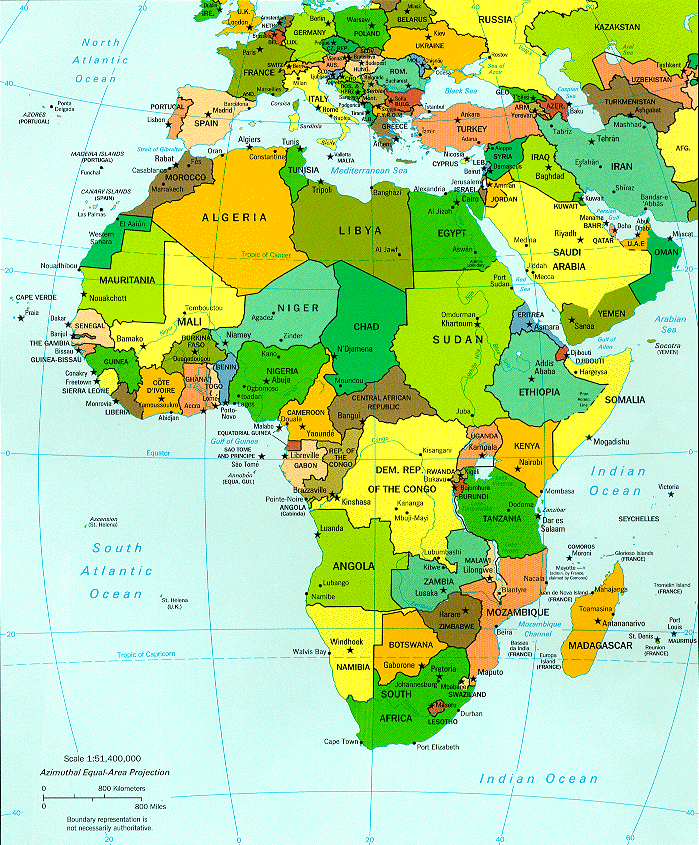
Things remained relatively stable in Upper Volta (as it was then known) until the French began nosing around in 1897. Since then, geographers and cartographers certainly have cause to complain : in less than a century, Burkina Faso has changed names six times!! Originally called the "Mossi Kingdoms" after the age-old West African empire founded by the Mossi people Burkina Faso, along with several other territories, became known as the "Colonie du Haut S�n�gal-Niger" (Upper Senegal-Niger). Fifteen years later, the Mossi kingdom split off from the other territories, becoming the "Colonie de Haute volta" (Upper Volta). In 1932, the French decided for purely commercial reasons to subdivide the region more times than an acre block in Manhattan. Bits of Upper Volta were given away to Mali, Niger and C�te d'Ivoire with all the sang-froid of a generous thief. This explains why during the colonial period, the old earthen mosque in Bobo-Dioulasso features on stamps from C�te d'Ivoire. The final nail in the coffin was the blackbirding of natives from Upper Volta to work on French plantations in neighbouring C�te d'Ivoire. For the next 60 years C�te d'Ivoire remained the precious princess of the region and Upper Volta the poor and ugly second cousin.
In 1947, Upper Volta regained both its traditional borders and the name it was to keep for another thirty-seven years. When independence was granted in 1960, neither the borders nor the name Upper Volta (referring to the upper courses of the Black Volta, Red Volta and White Volta, the main rivers running through the country) were changed. The country itself, on the other hand, entered a long period of political instability.