

 When outright colonisation finally started to lose its sex appeal in the middle of the 20th century, Upper Volta was one of the most vocal in calling for the return of independence. In 1960, Maurice Yaméogo, himself a Mossi, was elected as the country's first president. Unfortunately Yaméogo confused electoral success with a mandate to do as he pleased. A set of disastrous economic policies, coupled with a liberal attitude toward corruption, led to riots and demonstrations by the general populace. In 1966, a military-led coup ousted Yaméogo from office for, among other things, feathering his own nest with public funds.
The power vacuum created by Yaméogo's absence ushered in nearly two decades of coups and counter coups. During the '70s, the trade unions in Upper Volta were among the most powerful in Black Africa. No government could ignore them. They forced the military, after four years in power, to step down in 1970, allowing a civilian government to take over. This lasted for four years, until the military staged another coup. This time, the military was merely grabbing power, not responding to a public uprising. It suspended the consitution and banned political activity. The next 5 years after 1978 was laden with three more coups. The most notible was in 1983 when Captain Thomas Sankara, an ambitious young military star with left-wing ideas, staged a bloody coup and seized power.
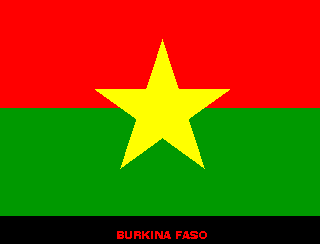
When the fiery Captain Thomas Sankara took over power at the beginning of the 1980's, his first and foremost aim was to put a stop to the rampant corruption affecting not only Upper Volta, but the whole of the African continent. He immediately set about implementing a set of radical socialist policies to ensure that such corruptive practices would once and for all became a thing of the past. In 1984 he renamed the country; Upper Volta thereby officially became known as the "Land of Honest People" (Burkina Faso), and was declared a People's Republic. In blitzkrieg style, he immunised every child against measles and yellow fever, trained home-grown doctors for every rural village, built over 350 schools, reduced ministerial privileges and overspending, started building a railway line to the Niger border, and painted Ouagadougou a non-Marxist white. These unabashedly socialist policies made him a hero to the general populace but did nothing for his standing among the elite. There was a collective intake of breath in the well-to-do circles when he slashed ministerial salaries by 25%, and tribal leaders worried that his habit of consultation with the people at a grassroots level undermined their traditional authority.