
THE REVELATION OF THE HOLY TRINITY: HEAVENLY KING
CONTINUED FROM PAGE 1
This allows a better understanding of the Semitic aspect of the liturgy and the Presence of the Shekhinah [Light, God, Messiah] and of words like "qerev" [core, heart, centre], connected with the root "qarov" [neighbour, relative] and "qorban" [offering] which generated in Syriac "qurbono/qurbana" specifically referring to the Sacrifice of the Eucharist.
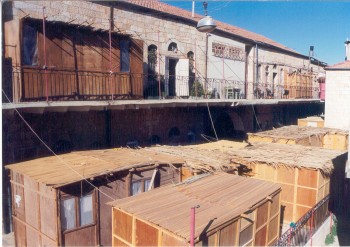
The Greek version of the Septuagint which is the essential reference for most writers of the Gospel, uses a specific Greek verb "skiazo" [to (make) shadow] such as in 2 Samuel 20:6; the Hebrew word "natzal" [to be in the shadow] is rendered by the Greek "skiasei" [to cover, overshadow, abide]. The expression "lehatzil lo" [to deliver him] in Genesis 4:6 is translated into Greek as "tou skiazein auto" [in order to put him into the shadow]. In this particular case, "Shakhan" [to dwell] is connected with the Hebrew root "sakhakh" [to cover] relating to the Shekhinah, cf. the Feast of the Booths ["Sukkah", in Aramaic: "metalela lmetalleta"], in which abide all the righteous of the history of salvation. In the Septuagint, "episkiazo" is used three times to translate the Hebrew verb "sakhakh [to cover]: Psalm 91:4; 140:8; Proverbs 18:11, linked to the Hebrew root S-KH: "imagine, conceive" and once for "shakhan" [to come and dwell in the right place]. Then, we might have to consider seriously the possibility that "Shekhinah" is dealing with an "overshadowing process" and it should be noted that this 'inhabition" is stated in three essential moments showing the effective Presence of God: in Saint Luke 1:35 [Annunciation], in Saint Matthew 17:5; Saint Mark 9:7; Saint Luke 9:34 [during the Transfiguration when the disciples are overshadowed by this Shekhinah and Divine Presence and in the Acts of the Apostles 5:15 [Saint Peter overshadowing a disabled man].
If we accept to take into account the rabbinical tradition, the Shekhinah is a Light, Feminime Presence of God and constantly overshadows the House of Israel and all human beings, nations, groups, in particular those who are not Jewish [cf. the Acts of the Apostles 15]. The Shekhinah is active with the sick [Shabbat 12b], strengthens the marital ties [Sota 17a, cf. the ritual of coronation during the Byzantine wedding]. She refreshes those whose heart is angry or alien [Berakhot 43b] and assists those who sin in secret [Hagigah 16a]. She takes away the sorrow of those who are in pain or suffer of some slander [Shabbat 30b; Sota 42a]. Therefore Rabbi Akiva said that the conjunction to "dwell seven days in the booths" [Leviticus 23:42] also applies to the revelation of God's Reign and of His Presence in every place. Targum Onkelos uses the Aramaic word "metallalta" for "sukkot" as an image of a wedding canopy or a cloud [Targum Yerushalmi].
The prophecy of Isaiah 4:5: "And the Lord will create upon every dwelling place of Mount Zion, and upon her assemblies, a cloud and smoke by day". Rabbi Akiva also considered the proselytes as "dwelling under the wings of the Shekhinah". This is what Saint Peter understood when he recognized that the Holy Spirit had enlightened Cornelios, "a righteous man, full of fear in the face of God [a proselyte]" [Acts of the Apostles 10:17-33].
One of the most ancient Christian prayers is "Heavenly King" which is daily recited by the Orthodox and Eastern rite believers and has been recently adopted by some other Christian groups in the West. It is not uttered during the time between Ascenson Day and the eve of the Pentecostal Feast, because the Church is willing to point out the importance of the Holy Spirit.
Below are given samplings of the text in various languages:
[NOTE: WE SHALL EDIT EACH VERSION WITH ITS OWN SPELLING CHART IN THE VERY NEAR FUTURE]
English:
Heavenly King, O Comforter, the Spirit of Truth, Who are everywhere present and fillest all things. O Treasury of every good and Bestower of life: COME AND DWELL IN US, and cleanse us from every stain, and save our souls, O Good One.
Greek:
Vasileu ouranie, Parakite, to Pneuma tis Alitias, Ho Panakhou paron ke ta panta pliron, Ho Thisauros ton agathon ke Zois Khorigos, ELTH KE SKIVOSON EN IMIN ke katharison imas apo pasis kilithos ke soson, Agathe, tas psykhas imon.
TO CONTINUE TO PAGE 3 PLEASE PRESS HERE

HOW to contact us?