| SONNETS BY DER MOUW |
| Through chalices of unreal crystal glows the tragic-purple velvet underground. The lamp's invisible; the handles drowned in slender waterfalls of sparkling flows. Galaxies glitter; nebulae, all round; constellations blink in yellow tremeloes: each chalice, a reflecting nothing, shows a universe above the grief profound. To sorrow's purple contradictory, diaphanous and polished, thus I see my crystal-ware of poems, cool and pure: world-nebula of melted sentiments, forged into scintillating thought. I sense of one God everywhere the signature. |
| Door kelken van onwezenlijk kristal schijnt de ondergrond van tragisch-paars fluweel Onzichtbaar is de lamp; langs ied're steel hangt, smal en stil, een zonn'ge waterval. Melkwegen welven; nevels, overal; en sterrebeelden flikk'ren, puntig geel: boven 't diep-werklijk paars tilt, irre�el, iedere kelk, een spieg'lend niets, 't heelal. Zo zie ik, fijngeslepen, diafaan, boven 't verdriet dat doorschijnt, zwevend staan 't kristalwerk van mijn verzen, rein en koel: tot wereldnevel van stemming vervloeid, tot flikk'rende gedachte ineen gegloeid, zie 'k overal eenzelfde Godsgevoel. |
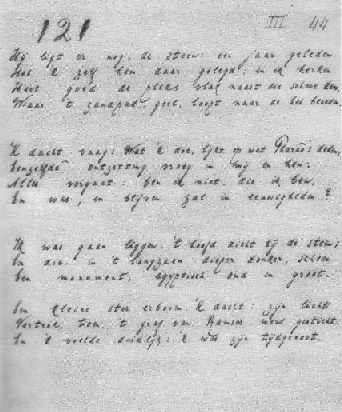
| The stone lies there, beside the crooked tree that stands next to the path, making its way downhill. A year ago I did convey it to the ground and in vague reverie I thought: "What I do bears analogy to pharaoh; we ask with the same dismay: all die: am I not, who I am today and was and will be in eternity? I knelt, my head moved closer to the stone; in falling darkness it had slowly grown, an ancient monument before me set. Above it a small star. I thought: "Its light departed in the days of Ramses' might." I felt the pharaoh and I had met. |
| Hij ligt er nog, de steen: een jaar geleden heb 'k zelf hem daar gelegd; en ik herken heel goed de plek, vlak naast die scheve den, waar 't zandpad, wit, loopt naar de hei beneden. 'k Dacht: "Wat 'k doe, lijkt op wat farao's deden; eenzelfde ontzetting vroeg in mij en hen: alles vergaat: ben ik niet, die ik ben, en was en blijven zal in eeuwigheden? Ik was gaan liggen, 't hoofd dicht bij de steen; en die, in 't langzaam dieper donker, scheen een monument, egyptisch oud en groot. Een kleine ster erboven. 'k Dacht: "Zijn licht vertrok, toen 't graf van Ramses werd gesticht." En 'k voelde duidelijk: 'k was zijn tijdgenoot. |
| ======================================= |
 |
| ======================================= |
| ======================================= |
| I'm Brahman. But we are without a maid. Around the house there's one thing I can do: I fill the waterjug and have no clue hence always spill and have the cloth mislaid. She says this work is to a man taboo. And I feel helpless and to myself tirade when she has my own clumsiness repaid by serving me her tasty, steamy stew. And I revered but Him, who does unfold in magic of the world, of art and knowledge: when she does enter with my plate of porridge and I her wrinkled fingertips behold, my adoration suddenly expands from Sun, Bach, Kant to her old callous hands. |
| 'k Ben Brahman. Maar we zitten zonder meid. Ik doe in huis het een'ge dat ik kan: 'K gooi mijn vuilwater weg en vul de kan; maar 'k heb geen droogdoek; en ik mors altijd. Zij zegt, dat dat geen werk is voor een man. En 'k voel me hulp'loos en vol zelfverwijt, als zij mijn lang verwende onpraktischheid verwent met wat ze toverde in de pan. En steeds vereerde ik Hem, die zich ontvouwt tot fee�rie van wereld, kunst en weten: als zij me geeft mijn bordje havermout, en 'k zie, haar vingertoppen zijn gespleten, dan voel ik ��nzelfde adoratie branden voor Zon, Bach, Kant, en haar vereelte handen. |
| -9- |
| -126- |
| A young and tender girl! So sweetly shy, a child! Twice graceful for blond maidenhair. I am -says mum- her mind's charg�e d'affaires. She reads good books. The ones I specify. She'll blush when greeted by a man and tear her dog away from his, because she'd die for shame should his front-paws be raised. O, my! The filthy animal! I do declare! Louys -she hints- that poet's views are wrong. She does like Heine or a Schumann song. She hates, and twice, the beautiful cocotte, adores Don Juan and laughs at Don Quijotte: Within what seems an Artemis, I'm sure lurks a demonic, yearning b�te d'amour. |
| Zo�n teer jong meisje! Ja, zo lief bedeesd, zo kind!. En dubbel grac�lijk, want ze is blond. Ze houd �zegt moeder- ook haar geest gezond, omdat ze op haar raad goede boeken leest. Ze kleurt, wanneer een heer haar groet, en vreest, dat net zijn terrier met haar herdershond zo raar gaat doen, twee poten van de grond, neen maar! zo�n vies en onfatsoenlijk beest! Louys-verraad ze- kan haar niet bevallen, wel Heine en Er, der herrlichste von Allen. Ze haat, dubb�le afgunst, de mooie cocotte, dweept met Don Juan en lacht om Don Quijote: in schijnbare Artemis ligt op de loer hunkrend, demonisch, la b�te d�amour. |
| -218- |
| ======================================= |
| -477- |
| The numbers of the sonnets refer to the page-numbers in the book J.A. der Mouw: Volledig Dichtwerk (G.A. van Oorschot, Amsterdam 1986) |
| ======================================= |
| Night on a quiet heath. Enclosing me a hall, as if transparent, crystal clear, an absolutely silent hemisphere around an ancient mountain deity. A siren shrieks from far away. I hear it tunneling. My dome cracks violently. A bark hews out a narrow cavity. I check the brutal splitting with my ear. My temples buzz. I hear the living blood. No: it�s earth�s heart. It trembles and it thuds to wake the silent god from twilight sleep. But, as I close my eyes to concentrate I�m hindered by a starry light: it seeps through microscopic holes that scintillate. |
| 't Is nacht. 'k Zit op de hei. Nergens geluid. Over me staat, als transparant kristal rondom een oude berggod in zijn hal een halve bol van stilte, die me omsluit: 'k hoor, hoe heel ver een lang gillende fluit een tunnel boort; mijn berg kraakt overal. Een blaf, ginds, hakt een gat; en recht en smal knapt een spleet open, tot mijn oor hem stuit. 'k Hoor t levend bloed, dat in mijn slapen gonst - Neen: 't is het hart van de aarde: het trilt, het bonst, of 't niet de god uit zijn verdoving wekt. Om goed te luistren, doe ik de ogen dicht, maar 'k word gehinderd nu door 't sterrelicht, dat tikkelend door fijne gaatjes lekt. |
| -34- |
 |
| An apiarist, I send my thoughts to air, to swarm the nightly sky when it�s ablaze with cosmic flowers. Their glittering bouquets reveal the Soul that blossoms everywhere. I gather, as I�m curiously ensnared by each, their essence. With it I inlay my spirit's honey-comb, so it displays the fragrant rose of Berenice�s Hair. My love directs their semi-conscious flight to starry beds that verge our galaxy, my peacock butterfly, my tortoiseshell: they carry home the fruits of reverie and knead my words to fashion, softly, white, my poems, moulding cell on starlit cell. |
| ======================================= |
| -17- |
| 'k Zend, imker, dikwijls mijn gedachtenschaar uit zwermen, als de nacht te schitt'ren staat van wereldbloemen, die ontluiken laat de Grote Ziel, ontzaglijk visionair. 'k Ben vreemd in elke aanwezig en vergaar, wat mij van eeuw'ge essentie tegenslaat: zo geurt dan in mijn ziel, een honingraat, de witte roos van Berenike's Haar. Mijn liefde leidt hun halfbewuste zwerm naar sterreperken langs de Melkwegberm, mijn pauwoog, mijn mystische nachtkapel: zij dragen naar hun huis de heil'ge vracht, en kneden uit mijn woorden, wit en zacht, mijn verzen samen, cel naast sterlichtcel. |
| Peacock and tortoiseshell are both names of butterflies. |
| Een pauwoog is een vlinder. "Kapel" is oud-Nederlands voor "vlinder". |
| High Altitude/In de hoogte A cycle of sonnets by Der Mouw (translation in progress) |