Healing Horses with Reiki
Healing Horses with Touch
Reiki and Horses, Here's How It Works
Horses are very open to Reiki, because they run on a higher energy vibration/frequency than what humans do, and their ability to heal themselves is much faster than our own. However, just like humans, animals carry with them anxiety, stress, sickness and the burdens of everyday life. This stress can cause energy and chakra blockages, which eventually cause sickness, lack of energy, unwillingness, and what every rider fears..the dreadful "problem" horse. When the chakra system is not flowing normal and smooth they tend to be cranky, restless, upset, colicky, etc...
All animals naturally possess the sixth sense ability, so they generally warm up to a Reiki practitioner quicker than they would with other strangers. This is because Reiki practitioners give off that higher vibration/frequency of energy that the animals can see. One of the things about Reiki is that it cannot be forced on an animal. If they feel uncomfortable with the treatment, or they just do not want it, they will let the practitioner know. The great thing about Reiki is that it doesn't matter what discipline you ride, what age your horse is, or the breed of the horse, it can benefit EVERY horse at ANYTIME!
Listed below is a list of problems and circumstances that Reiki would be great for:
Aleve anxiety and stress.
Ease separation issues; grief, loss, change of circumstances.
Promote physical healing for the injured and sick.
Help with behavioral issues; over-stabled, anger, depression, fear.
Reduce post-surgical stress and trauma.
Build or maintain stamina and agility.
Lower blood pressure.
Restlessness/worry.
Stop bad habits/vices.
Strengthen the immune system.
Relax sore/tight muscles.
Coincide with any prescribed medication or medical treatment.
Bring deep relaxation.
Dissolve energy blockages.
Past traumatic experiences.
Detoxify.
Abuse, rough handling, mental or physical cruelty.
Balance energy.
AND MUCH MORE.
All horses re-act differently to Reiki treatments, but I have provided a list of common occurrences that can be seen during a session. The majority of horses I work on show these signs right away, however, there are some cases where the horse will show these signs about 10-15 minutes after the session is over. During a Reiki session most horses become very calm and go into a sedated state. Only a small number can become agitated, due to being worried by the new sensations. Therefore, the treatment time may need to be shortened because of this. However, do not fret because the shortened time does not affect how successful the treatment can be.
After each session is over you should take a few minutes before moving the horse, so they can come out of their state of relaxing on their own terms. This is a good time to get a nice soft brush and give the horse a clam brushing over their entire body. After that, you should reside your horse back to their stall for a day of stall rest. This is when the horse will go into their healing time, and they may be a bit sleepy. Always allow them to rest and come out of that sleepy stage naturally. Horses should be worked or ridden before Reiki on the day of treatment, NOT after the treatment. No harm will come to the horse if you work him after a treatment, but you should allow the horse the chance to absorb the beneficial changes. If you were to ride or work the horse, the sudden stress can block the Reiki energy due to the rush of adrenaline increasing cellular activity. A great example is humans getting a relaxing massage, afterwards we feel relax, refresh, but bit sluggish. We would not want to get a nice massage then go to a high stressful job. Neither do our horses.
In addition, it is advisable not to have the farrier or other therapists arrive shortly after a Reiki session for the same reasons. Some big changes can take place during the first session so it is important for the horse to rest afterwards. Exceptions to this are competitive horses where Reiki can be beneficial during an event, race, or show.
The small number of agitated horses could include the following types:
Horses with sensitive skin or itchy skins
Easily worried horses.
Horses with short attention spans.
Horses with very tense owners.
Horses with a past history of physical or mental abuse.
NOTE that with every Reiki session these types of horses will get better and better.
The reactions you can expect from the horse include:
The Endorphin effect; Horse becomes sleepy, eyes close, head droops and nods.
Nostrils quiver and/or whiskers quiver.
The mouth becomes saggy, tension eases.
Wrinkles around the eyes smooth out.
Ears half back to listen to what is going on in the body; acceptance.
Head raises and the horse appears to be looking back along its body.
The horse becomes itchy and wants to nibble at the skin.
The horse becomes unsteady on its legs.
The horse sways from side to side.
Muscle twitches (kinetic release of energy).
The tail jerks up and stretches out.
The horse arches its neck and stretches back.
The horse stretches out on one or both hind legs.
Licking and chewing.
Snorting and clearing airways.
Deep sighs, yawning.
Change in skin temperature in various places.
Increased or decreased respiratory rate.
Nudging the owner-attention seeking to say, 'Look at what is going on.'
Vocal noises.
Shivering.
The back drops and becomes very relaxed.
Skin changes; brands may stand out more, skin around the neck and shoulder can be softer and looser.
There may be an added luster to the coat.
Horse and Human Chakras
Chakra is a Sanskrit word which means, "wheel of light". Traditionally there are seven chakras and these are the energy centers of the etheric body. The chakras appear as wheel-like vortices of pure energy and are sometimes referred to as "lotuses". They spin at great speed and in a deeply spiritual person; they become spheres of radiant energy. The chakras lie along the nave of the spine and through them; a person's spirit and soul become receptive and communicate with cosmic energies. Each chakra has its own purpose, association and connection. Balancing the chakras is not only beneficial to well being but also the only way of uniting the individual Soul with the Universal Soul.
This paragraph is based on human beings but applies to animals as well. Below is a graph of the horse's chakra system.
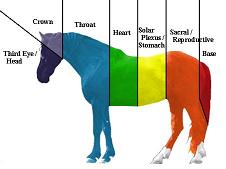
The seven major chakras of horses:
The first chakra is the"RED"root or base chakra.It is located at the beginning of the caudal vertebrae, (the first few bones of the tail bone). The root draws energy up from the earth and back, creating stability, grounding, support and survival instincts.
The second chakra is the "ORANGE" Sacral chakra. It is located between the dorsal part of the abdominal cavity and within the pelvic region. It corresponds to issues of taste/preference, sexuality, reproduction, and the emotional body.
The third chakra is the"YELLOW"Solar Plexus chakra. It is located at the stomach, incorporating some parts of the gastrointestinal (GI) tract and is associated with the energy assimilation center of the body.
The forth chakra is the"GREEN"Heart chakra. It is located at the chest. It incorporates the sternum and rib cage and is a sacred meeting place where the energies from the first three chakras feed up into the heart and energies from the higher three chakras feed down into it.
The fifth chakra is the"BLUE"Throat chakra. It is located at the throat. This is the gateway to the higher three chakras. It is concerned with communication, expression, and the higher spiritual realms of the universe.
The sixth chakra is the"INDIGO"Third Eye chakra. It is located between the eyes incorporating the frontal bones of the cranium on the forehead. The crown chakra is highly developed, because animals work on a higher vibration/frequency, and readily use their telepathic and psychic abilities.
The seventh chakra is the"VIOLET"Crown chakra. It is located at the top of the head. Here at crown the energy can be felt above the head. This energy center links the personality and soul of the animal with its higher self and with the source.
PLEASE NOTE:
Although Reiki can be perceived as alternative medical care, Reiki and massage are not substitutes for regular veterinary care. They should be complementary therapies used along with traditional medicine.
Back to Main Page.
Usui Reiki for HUMANS
The Tarot
Service Fees
Contact Me
Japan
Kuri's Links