
Southern Belize is comprised of the Maya Mountains. This area is a true tropical rain forest, rich with ferns, palms, and home to the Jaguar. The rainy season is from June to August with an annual rainfall of 170 inches.
The Maya Mountains Archaeological Project (MMAP) is discovering and documenting
ancient ruins occupied by the Maya in the Southern Maya Mts. Not only is the
MMAP an archaeological study, the geological and many biological aspects near
the ruins are surveyed.
The leader is Dr. Peter Dunham, from Cleveland State University. Each spring,
for the past few years, a team of archaeology and biology students, scientists,
and Maya guides spend 4-6 months in the jungle studying the area. Scientists
from many other institutions join the team, including the Smithsonian Institute.
The National Geographic Society has been filming the project and has plans for a documentary in the next year or so. We can only hope!!
More on Belize....
Maya Mystique Belize is blessed with an outstanding archaeological heritage of Maya temples and palaces. It is known that the Maya occupation began as early as 1500 B.C., and although it began its decline in 900 AD, some Maya cultural centers continued to be occupied until contact with the Spanish in the 1500's. Large Maya cultural centers no longer exist, there is still a significant Maya population residing within many small villages.
HISTORY
Columbus came near Belize,near the Gulf of Honduras,on this last voyage in
1502. Cortez traversed the Maya empire in 1524 with over a hundred soldiers
and three thousand Indians. They passed through a part of what is currently
Belize. The buccaneers, or international privateers, were thought to have been
the first to use the Belize coast for rest. The cayes served at refuges for
several infamous figures. In 1717 the pirate Blackbeard spent time in the waters
off Belize where it was said a chest was buried witha treasure on one caye.
Later, the pirate Jean Lafitte was pursued by the British throughout these cayes
The first true non-Indian settlement was in the mid-seventeenth century, when
British lumbermen arrived in the area to cut logwood trees. logwood gave the
most effective dyes known in Europe and was a major export item. Logwood requires
no cultivation and grew prolifically in the tropical climate. But by the late
eighteenth century, new methods of dying were developed and the export of mahogany
outstripped logwood in importance.
Belize became a British colony, called British Honduras. However, its boundaries
were never clearly defined and remain in dispute almost to this day. Guatemala
still does not officially recognize the right of Belize to exist and it its
not delineated on may of their maps. Although, during my last trip this past
October, 1999, while watching the news from Guatemala's in Belize I noticed
the map did not include Belize. Odd at the time because usually Belize is included
as part of Guatemala. There was a governmental election during my stay and maybe
times have changed due to that huge change in power.
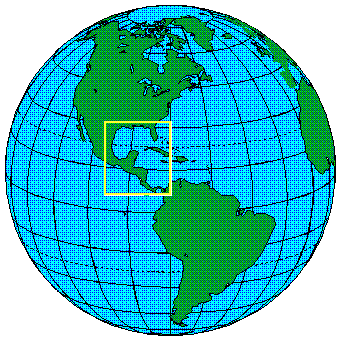
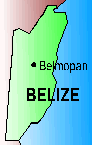 Belize,previously known as British Honduras,
lies on the east coast of Central America. It's neighbors are Mexico on the north,
Guatemala to the west and south, and the Caribbean Sea along it's east coast.
The northern half is a lowland plain that was once the bed of a sea. Scrub vegetation
and dense hardwood tropical forest make up the composition with an annual rainfall
of 50 inches.
Belize,previously known as British Honduras,
lies on the east coast of Central America. It's neighbors are Mexico on the north,
Guatemala to the west and south, and the Caribbean Sea along it's east coast.
The northern half is a lowland plain that was once the bed of a sea. Scrub vegetation
and dense hardwood tropical forest make up the composition with an annual rainfall
of 50 inches.
Ecotourism
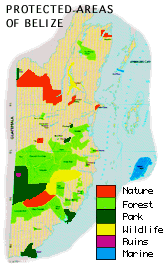 Belize's natural history has
always been its most precious resource, and therefore,it has become a paradise
for botanists,herpetologists, ichthyologists, mammalogists, ornithologist, and
zoologists. With numerous environmentally conscious organizations such as the
Audubon Society, the Smithsonian Institute, the World Wildlife Fund, and many
others, Belize has become an internationally recognized leader in preservation
and conservation.
Belize's natural history has
always been its most precious resource, and therefore,it has become a paradise
for botanists,herpetologists, ichthyologists, mammalogists, ornithologist, and
zoologists. With numerous environmentally conscious organizations such as the
Audubon Society, the Smithsonian Institute, the World Wildlife Fund, and many
others, Belize has become an internationally recognized leader in preservation
and conservation.
 Back
Back