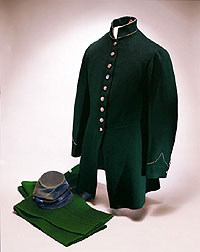
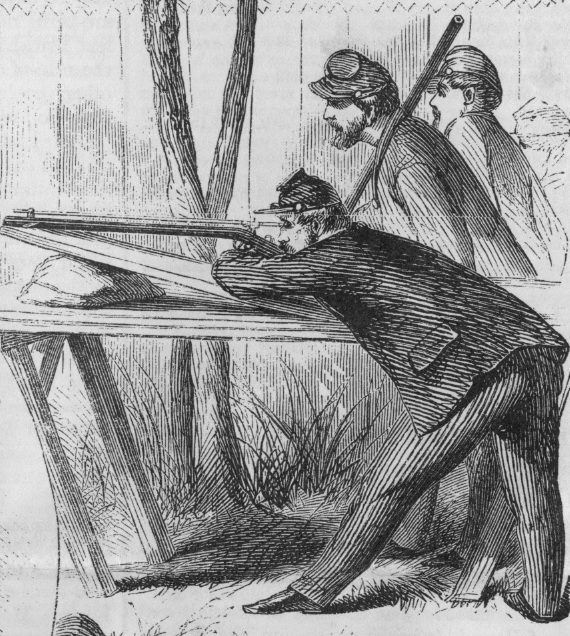
| � "What did They Wear?" Part 2 The Berdan Uniform Coat Revisited* (or 'Coats from A to Rifle-Green') By Bill Skillman As of this writing, I am aware of the existence of 3 surviving Berdan uniform or frock coats. One, the sealed pattern model, rests at the Smithsonian in Washington D.C. The other two belong to Don Troiani and William Hastings. The focus of this article will be to bring you up to speed on what we have learned about the Berdan uniform coat's origins and construction, so far. Mike Fahle, (author of The Best the Union could Muster), has been fortunate to examine an 'original' Berdan uniform coat, (that belonged to Willie B. Green, Co. G. 2d USSS), at the Mansfield Civil War shows the past two years. The coat's present owner is William Hastings who is the author of Letters from a Sharpshooter, (W. Green and family correspondence from 1861-1865). What immediately impressed Mike was that the color of the Hasting/Green coat was a substantially darker green compared to his reenacting uniform. In Mike's words, "it was almost black-green... it made my uniform look lime-green by comparison". The hue was also more muted (light absorbing) compared to the Woolrich wool used by Chris Sullivan and other sutlers who produce today's (reenacting) Berdan uniforms. Chris readily admits the discrepancy. He (and all other Berdan uniform sutlers) use a 'dark green', 20-22 oz., polyester/wool wrap known as 'melton wool', which is produced by Woolrich Woolen Mills. During Remembrance Day last year, he told me that he'd be happy to contact Woolrich and have them make all the authentic Berdan Coat wool we'd ever need "with all the bells and whistles" (correct weave, weight and color). All we would need to do is pony up "around $35,000 for a limited production run." As I was retrieving my lower jaw from the floor he grinned and shrugged his shoulders, "So far, I haven't had any takers!" Indeed. The very dark and rich green wool is known as "rifle-green" and has links to the uniforms worn by the Great Britain's 95th Rifles, (which evolved from the Experimental Rifle Corps developed by Sir Coote Mannington and William Stewart in 1803). The 95th served as skirmishers and sharpshooters as part of Wellington's Light Division during the Peninsula and Waterloo campaigns, (their exploits were revived by Bernard Cornwell's Sharpes books and TV series ). However, green uniforms were also worn by the Hanoverian (German), Tyrolian (Swiss), and even early American (62nd Royal Americans) marksmen. Mike and me share the opinion that the adoption of the rifle-green uniform by the Berdan Sharp Shooters was no coincidence. One only has to recall that the man believed to be the "soul" of the USSS was none other than Caspar Trepp, a Swiss �migr� and former British officer who saw service in the Crimean War. Trepp would have been familiar with English Rifle battalion tactics, (the 95th was deployed as skirmishers during the river crossing at Alma), not to mention the long history of military marksmanship in his native country. Marcot (1) mentions that in June of 1861, Caspar Trepp had written in a New York newspaper calling for the formation of a highly trained regiment of marksmen who would serve as skirmishers based upon the European example. Almost simultaneously, Hiram Berdan (one of New York City's prominent and wealthy inventors, as well as expert marksman) also had an article appear advocating for a "Corps of Riflemen" to offset the Confederacy's markmanship advantage. However, unlike Trepp's traditional employment of skirmishers, Berdan's concept would not become fully developed until the late 20th Century. Berdan's initial proposal had his sharpshooters mounted on horseback (and carrying scoped target rifles), so they could quickly move about the battlefield. They would locate targets of opportunity, dispatch them from a distance and be off before the survivors could mount a defense. The men's uniform would consist of a blue sack coats trimmed with black fringe, gray Russian twill trousers, and slouch hats. However, it was not until 1965, (with the training and deployment of the U.S. Marine scout-snipers in Vietnam), that this novel application of mobility (substituting helicopters for horses) and precision long range shooting was fully exploited--and with tremendous success. It is interesting to contemplate what sort of influence Hiram Berdan would have had on the evolution of modern warfare had he been allowed to realize his vision some 100 years earlier. Berdan eventually bowed to War Department pressures and shelved his initial proposal. The idea of soldiers operating in small teams while coolly 'murdering' an enemy at extreme distances clashed with military tradition and sensibilities of the times. So he adopted the European mode of dress (French style/British color) and skirmish tactics. But Berdan, ever the innovator, went one better by obtaining for his men the Sharps breech-loader (with set triggers to enhance long range hit potential). This gave them the advantage of rapid and accurate firepower, (by comparison the 95th's Baker rifles only fired 2 shots per minute, but they boasted "with each shot a dead Frenchman"). Casper Trepp, accepted Berdan as commander of the Sharp Shooters, probably realizing that only the native-born Berdan had the monetary and political connections, (not to mention willpower), to bring about the creation of these two remarkable regiments. Trepp became one of the first men to join the "Swiss/German" Company (A, 1st USSS), he later rose to become Lt. Colonel of the regiment and was killed at Mine Run in November 1863. But back to my story. Mike was feeling "a little bored with the Berdans" and went to his local library to peruse Don Troiani's Soldiers in America (from 1750-1865). He thought a brief stint as an 1812 soldier/living historian at nearby Fort Meigs would revitalize him. As Mike opened the Civil War section he expected to see Troiani's classic 2d USSS print. But instead, he discovered the famous Sgt. William Tilson coat (Co. F. 2d), and a whole treasure trove of new information on the coat's origins and construction. After a frantic three-hour phone call to me, I am privileged to share the results of his discovery with you. According to Troiani, the very first coats issued to the USSS companies assembled at Weehawken, New Jersey were made by Martin & Brother (of New York City). The coats were made of a very fine grade of wool and expertly tailored. The green wool was imported from Europe and Troiani reports "was probably a lighter weight than the material used in regulation uniforms." These coats were fondly recalled in both C.A. Stevens and R. Aschmanns' books. The buttons were made from black gutta-percha and described as "a small, round cylinder shaped something like a chocolate drop with a brass shank". However, the buttons (made by Thomas E. Carhart Co. of NYC) lacked the distinctive eagle that graced the brass infantry buttons. Troiani believes that the 'black eagle' buttons we use were actually purchased from the regimental sutler, they were not standard issue. Troiani reports that on April 10, 1862, the Quartermaster Department contacted the Philadelphia Depot to manufacture enough green uniforms to clothe both Sharpshooter regiments. But because the Depot did not have a supply of wool of that color they sent out bids to the civilian market. On April 21st Thomas Pilling & Co. from Newark, Delaware, (and owners of Elk Mills), submitted their proposal to deliver to the U.S. Depot of Army Clothing and Equipage at Philadelphia* "5250 yards wool dyed, fast color green kersey,*weighing 11 ounces per yard, all Army standard quality, at 79 cents per yard." For all the Berdan reenactors who have baked beneath a summer sun while wearing 22-ounce wool frock coats, this passage should come as a blockbuster! Not only were the original coats a lighter weight, but kersey (the same weave as the blue infantry trousers), tends to be a looser, diagonal weave- that is significantly cooler than the dense broadcloth dress coats issued to the infantry. Joseph Dean & Co. (of Newark) somehow scooped the uniform contract from under Pilling and delivered the green wool to the Philadelphia Depot on May 10th . The staff immediately began cutting, sewing and finishing the uniforms. Letters to Mr. Carhart requesting more special gutta-purcha buttons were sent out as well. I am uncertain of the type of construction techniques used by the Philadelphia Depot to assemble the coats. A study by Dr. Cunningham (2) of uniform coat assembly techniques ranged from being entirely hand sewn (Schuylkill, PA Arsenal), to a combination of machine and hand stitching, (Cincinnati, OH Arsenal). Mike hopes to find out the sewing technique used on Green's coat come the Mansfield show. (Subsequent research by Dan W. shows the USSS coats were hand-made for the Schuylkill Arsenal ) In a little more than two weeks the first lots of the second issue (but first U.S. Army produced) Berdan uniform coats began arriving at Fortress Monroe (May 29th 1862). In light of the problems associated with procuring and fielding the Sharps rifles for the USSS, the efficient service rendered by the U.S. Quarter Master and transportation departments is truly remarkable. Troiani notes that "from that moment on the Philadelphia Depot was able to maintain a steady supply of green coats and pants for the USSS ". However, he also noted that " the regiment was not always able to keep from mixing parts of the regulation blue uniforms with the much-preferred green. " By the Fall of 1864, a Washington Arsenal inventory showed 878 Berdan uniform coats still unissued. The Depot was then ordered to make new pants and caps to outfit the 203rd PA infantry. The new recruits were tapped with the dubious epithet "Birney's Sharp Shooters"- -though they were neither qualified nor trained for this purpose. Whatever thoughts the war-weary U.S. Sharp Shooters had when they saw these green troops (literally and figuratively) can only be imagined |
| The Search for the 'Rifle-Green' Fleece |
| Mike called me last September after a trip to "Amish Country" in southern Ohio. While there he struck up a conversation with the proprietor of a local woolen mill. Herr -- proudly showed Mike all the "upgrades" made to his establishment. With a sweeping arm he exclaimed, "all our looms are now from the 1860's". Now Mike's ears perked up. When he asked about wool samples, Herr-- directed him to some bins lining a wall. Mike discovered some bolts of the dark green ('Willie Green coat') wool and bought a couple yards worth. He then sent samples for my inspection. I took the samples with me to Gettysburg for Chris Sullivan and the N.Y. boys to examine. Roger T., Patrick K., and Ken K. all agreed that the color was "right in the ballpark", (they had seen the Tilson/Troiani coat on display at the West Point Museum). But when Tom Winter Sr. and Chris held it aloft to inspect the weave, both pronounced the wool to be too lightweight and too loosely woven to "survive the hard service you guys dish out in the field." Disappointed but not undaunted, I went to the museum to compare my samples with the USCT frock coat on display there. Same results-Mike's wool was not the dense broadcloth of the Infantry service. "We're close Mike, but no cigar", is what I reported back. Of course, in light of the new information provided by Troiani's article, all of us Berdan "experts" were proven dead wrong*. Remember: None of the Berdan uniforms were made from broadcloth! Dan Wambaugh heard that Don Troiani himself had examined one of the new wool samples and found it to be the best and closest (so far) to the original. So finally there is wool that is both the right color (rifle-green), weave (kersey), and weight (11oz), not to mention being made on machines from the exact same time period as the original coats. How many reenactors out there can make the same claim! The cost of the new wool is a jaw dropping $7.50/yd (compared to the $12-15/yd for Woolrich)! A coat will require roughly 3.5-4 yds of material. On February 12th, Mike sent me a "Hessville Depot Berdan Frock Coat" that was entirely hand-sewn by his wife Diane, (using an original pattern and my Sullivan frock coat as a guide). Dan's seamstress Jodi Nolan is currently sewing Dan a full uniform ( uniform coat/pants) from the new material. Conclusion, (for now): When the Y2K campaigns commence at least three of us Berdans will be outfitted in uniforms that are as close to the originals as can be made today. Mike, Dan and I will be putting the new coats through "field trials" to see how they perform under actual use. * Tom Sr. and Chris S. might be right on the mark with their analysis of the wool's light weight and weave. The durability of our "authentic" uniforms when exposed to actual "field trials" might provide us with some very useful information. Most importantly, does the coat's durability/or lack of durability, lend support for the issuance (and perhaps preference) of the standard blue blouse/sack coat to the Berdan Sharp Shooters in 1863-1864 (see Part 1 of "What did they Wear?"). Wool Update (June 5, 2000). Mike Fahle informed me that the wool mill he purchased the Rifle Green wool from has filed for bankrupcy. He saved the few remaining bolts of green wool and is now negotiating with a neighboring mill to see if they will produce more. As a number of Berdan reenactor's have expressed an interest in procuring this remarkable wool kersey, we will keep you updated through this website (WES) Sources: Marcot, R. Hiram Berdan, Chief of the Sharpshooters. Cunningham, M. "Evaluating Reproduction Federal Enlisted Men's Frock Coats". Watchdog Vol 2 No. 4 pages 2-3. Troiani, D. Don Troiani's Soldiers in America, 1750-1865. Hastings, Wm. Letters from a Sharpshooter. Fahle, M. The Best the Union could Muster. |
|
|
|
|
 |
 |
 |
 |
 |
 |
 |
 |
|
|
 |
 |