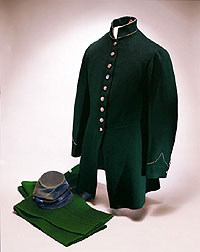
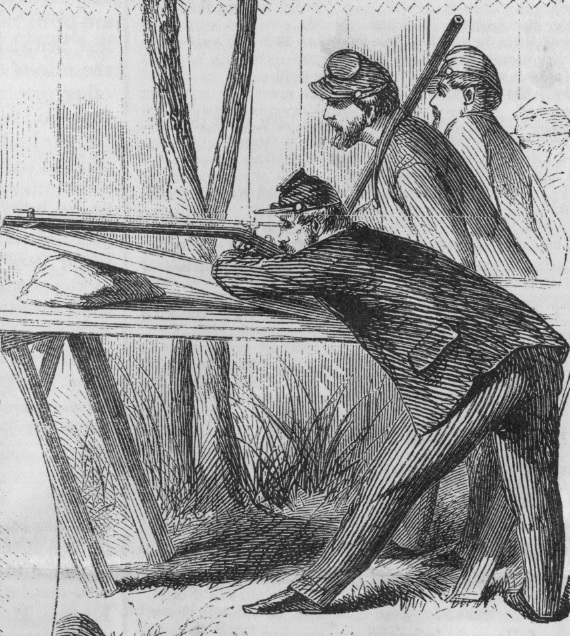
| � "What did They Wear?" Part 1. The Green-Coats? By Bill Skillman One of the recurring puzzles to reenactors and historians is what sort of uniform did the Berdan Sharp Shooters wear during the Civil War? First, let us review of the literature written by the original volunteers. Literature Review C.A. Stevens (1) wrote, "the uniform was made of a very fine material.. and consisting of green caps, coats and pants". Wyman White (2) noted wearing a green frock coat when reviewed by President Lincoln in the Spring of 1863. Even (the infamous USSS slacker), Willy Green (3), wrote of drawing a green (officers ?) uniform coat in November, 1864. So far so good, but now comes the confusing part. Rudolf Aschmann, (4), a Swiss �migr�, wrote "for lesser tenue both officers and men wore a blue flannel blouse". William Ripley (5) reported green blouses being issued! Then Wyman White noted "a bullet ..tore quite an opening in my blouse" during the Wilderness. If the original Sharpshooter's recollections are so contradictory how can we hope to answer this question after 135 years have elapsed? Photographic Evidence A promising source for what the USSS wore is by examining documented photographs. These can be found in books, public and private collections, even the Web, (Lt. Tilson photos -www.vermontcivil war. website). But are these men all Berdan Sharpshooters? First some background. The newly enlisted Billy Yank, after spiffing up in his new uniform, would have a photo taken by a "collodian artist" to send to the folks back home. I have examined literally hundreds of photos of men wearing the 'Regulation' 9-button uniform coats, but due to the black and white format it is impossible to determine if the coat's color is indigo blue or rifle green. If we don't have a traceable name and/or "USSS" on the back of the CDV, what do we do? A bulk of the documented photos are due to other uniform or accoutrement characteristics that were unique to the USSS. Some, like Chauncey Maltby (Co. B, 2d USSS), wear the distinctive calf hair pack (with gray overcoat rolled on top), feathered cap, and hold either a Colt revolving rifle or NM1859 Sharps with set triggers, (or rarely, a muzzle-loading target rifle). However, there are "suspected" U.S. Sharp Shooters whose identity is based upon by the presence of a set trigger (NM1859) Sharps. While the dst Sharps was the Berdan rifle a few very lucky units, like the Pennsylvania Bucktails, obtained up to 150 of these rifles for their own use. Equally vexing is these photos show some men sporting slouch hats or even cavalry boots. Are these one of the infamous USSS "slouches and slovens" or a man from an entirely unrelated unit? Quarter Master Records The third, and in my opinion, the best solution to our question is to scrutinize the original Quarter Master records. But first a little back ground. The Quartermaster represented one branch of supply (Ordnance and Commissary, the others) for the U.S. Army. They were responsible for drawing clothing from U.S. Arsenal stores and then issuing them to regimental Q.M.'s, (who in turn issued clothing to the respective companies). Army Regulations specified how many articles of clothing a soldier could draw during each year of their term of service. Each soldier had a 'clothing allowance' and if they drew more than their allotment for that year the cost of the over-drawn items was deducted from their wages. However, if the soldier drew fewer clothes he would get a monetary "bonus" added to his year-end pay. Every quarter, when clothing was to be issued to the enlisted men and non-commissioned officers, the Captain or his clerk would carefully document on a specified form the name of the soldier, the type (cap, socks, etc), quantity, and occasionally, the color of the item, issued. On August 12, 1999 I visited the William Clements Library at the University of Michigan to investigate the papers belonging to Captain Charles Merriman, (Co. F 1st USSS). His records cover all clothing and equipment issued from May 1863 to September 1864 (plus 4 undated QM papers). So back to my original question: What did they wear? I was stunned at what I discovered. Uniform (read frock) Coats-Green: 1 Blouses/Sack Coats: 38 Only 1 green frock coat issued in 17 months ! There was no way the uniform coats issued to the Sharp Shooters in 1862 could have remained serviceable after the hard campaigns of the Peninsula through Fredricksburg, let alone survived Chancellorsville through Petersburg. I checked the Muster & Pay Rolls for Captain Merriman's appraisal of the company's readiness: "Appearance-Good, Training-Good, "Weapons-Good, Accoutrements-Good and Uniforms-Tolerable Okay, so the Green Mountain boys weren't naked. But sack coats? It's a reenacting Berdan's nightmare! We'll look just like the, ugh , infantry! Let's dig some more. Steven's mentions that in the fall of 1863; "a large quantity of green clothing, previously turned in, was issued". This suggests that the uniform coats were not NEW issues, (which squares with Captain Merriman's records). But even more interesting, it would appear that just like today's military, the USSS turned in unnecessary uniforms and baggage for storage prior to being deployed into a combat zone. Did this practice date back to Civil War? Yes, Wilbur Fisk (6) wrote during the spring of 1863 and 1864, "Our division was ordered to turn in our dress uniforms and unnecessary equipment*to be stored". John Carey waded through the USSS Regimental records at the Library of Congress and uncovered a written notice by Lt. Col. Trepp dated April 1863 ordering; "the uniform coat will not to be worn when on fatigue duty*men will wear the blouse". Let's look at regulations for a minute. "Fatigue" refers to rough fieldwork, policing the ground around camp, digging trenches & sinks, but also active campaigning. The dress uniform was typically reserved for official regimental functions like reviews, parades, etc. While there exists accounts of the 24th Mich Infantry, and others going into battle wearing dress uniforms, this would have been the exception and not the rule for the majority of U.S. military units during the Civil War. Then there is a reference by Major Mattocks (8) viewing a USSS skirmish drill: "you would be much amused at the sight of my green breeches scrambling over the ground like so many mice". Mattocks was such a stickler on military matters that I can't see him using this phrase unless his men were not wearing green coats! So what can we conclude so far? 1) There were no NEW issues of the Berdan Rifle-Green uniform coats after May 1863 in the Vermont Company. 2) Green uniform coats were turned in, stored and then reissued during the winter months, (the heavier dress coat when combined with the overcoat would be appreciated during the cold weather). 3) Sharp Shooters scavenged to find the "best fit" among the re-issued uniforms after the prior owners had become casualties or were discharged (9). Others sent their dress coats home before discharge (10). 4) Photographs, (circa 1863-4) show USSS dressed in sack coats/blouses, ("the Bummers of Co. B." (1). This is further supported by Co. F. and Regimental QM records. 5) Engravings of existing newspapers, (Harper's Weekly of April & July 1862 "Berdan's Sharpshooters before Yorktown" and "at Malvern Hill") shows the men attired in sack coats/blouses. Artistic license or reality? 6) Curtiss Pool showed me an 1864 letter by Major Mattocks requesting a "Field Officers" court-martial hearing as some enlisted men had refused new green coats as they had already drawn blue blouses. Mattocks noted the men cited their clothing accounts would be overdrawn if they accepted the (unnecessary) coats. Okay, if the research supports that the Vermont USSS wore blouses during the 1863-64 campaigns, what color were they? John Carey's research shows that all the 1st USSS companies were issued the blue blouse/sack coat. There is no evidence of green blouses ever being made and issued to the USSS, (a few could have been produced through private tailors for NCO's or officers). Based upon the number of Sharps rifles in the hands of Co. F. in 1864 (47), the 38 blouses still falls short for the total number of men present. Is it possible that some continued to wear the green uniform coat? Some tantalizing evidence comes from campaign photos of the 6th Maine, and 1st Pennsylvania Reserves. Close inspection shows both officers and NCO's wearing uniform coats, while the enlisted men wear blouses. However, before we jump to conclusions, I will need to return to Ann Arbor to cross-reference non-com's names to the QM rolls. Or is anybody else intrigued and want to go for me? Conclusion, (for now) There is compelling evidence that a majority of enlisted men in the Vermont USSS wore sack coats/blouses during the late 1863-1864 campaigns. How does this new information effect us as reenactors? Since 1995, the Michigan USSS have proudly worn the green uniform on the 'battlefield' at local, regional and National events. This was to both honor our unique regiment, but more importantly to distinguish us as skirmishers and sharpshooters to uneducated Union commanders. It has come to pass that battalion and brigade level officers now fully appreciate our special talents and are eager to cast us "up the road" to see what sort of "muss" we "kick up". Therefore, I believe those Co. B. members who wish to accurately portray the original volunteers during the late War period can incorporate the blue flannel sack coat/blouses into their impressions. I welcome your thoughts and comments-W.E.S. Merriman's records cover May 1863 to muster out September 1864. Unlined sack coats issuance: Nov 63=3, Jan-Mar 64=15, Apr-June=14, July-Sept=10. Total=42 Undated= 9 (probably issued prior to November 1863). References: 1) Stevens, C.A. Berdan's United States Sharpshooters in the Army of the Potomac (1893) 2) White Wyman The Civil War Diary of Wyman White, Company F. 2nd U.S. Sharpshooters. 3) Hastings, Wm. Letters from a Sharpshooter, the Diary of Willie B. Green 4) Aschmann, R. Memoirs of a Swiss Officer in the American Civil War. 5) Ripley, Wm. Vermont Riflemen in the Civil War 1861-1865. 6) Fisk, Wilber. Hard Marching Every Day. 7) Sword, Wiley. Hiram Berdan, his Famous Sharpshooters, and their Sharps Rifles. 8) Mattocks, Chas. Unspoiled Heart, the Letters of Charles P. Mattocks. 9) Mead, C. "The 1863 Charles Mead Diaries" Rutland Vermont Historical Quarterly (1998) 10) Cobb, Frank. Civil War Letters 1861-1864 |
|
|
 |
 |
 |
 |
 |
 |
 |
 |
 |