<%@ Language=JavaScript %> rcc cricket


Riverside Tigers


  Home
  About Riverside CC
  President Message
  Executive Committee
  Players Profile
  Fixtures 2000
  Latest Results
  Constitution

  Directions
  Photo Gallery
  FunnBoy Report
  Judge Moka Court
  Events 2000
  Sign Our Guest Book
  Send E Mail
  Great Links


Cricket Signals 

Find the tools of the game and signals.  


.Did you know ? 

The Equipments and Game Signals

   
The Ball  The ball is hard, made of cork and string, and covered with leather. The leather covering is joined in two hemispheres. The seam is thus like an equator, and the stitching is raised slightly. The circumference is between 22.4 and 22.9 cms (8.81 to 9.00 inches), and the ball weighs between 156 and 163 grams (5.5 to 5.75 ounces). Traditionally the ball is dyed red, with the stitching left white. 
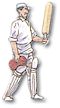
The Bat   The blade is made of willow, flat on one side, humped on the other for strength, attached to a sturdy cane handle. The blade has a maximum width of 108 millimetres (4.25 inches) and the whole bat has a maximum length of 965 millimetres (38 inches).
Stumps Stumps Three wooden posts, 25 millimetres (1 inch) in diameter and 813 millimetres (32 inches) high. They have spikes extending from their bottom end and are hammered into the ground in an evenly spaced row, with the outside edges of the outermost stumps 22.86 cms (9 inches) apart - close enough together that a cricket ball cannot pass between them. 
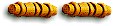
Bails 
cbails.jpg (2431 bytes)
The bails are two wooden crosspieces which sit in grooves on the top of adjacent pairs of stumps. Each bail is 11.1 cms in length.
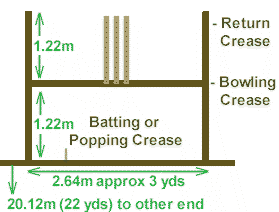
  Pitch Diagram Diagram of the crease     
Umpires' Signals 
Dickie Bird
Umpires gestures to the scorers, players and spectators on the following events:
Out Out When a batsman is out, the umpire making the decision raises one hand above his head, with the index finger extended. 
Not Out  This is a trick question! There is no formal signal to indicate that a batsman is not out. The umpire can either shake his head `no' or not signal at all. 
Four runsFour A four scored by the ball reaching the boundary is signalled by an arm extended horizontally and waved briefly back and forth in a horizontal arc. 
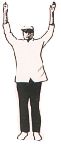
Six runs 


A six is signalled by raising both arms straight over the head. SIX !!
No Ball 
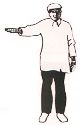
No ball
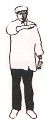
A no ball is signalled by holding an arm out horizontally. 
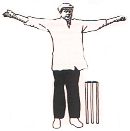
Wide  A wide is signalled by holding both arms out horizontally. Wide
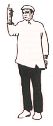
Byes  Runs scored as byes are signalled by raising one arm over the head, palm open. 
Leg Byes Leg byes are signalled by raising one leg and tapping the knee with one hand. 
Dead Ball 
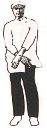
Dead ball
If the umpire has to signal dead ball to prevent the players from assuming that the ball is still alive, he waves both arms across each other in front of his abdomen.
One Short 
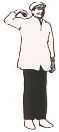
One short
One short is signalled by touching the tip of one hand to the same shoulder.
TV Replay 
TV Replay
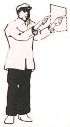
If an umpire wishes the third umpire to make a decision based on a TV replay, he signals by drawing a large square shape in the air with both hands, spreading them out high in the air in front of him, bringing them down, and then together again. 

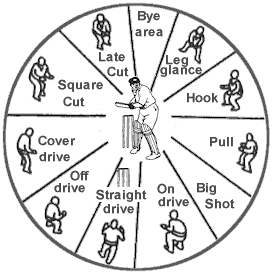
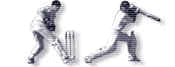
Playing shots

The Different Playing Shots 


 Riverside Extreme Action big6

        [Ct cricket league]    [CricInfo]    [SkySports]    [Tendulkar[     [SinghSport]

Say Yes! 

  © 2000 — 2001 Funnboy Sports. Yeah Baby!                     

  Webmaster Agent Funnboy
Hosted by www.Geocities.ws

1