The GE Superradio Tech Page
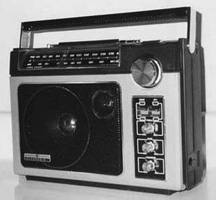
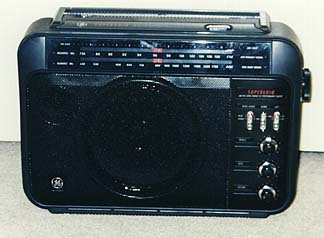
This page is designed to give you quick, accurate technical information about the GE Superradio series of radios. I acknowledge the contributions and content on other Superradio pages - I quickly realized there was a need for a quick "how-to" reference for hobbyists who didn't want to dig. I personally own a 2 and a 3, but not a "1" or the casette version, so I cannot speak definitively about either of them. I have access to the manual for the Superradio 1, however, and have used it to compare with the "2". The casette version supposedly has the Superradio circuitry in the radio portion.
The original Superradio 1 manual is dated January 1979. This may not be the origin of the superradio idea, however. While there had been many "tuned RF" AM portable radios in the 1960's primarily from Radio Shack and RCA, there were no units on the market at the time that combined both a quality AM and a quality FM section. Given the rising popularity of the FM band, it was almost inevitable that somebody would make a unit with tuned RF on both bands. I own a Montgomery Ward radio from the 1960's that has many of the characteristics of the Superradio series. While there has been a population shift from rural to urban among the population, it could well be that GE and other manufacturers saw an opportunity to tap into the remaining rural market with a radio capable of receiving stations from nearby cities. The recent movement of "rim shot" stations into urban markets has only served to increase demand among rural listeners whose stations have been abandoning their area for the lure of the city - much as individuals do. Individuals who remain in rural areas by choice, or who cannot move to the city for whatever reason become skilled DX'ers, and the GE Superradios sell briskly to these disenfranchised listeners. The GE Superradio also is the radio of choice for the incarcerated - prisons are often purposely located in rural areas for security reasons. I welcome incarcerated readers to this page, although I recognize that your ability to use tools and solder may be limited for security reasons.
For technical information on your particular model, click on its image above, or on the title headings below.
The GE Superradio 1 and 2 are very similar. As I stated above, the release date for the manual was January 1979. Both the AM and the FM sections contain one tuned (and amplified) RF stage, making the tuning capacitor six sections. The AM section contains four IF stages, and the FM has three IF stages and one FM ceramic filter - making this one of the first portable radios to contain a ceramic filter. It also uses an unidentified IC to perform several functions of the radio, including AM oscillator, AM/FM mixing, some of the AM/FM IF amplification, AM/FM detection, and the audio output. This IC is used throughout the Superradio series.
The most noticable difference between the Superradio 1 and 2 is the addition of a tweeter for high frequency sound reproduction, and the inclusion of connections for external AM and FM antennas. No doubt market research showed that both additions were wanted by users.
After a review of the schematics, I have found a number of component value changes between it and the "2". The printed circuit board was also redesigned between the "1" and "2" to put components on 90 degree angles for automated assembly. In the process, the "main" board was enlarged about 3/4 of an inch to the left, as you look inside the case of the radio.
I believe that there is no manual for the "2" - the information is included in the manaul for the "1" as "design changes" appended to the rear of it.
As of this writing, the Superradio 3 is the most current version of the GE Superradio series. It was a complete mechanical redesign of the housing, and several circuitry changes were made as well. Some people, including myself, think that the housing of the "3" is a bit more flimsy than that of the 2. I also think that the "2" sounds better, and has better FM reception. Design changes include:
Make no mistake, the "3" is nothing more than a derivation of the "1" and "2" designs. The schematic shows many common topologies - modified to accomodate the varactors and bandwidth switch on AM - but the circuit architecture of the "3" hhas otherwise changed very little. The reference designators on the schematic and PC board have changed, but their locations, functions, and sometimes even values are the same as the "2".
As nice as they are, GE Superradios can't be all things to all people.
I have received many inquiries about the Radio Shack Optimus models 12-603 and 12-903. Many people have claimed that they are nothing other than repackaged GE's. This is not true. Both are fine radios, but they are complete redesigns that cost reduce the GE. Consequently, the performance is not as good. I own one, and have analyzed it at the link above.
I hear that Thompson has acquired the GE Superradio line. They don't support it well, at least as far as manuals are concerned. I do not know if there is a Superradio 4 in works, or whether it will contain digital readout / IBOC, etc. Ask Thompson. I also do not know if the "3" has been discontinued - they seem to be available at Amazon.com, Sears, Frys, and other retailers. Since they fill a niche that other radios don't, and continue to sell, I assume they will continue to be available. After that, they will probably be on EBay for a long time to come, gradually increasing their value.