|
Increasingly students are placed in alternative programs due to their failure to succeed in mainstream settings. In reviewing the literature much of the recent documentation examines the effectiveness of these programs with the disenchanted, at-risk and disengaged students referred to them. However, the continuity of other models for alternative schools that reflect the community based/individualised learning environment of the past must be acknowledged. There is a definite distinction which must therefore be recognised. Two functions or settings for alternative education can be identified: 1. The provision of an alternative learning environment to provide values, curriculum and teaching styles that reflect the values and ideologies of individual groups and/or communities. The include approaches such as Montessori Schools, community schools, private religious schools as well as programs in mainstream education such as gifted & talented programs, fine arts programs. 2. For students who have demonstrated an 'unsuitability' for mainstream education, alternative education programs have been created to provide further possibilities for these students to complete their education and become better able to make a positive contribution to the communities in which they live. A range of characteristics can be used to describe these students:
Alternative Education - A Recent Historical Perspective Throughout the last twenty years the search for alternatives in the education of at-risk students has remained a constant priority. Boss (1998) comments that according to the public agenda, 88 percent of teachers nationwide (USA) believe academic achievement would improve substantially if persistent troublemakers were simply removed from class. Surveys, interviews and discussions about school problems with teachers in any public secondary school in Australia and the USA have invariably placed the issue of disruptive students as a high priority of concern. The cost of disruptive behaviour has also been well documented. The American Federation of Teachers has estimated that for the [$1750] additional dollars spent on each [disruptive ] students attending an alternative school, the public annually gains $14,000 in student learning time that would have been lost, $2,800 in reduced grade repetition costs, $1750 in reduced welfare costs, and $1500 in reduced prison costs. This is a total savings of $18,000 per student. The association between disruptive school behaviour and juvenile justice issues is also clear. Gottfredson, Sealock & Kroker (1996), Catalano & Miller (1992), Howell, Krisberg, Wilson & Hawkins (1995) have found that many of the precursors of delinquent behaviour are school-related. School related experiences and attitudes which often precede delinquency include:
With the introduction of the Individuals with Disabilities Education Act (IDEA) in 1975 all districts in the USA were mandated by Federal Law to provide comparable educational opportunities for every student identified with special needs. This has guaranteed that the continual search for alternative programs which meet the individual needs of students. With this increasing emphasis over time to provide alternatives for students failing to success in the mainstream school system, there has developed and been implemented a variety of models to deliver alternative education. Morley (1995) identifies several common types of alternative schools
developed:
Throughout this twenty to thirty year process in the development of alternative programs for disruptive students the characteristics of the students referred to these programs has changed. Initially, in the 1960s the resurgence in alternative education introduced unmotivated students engaged in the process of education into an alternative learning environment where motivation could be rekindled and their education goals goals fulfilled. More recently, students are unmotivated and disengaged from the learning process. Unable to just dropout or find jobs, they remain in the broader education system and come with many labels attached such as Attention Deficit Hyperactivity Disordered (ADHD), Depressed, Schizophrenic, Emotionally Disturbed, Conduct Disordered, Oppositional, Passive/aggressive . . . . . . . . This marked change in the attitude of students to formalised education
has created the need for alternative programs to further develop their
strategies and programs to incorporate the need to re-engage these students.
It is therefore the aim of this study to look at strategies that can work
to re-engage students who lack commitment and a personal investment in
learning. Research into the area of alternative education has not
been extensive in the past, and as this study looks at the present with
a view to the future, it is necessary to broaden the area on inquiry to
include studies done in other areas such as dealing with substance dependency
and resiliency. Therefore, throughout this study there will be a
coalescence of two areas - alternative education and dealing with substance
dependency based upon stage based change.
Definitions Alternative Education While the types of programs represented within alternative education have been outlined it is necessary to provide a broader definition and understanding of what ‘alternative education’ means. Morley provides a general definition of alternative education as:
While this definition provides an ‘umbrella’ to cover all forms of alternative education, further clarification can be made. Raywid (1990), identities from thirty years of research, three underlying philosophies that are encompassed in Morley’s definition:
The definitions outlined give an overview to clarify what an alternative
education perspective might look like. However, given the broad scope
within this perspective of the form programs take, an examination of the
evaluation of programs which encompass this perspective may form a clearer
picture of programs.
Alternative Education Under the Microscope Evaluations of alternative education programs, while regularly completed have not general lent themselves to quantitative comparison. In comparison, mainstream education, though the imposition of consistent, predetermined content and the testing of outcomes can be viewed through the microscope and quantitative record. To use an analogy, alternative education is largely in the area of quantum physics - prone to random outbursts of inconsistent activity, which resist delineation through quantitative representation. Comparisons between alternative education and mainstream education are difficult to make due to the differing philosophies underlying each approach and the diversity of students involved in each learning environment. Many of the students in alternative education are the ‘failures' of the mainstream system and the factors influencing this failure are often beyond the school. Therefore, much of the work on alternative schools explores their organisational arrangements and process - providing a blueprint for others to follow and an understanding of the approach used, rather than describing the outcomes for students (Raywid 1994b). Evaluations of alternative education have relied on a number of approaches to generate information that can be utilised to provide an assessment of successful programs:
Characteristics of Successful Programs Through the research outlined by the above studies several characteristics can be identified that are components of successful alternative education programs. The most widely reported are:
From the research available there have also been identified a set of characteristics common to unsuccessful programs. Raywid(1990) found alternative discipline programs had little success and therapeutic programs while having some positive results initially, the students involved regressed when placed back in mainstream settings. Morley outlines further ‘alternatives for failure’:
With an expanded definition of alternative education presented through the outline of these characteristics of successful and unsuccessful programs, a return to the historical development of alternative adventure and the situation facing many alternative education programs in the 2000s will introduce the consideration of a model for stage based change. Much of the literature (Morley, Raywid, Oklahoma Technical Assistance Center, Barr and Parrett) focuses on the importance of the perceptions and underlying philosophies of programs. In examining the perceptions within public education in Australia and the USA, there is an overwhelming emphasis on alternative education as a solution to the problems causes by disruptive students, and the concern of communities for the poor retention rates of students that completed a full twelve years of secondary education. Therefore, as mentioned earlier, it is important to review the characteristics defined by past research and make a considered assessment of the implications present philosophies impose on these findings. While many of the characteristics are relevant for the development of alternative programs for disruptive and unmotivated students, there is a clear focus needed to ensure that alternative education programs provide successful learning environments into the future. To assist with this focus, consideration of the Model of Stage Based Change developed by Prochaska, Norcross and Diclemente (1984) is necessary. Stage Based Change Originating in the area of substance abuse and research into the ways addictions come be overcome, the Model of Stage Based Change in unique in several ways (Westermeyer). 1. It is empirically driven and based on the researchers scientific investigation of change in humans.The model was the result of a search for the common components of the major therapies. Prochaska et al, made a 'cross-cultural' study of the different schools of psychology, in the hope of finding a way to integrate them. Extensive data was gather about how each therapy actually helped people to change. Finally, this was organised into a representation that provided an accurate description of the underlying process of change common to these therapies. In the model developed, Prochaska et al describe six stages of attitude and contend that it is quite normal for individuals to require several trips through the stages before making a lasting change. The six stages are:
Contemplation: There a glimmer of recognition that a problem exists for the individual. While seeing that they have a problem they are still unwilling or unable to act to make the situation different. A contemplative student will see that they need to maintain their education. They are realistic and willing to consider that their anger, inattention, emotional instability . . . . , is causing a problem for them but they are unwilling to work at developing the skills to overcome these attributes. Determination/preparation: This is the planning stage when intentions are clearly articulated and the actions needed to follow through are worked out. For students it involves engaging in a relationship with a teacher, counselor, administrator or other support person, and learning the skills underlying any change in ways to deal with anger, impulsiveness, emotional instability . . . that have been a feature of their attitudes and behavior in the past. They will also examine the difficulties they will have to overcome to make this change. Action: Change occurs as plans and skills are put into action. Students are motivated to follow rehearsed skills and deal with situations with thoughtful, considered actions. Difficulties are met with perseverance. Rather than becoming caught in the negatives and generalisations of old patterns in attitude and behaviour, they use their strength, personal insight and skills to remove long standing barriers to change. Maintenance: Skills are practised until they become automatic. Students find positive actions more natural and a positive response from teachers, peers and parents reinforces the changes made. Moments of doubt and uncertainty are dealt with and momentarily lapses are corrected skillfully and quickly. Relapse: While changes occur they don't always last or remain unchallenged by failure. This stage allows for individuals to move back through the spiral or cycle. This Model of Stage Based Change provides a significant insight in the review of alternative education practices into the future as it focuses on the motivation and commitment of the individual. Going back once again to the historical perspective, the struggle for the 1990s in general education has been to develop programs that engage those students on the margins of the education system. While ethnicity and gender have been partially addressed within the curriculum and structure of mainstream schools, disruptive behaviour and emotional problems have remained a continuing challenge. Many alternative education programs have worked on developing models of cognitive behaviour modification, which Gottfredson (1997) identifies as highly effective in the prevention of crime with students who are engaged in continuing programs within schools. These students working at the Determination/preparation or Action stages respond positively to the strong relationship and clear skills that characterize this approach. However, students at the Precontemplative or Contemplative stages are not interested in a system of feedback and modification. As a result they are removed from programs and wait in the margins for further alternatives to be developed that address the needs of students at these early stages of change. Precontemplative Possibilities In 1989, the NSW Department of School Education in Australia recognised the need to develop an alternative approach for those students on long-term suspension or exclusion from school. After an extensive literature search for a program that could 'turn around' students with entrenched attitudes and behaviours - and no motivation to change, the Wilderness Enhanced Program was developed. This approach (Handley 1993, Brand & Smith 1999 , Stolz 1997) utilised intense wilderness experiences within a general systems framework that provided a continuing program of support to students, parents and schools over two years. While providing successful outcomes in changing the attitudes of the student (Handley 1990, Rudzats 1990), this approach failed to provide an extensive enough program to incorporate all the stages of change outlined. The Wilderness Enhanced Program shared many of the characteristics of a successful alternative education programs - autonomy, important relationships, focus on the whole student, community/school links, small size. counseling support, however it was unable to provide a structure for students to maintain a long term commitment to personal change. Students moved through the Precontemplative to the Contemplative and Determination/preparation stages of change successfully within the program but were thwarted at the Action and Maintenance stages by the unsupportive learning environment of mainstream schools. Conversely, the Regional Educational Alternative Learning (REAL) School in Maine, USA developed as a truly alternative learning environment for students who were motivated to learn but were disengaged from the learning opportunities offered by mainstream schools. Throughout the 1990s the characteristics of the students referred to the school gradually changed. In 1988, 5% of students were identified with special needs. In 2000, 91% of students at the school were considered to have special needs - most in the area of behaviour problems or emotional disturbance (Handley 2000). Demands increased to cater for the needs of these students, who were often unmotivated to learn and disengaged from the education process. However, many of these students at the Precontemplative and Contemplative stages of change failed to move themselves into an Action stage where they could take advantage of the experiential education programs, integrated curriculum, long term program, strong student/teacher relationships and small class size offered by the school. The school offered broad options for students at the latter stages of change but struggled to engage students who had failed to make the changes in the earlier stages which were necessary to allow them to take these opportunities. Implications for the Future For alternative education to develop successful characteristics that meet the needs of the future the integration of a Model of Stage Based change is crucial to the planning process. As placements continue to be required for 'dangerous', disturbed, disruptive and disengaged students programs must become responsive to the stage students have reached in the process of change. Therefore, in the consideration of the individual needs of the students two areas must be placed side-by-side in the referral and planning process. These are:
Table 1: Stages of Change vs Characteristics of Successful Programs 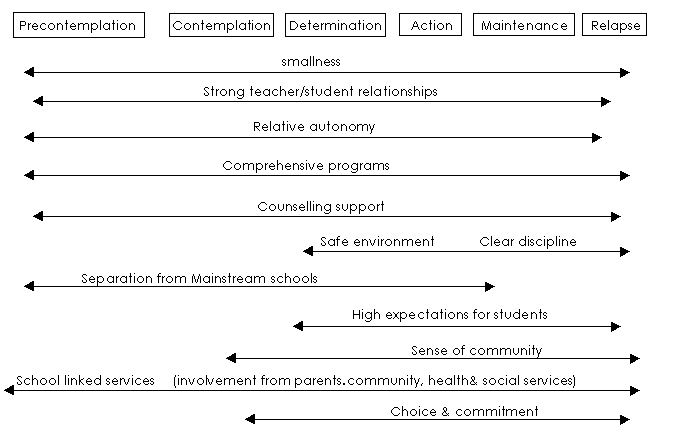 Programs can work towards greater chances of success if they can develop the characteristics appropriate to the needs of their students. Generally students enter and relapse at all the stages in the program some time so there is a strong indication that successful programs of the future will have to encompass all the stages of change within the characteristics of their program. If programs consider only students in the latter stages of change there are marked implications. In the political and educational environment of the 2000s within public education, a narrowing of the criteria for acceptance into programs seriously brings into question the viability of these programs to compete for the limited funds available for alternative public education. Within the 2000s are variety of program styles can be identified. The list of programs is by no means all-inclusive. However, it provides a comprehensive guide to the options most commonly chosen by school districts in the USA and Australia.
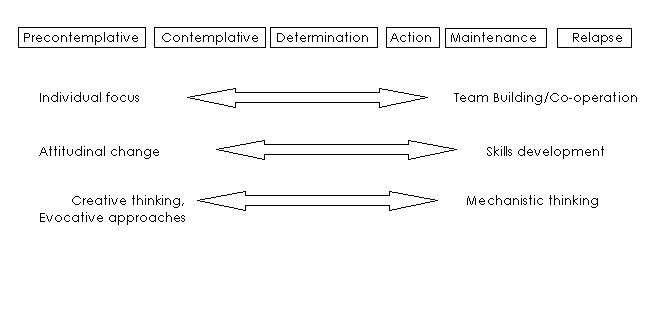
Table 2: 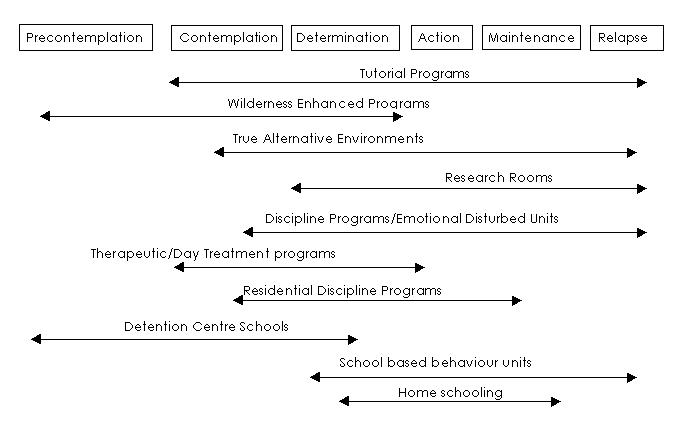 Using the Stage Based Change Model still further it is possible to break down the characteristic of programs. Moving beyond underlying structure and program characteristics, the interactional dynamics at each stage of the change model can be represented to include whether programs are most effectively presented individually, in small groups or in class groups. The interactional style can also be mapped from evocative styles such as open forums and reflective time to skills and team building. Table 3 illustrates the different interactional characteristics against the Stages of Change cycle. Table 3:
From this table several approaches are represented: The level of individualisation. This refers to the primary work group. At the precontemplative stage students require one-on-one or very small group interaction. At later stages group dynamics and team building structures can be considered. Comprehensive programming focuses on attitudinal change, personal reflection and information at the precontemplative and contemplative stages of change. Miller and Rollnick (1991) state that what frequently jars most people into the next stage is convincing, personally and timely information - not coercion or advice. At the later stages skills development, role rehearsal, mentoring and advice can be used. Creative, evocative and flexible approaches to interaction that
do not externally challenge students to change are required at the earlier
stages of the change cycle. Such approaches are characterised by
an ability to create an internal tension or dissonance for indiviiduals
that necessitates decisions and action. They provoke questions of
choice and a curiosity to consider possibilities. As change is accepted
and action taken interaction can be more mechanistic and question/answer
based, as ideas are bounced around and plans made.
Conclusion For alternative education programs to provide both the means to re-engage students and the ability to move them through the precontemplative, contemplative and determination stages of change, into a readiness to develop the skills and take the opportunities to participate successfully in society, alternative education programs must rely on:
Alternative education has become much more that a different school structure
and program. It has moved to the cutting edge between education and
therapy. To provide effective programs alternative educators must search
the complexity of educational and psychological theory for the simple solutions
that can be used daily to work with difficult students. The Stage
Based Model of Change provides an effective tool for this demystification
and builds on the great depth of work in alternative education over the
last thirty years. The intention of this paper has been to assist
planners and practitioners in developing a perspective that merges these
two areas as they establish effective alternative education programs into
the future.
References:
Aronson, S.R. 1995 Alternative Learning Environments: (Insights on Education Policy, Practice, and Research, Number 6). Southwest Educational Development Laboratory, Texas Avrich, P. 1980 The Modern School Movement. Princeton, NJ Princeton University Press. Barr, R.D. & Parrett, W.H. 1997 How to Create Alternative, Magnet and Charter Schools that Work. Bloomington, IN: National Education Service Barr, R.D. & Parrett, W.H. 2001 Hope Fulfilled for At-risk and Violent Youth. Boston: Allyn and Bacon Brand, D. & Smith, M. 1999 Key Elements of a successful wilderness program for delinquents: A summary. In Gray,T. (ed) Australian Journal of Outdoor Education 4(1) pp. 40-47 Boss, S. 1998 Learning from the Margins in Northwest Education Magazine Summer [online] http://www.nwrel/summer_98/text.2html. Butchart, R.E. 1986 Dropout prevention through alternative high schools: A study of the national experience. New York: Elmira Board of Cooperative Educational Services. (ERIC Document Reproduction Service No. ED 273 872) Gottfredson, D.C. 1997 School Based Crime Prevention. In L.W. Sherman, D.C. Gottfredson, D.L. MacKenzie, L. Eck, P. Reuter, & S.D. Bushway (ed). Preventing Crime: What works, What Doesn't, What is Promising: A Report to the United States Congress. [on-line] http://www.preventingcrime.com/report/index/htm. Gottfredson, D. C., Sealock, M. D., and Koper, C. S. 1996 Delinquency. In R. DiClemente, W. Hansen, and L. Ponton (eds.), Handbook of Adolescent Health Risk Behavior. New York: Plenum Publishing Corp. Hadderman, M. 1999 Alternative Schools in Trends and Issues: School Choice. ERIC Clearinghouse on Education Management. Handley, R. 1990 Wilderness Enhanced Programs for Behaviour Disordered Adolescents - A Cybernetic Systemic Model. In Willis, B. & Izard, J. (eds). Student Behaviour Problems: Directions, Perspectives and Expectations. Hawthorn, Australia: ACER. Handley, R. 1994 Out of the Bush, Into the Wilderness. In Tainsh, M. & Izards, J. (eds) Widening Horizons: New Challenges, Directions and Achievements. Hawthorn: ACER Handley, R. 1999 The Wilderness Enhanced Model for Holistic Strategic Intervention. In C.M. Itin (ed) Exploring the Boundaries of Adventure Therapy: International Perspectives. Leederville WA: Camping Association of Western Australia pp 201-212. Handley, R. 2000 The Review of Program 1999/2000 Brochure produced by the REAL School, Maine: Windham School Department Howell, J. C., Krisberg, B., Wilson, J. J., and Hawkins, J. D. 1995 A Sourcebook on Serious, Violent, and Chronic Juvenile Offenders. Newbury Park, CA: Sage Publications Iowa Association of Alternative Education 1990 Brochure available from Kathy Knudtson, 1212 7th St. S.E., Cedar Falls, IA 52401 Jacobs, B. 1994 Recommendations for alternative education. A Report to the joint Select committee to Review the Central Education Agency. Texas Youth Commission. Kadel, S. 1994 Reengineering high schools for student success. Hot topics: Usable research. Palatka, Florida: SouthEastern Regional Vision for education. (ERIC Document Number 366 076) Kershaw, C.A. & Blank, M.A. 1993 Student and education perceptions of the impact of an alternative school structure. Paper presented at the Annual Meeting of the American Research Association, Atlanta, GA. Miller, W.R., & Rollnick, S. 1991 Motivational Interviewing: Preparing People to Change Addictive Behavior. New York: Guildford Publications. Morley, R. E. 1991 Alternative Education. Dropout prevention research reports. Clemson, South Carolina: National Dropout Prevention Center. (ERIC Document Reproduction Service No. 349 652) Oklahoma Technical Assistance Center 1995 Materials and results of evaluations of programs funded by the State Department of Education's Alternative Education Grant Program and High School Challenge Grant Program. (Contact Person: Kathy McKean) Prochaska. J.O., Norcross, J.C., & Diclemente, C.C. 1994 Changing for Good. New York: Avon Books Raywid, M. A. 1990 Alternative Education: The definition problem. Changing Schools, 18, 4-5, 10. Raywid, M.A. 1994a Focus schools: A genre to consider. New York: ERIC Clearinghouse on Urban Education, Institute for Urban and Minority Education. Raywid, M.A. 1994b The Research Record. In J.Mintz, R. Solomon, & S. Solomon (eds), The Handbook of Alternative Education. New York: Macmillan Publishing Company pp.7-11 Rogers, P.C. 1991 At-risk programs: Assessment issues. Center for At-Risk Students, 2, 1-4. Newsletter from the former Center for At-Risk Students housed at La Guardia Community College, Long Island City, New York. Rudzats, E. 1990 Evaluation Report: South Coast Wilderness Program. NSW Department of Education, Australia Smith, G.R., Gregory, T.B., & Pugh, R.C. 1981 Meeting Student Needs: Evidence of the superiority of alternative schools. Phi Delta Kappan, 62, 561-564 Stolz, P. 1996 The Shipping News, Michael White's Narrative Therapy and Wilderness Enhanced Programs: Stories of Change. In Brann, P/ (ed) Victorian Association of Family Therapists Newsletter: No. 3 June pp. 15-17. US Department of Education 1987 Dealing with Dropouts: The urban superintendents' call to action. Wehlage, G., Rutter, R.A., Smith, G.A., Lesko, N. & Fernandez, R.R. 1990 Reducing the Risk: School as Communities of Support. New York: The Falmer Press Westermeyer, R. undated A User Friendly Model of Change [online] http://www.habitsmart.com/motivate.htm Whitmont, T. 1991 The Young and the Arrested. HQ Magazine. March. Australia Young, T.W. 1990 Characteristics of Effective Public Alternative
Schools. In T.W. Young (ed), Public Alternative Education: Options and
Choices for Today's Schools (pp45-52). New York: Teacher's college
press, Columbia University.
|