Stepping from theory into practice into therapy
The pilot experience provided many insights into the literature as the intersection of ideas and situations presented themselves. At one point, as we neared the end of a long day about four days into the experience, we scrambled along the base of the cliffline until we found a large overhang. By this stage we had moved well away from the comfort level of the students. The landscape was isolated, rugged and completely disorienting. There had been no signs of roads, signs or other people for several days. Now, in the shelter of a welcoming overhang the students found immediate comfort and a place to rest. We dropped our packs but the other teacher and I were keen to look at the possibility of a better overhang a short distance further along the cliffline. While the students rested, ate, slept and/or complained we headed out to search for the overhang that we had heard about that was not far from where we were. Finally, after about twenty-five minutes we found a beautiful shelter with a waterfall nearby and ample shade. As we drudged back we discussed the options we had available to us. We knew the second overhang was the best choice for the night but the thought of trying to convince eight tired and now relaxed students to drag their packs back on and walk another thirty minutes was daunting. While nature called my colleague, I called on all my reserves of energy and ideas, and walked back into the overhang.
Coming through the rocks into the clearing I was greeted by eight eager faces with questions about the next and abundant offers to help shoulder my pack. We could not understand the source of such enthusiasm and the students were not forthcoming with any explanation as to why they were suddenly so motivated.
However, later that night as the fire died and we moved a short distance away to make some hot chocolate, we detected a new tone to the conversation. As the students talked it became clear that while we were searching for the overhang they had become worried by the length of time we had been away. Even though our pack remained with them in the overhang their fears had mounted and they had begun to focus on the severity of their predicament. When we finally appeared their relief was translated into voluntary compliance - something not witnessed before from these individuals.
It was clear to us then, and amplified through our follow up, that something had happened on that afternoon that held great promise in our desire to find a turnaround experience. The challenge was to identify the process in what we had observed, and to develop a program that utilized this process in an effective way.
The students had learnt something that afternoon. A change had occurred. The beginnings of a turnaround experience had been created. It could not be described in logical, linear terms such as cause and effect. It was not a '2 + 2 = ' type of process with it's mechanistic simplicity and predictability. It was a chaotic, unpredictable reaction, yet one with some clear patterns and features. As we used carefully constructed more interactions with the students our understanding grew, and the process we had witnessed developed into the Wilderness Enhanced Program.
Where the mechanistic, rational approach of school systems had been unable to generate any fundamental change in the attitudes and behaviour of difficult students, a creative, process orientated wilderness experience could be successful. Part of the explanation of how this occurred can be found in examining theories of change. Many of these theories see change as a series of stages. DiClemente, Norcrosse & Prochaska (1994) see these stages as precontemplation - contemplation - preparation - action - maintenance - recycle.
These terms can be simplified into a context describing adolescents with severe behaviour problems.
The stages, described by their attitudes are:
- haven't got a problem/no need to change- got a problem but doing nothing to change- got a problem and planning to change- trying to change with some success- making a change but still having problems.
While most programs and opportunities for therapy assume that the
client is willing and motivated to improve their situation the reality
is often different. In particular, adolescents who are presenting
as problems to their families and schools are resistant to change and see
little need or responsibility to change their attitudes and behaviour.
At this precontemplation stage there is little investment in any program
and they are disengaged from all forms of traditional education and therapeutic
intervention.
Most of the strategies we employ as intervention for adolescents are
directed the last three categories. For these adolescents they can
be effective. However, there is a significant minority of students
who fit into the first category and these are clearly not ready for any
strategy that implies an investment or commitment to change from the individual.
As Cade and O'Hanlon (1993) state:
"People will not work toward change for which they are not a customer,
however necessary, desirable or beneficial those changes may seem
to be to us or to others in their lives."
Therefore to affect change with this group, strategies must be employed
that address the characteristics of people in this first stage of change.
Getting back to DiClemente et al, four characteristics of people at this
stage are outlined:
# Reluctant - does not want to consider change through lack of knowledge or inaction.# Rebellious - has a heavy investment in the present behaviour. Resistant to being told what to do and appears hostile.
# Resigned - lack of energy and commitment. Has given up on the possibility of change and is overwhelmed by the present situation.
# Rationalizing - has all the answers. Debates all discussion.
Sound familiar? At this stage individual needs overwhelm an
ability to function in a group or team setting. It is ineffective
to generate activities in team building with participants who are functioning
poorly as individuals. A high ropes course or initiative activity
may have little relevance or effect with individuals at this stage of change.
Therefore, what do we do if it is this group of individuals with whom we are to work. In again looking at the stages of change we can also stretch some other characteristics along this continuum.
Figure1: Model for Stage Based Change
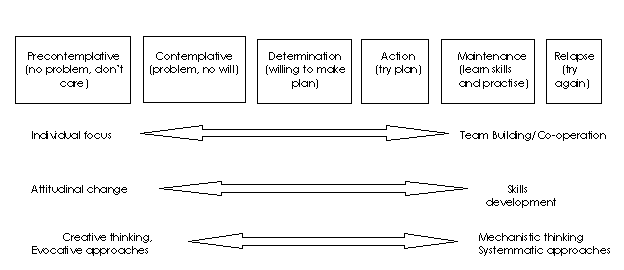
At the early stages attitudinal change must be developed. Later on, the development and improvement of skills is more important. Associated with this, the avoiding stages require more responsive and creative approaches. As change is accepted more mechanistic or systemmatic approaches can be used. At the early stages of change the development of effective individuals is needed. Work on group interaction and team building is helpful later on. As our society becomes more globally focussed and individualistic through the implementation of technology and the loss of community, we are moving as a society more to the left on this continuum. While changes in society proceed undauntingly, many individuals are responding with greater disalienation and conservatism. Therefore, while the subject of this discussion is clearly adolescents with behaviour problems who are resistant to change, the implications of this models are widespread.
To address the need for individualised attitudinal change, creative strategies that move beyond a mechanistic or skills driven model and focus on a clear process of personal challenge, reflection and insight are required. We have moved from the need to know into an era where we need to think. There is a powerful anecdote told to me many years ago about two small boys who were talking to one another.
One boy says to the other boy, "I've taught my dog to talk."
The boys responds, 'But your dog can't talk."
"I know," says the first boy, " I didn't say he learnt it, I just said I taught him."
The Creative Process of Change
Change is constant. Whether we direct it, like it or understand
it, change occurs in everything and the world in which we are a part moves
on. As the process of change rapidly increases in pace with
the technological era in which we now live, there is a need for creative
solutions to the dilemmas and problems now faced. While the model
of stage based change outlined previously explains the reaction of individuals
to the process of change, an examination of the core elements of adventure
therapy can provide a framework on which the implementation of creative
change can be based. Using the tension model of change presented
by Handley (1994) it is possible to describe the process by which change
occurs.
Figure 2: Tension Model
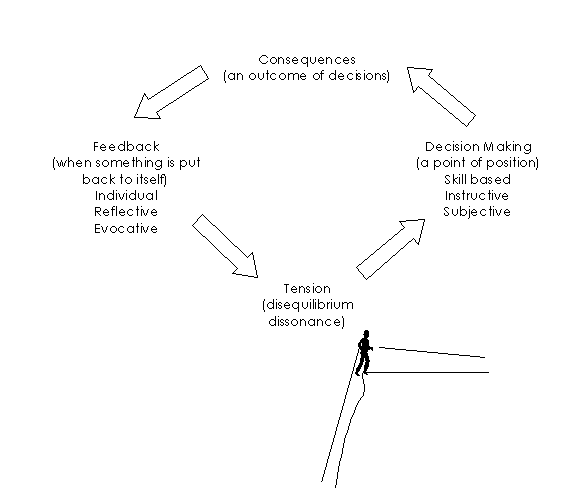
The key to this framework is the experience of tension/disequilibium (Nadler & Luchner, 1992) and dissonance (Festinger, 1964). At this point the individual is uncomfortable. He/she is literally (sometimes) on the edge. A decision must be made by the sheer necessity of the situation. Consequences result. In the natural setting used by the adventure therapist these consequences are imposed by nature and/or the natural interaction of groups within this environment. As a result feedback is received that can either reduce the tension or maintain it. When tension is reduced change is accepted and maintained. In continuing the tension further decisions are compelled until acceptable changes are found.
Historically, the process of change has involved teaching people to make better decisions by providing systems of behaviour or skills on interaction and communication. Again, these process are effective and relevant at the latter stages of changes. Natural (experiential) learning has been based on understanding experiences by using feedback and personal reflection to utilize tension. The interplay of tension and reflection provides a significant effect at the earlier stages of change. Because adventure therapy is based on this interplay it has extended the scope of natural learning into a consolidated field that goes beyond education and into areas of mental health, substance abuse, delinquency and personal development.
The use of tension is not a new concept. In fact, it is very old. Many religious and/or philosophical groups rely on the principle of using tension to motivate decisions. From these decisions the consequences are experienced and personal feedback/reflection is used to find the value in the experience. For example the religions of the Middle East - Judaism, Christianity, Islam, all use powerful stories as a way of communicating the essence of truth in their teaching. An insightful example of these stories comes from the Sufi tradition within the Islamic faith:
Dividing Camels (Shah 1971)
There was once a Sufi who wanted to make sure that his disciples would, after his death, find the right teacher of the Way for them. He therefore, after the obligatory bequests laid down by law, left his disciples seventeen camels, with this order: 'You will divide the camels among the three of you in the following proportions: the oldest shall have half, the middle in age shall have one-third, and the youngest shall have one-ninth.
As soon as he was dead and the will was read, the disciples were at first amazed at such an inefficient disposition of their Master's assets. Some said, 'Let us own the camels communally,' other sought advice and then said, 'We have been told to make the nearest possible division,' others were told by a judge to sell the camels and divide the money; and yet the others held that the will was null and void because it could not be executed.
Then they fell to thinking that there might be some hidden wisdom in the Master's bequest, so they made inquiries as to who could solve the insoluble problem. Everyone they tried failed, until they arrived at the door of the son-in-law of the Prophet, Hazrat Ali. He said:'This is the solution. I will add one camel to the number. Out of the eighteen camels you will give half - nine camels -to the oldest disciple. The second shall have a third of the total, which is six camels. The last disciple may have one ninth, which is two camels. That makes seventeen. One - my camel - is left over to be returned to me."
This was how the disciples found the teacher for them.
This story provides a powerful model by which the adventure therapist can effectively orchestrate the process of change. The answer is not logical but it requires logic. It is intuitive. It looks 'outside the box' for a solution that is both devastatingly obvious and deceptively simple. It requires 'letting go' a preoccupation to divide the problem into parts or methodically analyze it. Edward De Bono (1990) talks about the process of creative thinking in terms of the lateral leap - a complete shift from one mode of thought across to another. An example of how this occurs can be found in humor - especially the telling of joke. The joke is told and the listener wanders down a certain path with the narrator. Suddenly the punch line is reached and for a moment nothing makes any sense. The listener searches madly for another meaning and a different perspective from that which they had originally constructed. Quickly it arrives and the story is understood.
It working as therapists within an adventure setting, the creation of
this lateral leap where perceptions are changed and insights are developed
is the central process around which we work. After having seen the
need to create a motivation to change and examined the framework around
which this motivation can be created, it is necessary to look at ways for
making it happen.
The Adventure Chasm
Using the bridge of therapy
Therefore, the adventure therapist is required to create the chasm for which a lateral leap is required and maintain the tension that impels the leap. Bacon (1983) describes this in terms of isomorphic experiences and the transderivational search while Handley (1994) describes it in terms of strategic/non-direct intervention. The essential component in both these descriptions is a focus on process and the creation of situations in which participants are drawn into making decisions. Following this commitment answers are not given but questions are raised. These provide opportunities for leaders as therapists to explore and articulate with the client.
However, to make these approaches work the adventure therapist must
be prepared. Good jokes must be learnt but they only work when they
are well told, well timed and when the teller 'lets go' of the punch line.
That is, doesn't try too hard or force the meaning of the punch line.
Letting go is not an original concept. Chopra (1994) describes this
in three of his Seven Spiritual Laws of Success:
1. The law of least effort requiring an acceptance of the present as it is; responsibility for the present is not blaming anyone and anything for the situation; and a defenselessness which relinquishes the need to persuade others to perspective.
2. The law of intention and desire where intention is the focus in the present on the potential available. Intentions provide the power that enable desire to be realized without an attachment to the outcome.3. The law of detachment requires a freedom from expectations that accepts others as they are and sees uncertainty as an essential ingredient in all experience. This willingness to accept uncertainty allows possibilities to arise and solutions to be found.
By letting go the adventure therapist is able to use the intuitive
skills that enable the therapist to process the experience creatively and
with a maximum use of constructive tension. It also provides
the source of the empathy to ensure that destructive or negative tension
is recognized and/or anticipated. By letting go the therapist is
able to detach from the individual, interactional agendas so readily presented
by difficult adolescents. Detached from these personal 'triggers',
the therapist is able to attach to the process and focus on the needs and
responses of the client. The difference between constructive and
destructive/negative tension can only be identified by having a clear understanding
of the theoretical model upon which the adventure therapist is working.
Referring back to Figure 2, tension leading to decision making is constructive.
Tension leading to distress or emotional withdrawal is destructive as it
leads to the avoidance of decision making.
To assist the Adventure Therapist in their efforts to let go, to remain detached from their personal expectations and free to explore the possibilities of the present, I believe it is necessary to discard a number of terms that hold us into a mechanistic, '2 + 2 = ' view of the world. These terms include:
goals
outcomes
safety
debrief
answers
structure
consistency
While there is nothing inherently wrong with these words I believe
they lock us into a paradigm of mechanistic thinking that works against
our intuitive wisdom in using the adventure experience to produce effective
changes within participants.
To take one of these terms as an example - goals. Most of us see goals as a crucial part of our personal life and our work. I believe it is a proverbial albatross around our necks - constantly making problems for us and holding us back from our potential. Goals are defined and then worked towards. In the process of achieving these goals many possibilities arise which are discarded as secondary to fulfilling this goal. In reaching the goal we often fail to see the potential of these possibilities. And if we follow these possibilities they appear to drag us away from our goal, producing outcomes that does not match our expectations. This leaves us with a feeling of dissatisfaction and failure. To see goals instead, as intentions, leaves room for possibilities to be explored, and our desires to become the focus of our motivation.
Other substitute terms to consider are:
Through these terms we can create, as De Bono (1970) describes, a language of perception. As adventure therapists, a language that evokes for participants an exploration of their personal responses to an experience of the environment, is a fundamental condition for our work.safety - possibility
debrief - dilemma
answers - questions
structure - creativity
consistency - uncertainty
With a framework around which an intuitive skill can be used to explore
the process, and a refreshed language to articulate this exploration, it
is possible for therapists who use adventure experiences to develop a greater
insight into the possibilities available to them. As the language
of perception is explored by practitioners, the therapeutic process is
developed and refined. Importantly this provides the field of adventure
therapy with an emphasis away from adventure and towards the process of
therapy that is essential if the field is to have any relevance or significance
in the broader therapeutic community.
Conclusion
In many areas of society the demands to think and act differently are
creating problems for which solutions need to be found. Alternatives
are continually placed before us in an effort to address this need for
answers. As adventure therapist we have a valuable and well tried
alternative to present. However, we must be clear in our conceptualization
of what we do. We must move away from using the language of mechanistic
learning and be ready to adopt the language of perception intrinsic to
a natural education based on tension and intuition.
References
Bacon, S.(1983) The Conscious Use of Metaphor in Outward Bound. Denver: Colorado Outward Bound School
Cade, B. & O'Hanlon, W. (1993) A Brief Guide to Brief Therapy. WW Norton NY
Chase, N. (1981) Outward Bound as an Adjunct to Therapy - Reports: Evaluative/Feasibility Denver: Colorado Outward Bound School
Chopra, D. (1994) The Seven Spiritual Laws of Success. USA Amber-Allen/New World Library
De Bono, E. (1970) Lateral Thinking: Creativity Step by Step. US : Harper/Collins
DiClemente, C., Norcrosse, J. & Prochaska, J. (1994) Changing for good: the revolutionary program that explains the six stages of change and teaches you how to free yourself from bad habits. New York: W. Morrow
Festinger, L. (1964) Conflict, Decision and Dissonance. London: Tavistock
Griffin, W. (1981) Evaluation of a Residential Therapeutic Camping Program for Disturbed Children. A Report for the Educational Research and Development Center: The University of Western Florida
Handley, R. (1994) Out of the Bush, Into the Wilderness; in M. Tainsh & J.Izards (eds) Widening Horizons: New Challenges, Directions and Achievements. Hawthorn: ACER
Luchner, J. (1987) Enhancing the Self-esteem of Special Needs Students. A paper presented at the 65th Annual Council for Exceptional Children
Nadler, R & Luchner, J. (1992) Processing the Adventure Experience. Iowa : Kendall/Hunt
Shah, I. (1971) Thinkers of the East.
London: Penguin Books
Author's Biography:
Ray Handley is presently the Director of the Regional Educational
Alternative Learning (REAL) School in Maine , USA. Previously he
was the coordinator of the Wilderness Enhanced Program based in NSW, Australia.
Ray has developed, written and presently widely on the non-direct/strategic
intervention approach for the management of difficult clients in programs
for outdoor and alternative settings.