Jaunsaries
In the North of Dehradun
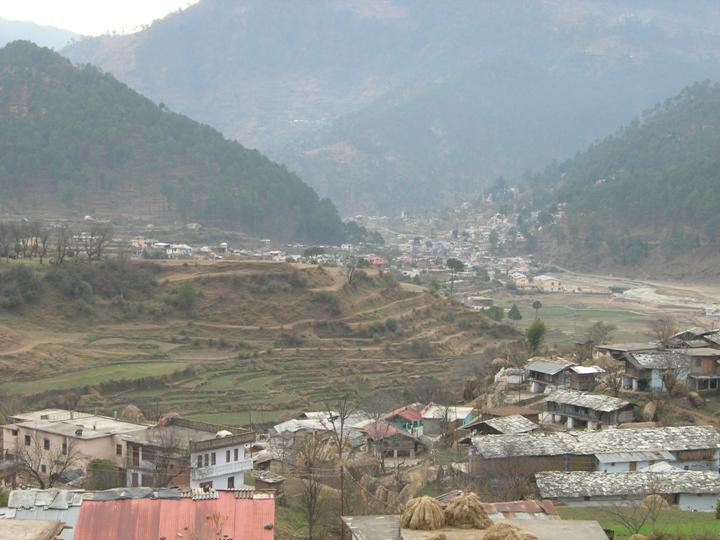
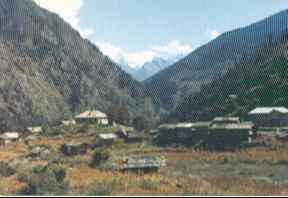
district there is a hilly region called Jaunsar. Jaunsar-Babar forms the
northern half of Dehradun District. Tribal people live there and are
called the Jaunsaries. They are a feudal society covering the
hill-locked region of Chakarta, and Damta, Nainbag of the Uttarkashi &
Tehri District. This area had links with the ancient cultural waves
which swept over the northern part of India, particularly during the
Vedic, Mahayan, Kushan and Gupta periods of ancient Indian history. The
inhabitants follow the old customs even today, distinct from their
counterparts elsewhere in Garhwal, Kumaon and Himachal Pradesh. Their
physical features, customs, traditions and dress are distinctly
different. Even the art and architecture has its unique features, with
profound use of woodwork. Jaunsaries people believe in united family, so
they have a large family. River Yamuna divide the Area in two parts one
side is Jaunsar and other is Jaunpur, Jaunsaris celebrate there fairs
and festival in Groups.
Polyandry is still common among these people. Women
are the backbone of the family economy, since they collect firewood,
fetch water and have to bear the brunt of social insinuations after
attending to the daily chores of life, while the men normally gossip,
sit idle or drink. An interesting aspect of Jaunsari weddings is that
the bride goes to the bridegroom's house where the wedding ceremony is
performed. The bride's party is feasted followed by lots of merry-making
Jaunsaries are fond of dressing up and during festivals they wear the
Thalka or Lohiya, which is a long coat. Thangel folds like tight-fitting
trousers. Digwa or the cap is the traditional Jaunsari head dress made
of woolen cloth. Women wear Ghagra, Kurti and Dhoti and are fond of
ornaments.
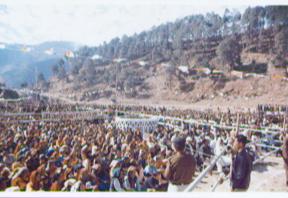
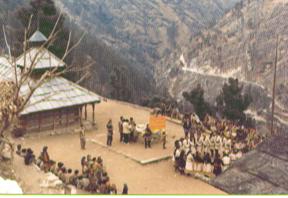
The most important festival of the Jaunsaries is the Magh Mela. The
Jaunsari festival is an entirely religious affair connected with the
Mahasu Devta. The deity is taken out for a religious bath to the nearby
river. Another interesting fair is the Maun fair which is connected with
the catching of fish. Maun fair is of two types, one is simple maun in
which people eat, dance and drink in group. another is Fish Maun in
which people catch fishes. Bark of the Tejpal tree is collected, and
after grinding into powder form is thrown into the water since it has a
stunning effect on the fish.
Another important fair of the jaunsaries is Visu, people
The pivot of the religious life of the Jaunsaries is
Hanol, where the Mahasu temple is situated. Hanol is situated 40 Km.
after Purola. People come and worship here for there wellness.