In this section, we look at the performance of Hindi News Genre in the two markets Mumbai and Ahmedabad and how the individual channels fare after the two events.
The News Genre viewership is clearly demarcated on the
two events that have impacted the news channels in the past three days
and as the Ayodhya Attack happened in the morning hours, the ratings on
July 5th are considerably higher during the morning time band.
During the London attacks the afternoon ratings start climbing in the
2PM to 3PM time band and in the evening peak achieved on July 7th is even
higher than that achieved during the Ayodhya Attack.
This might say something about the news that bothers/concers an average
Mumbaikar and the manner in which international events affect the financial
capital more than the events in India, though the magnitude of the two
events are not comparable to that extent.
This again goes on to emphasizes the point that certain
type of content attract a specific audience and audience can be targeted
by tailoring the content on a news channel wherever possible.
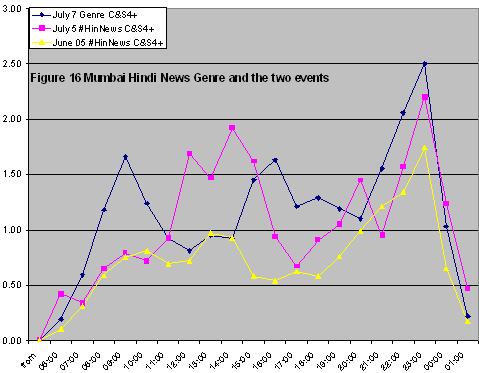
It comes across that for Mumbai an attack on London is more important
than an attack on Ayodhya. The ratings of News Channels reached a peak
of 2.5 at 11PM that is significantly higher than 1.74 during June 2005
and even higher 2.2 reached on July 5th, 2005.
The distinct trend of a morning event and an afternoon
event is evident when we look at the hourly ratings for News Genre on
5th July. The ratings show a steep rise in the morning hours and a bigger
increase during the evening prime time.
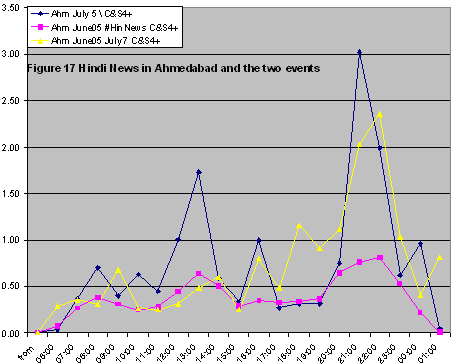
This market is still more focused on happenings in India and the ratings
for Ayodhya are higher than the ratings for London attack but both events
have pushed the ratings up to a much higher levels than Mumbai. Obviously
Mumbai being a larger metro will definitely have more individuals in absolute
terms than Ahmedabad.
The morning ratings for 7th July were beginning to return to the June
levels as the Ayodhya effect has worn off, but they starting rising in
the 2PM to 3PM slot and the evening peak was reached at 10PM (2.36).
- News is an emotional subject and be it a terrorist attack on a religious
site or an attack on London the viewership takes a quantum leap.
- Mumbai is more tuned to international events and their impact is felt
more in Mumbai than in Ahmedabad.
- Ahmedabad still gets emotionally involved with matters of the country
but the rise in consumption of news triggered by any event is more in
Ahmedabad than in Mumbai.
- In the case of increase of demand the top players get the maximum
traffic.
- Another interesting trend that comes out of the whole exercise is
that people still tune in to AajTak when there is Breaking News. This
reemphasizes the positioning of AajTak being Sabse Tez (The Fastest).
The gains for AajTak in both the markets esp. Ahmedabad are more than
NDTV India as demonstrated by these two events.
- This also gives us an insight into news consumption habits of the
masses. News which is not considered to have appointment viewing with
regards to particular Channels and Programs, throught this analysis
the NEWS GENRE exhibits a certain stability in terms of audiences walking
into this environment. In the case of Breaking News or a major event
happening the increase is always higher during prime time rather than
during the time when the event has occurred. This can be used as a surrogate
for appointment viewing.
- The peak ratings also follow set trends across months, years (June
2004 vs. June 2005) wherein we see the peak for the morning and evenings
are achieved during same time slots and this does not change even during
major events occurring, at least in the evening prime time.
- Again the peak for Ahmedabad and Mumbai occur at different times and it is earlier in the evening for Ahmedabad (9PM) and late in the evening (11PM) for a fast paced metro like Mumbai.

